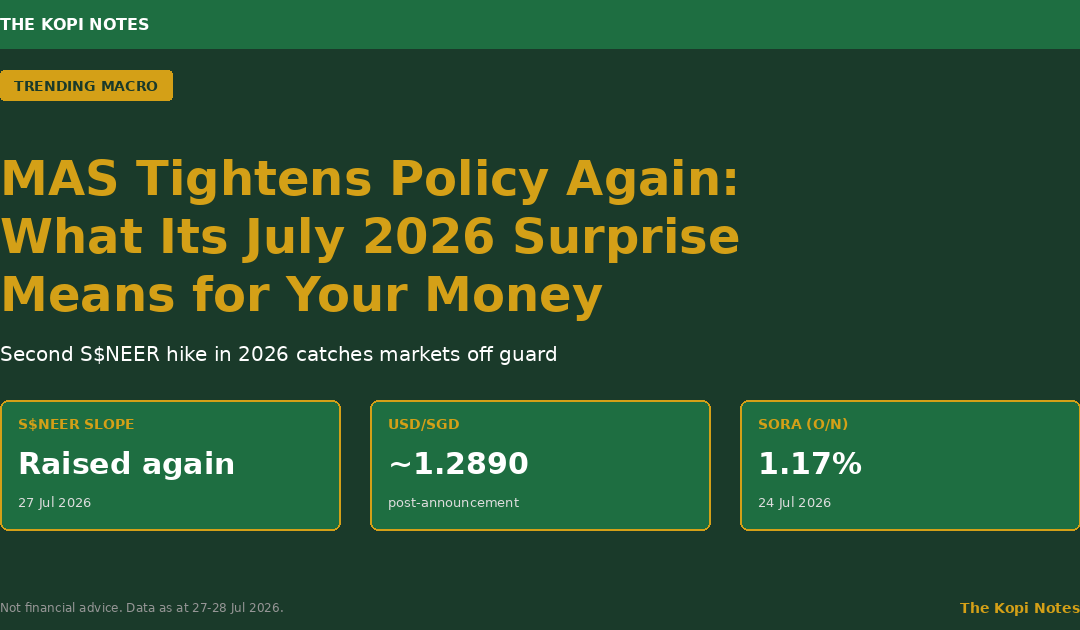
MAS Tightens Policy Again in July 2026: What the Surprise S$NEER Move Means for Your Money
Singapore’s central bank raised the S$NEER slope for the second time in 2026, catching most analysts off guard. Here’s what changed, why, and what it means for your CPF, T-Bills, SSBs and S-REIT holdings.
On 27 July 2026, the Monetary Authority of Singapore (MAS) tightened monetary policy for the second consecutive review, slightly raising the slope of the Singapore dollar’s Nominal Effective Exchange Rate (S$NEER) policy band. The move surprised markets — 12 of 16 analysts in a Reuters poll had expected no change. It signals MAS sees inflation risks as more persistent than growth risks right now.
Not financial advice. All figures are for educational reference only. Data as at 27–28 July 2026 unless otherwise noted.
- MAS tightened policy again on 27 July 2026 — the second hike this year, but a smaller step than April’s move.
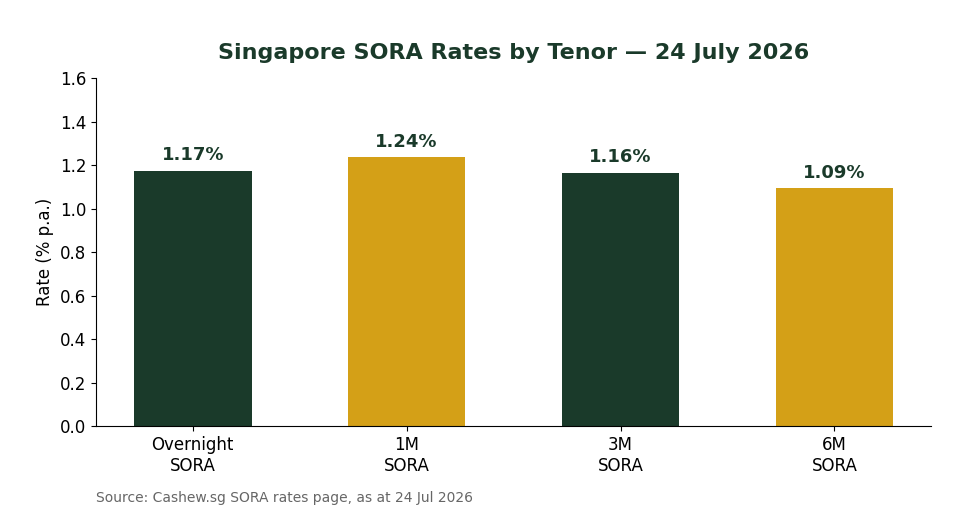
- Core inflation is picking up (1.5% in Q2 2026, up from 1.2% in Jan–Feb) while growth stayed firm (2Q2026 GDP +5.7% on advance estimates), giving MAS room to act.
- For you: expect the Singapore dollar to stay firm, SORA-linked rates to hold up rather than fall, and S-REITs to face a mixed — not clearly positive — setup.
What MAS Just Announced
MAS manages monetary policy differently from most central banks. Instead of setting an interest rate, it manages the exchange rate — specifically the S$NEER, a trade-weighted basket of currencies. It lets the Singapore dollar float within an undisclosed policy band, and can adjust three levers: the band’s slope (how fast the dollar is allowed to appreciate), its width, and where it’s centred.
On 27 July 2026, MAS said it would “very slightly” raise the slope of the S$NEER band — a smaller adjustment than the tightening it made back in April. The width and centre of the band were left unchanged. In plain English: MAS is letting the Singapore dollar strengthen a bit faster than before, which helps push down the cost of imported goods and energy.
This is MAS’s second tightening move in 2026. The first came in April, widely described as the first tightening in three years, driven by a spike in Middle East-linked energy costs. USD/SGD slipped to around 1.2890 after the July announcement, according to VT Markets’ coverage of the decision.
Why This Surprised the Market
Most economists didn’t see this coming. In a Reuters poll ahead of the review, 12 of 16 analysts forecast MAS would hold policy steady. Only a minority expected another hike.
That’s because on the surface, conditions looked calmer than in April. Oil prices have eased back from their spring peaks after a partial U.S.-Iran de-escalation, and headline inflation has stayed inside MAS’s forecast range. So why tighten again?
The answer is timing. MAS said core inflation is set to “step up” from July and stay elevated into early 2027, even as near-term energy costs look calmer. Meanwhile, growth has been stronger than expected — second-quarter GDP grew 5.7% on advance estimates, powered by resilient global demand, robust AI-related investment, and a solid pipeline of construction projects. A hotter economy with a widening output gap gives MAS more room, and more reason, to act pre-emptively rather than wait for inflation to show up in the data first.
Some economists called this a pre-emptive move to anchor inflation expectations before they drift higher. Others read it as a cautious, incremental step — smaller than April’s — that still leaves room for MAS to pause at its next scheduled review in October if conditions stay contained.
The Numbers Behind the Decision
Here’s the data MAS pointed to in its 27 July statement, compared against the backdrop of the April tightening:
| Metric | April 2026 Review | July 2026 Review |
|---|---|---|
| Policy action | S$NEER slope raised (first hike in 3 years) | S$NEER slope raised again, smaller step |
| Core inflation (period average) | ~1.2% (Jan–Feb 2026) | 1.5% (Q2 2026) |
| 2026 inflation forecast (core & headline) | 1.5%–2.5% | Unchanged at 1.5%–2.5% |
| GDP growth | – | 2Q2026: +5.7% (advance estimate) |
Source: MAS Monetary Policy Statement, 27 Jul 2026, as reported by Dimsum Daily and VT Markets.
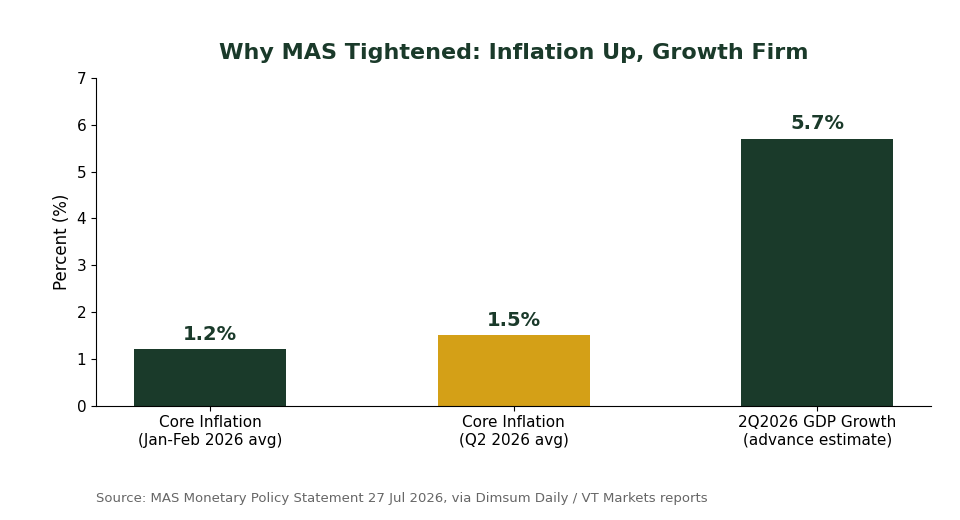
Away from the policy statement itself, Singapore’s short-term interest rate benchmark tells a related story. As at 24 July 2026, the daily SORA (Singapore Overnight Rate Average) stood at 1.17%, with 1-month SORA at 1.24%, 3-month SORA at 1.16%, and 6-month SORA at 1.09% — still comfortably below the 3.5%–3.8% peaks seen in 2023–2024, but not falling much further either.
What It Means for Your CPF, SRS and T-Bills
MAS doesn’t set the SORA rate directly, but its exchange-rate stance shapes the environment SORA sits in. With MAS tightening instead of easing, and analysts now expecting SORA to hold in the 1.0%–1.4% range through end-2026 rather than drift lower, cash instruments pegged to SORA or T-bill yields aren’t about to fall off a cliff.
That matters for three things you probably hold:
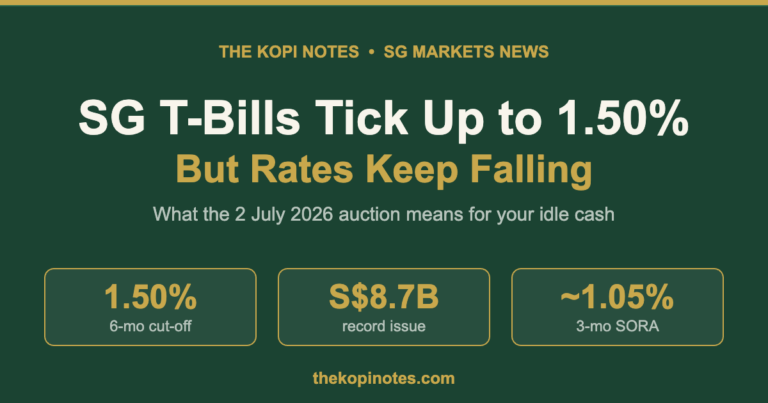
T-Bills. The most recent 6-month T-bill (auction on 16 July) cleared at a cut-off yield of 1.55%, and the closing yield sat at 1.53% on 23 July. The next 6-month auction (BS26115N) lands on 30 July — worth watching, since a firmer-for-longer rate backdrop argues against yields sliding much further in the near term. Our Singapore T-Bills 2026 guide walks through how to apply and what to expect at each auction.
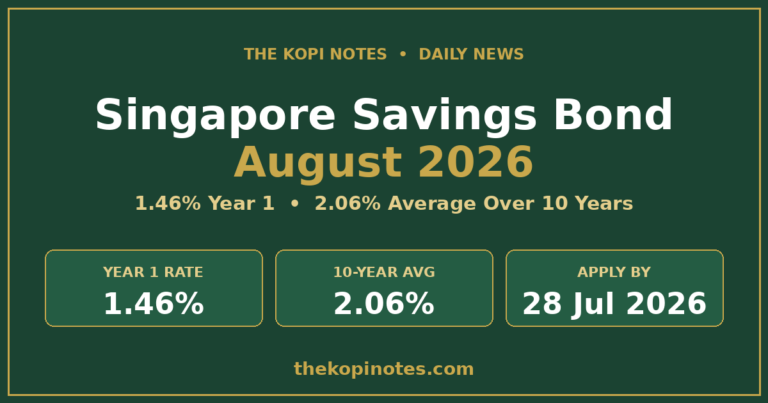
Singapore Savings Bonds (SSBs). The August 2026 tranche offers a 1.46% first-year rate and a 2.06% 10-year average return — unchanged in direction from what we covered when the August SSB was announced. A steadier rate backdrop is broadly supportive of SSBs holding their appeal as a low-risk parking spot, rather than becoming instantly less attractive the way they would if rates were falling fast.
CPF and SRS. CPF Ordinary Account interest (2.5% floor) and Special/MediSave/Retirement Account interest (4% floor, before extra interest) are legislated floors, not market-linked — they don’t move with MAS policy. But the opportunity cost of parking spare cash in CPF versus T-bills or SSBs shifts slightly in CPF’s favour when market yields stay capped rather than climbing. If you’re weighing where to direct SRS contributions this quarter, our CPF investment strategy guide covers how to think about the trade-offs.
What It Means for S-REIT Investors
For S-REITs, this isn’t a clean positive or negative signal — it’s mixed, and worth understanding rather than reacting to.
The headwind: S-REITs generally do best when borrowing costs fall. MAS tightening (twice now in 2026) and SORA holding in a 1.0%–1.4% range rather than sliding further means REIT financing costs aren’t getting materially cheaper from here. That’s a different backdrop from the “rates are falling” narrative that dominated Singapore markets news through most of Q2 2026.
The tailwind: A stronger Singapore dollar helps REITs with overseas income streams (think logistics, data centre and European retail REITs) when they convert foreign rental income back to SGD — though the effect cuts both ways depending on whether a REIT has hedged its distributions. It also signals MAS’s confidence in the domestic growth outlook, which supports occupancy and rental reversion trends for Singapore-focused REITs.
The bigger picture: this July move doesn’t overturn the broader S-REIT recovery story we’ve tracked through 2026 — it’s a reminder that the recovery has never been a straight line. We break down the SORA-vs-Fed dynamics driving that recovery in more detail in our S-REIT Recovery 2026 deep dive, and you can see which counters have held up best in our list of the best S-REITs in Singapore for 2026.
What Could Happen Next
MAS reviews policy roughly every six months, so the next scheduled statement is due around October 2026. Views are split on what happens then:
| View | What They Expect |
|---|---|
| More tightening | One house expects a further steepening of the S$NEER slope later in 2026, potentially toward 1.50%, with upside risk to 1.75% by year-end, if growth keeps outpacing forecasts. |
| Pause and hold | Others argue the bar for a third consecutive hike has risen — MAS will likely watch incoming inflation and global data through October rather than act again immediately. |
Source: analyst commentary reported by Dimsum Daily, 27 Jul 2026.
The key risks MAS itself flagged are two-sided: a renewed spike in oil prices (drawn-down fuel reserves, potential supply disruption) could push inflation higher, while tighter global financial conditions or a pullback in AI-related investment could weigh on growth. Watch both before assuming the direction of the next move.
How to Position Your Portfolio
You don’t need to overhaul your portfolio because of one policy statement. But a few practical steps make sense given where things stand:
Don’t assume cash yields are about to crash. If you were planning to shift heavily out of T-bills and SSBs into riskier assets purely because “rates are falling,” this decision is a reminder that the path isn’t guaranteed to be smooth or fast. Keep laddering T-bills and SSBs as part of your cash allocation — our Singapore cash yields guide for H2 2026 has the current rates across options.
Stay selective, not defensive, on S-REITs. A firmer-for-longer rate backdrop rewards REITs with low gearing, strong sponsor support and resilient occupancy over highly leveraged names chasing yield. Don’t sell out of S-REITs wholesale on this news — but do revisit gearing ratios and interest coverage on anything you hold that’s already stretched.
Keep contributing systematically. Dollar-cost averaging into a diversified portfolio via CPF, SRS or cash smooths out the noise from any single policy statement. If you want a clearer sense of your long-term numbers, our Singapore retirement calculator can help you model different rate and return assumptions.
Frequently Asked Questions
What did MAS actually change on 27 July 2026?
Why does MAS use the exchange rate instead of interest rates?
Was this tightening expected?
Does this mean SORA rates will rise?
How does this affect my CPF interest rate?
Is this good or bad for S-REITs?
Should I sell my S-REITs after this news?
When is MAS's next policy review?
What should I do with spare cash right now?
Building a Rate-Resilient Singapore Portfolio?
Whether it’s T-bills, SSBs, S-REITs or a diversified robo-advisor portfolio, the right mix depends on your goals — not on reacting to any single MAS statement.
This article was researched with the help of AI. While we strive to keep all information accurate and up to date, there may be errors. If you notice any discrepancies, please contact us.