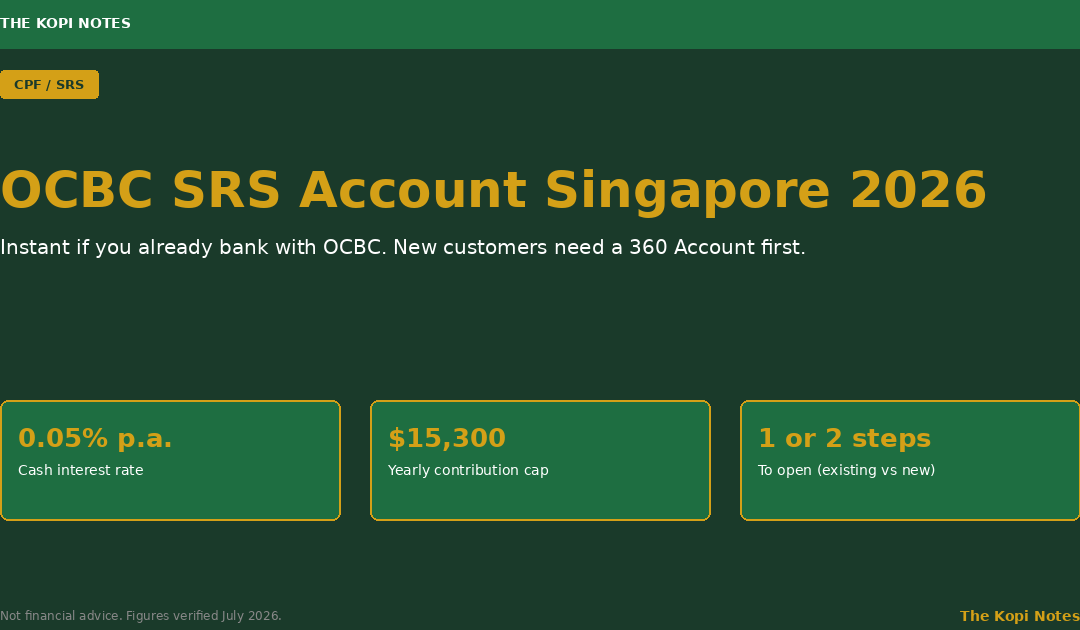
OCBC SRS Account Singapore 2026: Instant via App (If You Already Bank With Them)
How to open an OCBC Supplementary Retirement Scheme account, why new-to-OCBC customers need a 360 Account first, and how OCBC compares to DBS and UOB for opening speed, contribution channels and investment options.
The Supplementary Retirement Scheme (SRS) gives you dollar-for-dollar income tax relief on every dollar you contribute — but the cash sitting inside it earns just 0.05% p.a., identical at OCBC, DBS and UOB. OCBC’s twist is the account-opening path: existing OCBC customers can open an SRS account instantly in the app, but if you don’t already bank with OCBC, you’ll need to open a 360 Account (or another current/savings account) first before SRS opening unlocks online. This guide covers exactly how that works, 2026 contribution caps, how to fund the account, and how OCBC stacks up against DBS and UOB.
Not financial advice. Figures verified against OCBC, CPF Board and IRAS sources as at July 2026.
Free download: The Singapore Money Playbook — 7 money mindset shifts written for Singapore, with the CPF-adjusted retirement number most guides get wrong (PDF + Notion).
Table of Contents
Contents — Click to expand
- Key Facts at a Glance
- Who Can Open an OCBC SRS Account
- How to Open an OCBC SRS Account
- SRS Contribution Caps for 2026
- How to Contribute to Your OCBC SRS Account
- Opening Speed: OCBC vs DBS vs UOB
- Tax Savings Worked Example
- What You Can Invest In With OCBC SRS Funds
- OCBC vs DBS vs UOB: Which SRS Operator?
- Withdrawal Rules Recap
- Common Mistakes to Avoid
- Frequently Asked Questions
Key Facts at a Glance
| Item | 2026 Figure |
|---|---|
| SRS cash interest rate (OCBC) | 0.05% p.a. (same at DBS & UOB) |
| Contribution cap — Singaporean/PR | $15,300/year |
| Contribution cap — Foreigner | $35,700/year |
| Account opening (existing OCBC customer) | Instant via OCBC app or Internet Banking |
| Account opening (new to OCBC) | Open a 360 Account first, then apply for SRS — or visit a branch directly |
| Ways to contribute | Internet Banking, OCBC app, cash (branch only), cheque (Quick Cheque Deposit) |
| Standing instruction | Not available — every contribution must be made manually |
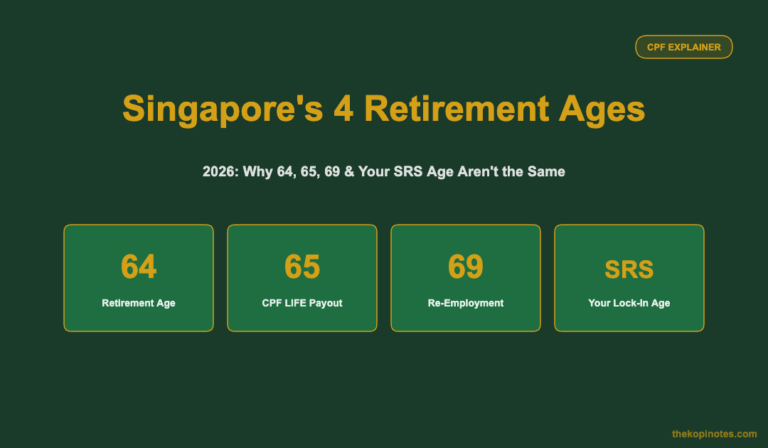
| Penalty-free withdrawal age | 63 (before 1 Jul 2026 first contribution) / 64 (from 1 Jul 2026) |
| Withdrawal tax | 50% of withdrawal taxable after statutory retirement age |
Who Can Open an OCBC SRS Account
You’re eligible to open an OCBC SRS account if you:
- Are at least 18 years old
- Are a Singaporean, Singapore Permanent Resident, or foreigner holding a valid pass (e.g. Employment Pass, S Pass or Student Pass)
- Are not an undischarged bankrupt and are capable of managing your own affairs
- Do not already hold an SRS account (or a pending application) with any bank — you can only have one SRS account across OCBC, DBS and UOB combined
Documents needed: NRIC for Singaporeans/PRs, or passport plus valid pass for foreigners, plus one document showing your residential address (phone bill, half-yearly CPF statement, or a bank statement).
How to Open an OCBC SRS Account
OCBC splits the opening process depending on whether you’re already a customer — this is the single biggest difference versus DBS, which lets anyone open an SRS account from a blank slate in one online flow.
If you already have an OCBC current/savings account
Open a SRS account instantly via the OCBC app (tap the left menu, select “Apply” → “SRS Account”) or in a few clicks through Internet Banking. No branch visit needed.
If you’re new to OCBC
You cannot open an SRS account online from scratch. You must first open a 360 Account (or another OCBC current/savings account), then apply for the SRS account as a second step once that account is active. Alternatively, skip the digital route entirely and open your SRS account directly at an OCBC branch with your NRIC/passport and proof of address.
The 8-step digital application (once you have an OCBC account)
- Log in to the OCBC app or Internet Banking with your access code and PIN, or fingerprint/Face ID
- On the app, tap “SRS Account”; on desktop, click “Open an account” and select “SRS account” under Investment account
- Enter the One-Time Password sent via SMS
- Choose to open an additional account and confirm your mailing address
- Select your occupation and self-employment status, and enter your CDP account number if you have one
- Review and agree to the SRS Terms & Conditions
- Review and confirm all details before submitting
- Done — your SRS account is opened immediately
SRS Contribution Caps for 2026
The caps are set by MOF, not by OCBC, so they’re identical across every SRS operator:
- Singapore Citizens and PRs: up to $15,300 per year
- Foreigners: up to $35,700 per year
Every dollar contributed reduces your chargeable income by the same amount, subject to the overall $80,000 personal income tax relief cap (which covers SRS plus CPF top-ups, course fees relief, and other reliefs combined). The cap resets every 1 January and does not carry over — an unused 2025 cap doesn’t roll into 2026.
How to Contribute to Your OCBC SRS Account
OCBC supports four contribution channels, with some real timing quirks worth knowing before 31 December:
| Channel | How |
|---|---|
| Internet Banking | Log in → “Investment & insurance” → “Retirement portfolio” → “Make a SRS Contribution” |
| OCBC app | Log in → “More” → “Payments & transfers” → “Make a SRS Contribution” |
| Cash | Over the counter at an OCBC branch only |
| Cheque | Write a cheque payable to yourself, drop it in a Quick Cheque Deposit box with your name, NRIC/FIN, SRS account number and contact number written on the back |
Important timing notes:
- SRS contributions cannot be made via another bank’s internet or mobile banking — you must contribute through the bank that holds your SRS account
- Requests submitted 9am–9pm Monday to Saturday (excluding public holidays) are processed immediately; anything after 9pm or on a non-business day is processed the next business day
- OCBC does not currently offer standing instructions for SRS — you’ll need to remember to contribute manually every year
- If contributing in January, wait until mid-January — OCBC’s systems take the first two weeks of the year to refresh the new year’s contribution cap
- Contributions must be made by 31 December to count toward that year’s tax relief
- A $2 transaction fee applies for each Singapore Savings Bond application or redemption made within the SRS account
Opening Speed: OCBC vs DBS vs UOB
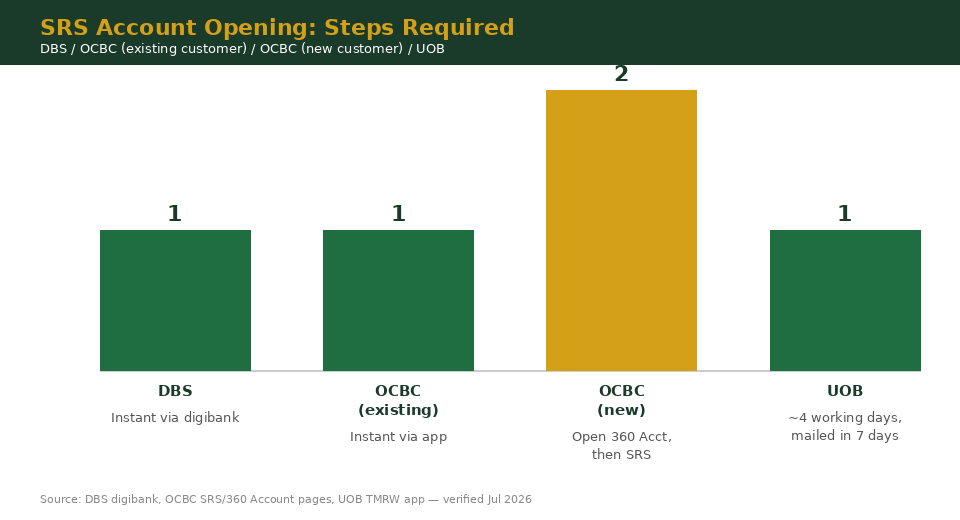
All three local banks pay the same 0.05% p.a. on uninvested SRS cash — it’s an MOF-set rate, not a bank-set one, so there’s nothing to gain by shopping around on interest. Where the banks genuinely differ is how fast you can actually get an account open:
- DBS: one step, always instant via digibank — no prerequisite account needed
- OCBC (existing customer): one step, instant via the OCBC app
- OCBC (new to the bank): two steps — open a 360 Account first (also typically fast online), then apply for SRS
- UOB: one step to apply, but processing takes roughly 4 working days, and your account number isn’t shown on screen — it’s mailed to your registered address within 7 working days
In practice: if you already bank with OCBC, it’s just as fast as DBS. If you’re coming in cold, DBS’s single-flow application is the most frictionless of the three, since OCBC’s prerequisite account step and UOB’s multi-day mail-out both add extra time DBS doesn’t require.
Tax Savings Worked Example
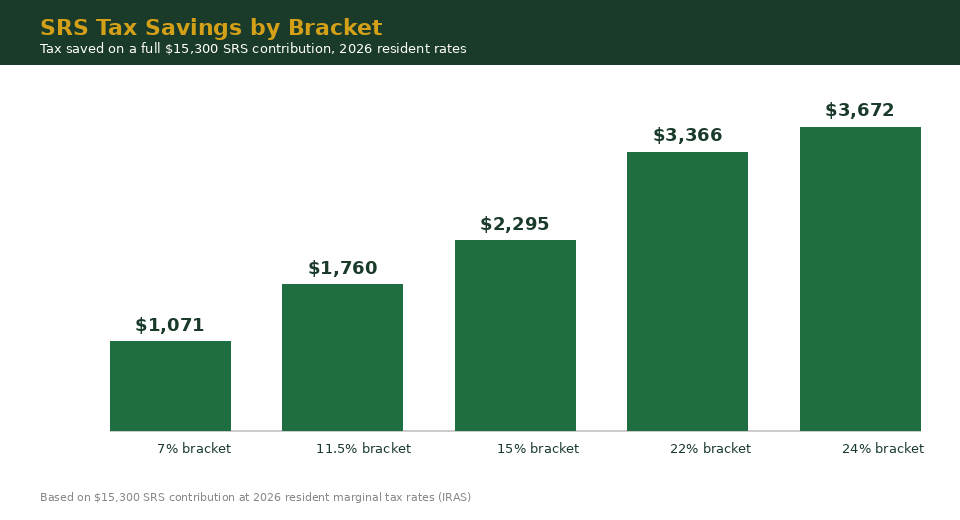
Say you earn $130,000 a year with $30,000 in other personal reliefs, leaving $100,000 taxable. Contributing the full $15,300 SRS cap reduces your taxable income to $84,700 — and the actual dollar value of that saving depends on your marginal tax bracket:
| Marginal Tax Bracket | Tax Saved on $15,300 Contribution |
|---|---|
| 7% | $1,071 |
| 11.5% | $1,759.50 |
| 15% | $2,295 |
| 22% | $3,366 |
| 24% | $3,672 |
That tax saving is realised the same year you contribute, regardless of what the SRS cash then earns — which is exactly why leaving it stagnant at 0.05% is such a waste of an otherwise generous scheme. For the deeper mechanics of the 0.05% rate itself, see our dedicated SRS Account Interest Rate guide.
What You Can Invest In With OCBC SRS Funds
Leaving SRS cash at 0.05% is rarely the point — the scheme is designed for you to invest it. OCBC offers a fairly wide product shelf directly linked to your SRS account:
| Product | Example / Notes |
|---|---|
| Endowment insurance | GREATLife Endowment Insurance 3 (single premium) |
| Unit trusts | e.g. Schroder Asian Income Fund, Fullerton USD Income Fund, plus OCBC’s wider fund shelf |
| Structured deposits | Fixed lock-in period, higher potential returns than cash |
| Equities | SGX-listed shares, REITs and ETFs via an OCBC Securities trading account |
| Blue Chip Investment Plan (BCIP) | 20 blue-chip counters and Singapore-listed ETFs from as low as $100 |
| Time deposits | Fixed tenures in SGD and major foreign currencies |
| Singapore Government Securities | SGS bonds and Singapore Savings Bonds ($2 fee per application/redemption) |
As with DBS and UOB, direct property investments, life insurance sums assured greater than 3x the single premium, and critical illness/health/long-term-care products are not allowed inside SRS.
OCBC vs DBS vs UOB: Which SRS Operator?
The 0.05% base rate and $15,300/$35,700 caps are identical everywhere — the real differences are opening friction, contribution channels and linked-account perks:
| Bank | Opening Channel | Key Differentiator |
|---|---|---|
| OCBC | OCBC app / Internet Banking (instant for existing customers; new customers need a 360 Account first) or branch | No standing instruction for contributions; widest single-page product shelf (endowment, unit trusts, BCIP, SGS all listed on one page) |
| DBS | digibank online (instant, no prerequisite account) or branch | Fastest cold-start opening; DBS Vickers link, digiWealth robo tool |
| UOB | UOB TMRW app (Myinfo) or branch | Slowest — ~4 working days processing, account number mailed within 7 working days; foreigners must apply in-branch |
If you already hold an OCBC current or savings account, OCBC is just as fast as DBS. If you’re starting completely fresh with no bank relationship anywhere, DBS’s single-step flow is the most frictionless. For the full detail on the other two operators, see our DBS SRS Account guide and UOB SRS Account guide.
Withdrawal Rules Recap
Withdrawals are penalty-free from the statutory retirement age prevailing at the time of your first SRS contribution — currently 63, rising to 64 from 1 July 2026. Once locked in, later increases to the statutory retirement age don’t affect you. Withdraw earlier and you’ll face 100% tax on the amount withdrawn plus a 5% penalty, with exceptions for death, medical grounds, bankruptcy, or a foreigner’s one-time full withdrawal after 10 years of non-residency and a 10-year-old account.
From your locked-in retirement age onward, only 50% of each withdrawal is taxable, and you can stagger withdrawals over up to 10 years to spread — and often largely eliminate — the tax bill. For full mechanics and worked examples, see our SRS Withdrawal guide.
Common Mistakes to Avoid
- Assuming you can open SRS online with no OCBC history: you can’t — you’ll need a 360 Account (or similar) first, or a branch visit
- Forgetting there’s no standing instruction: unlike some recurring-payment setups, you must manually contribute every year, including remembering the 31 December deadline
- Trying to fund SRS from another bank’s app: contributions must come through the bank holding your SRS account, not any other bank’s internet/mobile banking
- Contributing in the first two weeks of January: OCBC’s systems need until mid-January to refresh the new year’s cap — contribute later in the month if you’re topping up early
- Leaving SRS cash uninvested indefinitely: 0.05% p.a. barely keeps pace with a rounding error, let alone inflation — see the investment options above
- Opening a second SRS account elsewhere: you’re only allowed one SRS account across all banks combined; a duplicate application will be rejected
Ready to Put Your SRS Funds to Work?
Low-cost platforms like Endowus and FSMOne accept SRS funds directly for diversified investing, while Syfe offers managed portfolios if you’d rather not pick individual funds.
Frequently Asked Questions
Is an OCBC SRS account the same as an OCBC CPF Investment Account (CPFIA)?
Can I open an OCBC SRS account if I've never banked with OCBC before?
How much can I contribute to my OCBC SRS account in 2026?
What interest rate does OCBC pay on SRS cash?
Does OCBC offer a standing instruction for SRS contributions?
Can I have SRS accounts with more than one bank?
How long does it take to open an OCBC SRS account?
What can I invest my OCBC SRS funds in?
Should I choose OCBC, DBS or UOB for my SRS account?
This article was researched with the help of AI. While we strive to keep all information accurate and up to date, there may be errors. If you notice any discrepancies, please contact us.