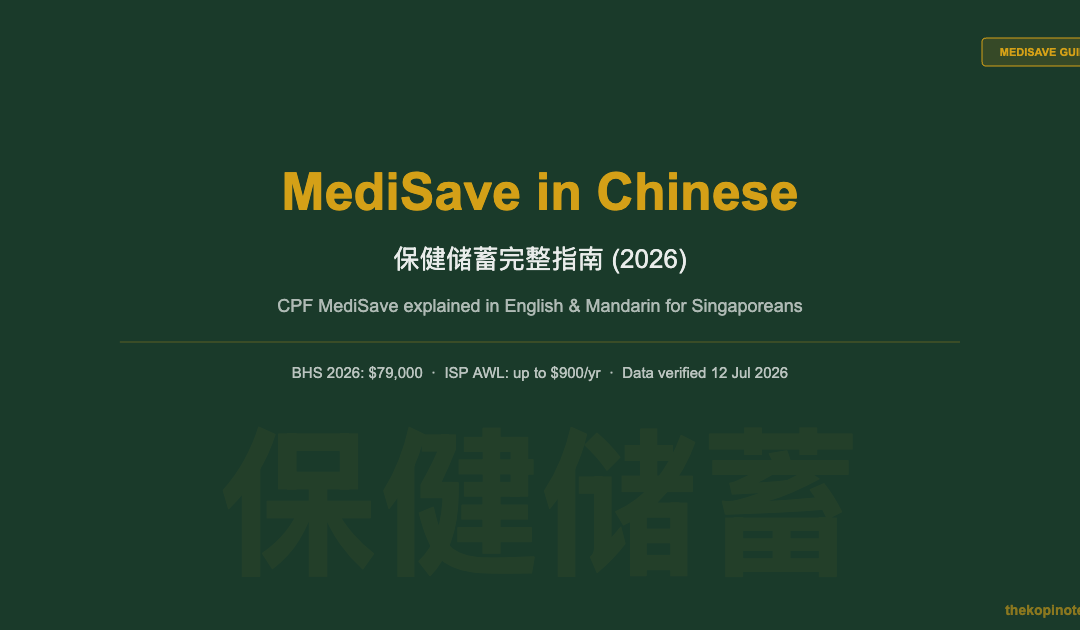
MediSave in Chinese: 保健储蓄完整指南 (2026)
专为华语新加坡人编写的双语指南 · Bilingual guide for Singapore
MediSave (保健储蓄, Bǎojiàn Chúxù) is Singapore’s mandatory healthcare savings account within your CPF (中央公积金). Every working Singaporean automatically contributes a portion of their monthly salary to MediSave. You can use it to pay for hospitalisation, approved outpatient treatments, chronic disease management, and health insurance premiums — including your Integrated Shield Plan (综合保健计划). The 2026 Basic Healthcare Sum (BHS) cap stands at $79,000.
Not financial advice. All figures are for educational reference only. Data verified as at 12 July 2026.
- 保健储蓄 (MediSave) 是强制性CPF医疗储蓄账户,每月自动从工资扣除
- 2026年保健储蓄上限 (Basic Healthcare Sum) 为 $79,000
- 可用于住院、慢性病管理 (CDMP) 及综合保健计划 (ISP) 保费,每年可用 $300–$900
什么是保健储蓄?What is MediSave?
保健储蓄 (MediSave) 是新加坡中央公积金 (CPF) 三个账户之一,也是强制性的医疗储蓄账户。每位在职新加坡人和永久居民,每月都会从工资中自动扣除一部分供款至保健储蓄账户。
MediSave is one of three CPF accounts — alongside your Ordinary Account (OA) and Special Account (SA). Each month, a portion of your total CPF contribution flows automatically into MediSave based on your age group. The contribution rate to MediSave is higher for older workers, reflecting greater future healthcare needs.
You cannot withdraw MediSave as cash. 注意:保健储蓄不能提取现金。 It can only be used for approved healthcare expenses and insurance premiums. However, it earns a guaranteed interest of 4% per year (保证年利率4%), making it one of the safest long-term medical savings vehicles in Singapore.
The Basic Healthcare Sum (基本医疗总额 — BHS) is the maximum balance allowed in MediSave. For 2026, the BHS is $79,000 for members below age 65. Once your MediSave reaches this limit, any additional contributions are automatically transferred to your Special Account (特别账户) or Retirement Account (退休账户). The BHS is adjusted annually in line with healthcare cost inflation.
保健储蓄的主要用途 Key Uses of MediSave
Your MediSave can cover a wide range of healthcare expenses. Here are the five main uses — with their Chinese names so you know exactly what to look for on hospital bills and insurance documents.
1. 住院 (Zhùyuàn) — Hospitalisation
Use MediSave for inpatient ward charges (病房费), daily treatment fees (治疗费), investigations like blood tests and X-rays (检查), and medicines (药物) at approved hospitals. The daily withdrawal limits vary by how long you stay. See the full table in the next section.
2. 日间手术 (Rìjiān Shǒushù) — Day Surgery
Day surgery means you go in and out on the same day — no overnight stay. MediSave covers the ward component (up to $830/day) plus an operation-specific amount (手术费) that depends on the type of procedure performed.
3. 慢性病管理计划 (CDMP) — Chronic Disease Management Programme
If you manage a chronic condition — diabetes (糖尿病), hypertension (高血压), high cholesterol (高胆固醇), or asthma (哮喘) — you can use MediSave at polyclinics (综合诊所) and approved GP clinics. From 2026, limits are $700/year for standard conditions and $1,000/year for complex chronic cases.
4. 门诊扫描 (Ménzhěn Sǎomiáo) — Outpatient Diagnostic Scans
From 1 January 2026, the annual MediSave limit for outpatient scans was doubled to $600/year (up from $300). This applies to approved diagnostic imaging at restructured hospitals and specialist outpatient clinics.
5. 健康保险保费 — Health Insurance Premiums
MediSave pays for MediShield Life (健保双全) premiums in full. For your ISP (综合保健计划) private insurance component, you can use MediSave up to the Additional Withdrawal Limit (AWL / 附加提取限额) — which ranges from $300 to $900/year depending on age.
Want more detail? Read our complete MediSave guide for Singapore 2026 for worked examples and claim walkthroughs.
2026年提取限额一览 MediSave Withdrawal Limits 2026
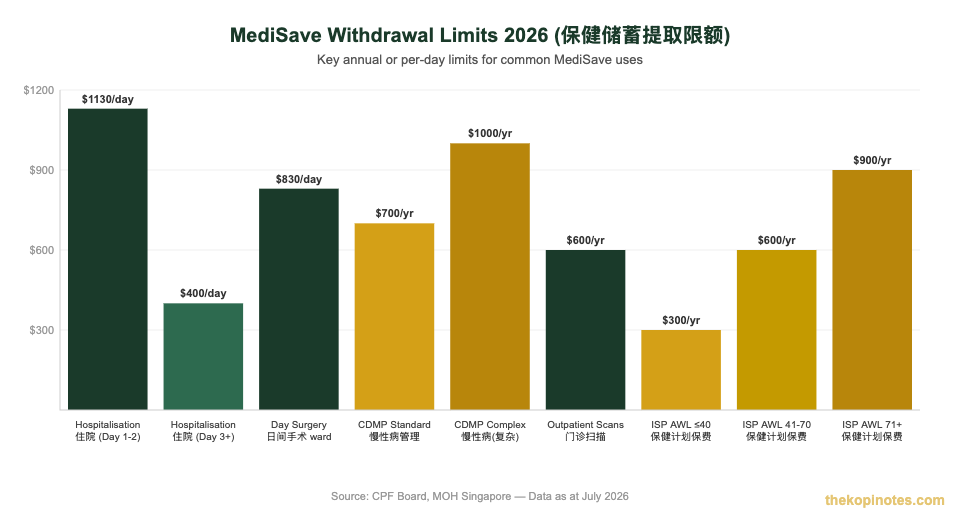
Here is a quick-reference table of the key MediSave withdrawal limits for 2026 — verified against official CPF Board and MOH data. 以下是2026年的主要保健储蓄提取限额,已核实自中央公积金局和卫生部官方数据。
| Use Case (用途) | Chinese (中文) | Limit (限额) |
|---|---|---|
| Hospitalisation — Day 1–2 | 住院(第1至2天) | $1,130/day |
| Hospitalisation — Day 3+ | 住院(第3天起) | $400/day |
| Day Surgery — Ward Component | 日间手术病房费 | Up to $830/day |
| CDMP — Standard Conditions | 慢性病管理(标准) | $700/year |
| CDMP — Complex (from 2026) | 慢性病管理(复杂,2026年起) | $1,000/year |
| Outpatient Scans (from Jan 2026) | 门诊扫描(2026年1月起) | $600/year |
| Basic Healthcare Sum (BHS) 2026 | 基本医疗总额(BHS) | $79,000 |
Source: CPF Board, MOH Singapore — Data verified as at 12 July 2026
For a full breakdown including the BHS history and what happens when you hit the cap, read our CPF MediSave cap 2026 guide.
综合保健计划与保健储蓄 ISP and MediSave
An Integrated Shield Plan (ISP / 综合保健计划) tops up your MediShield Life (健保双全) coverage to give you access to Class A wards (甲级病房) or private hospitals (私立医院). Five insurers in Singapore offer ISPs: AIA (友邦), Prudential (英国保诚), Great Eastern (大东方), NTUC Income (职总英康), and Singlife (新加坡人寿).
You can pay ISP premiums using MediSave, up to the Additional Withdrawal Limit (AWL / 附加提取限额). The AWL applies only to the private insurance component — MediShield Life premiums are covered in full by MediSave separately.
| Age Next Birthday (年龄) | MediSave AWL for ISP | Chinese (中文) |
|---|---|---|
| 40 and below (40岁及以下) | $300/year | 每年最高 $300 |
| 41 to 70 (41至70岁) | $600/year | 每年最高 $600 |
| 71 and above (71岁及以上) | $900/year | 每年最高 $900 |
Source: CPF Board, MOH Singapore — Data verified as at 12 July 2026
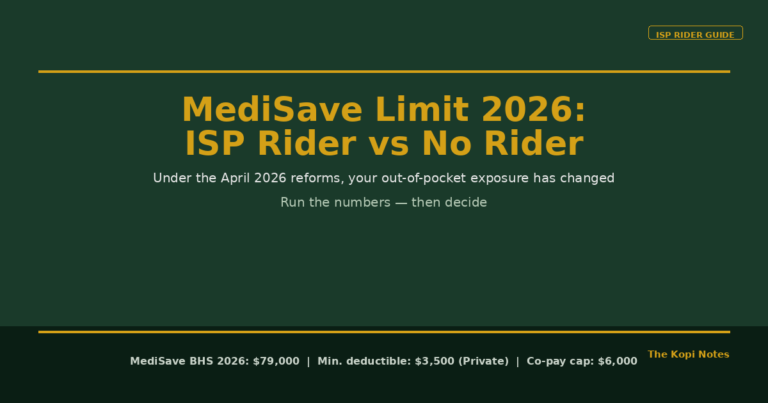
From 1 April 2026, new ISP riders (附加保险) no longer cover the deductible (免赔额). For a private hospital plan, you pay the first $3,500 out-of-pocket before the rider kicks in — with a maximum co-payment cap (共付额上限) of $6,000/year. See the Singlife Shield Plan 2026 guide and our Prudential integrated shield plan Singapore review for detailed premium tables.
Use our Singapore retirement calculator to check whether your MediSave and ISP coverage will be enough to cover future healthcare costs in retirement.
常见中英医疗词汇 Chinese-English Medical Terms
Navigating Singapore’s healthcare system is much easier when you know the key terms in both English and Chinese. Here is a bilingual glossary (中英词汇对照) — save it on your phone before your next hospital visit or insurance review.
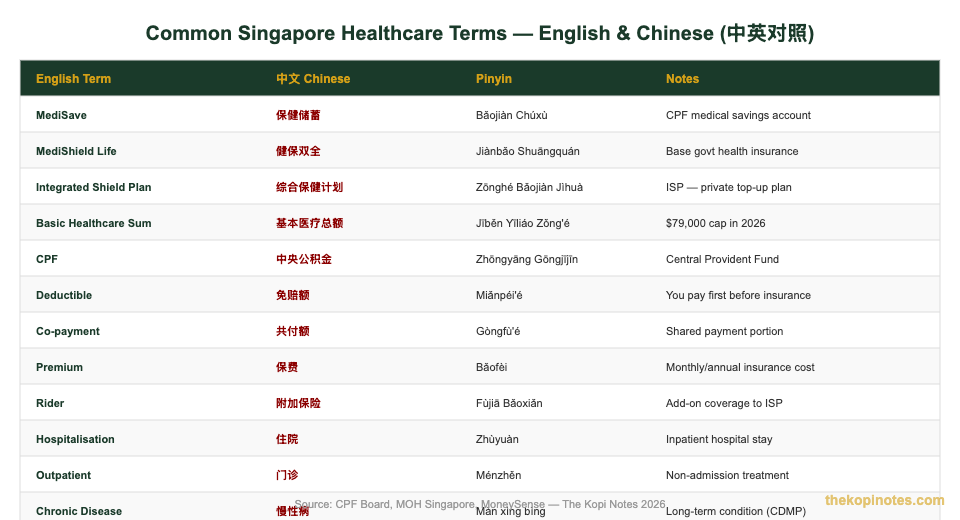
Here are more terms you will encounter at hospitals and on insurance documents (医院和保单中的其他常见词汇):
- 住院医生 (Zhùyuàn Yīshēng) — Attending physician / doctor in charge (主治医生)
- 出院 (Chūyuàn) — Discharge from hospital
- 急诊 (Jízhěn) — Emergency department A&E
- 专科诊所 (Zhuānkē Zhěnsuǒ) — Specialist outpatient clinic (SOC)
- 综合诊所 (Zōnghé Zhěnsuǒ) — Polyclinic
- 理赔 (Lǐpéi) — Insurance claim submission (申请保险赔付)
- 赔付 (Péifù) — Claim payout from insurer
- 预付款 (Yùfùkuǎn) — Hospital deposit / advance payment
如何充值保健储蓄 Topping Up Your MediSave
You can voluntarily top up your MediSave at any time — as long as your balance is below the 2026 BHS of $79,000. This is smart for two reasons: it ensures you have medical savings ready, and it qualifies you for income tax relief (所得税减免).
Who can top up? (谁可以充值?) Both employed (受雇人士) and self-employed persons (自雇人士) can top up their own MediSave. You can also top up for immediate family members — your spouse (配偶), parents (父母), parents-in-law (岳父母/公婆), grandparents (祖父母), and siblings (兄弟姐妹).
Tax relief (税务减免): Cash top-ups receive dollar-for-dollar income tax relief — up to $8,000/year for yourself plus another $8,000 if topping up for eligible family members. Total maximum from MediSave top-ups: $16,000/year. This is subject to prevailing IRAS rules.
How to top up (如何充值):
- Log in to My CPF Online Services (我的公积金网上服务) using Singpass (新加坡通行证)
- Select “Contribute to my MediSave Account” (供款至我的保健储蓄账户)
- Pay via PayNow or eNETS — credited the same day
Self-employed persons (自雇人士): If your annual net trade income (净贸易收入) exceeds $6,000, MediSave contributions are compulsory and must be paid within 30 days of your income tax assessment notice (税务评估通知).
常见问题解答 Frequently Asked Questions
保健储蓄和健保双全有什么区别?(MediSave vs MediShield Life — what is the difference?)
MediSave (保健储蓄) 是您的个人医疗储蓄账户——每月强制供款,余额是您自己的。MediShield Life (健保双全) 是政府的强制基本医疗保险,其保费每年自动从您的MediSave账户扣除。MediSave is your personal savings wallet. MediShield Life is the mandatory basic insurance policy you pay for with that wallet.
2026年保健储蓄上限是多少?(What is the MediSave BHS for 2026?)
2026年的保健储蓄上限(基本医疗总额 / BHS)为 $79,000。65岁以下CPF会员适用此上限。65岁时,您的BHS将永久固定在该年的现行金额。The 2026 BHS is $79,000 for members below 65. When you turn 65, your BHS is locked in at whatever the BHS is that year, for the rest of your life.
我可以用保健储蓄支付私立医院账单吗?(Can MediSave pay for private hospital bills?)
可以。私立医院住院:第1至2天限额 $1,130/天,第3天起 $400/天。如果您有ISP,保险公司负责超出保健储蓄限额的部分(扣除免赔额和共付额后)。Yes — $1,130/day for days 1–2 and $400/day from day three. If you have an ISP, it covers costs above the MediSave cap, minus your deductible and co-payment. Read our complete MediSave guide for examples.
综合保健计划保费可以用保健储蓄支付多少?(How much MediSave can pay for ISP premiums?)
根据您的年龄(下次生日年龄),每年可从保健储蓄中提取:$300(40岁及以下)、$600(41至70岁)或 $900(71岁及以上)用于支付ISP私人保险部分保费。超出AWL的差额需以现金支付。The AWL is $300/yr (≤40), $600/yr (41–70), $900/yr (71+). Cash top-ups are needed if your ISP premium exceeds the AWL.
自雇人士 (自雇人士) 需要缴纳保健储蓄吗?(Do self-employed persons need to contribute to MediSave?)
是的。如果自雇人士的年净贸易收入超过 $6,000,必须强制缴纳保健储蓄。供款金额根据净贸易收入和年龄计算,需在收到IRAS税务评估通知后30天内缴纳。Yes — self-employed persons with net trade income above $6,000/year must make mandatory MediSave contributions, payable within 30 days of the tax assessment notice.
保健储蓄超过 $79,000 后怎么办?(What happens when MediSave exceeds the BHS?)
当保健储蓄余额达到 $79,000 后,多余的供款将自动转入:55岁以下转入特别账户 (SA);55岁及以上转入退休账户 (RA)。保健储蓄账户继续赚取每年4%利息。Once MediSave hits $79,000, excess is redirected to your Special Account (under 55) or Retirement Account (55+). Your MediSave still earns 4%/year. See our CPF MediSave cap 2026 guide.
Get Free Insurance Advice
Speak with a licensed insurance advisor. No obligation, no cost.
By submitting this form, you agree to our Privacy Policy.
This article was researched with the help of AI. While we strive to keep all information accurate and up to date, there may be errors. If you notice any discrepancies, please contact us.