Medisave Limit 2026: Robotic Surgery in Singapore — What Your ISP Covers
Integrated Shield Plans · 15 November 2026 · 12 min read
Table of Contents
- What Is Robotic Surgery in Singapore?
- Medisave and Robotic Surgery: Same TOSP Codes, Same Limits
- Real Robotic Surgery Costs in Singapore (2026)
- The Coverage Gap: Where Your ISP Steps In
- April 2026 ISP Rider Changes: What This Means for Your Claim
- Step-by-Step: Claiming with Your ISP for Robotic Surgery
- Frequently Asked Questions
Robotic surgery in Singapore uses the same TOSP procedure codes as conventional open or laparoscopic surgery — your Medisave withdrawal limit is identical whether the surgeon operates with a da Vinci robot or not. For a private-hospital radical prostatectomy, Medisave covers just $3,260 of the surgeon fee while the total bill can exceed $67,000. Your Integrated Shield Plan bridges that gap — but the April 2026 co-payment rules change how much you personally pay.
Not financial advice. All figures are for educational reference only. Data as at November 2026 unless noted. Always verify current limits with CPF Board and your insurer.
What Is Robotic Surgery in Singapore?
Robotic-assisted surgery uses a surgeon-controlled robotic platform — most commonly the da Vinci Surgical System — to perform minimally invasive procedures with greater precision and dexterity than traditional laparoscopy. Singapore’s public and private hospitals have rapidly adopted robotic surgery: today, virtually every radical prostatectomy performed in Singapore is robotic, according to Farrer Park Hospital urologist Dr. Png Keng Siang (June 2026).
Common robotic procedures in Singapore include:
- Radical prostatectomy (prostate cancer) — TOSP code SH830P, Table 6A
- Total or radical hysterectomy (uterine cancer, fibroids) — TOSP codes SH560P–SH570P, typically Table 5–6
- Colorectal resection (colon or rectal cancer) — Table 7 complexity
- Partial nephrectomy (kidney tumour) — Table 6–7 depending on complexity
The robotic platform does not change which TOSP code is assigned. That is set by the procedure itself and the organ involved — not by the surgical tool used. This is the most important thing to understand when planning your healthcare financing.
Medisave and Robotic Surgery: Same TOSP Codes, Same Limits
Singapore’s Medisave scheme sets withdrawal limits by TOSP (Table of Surgical Procedures) complexity — from Table 1 (minor, e.g. nail removal) to Table 7 (major, e.g. complex colorectal resection). Robotic surgery is not a separate TOSP category. A robotic radical prostatectomy (SH830P) draws on the same Table 6A limit as an open prostatectomy performed by conventional means.
For an inpatient procedure, your Medisave can cover:
- Daily hospitalisation charge limit: $1,130/day for the first 2 days, then $400/day from day 3
- Surgical limit: based on TOSP table (see Table 1 below)
For a 3-day private hospital stay with a Table 6A procedure, Medisave covers a maximum of $1,130 + $1,130 + $400 + $3,260 = $5,920 in total. Against a typical private hospital bill of $67,809 for a robotic prostatectomy, that leaves a gap of roughly $61,889 — which is exactly where your Integrated Shield Plan becomes critical. See our complete 2026 Medisave limit guide for a full breakdown of all withdrawal types.
Table 1: Medisave Surgical Withdrawal Limits by TOSP Table (2026)
| TOSP Table | Examples (Robotic Procedures) | Medisave Limit (A/B/C) |
|---|---|---|
| Table 4 | Robotic cholecystectomy (simple gallbladder removal) | $2,380 / $2,440 / $2,540 |
| Table 5 | Robotic hysterectomy (benign); robotic myomectomy (complex) | $2,610 / $2,660 / $2,770 |
| Table 6A | Robotic radical prostatectomy (SH830P); robotic radical hysterectomy (cancer) | $3,260 |
| Table 7 | Robotic colorectal resection (cancer); robotic partial nephrectomy (complex renal tumour) | $4,340 / $4,830 / $5,290 |
Source: MOH Medisave Inpatient Care page, last updated 27 August 2026. A/B/C tiers reflect procedure complexity sub-classification within each table.
Real Robotic Surgery Costs in Singapore (2026)
Robotic surgery commands a significant premium over conventional approaches — driven by robot maintenance costs, disposable instruments, and longer operating time. In Singapore, the MOH publishes median total bills for key procedures on its TOSP bill information pages. Here is what patients at private hospitals typically face:
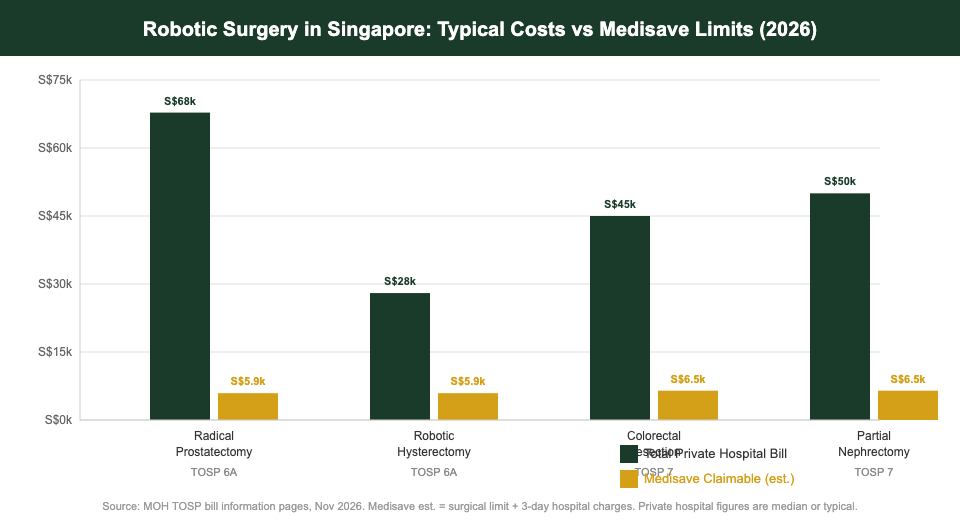
Table 2: Robotic Surgery Costs vs Medisave Coverage (Private Hospital, 2026)
| Procedure | TOSP | Typical Private Bill | Medisave Covers (est.) | Gap (Pre-ISP) |
|---|---|---|---|---|
| Radical prostatectomy (robotic) | 6A | $67,809 | ~$5,920 | ~$61,889 |
| Hysterectomy (robotic, cancer) | 6A | ~$28,000–$35,000 | ~$5,920 | ~$22,000–$29,000 |
| Colorectal resection (robotic) | 7 | ~$45,000–$55,000 | ~$6,470 | ~$38,500–$48,500 |
| Partial nephrectomy (robotic) | 6–7 | ~$45,000–$60,000 | ~$5,920–$6,470 | ~$39,000–$54,000 |
Source: MOH TOSP bill information pages (SH830P, Nov 2026); other figures are illustrative ranges based on private hospital market rates. Medisave estimate assumes 3-day inpatient stay + surgical limit (Table 6A). Actual amounts vary by hospital, ward, and clinical complexity.
These numbers make one thing clear: without an ISP, most Singaporeans would face a five-figure out-of-pocket bill for robotic surgery at a private hospital. Even at a restructured public hospital (Ward A), the total bill for a radical prostatectomy is around $28,000 — still far above what Medisave alone can cover.
The Coverage Gap: Where Your ISP Steps In
All five ISP providers — AIA HealthShield Gold Max, Great Eastern Supreme Health, NTUC Income Enhanced IncomeShield, Prudential PRUShield, and Singlife Shield — cover robotic surgery. As noted above, ISPs do not care whether the surgeon uses a robot: they reimburse based on the final hospital bill and the TOSP code, subject to your plan’s deductible and co-payment rules.
For a private hospital ISP (Plan A tier), the coverage mechanics work like this for 2026:
- Medisave is applied first — covering the surgical limit (e.g. $3,260 for Table 6A) plus the daily hospitalisation charges.
- Deductible is applied next — you pay the first $3,500 of the remaining bill each policy year (before the ISP pays anything further). Some plans have lower deductibles for public hospitals.
- Co-payment (5%) applies to what’s left — after deductible, you pay 5% of the remaining balance and your ISP pays 95%.
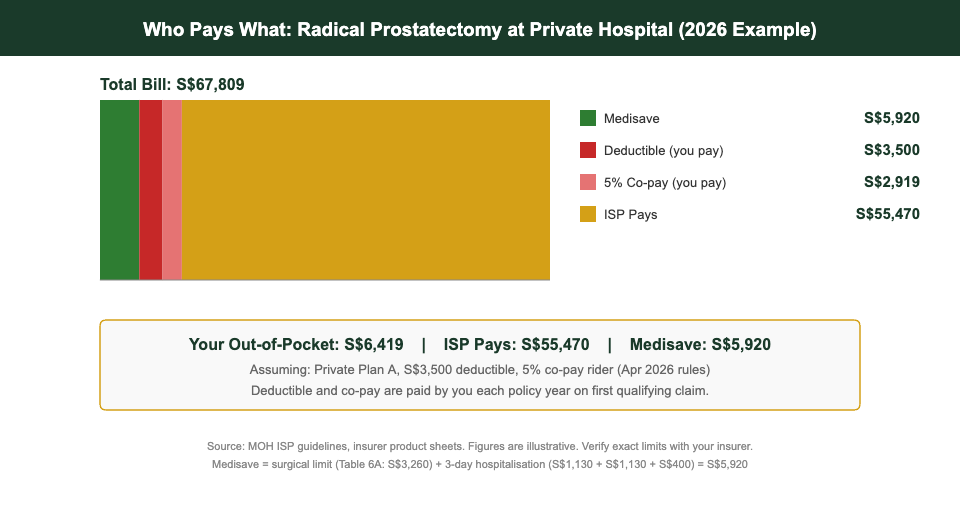
Using the radical prostatectomy example ($67,809 total):
- Medisave covers: ~$5,920
- Remaining bill: $67,809 − $5,920 = $61,889
- Your deductible: $3,500
- Balance after deductible: $61,889 − $3,500 = $58,389
- Your 5% co-pay: $58,389 × 5% ≈ $2,920
- ISP pays: $58,389 − $2,920 ≈ $55,469
- Total out-of-pocket: $3,500 + $2,920 ≈ $6,420 (plus Medisave used)
Compare this to paying the $67,809 bill without ISP — the difference is stark. See our ISP comparison for 2026 to find which plan has the best private hospital coverage for your needs.
April 2026 ISP Rider Changes: What This Means for Robotic Surgery Claims
From 1 April 2026, MOH’s new requirements for ISP riders introduced a mandatory 5% co-payment for all new plans and renewals. The goal is to curb claims inflation — including the uptake of premium surgical options such as robotic platforms, which cost hospitals more and therefore drive up insurance payouts.
What this means practically for robotic surgery:
- If your plan was purchased before 1 April 2026 and has a full rider (no co-pay), you retain that benefit for existing policies until renewal. But check with your insurer — some riders are being phased out.
- If you purchased or renewed after 1 April 2026, the 5% co-pay applies. For a $67,809 robotic prostatectomy claim, the 5% works out to roughly $2,920 as shown above.
- Some insurers offer a co-pay waiver for specific panel hospitals or surgeons. It is worth calling your insurer to check whether your preferred surgeon is on their panel, which can reduce co-pay exposure.
These changes are part of a broader MOH effort to ensure Singapore’s private health insurance market remains sustainable as robotic surgery — and its associated cost premium — becomes the standard of care for more procedures. Including a healthy CPF investment strategy in your financial plan helps ensure your Medisave account is well-funded for future healthcare needs.
Step-by-Step: Claiming with Your ISP for Robotic Surgery
If you are facing robotic surgery at a private hospital, here is how to ensure a smooth ISP claim:
- Confirm pre-authorisation requirements. Most ISPs for private hospital admissions require pre-authorisation from the insurer before surgery. Submit your surgeon’s recommendation and estimated costs at least 1–2 weeks before the procedure date. Without pre-auth, some plans may downgrade your benefit.
- Check if the hospital and surgeon are on the insurer’s panel. Panel surgeons often attract a lower deductible or co-pay. This can save thousands for high-cost procedures.
- Ask your hospital’s billing department to file directly with your ISP. Most private hospitals have an insurance liaison team and will direct-bill your insurer, with the balance (deductible + co-pay) charged to you.
- Apply Medisave at discharge. Your surgeon’s fees and hospital charges are charged to your Medisave account up to the applicable TOSP and daily limits. The hospital’s billing team handles this process.
- Review your Explanation of Benefits (EOB). After discharge, your insurer issues an EOB showing what was paid to the hospital, what Medisave covered, and your share. Keep this for tax purposes (Medisave is not taxable but you may want records for financial planning).
Use our retirement planning calculator to model how a large healthcare expense like robotic surgery might affect your long-term CPF savings and retirement timeline.
Frequently Asked Questions
Does Medisave cover robotic surgery differently from conventional surgery?
No. Medisave does not distinguish between robotic and conventional surgery. Your withdrawal limit is set entirely by the TOSP table assigned to the procedure (e.g. Table 6A for radical prostatectomy), regardless of whether a da Vinci robot or traditional laparoscopy was used. The limits are the same: $3,260 surgical limit for Table 6A, plus the daily hospitalisation charge of $1,130/day for the first two days and $400/day from day 3 onwards.
Will all five ISP providers cover robotic surgery at private hospitals?
Yes. All five ISP providers in Singapore — AIA HealthShield Gold Max, Great Eastern Supreme Health, NTUC Income Enhanced IncomeShield, Prudential PRUShield, and Singlife Shield — cover robotic surgery at private hospitals under their private hospital tier (Plan A). Coverage applies to the actual bill submitted by the hospital, subject to your plan’s deductible ($3,500 for most private plans) and from April 2026, the mandatory 5% co-payment on the remaining balance. Always confirm your plan’s exact terms with your insurer before surgery.
How much will I pay out of pocket for robotic surgery with an ISP?
For a typical robotic radical prostatectomy at a private hospital (total bill ~$67,809) with a Plan A ISP under April 2026 rules: Medisave covers approximately $5,920. You then pay the deductible ($3,500) plus 5% co-payment on the remaining balance (~$2,920), for a total out-of-pocket of roughly $6,420 (plus Medisave utilised). The exact amount depends on your specific plan, whether your surgeon is on the insurer’s panel, and the actual final bill. This is a significant saving versus the full $67,809 uninsured cost.
Does the April 2026 5% co-payment apply to my existing policy?
The mandatory 5% co-payment under MOH’s April 2026 rules applies to new ISP plans and renewals from 1 April 2026 onwards. If you hold an older policy with a full rider (no co-pay) that was purchased before this date, your existing benefit is typically preserved until your policy renewal date. However, you should check directly with your insurer, as some legacy full-rider products are being phased out at renewal. Policies renewed after 1 April 2026 will generally transition to the new co-pay structure.
Can I use Medisave to pay the deductible and co-payment?
No. Medisave can only be used for the allowable inpatient hospitalisation and surgical charges (up to the TOSP limits). It cannot be used to pay the ISP deductible or co-payment — these must be paid in cash. This is an important planning consideration: even with an ISP, robotic surgery at a private hospital may require $3,500–$7,000 in cash reserves to cover the deductible and co-pay. Building an emergency healthcare fund alongside your ISP is a sound part of any healthcare financing strategy.
Is robotic surgery at a public hospital (restructured) also covered by ISP?
Yes. If you have an ISP covering Class A wards at restructured hospitals (e.g. SGH, NUH, CGH), robotic surgery performed there is covered. The deductible for restructured hospitals is typically lower (around $2,000 for Class A coverage) than for private hospitals. The same 5% co-payment applies from April 2026. The total bill is also significantly lower: a radical prostatectomy in a restructured hospital Ward A runs around $28,409 (median), versus $67,809 at a private hospital — resulting in a substantially smaller gap for Medisave and ISP to cover.
Plan Ahead for Healthcare Costs
Robotic surgery represents the future of minimally invasive care in Singapore — and understanding how Medisave and your ISP interact is essential to avoiding financial shock at an already stressful time. The key takeaways:
- Medisave limits are the same for robotic and conventional surgery — set by TOSP table, not by surgical technique
- Private hospital robotic surgery can cost $28,000–$67,000+, leaving a gap of $22,000–$62,000 above Medisave
- A Plan A ISP covers the bulk of that gap — your share is typically deductible + 5% co-pay ≈ $6,000–$8,000
- April 2026 changes mean the 5% co-pay is now mandatory for new and renewing policies
For broader wealth-building beyond healthcare costs, explore passive income strategies in Singapore that complement your CPF savings and help build the cash reserves you will need for healthcare expenses like these.
Get Free Insurance Advice
Speak with a licensed insurance advisor. No obligation, no cost.
By submitting this form, you agree to our Privacy Policy.
This article was researched with the help of AI. While we strive to keep all information accurate and up to date, there may be errors. If you notice any discrepancies, please contact us.