How to Dollar-Cost Average Into CSPX in Singapore (2026 Guide)
Monthly investment plans compared: FSM Global RSP, IBKR Recurring Investments, moomoo and Syfe.
Singapore investors can dollar-cost average (DCA) into CSPX — the iShares Core S&P 500 UCITS ETF — through FSM Global’s Regular Savings Plan (from S$50/month) or Interactive Brokers’ Recurring Investments feature (commission-free for iShares ETFs from EUR 10). moomoo and Syfe do not currently automate recurring buys of this LSE-listed ticker, so investors on those platforms must place manual monthly orders instead.
Not financial advice. All figures are for educational reference only. Data as at November 2026 unless noted; verify current fees and plan terms with each platform before investing.
Table of Contents
Contents — Click to expand
- Why Dollar-Cost Average Into CSPX?
- DCA Platforms Compared: Fees & Minimums
- FSM Global Regular Savings Plan — Step by Step
- Interactive Brokers Recurring Investments — Step by Step
- What About moomoo and Syfe?
- Worked Example: S$500/Month Into CSPX
- DCA vs Lump Sum for CSPX
- Risks and Practical Pitfalls
- Who Should DCA Into CSPX?
- Frequently Asked Questions
Why Dollar-Cost Average Into CSPX?
CSPX (iShares Core S&P 500 UCITS ETF, ISIN IE00B5BMR087) is an Ireland-domiciled, accumulating ETF listed on the London Stock Exchange that tracks the S&P 500. It is a popular core holding for Singapore investors because it carries only 15% US dividend withholding tax and no US estate tax exposure — see our CSPX ETF Singapore guide and our dedicated US estate tax guide for Singapore investors for the full mechanics. A TER of 0.07% p.a. and roughly USD 80 billion in AUM (as at Q1 2026) make it one of the deepest, most liquid S&P 500 UCITS ETFs available.
Dollar-cost averaging — investing a fixed SGD amount into CSPX at regular intervals rather than all at once — spreads purchase prices across market cycles and removes the need to time entries. For a salaried Singapore investor funding CSPX monthly from a paycheck, the real question is not whether to DCA, but which platform actually lets you automate it into a London-listed ticker, and what that automation costs.
DCA Platforms Compared: Fees & Minimums
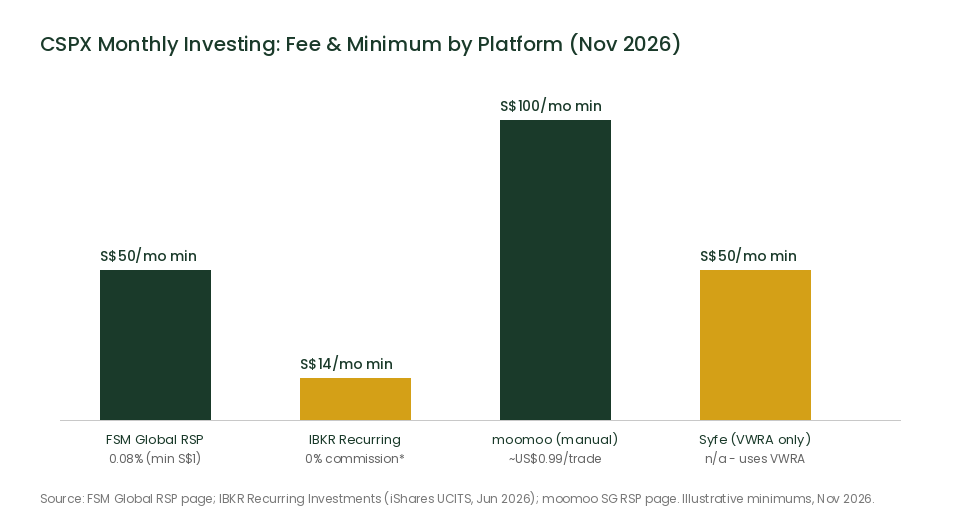
As at November 2026, only two platforms available to Singapore investors offer a genuine automated recurring-purchase feature that supports CSPX specifically: FSM Global (the rebranded FSMOne, effective 25 July 2026) and Interactive Brokers. moomoo’s Regular Savings Plan is built around US-listed stocks and ETFs and does not currently extend to LSE-listed tickers, and Syfe’s recurring investing runs through its managed Core/Equity100 portfolios, which hold VWRA rather than CSPX directly.
| Platform | Automates CSPX buys? | Minimum | Fee | Notes |
|---|---|---|---|---|
| FSM Global RSP | Yes | From S$50/month | ~0.08% of transacted amount, min S$1* | Over 250 ETFs across SGX, HKEX, LSE and US |
| IBKR Recurring Investments | Yes | From EUR 10/order | 0% commission on eligible iShares UCITS ETFs (since Jun 2026)* | Requires CSPX to be fractionally tradable in your account; FX conversion still applies when funding in SGD |
| moomoo Singapore | No (manual only) | No ETF-specific minimum | Standard LSE trade commission applies per order | RSP feature currently covers US-listed stocks/ETFs only |
| Syfe Brokerage | No (different ETF) | From S$1 (Syfe Core) | Platform fee on managed portfolio | Recurring investing runs through Syfe Core/Equity100, which holds VWRA, not CSPX |
*Fees and minimums are indicative and change over time — confirm the current schedule on the FSM Global and IBKR sites before committing to a plan. Source: FSM Global RSP page; IBKR Recurring Investments announcement (commission-free iShares UCITS ETFs across Europe, June 2026); moomoo SG RSP help page, all accessed November 2026.
FSM Global Regular Savings Plan — Step by Step
FSM Global (formerly FSMOne, rebranded 25 July 2026) runs the most established Regular Savings Plan (RSP) that Singapore investors use to automate LSE-listed ETF purchases, including CSPX.
Step 1: Open an FSM Global account
Sign up at fsm.global/sg (the new domain that replaced secure.fundsupermart.com/fsmone from July 2026) and fund your account via PayNow, GIRO or bank transfer.
Step 2: Set up the RSP
Search for CSPX under the ETF RSP section, select the London Stock Exchange listing, and choose a monthly contribution of S$50 or more. You pick the deduction date and FSM Global auto-converts SGD to USD to execute the purchase.
Step 3: Let it run
Each month, the plan purchases CSPX automatically at prevailing market price. The transaction fee is approximately 0.08% of the invested amount, subject to a minimum of S$1 — confirm the live fee schedule in your account before your first contribution, since promotional 0% periods have applied in the past.
Interactive Brokers Recurring Investments — Step by Step
Interactive Brokers (IBKR) introduced commission-free Recurring Investments for a range of iShares UCITS ETFs — including CSPX — across its European-accessible product set from June 2026.
Step 1: Fund your IBKR account
Transfer SGD and hold it, or convert to USD/GBP manually via IBKR’s FX tool for tighter spreads if you trade frequently.
Step 2: Create the recurring plan
In Client Portal, go to Recurring Investments, search for CSPX on the London Stock Exchange, and set a contribution amount (minimum roughly EUR 10 equivalent) and a monthly, fortnightly or weekly schedule.
Step 3: Confirm fractional eligibility
IBKR’s Recurring Investments feature only works on instruments that are fractionally tradable in your account. Most investors can set this up for CSPX without issue, but if the plan fails to save, check the FAQ note on fractional-share eligibility before assuming it is a platform bug. If markets are closed on your scheduled date, the order simply shifts to the next trading day.
What About moomoo and Syfe?
moomoo Singapore’s Regular Savings Plan page describes a product built around US-listed stocks and ETFs, invested daily, weekly or monthly from as little as S$10–50. As at November 2026 it is not set up for LSE-listed tickers like CSPX, so investors who prefer moomoo for its app experience and want CSPX exposure need to place a manual monthly buy order each time — the discipline works, but you lose the “set and forget” automation. See our moomoo Singapore review for the platform’s full fee schedule.
Syfe’s recurring deposits flow into its managed Syfe Core or Equity100 portfolios, which are built around VWRA (an all-world ETF) rather than a single S&P 500 ticker — Syfe does not offer a self-directed “auto-buy CSPX” feature on its brokerage. Investors who want the simplicity of automated monthly investing but are happy with global rather than US-only exposure can use our Syfe referral code to open an account instead.
Worked Example: S$500/Month Into CSPX
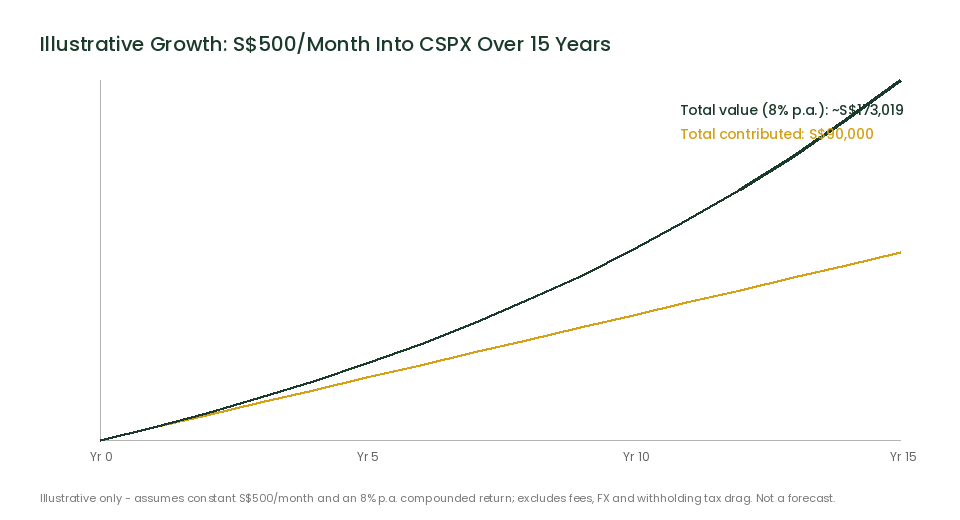
Assume a Singapore investor sets up an RSP or recurring plan to invest S$500 every month into CSPX, and assume (purely for illustration, not as a forecast) that the portfolio compounds at 8% per year — roughly in line with the S&P 500’s long-run average in USD terms, before accounting for SGD/USD currency movements, the 0.07% TER, and the 15% withholding tax drag on dividends.
| Horizon | Total Contributed | Illustrative Value at 8% p.a. |
|---|---|---|
| 5 years | S$30,000 | ~S$36,800 |
| 10 years | S$60,000 | ~S$91,500 |
| 15 years | S$90,000 | ~S$173,000 |
Illustrative only. Assumes a constant S$500/month contribution and an 8% p.a. compounded return with monthly compounding; excludes transaction fees, FX conversion costs and the 15% US dividend withholding tax drag discussed above. Past S&P 500 performance is not indicative of future results.
At the FSM Global RSP’s indicative 0.08% fee, the cumulative platform cost on S$90,000 of contributions over 15 years is roughly S$72 in total — a small drag relative to the compounding shown above, but still worth comparing against IBKR’s commission-free structure if you are investing larger monthly amounts.
DCA vs Lump Sum for CSPX
Dollar-cost averaging into CSPX trades a (statistically likely) lower long-run return for lower regret risk: because markets rise more often than they fall, investing a lump sum immediately has historically outperformed spreading it out, but DCA smooths out the emotional and timing risk of investing a large sum right before a downturn. For a reader deciding between the two approaches in general — not specific to CSPX — our broader dollar-cost averaging vs lump sum guide walks through the historical data. For most salaried investors funding CSPX from monthly income rather than a windfall, DCA is simply the practical default — the comparison matters most if you suddenly have a large sum (bonus, inheritance, property sale proceeds) to deploy at once.
Risks and Practical Pitfalls
- Currency risk: CSPX trades in USD on the LSE. A recurring SGD-funded plan is exposed to SGD/USD movements every month — this is an unavoidable feature of the ETF, not a platform quirk.
- Fractional-share eligibility can change: IBKR’s Recurring Investments depends on CSPX remaining fractionally tradable in your account type; this is not guaranteed to persist indefinitely.
- Fee creep on small amounts: at the lower end of FSM Global’s S$50 minimum, flat-fee components (where applicable) represent a larger percentage drag than on a S$500 contribution — check the fee structure applies proportionally, not as a flat minimum that erodes small plans.
- No CPF compatibility: like all LSE-listed UCITS ETFs, CSPX is not on the CPF Investment Scheme approved list, though it is SRS-compatible — see our CPF investment strategy Singapore guide for how SRS funds can be routed into CSPX instead.
- Single-index concentration: CSPX holds only US large-caps. Investors wanting broader diversification alongside their CSPX RSP may prefer pairing it with Singapore-focused income assets — see our guide to the best S-REITs in Singapore 2026 for the complementary income side of a balanced portfolio.
Who Should DCA Into CSPX?
A recurring CSPX plan suits you if you:
- Invest a fixed amount from salary each month and want to remove timing decisions entirely
- Already hold or plan to open an FSM Global or IBKR account that supports automated LSE ETF purchases
- Want pure S&P 500 exposure rather than a globally diversified fund like VWRA
- Are building a 10+ year position and are comfortable with USD exposure and no CPF compatibility
Consider alternatives if you:
- Only have access to moomoo or Syfe and are not willing to place manual monthly orders — Syfe’s VWRA-based recurring portfolios may be the more automatable fit
- Have a lump sum to deploy rather than a steady monthly surplus — read our DCA vs lump sum comparison before committing to a drip-feed plan
- Want CPF-compatible S&P 500 exposure — explore CPFIS-approved unit trusts via the Endowus referral code, bearing in mind higher fund fees
Use our Singapore retirement calculator to model how a monthly CSPX contribution, combined with CPF and other assets, could shape your retirement timeline.
All investments carry risk, including loss of capital. Past performance of the S&P 500 and CSPX is not indicative of future results. Fees, minimums and platform features cited above are accurate as at November 2026 and are subject to change — always confirm current terms directly with FSM Global, IBKR, moomoo or Syfe before investing. This article is for educational purposes only and does not constitute financial advice. Consult a licensed financial adviser before making investment decisions.
Frequently Asked Questions
Can I dollar-cost average into CSPX in Singapore?
Yes. FSM Global’s Regular Savings Plan (from S$50/month) and Interactive Brokers’ Recurring Investments feature (from around EUR 10, commission-free for eligible iShares ETFs since June 2026) both let you set up an automated monthly purchase of CSPX. moomoo and Syfe do not currently offer the same automation for this specific LSE-listed ticker.
What is the minimum amount to start a CSPX RSP?
FSM Global’s RSP accepts contributions from as little as S$50 per month into CSPX. Interactive Brokers’ Recurring Investments feature has a minimum of roughly EUR 10 per order (about S$14, depending on the exchange rate). Confirm current minimums on each platform, as they can change.
Does moomoo support recurring purchases of CSPX?
Not as at November 2026. moomoo Singapore’s Regular Savings Plan is built around US-listed stocks and ETFs. CSPX is listed on the London Stock Exchange, so moomoo users need to place manual monthly buy orders rather than relying on an automated plan.
Is dollar-cost averaging better than investing a lump sum into CSPX?
Historically, investing a lump sum immediately has outperformed dollar-cost averaging more often than not, simply because markets rise more years than they fall. DCA’s advantage is behavioural and risk-based: it smooths out the regret of investing a large sum right before a downturn and suits investors funding CSPX from regular salary rather than a one-off windfall. See our full comparison for the historical data.
Can I use my CPF or SRS funds to DCA into CSPX?
CSPX is not on the CPF Investment Scheme (CPFIS) approved list, so you cannot use CPF OA or SA funds directly. It is SRS-compatible, however: if you open an SRS brokerage account and your broker supports SRS-funded RSPs, you can route SRS contributions into a recurring CSPX plan.
What fees should I expect from a CSPX recurring investment plan?
FSM Global’s RSP charges approximately 0.08% of the transacted amount per contribution, subject to a minimum of S$1. Interactive Brokers offers commission-free Recurring Investments for eligible iShares UCITS ETFs including CSPX, though standard FX conversion costs still apply if you are funding the account in SGD. Always check the live fee schedule before committing, since promotional rates change.
Ready to Start a Recurring CSPX Plan?
Open a brokerage account that supports automated LSE ETF purchases and start your CSPX RSP today.
This article was researched with the help of AI. While we strive to keep all information accurate and up to date, there may be errors. If you notice any discrepancies, please contact us.