[divi_section][divi_row][divi_column type=”4_4″]
[divi_text]
Singapore’s three big bank stocks — DBS, OCBC, and UOB — just finished reporting Q3 2026 results, and the picture is mixed: DBS and UOB missed analyst forecasts while OCBC was the only one to beat expectations. With bank share prices already down 5–10% from recent highs, Singapore retail investors are asking: are the banks cheap enough to buy now?
This is an editorial analysis. Not financial advice. Data verified as at 10 November 2026.
The Q3 2026 Scorecard: DBS and UOB Miss, OCBC Outperforms
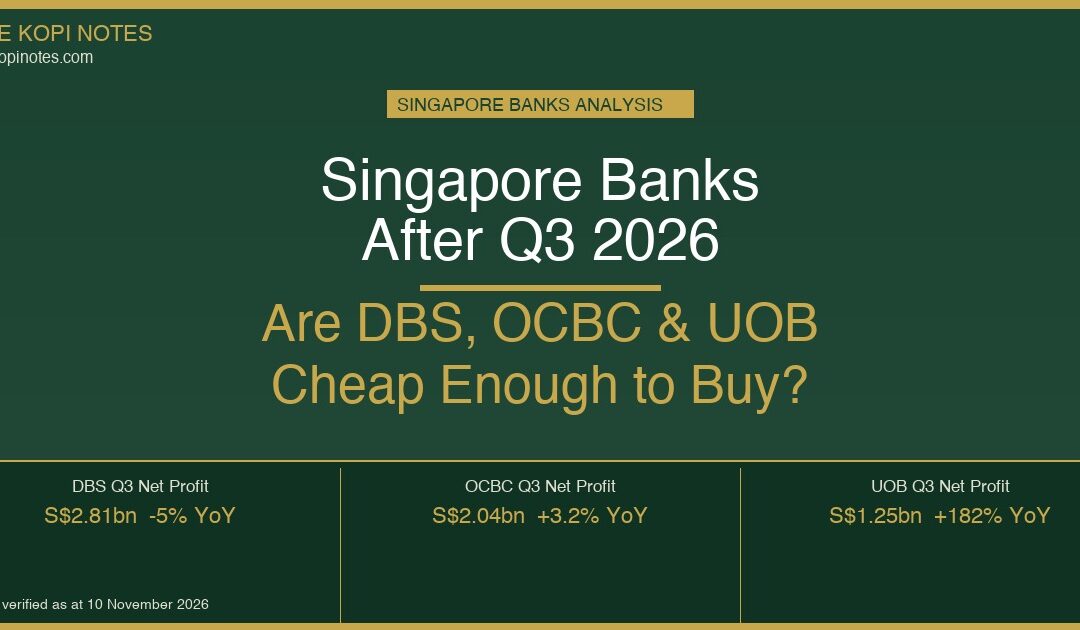
The Q3 2026 results season delivered a split verdict for Singapore’s banking sector. While all three banks remain profitable and financially healthy, only OCBC managed to beat analyst expectations — and only by a slim margin.
DBS posted a net profit of S$2.81 billion for Q3 2026, down 5% year-on-year and 9% quarter-on-quarter. The result missed the consensus estimate of around S$2.90–2.95 billion, primarily because trading income collapsed — markets trading income fell 65% year-on-year to just S$152 million. For context, DBS has historically had the most volatile income profile among the three banks due to its larger treasury operations.
Despite the quarterly miss, DBS’s nine-month performance remains strong: 9M26 net profit of S$8.82 billion is up 2% year-on-year and a record. The bank’s wealth management franchise also set a new milestone with assets under management reaching S$544 billion.
OCBC was the standout performer, reporting Q3 2026 net profit of S$2.04 billion — up 3.2% year-on-year and slightly above the analyst consensus of S$2.01 billion. Crucially, OCBC’s banking operations (excluding insurance) posted a record net profit of S$1.90 billion, up 16% year-on-year. Loan growth was particularly strong, with loans up 14% in constant currency terms. The drag came from its insurance arm, Great Eastern, which saw income fall 37% due to mark-to-market losses on its investment portfolio.
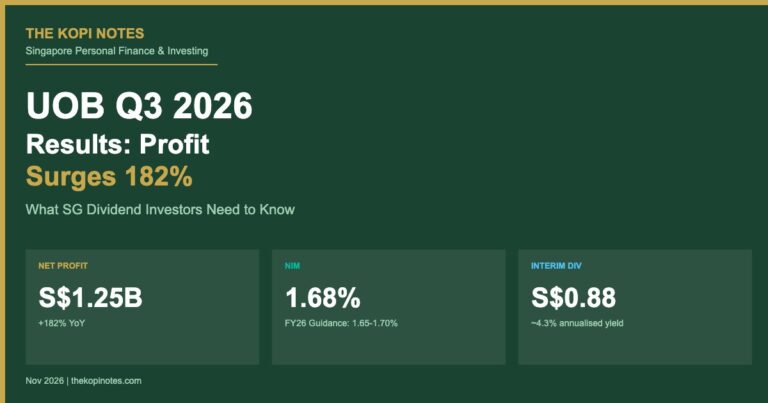
UOB reported the most headline-grabbing number — net profit surged 182% year-on-year to S$1.25 billion — but context matters enormously here. The year-ago quarter (Q3 2025) was distorted by S$1.36 billion of large specific allowances. Stripping that out, UOB’s underlying performance actually missed analyst consensus of S$1.35 billion by roughly 7.4%. More concerning was UOB’s decision to cut its full-year NIM guidance from the 1.75–1.80% range to “below 1.75%.”
| Bank | Q3 2026 Net Profit | YoY Change | vs Consensus | NIM (Q3 2026) | 9M 2026 Profit |
|---|---|---|---|---|---|
| DBS | S$2.81bn | -5% | Missed (~S$2.90bn est.) | 1.87% | S$8.82bn (+2%) |
| OCBC | S$2.04bn | +3.2% | Beat (S$2.01bn est.) | 1.66% | S$6.23bn (est.) |
| UOB | S$1.25bn | +182%* | Missed (~S$1.35bn est.) | 1.68% | Not yet reported |
*UOB’s YoY surge reflects a distorted Q3 2025 base of only S$443m due to S$1.36bn in provisions. Sources: DBS, OCBC, UOB investor relations. Consensus estimates per LSEG.
NIM Under Pressure: The Rate Environment Singapore Bank Investors Must Understand
Net Interest Margin (NIM) — the difference between what banks earn on loans and what they pay depositors — is the single most important driver of bank profitability in Singapore. And the direction is clearly down.
All three banks saw NIM compression in Q3 2026:
- DBS NIM: 1.87% (down from 1.96% a year ago)
- OCBC NIM: 1.66% (down from 1.84% a year ago)
- UOB NIM: 1.68% (down approximately 6 basis points quarter-on-quarter, with full-year guidance now below 1.75%)
For Singapore retail investors, this matters because lower NIMs directly compress bank earnings, putting pressure on future dividend capacity. The NIMs are falling for a combination of reasons: intense deposit competition (digital banks like GXS and MariBank offering competitive savings rates), lower SORA (Singapore Overnight Rate Average) linked loan repricing, and central banks globally maintaining a cautious tone.
Interestingly, the US Federal Reserve raised interest rates in September 2026 — the first hike since 2023 — but Singapore bank NIMs have continued to fall. This reflects the disconnect between US monetary policy and Singapore’s domestic funding costs, where SORA has remained relatively low due to Singapore’s open capital account and global trade uncertainty.
DBS management has guided for an exit NIM of 1.90% — slightly above Q3’s 1.87% — which provides some hope for modest stabilisation in Q4. But with all three banks facing similar structural pressures, the consensus is that NIMs are unlikely to return to the 2.0%+ peaks seen in 2023–2024.
Dividend Investors: What Are the Banks Paying?
Despite earnings pressure, Singapore’s big three banks continue to offer attractive dividend yields — one of the primary reasons retail investors hold them.
DBS remains the most shareholder-friendly. For Q3 2026, DBS declared total dividends of S$0.81 per share: an ordinary dividend of S$0.66 (up from S$0.60 a year ago, a 10% increase) plus a capital return of S$0.15 per quarter. Crucially, DBS has committed to maintaining the S$0.15 capital return through both 2026 and 2027. At the current share price of approximately S$70.78 (as of 5 November 2026), DBS’s annualised dividend yield is approximately 4.6%.
OCBC pays dividends only at the half-year and full-year points, so no Q3 dividend was declared. However, OCBC has maintained a 50% payout ratio guidance and also committed to completing its S$2.5 billion capital return programme by end of FY2026. At recent price levels, OCBC is estimated to offer a dividend yield of approximately 5.0–5.5%.
UOB similarly pays twice yearly. For 1H 2026, UOB paid an interim dividend of S$0.88 per share (up from S$0.85). No Q3 dividend was declared. At current price levels, UOB is estimated to yield approximately 4.5–5.0%.
For income-focused Singapore investors, the dividend story remains compelling even as earnings growth slows. All three banks have strong capital ratios (DBS CET1: 15.9%, OCBC and UOB both above 15%) that support continued distributions.
Valuation Check: Are Singapore Bank Stocks Cheap?
This is the question on every Singapore investor’s mind after the sharp share price declines in October 2026. All three banks sold off 5–10% ahead of Q3 results as investor sentiment soured on the earnings outlook. The question now: has the sell-off created a buying opportunity?
Valuation snapshot (prices as of early November 2026):
| Bank | Approx. Share Price | Est. P/B Ratio | Est. P/E (Trailing) | Est. Dividend Yield | CET1 Ratio |
|---|---|---|---|---|---|
| DBS | ~S$70.78 | ~2.9x | ~19x | ~4.6% | 15.9% |
| OCBC | ~S$26–27 | ~1.5–1.6x | ~14–15x | ~5.0–5.5% | >15% |
| UOB | ~S$37–38 | ~1.2–1.3x | ~14–15x | ~4.5–5.0% | 15.4% |
Estimates based on analyst research and available data as at early November 2026. Share prices are approximate and subject to change. P/B = Price-to-Book, P/E = Price-to-Earnings.
On a price-to-book (P/B) basis, DBS stands out as the most expensive at ~2.9x — nearly double its long-term historical average of around 1.6x. This premium reflects DBS’s superior ROE (~17%), wealth management franchise, and capital return programme, but also implies the market has high expectations already priced in.
OCBC and UOB trade at more modest valuations of 1.5x and 1.2–1.3x book respectively, offering more margin of safety for value-oriented investors. OCBC, as the only bank to beat Q3 estimates, arguably offers the best combination of quality and value at current levels. UOB’s lower P/B reflects its relatively lower ROE and ongoing NIM guidance cuts, but its strong fee income growth (net fee income up 19% in Q3, wealth management fees a record S$258 million) highlights a business in transition.
Analyst views are mixed. Citi downgraded OCBC with a target of S$27.50, while RHB (pre-results) had OCBC as its top Singapore bank pick with a S$33.70 target. The divergence underscores genuine uncertainty about the 2027 earnings trajectory.
The 2027 Outlook: What Singapore Investors Are Really Pricing In
The critical question for Singapore bank investors isn’t Q3 2026 — it’s what 2027 looks like. And the signals are cautious.
DBS has guided for mid-single-digit total income growth in FY2027 and a cost-income ratio in the low-40s%. UOB cut its NIM guidance. OCBC raised its 2026 loan growth guidance to low-double-digits, suggesting momentum — but loan growth in a slowing economy can also signal increased credit risk.
A key concern for Singapore bank investors heading into 2027 is the interplay between global trade uncertainty (which dampens loan demand), rising deposit competition from digital banks, and the trajectory of SORA. If SORA continues to drift lower, NIMs face further compression — a headwind that all three banks are managing but cannot fully escape.
On the positive side, Singapore banks’ wealth management businesses continue to grow strongly. DBS wealth AUM hit a record S$544 billion, OCBC’s wealth income was up 27% in 1H26, and UOB’s wealth management fees set a record in Q3. This diversification away from pure NII provides a structural buffer.
What Singapore Retail Investors Should Do Now
For TKN readers holding or considering Singapore bank stocks, here’s how to frame your decision:
If you’re an income investor focused on dividends, all three banks still offer compelling yields of 4.5–5.5%. DBS’s capital return programme provides visibility through 2027. The dividend growth story remains intact even if earnings growth has slowed. Dollar-cost averaging (DCA) into Singapore bank stocks during this period of uncertainty is a reasonable strategy for long-term holders.
If you’re a value investor focused on P/B, UOB (at ~1.2–1.3x book) offers the most traditional “value” on this metric, while OCBC (~1.5x) provides a balance of value and quality. DBS at ~2.9x book is priced for perfection and carries the most downside risk if 2027 earnings disappoint.
If you’re using CPF-OA funds via CPFIS to invest in Singapore bank stocks, remember that your opportunity cost is the CPF-OA risk-free rate of 2.5%. Bank stocks carry equity risk (prices can and do fall), so the expected return needs to significantly exceed 2.5% to justify the risk. At current dividend yields of 4.5–5.5%, the yield premium over CPF-OA is 2–3 percentage points — historically an acceptable buffer, but one that narrows as share prices rise.
TKN’s related analysis: DBS Q3 2026 Results in Detail | OCBC Q3 2026: Only Bank to Beat Estimates | UOB Q3 2026: Profit Surge But Missed Forecasts | Singapore Banks October 2026 Selloff | T-Bill Rates in Singapore 2026 | Best Investments for Singapore Investors 2026
Bottom Line for SG Investors
Singapore bank stocks are navigating a tricky period: NIMs are under pressure, two of three banks missed Q3 2026 estimates, and the 2027 outlook is cautious. However, all three banks remain fundamentally sound — record wealth management revenues, strong capital ratios above 15% CET1, and dividend yields of 4.5–5.5% that still beat most fixed deposits and T-bills.
The October 2026 sell-off and mixed Q3 results have created a more reasonable entry point, particularly for OCBC and UOB which trade at more modest P/B multiples. DBS remains premium-priced but offers the clearest capital return visibility through 2027.
For Singapore retail investors, the right approach is not “buy or sell” but “right size your position.” Bank stocks belong in a diversified Singapore portfolio, but concentrate too heavily and you bear significant NIM and economic cycle risk. Balance them with S-REITs, global ETFs, and safe instruments to manage overall portfolio risk.
[/divi_text]
[divi_text module_id=”faq”]
Frequently Asked Questions: Singapore Banks Q3 2026
Why did DBS and UOB miss Q3 2026 analyst estimates?
DBS’s shortfall was primarily driven by a 65% year-on-year collapse in markets trading income, which is inherently volatile. UOB missed on the bottom line despite strong fee income growth, as trading and investment income fell 33% and NIM guidance was cut. These are partly cyclical factors, not structural problems with the businesses.
How is OCBC performing better than DBS and UOB in 2026?
OCBC’s outperformance reflects strong loan growth (up 14% in constant currency), record banking operations profit, and disciplined execution. OCBC has also benefited from its Southeast Asian franchise and strong wealth management growth. The drag from Great Eastern insurance is partly a mark-to-market issue that may reverse.
Are Singapore bank dividends safe with earnings under pressure?
Yes, in the near term. All three banks have CET1 capital ratios above 15%, well above regulatory requirements. DBS has explicitly committed to maintaining its S$0.15 capital return through 2027. OCBC’s 50% payout ratio guidance is conservative enough to withstand modest earnings declines. UOB’s strong fee income diversification provides additional support.
What is NIM and why does it matter for Singapore bank investors?
Net Interest Margin (NIM) is the spread between the interest rate banks earn on loans and what they pay depositors. For every 10 basis point (0.10%) drop in NIM, Singapore bank net interest income falls by hundreds of millions of dollars annually. With NIMs falling at all three banks in 2026, earnings growth is naturally constrained — which is why share prices have come under pressure.
Should I use CPF-OA (CPFIS) to buy Singapore bank stocks?
Using CPFIS to buy Singapore bank stocks means giving up a risk-free 2.5% return for equity risk. At current dividend yields of 4.5–5.5%, the yield premium is roughly 2–3%, which may compensate for the risk over the long run. However, bank stocks can fall 20–30% in downturns, which the CPF-OA rate will not. CPFIS is best suited for investors with a 5+ year horizon and comfort with equity volatility.
Which Singapore bank is the best buy right now: DBS, OCBC or UOB?
There is no universal answer — it depends on your investment objectives. For value (lowest P/B): UOB (~1.2–1.3x book). For quality-at-a-reasonable-price: OCBC (~1.5x book, only bank to beat Q3 estimates). For income certainty and capital returns: DBS (capital return committed through 2027, though expensive at ~2.9x book). Consider holding small allocations in all three for diversification.
[/divi_text]
[/divi_column][/divi_row][/divi_section]
This article was researched with the help of AI. While we strive to keep all information accurate and up to date, there may be errors. If you notice any discrepancies, please contact us.