XND vs CNDX vs EQQQ: Which Nasdaq 100 ETF Should Singapore Investors Buy? (2026)
XND brings the Nasdaq 100 to SGX in SGD at 0.20% a year. Here is how it compares with London’s CNDX and EQQQ.
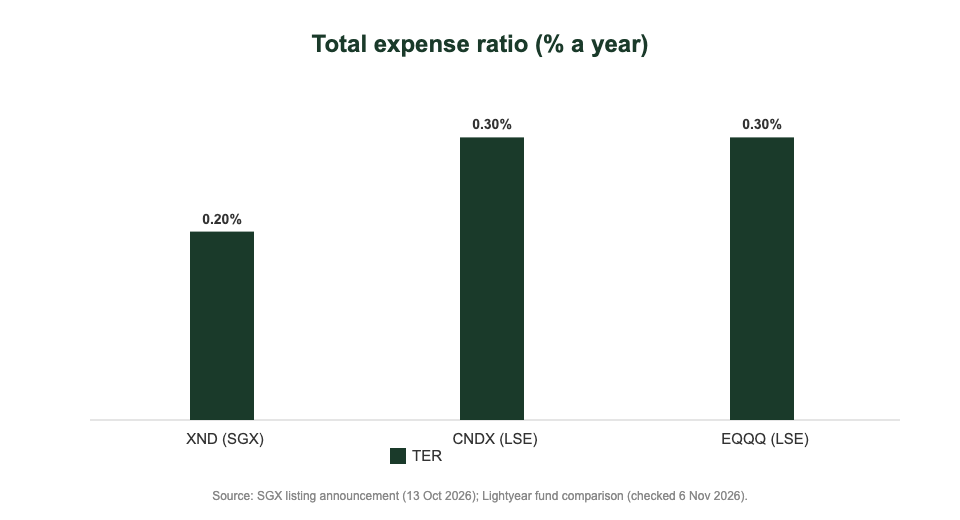
XND is the Xtrackers Nasdaq 100 UCITS ETF, trading on SGX in Singapore dollars since 13 October 2026. CNDX (iShares) and EQQQ (Invesco) are the two best-known Nasdaq 100 UCITS ETFs on the London Stock Exchange. All three are Ireland-domiciled and track the same 100 stocks. XND charges 0.20% a year against 0.30% for CNDX and EQQQ, accumulates dividends and is SRS-eligible. CNDX and EQQQ are far larger and more liquid; EQQQ pays its dividends out.
Not financial advice. All figures are for educational reference only. Data as at the dates shown under each table (June to November 2026).
Table of Contents
What Is XND? The Nasdaq 100 on SGX
XND is the SGX trading line of the Xtrackers Nasdaq 100 UCITS ETF, managed by DWS. The fund itself launched in January 2021 and already trades in Europe; the SGX line links to the same pool of assets through the international central securities depository (ICSD) model SGX used for this listing.
On SGX it trades in SGD, during Singapore market hours, in board lots of one unit. It holds all the index shares (full physical replication), reinvests dividends (accumulating) and is not currency-hedged.
XND is one of four Xtrackers ETFs that listed together, with XUS, XWR and EUS. See our guide to the four Ireland-domiciled ETFs on SGX for the full set.
XND vs CNDX vs EQQQ at a Glance
| XND (SGX) | CNDX (LSE) | EQQQ (LSE) | |
|---|---|---|---|
| Full name | Xtrackers Nasdaq 100 UCITS ETF | iShares Nasdaq 100 UCITS ETF | Invesco EQQQ Nasdaq-100 UCITS ETF |
| Exchange / trading currency | SGX / SGD | LSE / USD | LSE / GBP |
| Total expense ratio | 0.20% | 0.30% | 0.30% |
| Dividends | Accumulating | Accumulating | Distributing |
| Fund size (whole fund) | About €2.6bn | More than US$25bn | More than £9bn |
| Replication | Full physical | Physical | Full physical |
| Domicile | Ireland | Ireland | Ireland |
| US dividend withholding tax | 15% (fund level) | 15% (fund level) | 15% (fund level) |
| US estate tax exposure | No | No | No |
| SRS | SRS-eligible (per SGX); check your SRS operator | Not via the usual SRS route | Not via the usual SRS route |
Source: SGX listing announcement (13 Oct 2026); extraETF fund profile for XND fund size and replication; Lightyear CNDX vs EQQQ comparison, checked 6 Nov 2026
All three hold the same 100 companies under the same Irish tax treatment. What separates them is the fee, the exchange and currency you trade in, whether dividends are paid out, and how much trading depth each line has.
What the Nasdaq 100 Really Holds
The Nasdaq 100 is the 100 largest non-financial companies listed on the Nasdaq exchange. In practice it is a concentrated bet on US technology and a handful of mega-caps.
In the June 2026 holdings, the ten biggest companies made up about 48% of the index, and the top three alone (NVIDIA, Apple and Alphabet) about 21%. When those few names have a bad year, a Nasdaq 100 fund feels it far more than a broad S&P 500 or MSCI World fund.
| Index | Companies | Top 10 weight | What it is |
|---|---|---|---|
| Nasdaq 100 | 100 | About 48% (Jun 2026) | Large non-financial Nasdaq stocks, tech-heavy |
| S&P 500 | About 500 | Lower than Nasdaq 100 | Broad US large caps |
| MSCI World | 1,248 | 26.58% (Oct 2026) | 23 developed markets |
Source: ChartRow Nasdaq 100 concentration (June 2026 holdings); MSCI World factsheet (30 Oct 2026)
That is why many investors hold the Nasdaq 100 as a satellite next to a broad core fund rather than on its own. Our S&P 500 vs Nasdaq 100 ETF explainer walks through the trade-off, and our XWR vs IWDA comparison covers the broad global option now on SGX.
The Fee Gap in Dollars
XND is 0.10 percentage points a year cheaper than CNDX and EQQQ. In money, before growth:
| Amount invested | CNDX or EQQQ at 0.30% | XND at 0.20% | Yearly difference |
|---|---|---|---|
| S$10,000 | S$30 | S$20 | S$10 |
| S$50,000 | S$150 | S$100 | S$50 |
| S$100,000 | S$300 | S$200 | S$100 |
| S$200,000 | S$600 | S$400 | S$200 |
Source: The Kopi Notes calculation: amount × TER. Excludes trading costs and tracking difference.
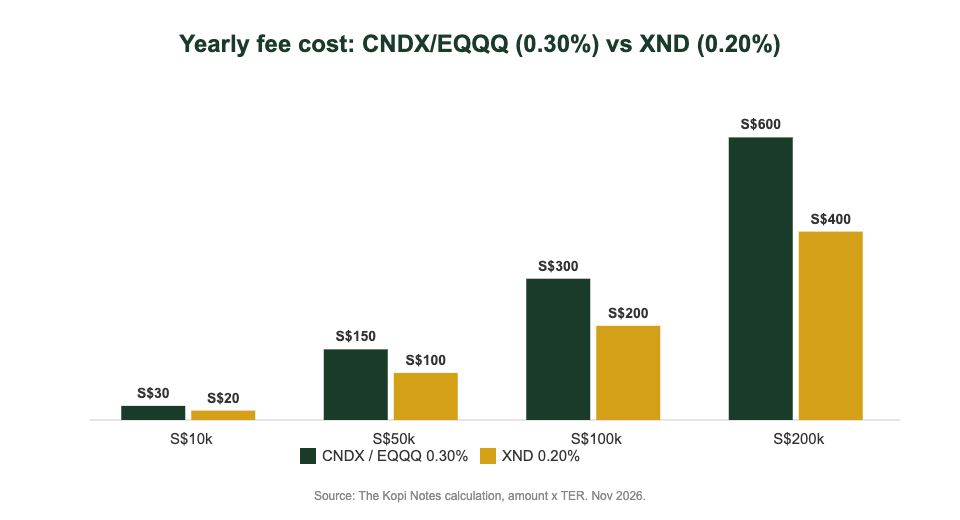
Over 10 years on a steady S$100,000, that is about S$1,000 saved in fees. It is a real gap, but tracking difference and trading costs can narrow or widen it, so treat the fee as a starting point rather than the final answer.
Accumulating or Distributing?
XND and CNDX are accumulating: dividends are reinvested inside the fund. EQQQ is distributing: it pays dividends out to you. The Nasdaq 100 yields little, so the payouts are small either way.
For Singapore investors there is no tax difference between the two. US dividends are taxed at 15% inside all three Irish funds, and Singapore does not tax the dividends you receive. Accumulating suits most people building wealth; distributing suits those who want occasional cash without selling units.
Does Trading in SGD Remove Currency Risk?
No. XND owns US shares, so its SGD price rises and falls with the US dollar. EQQQ’s London line is quoted in pounds, but its holdings are still US dollar assets; the quote currency does not change the underlying exposure.
What XND removes is the broker’s currency conversion. With CNDX you change SGD into USD; with EQQQ’s GBP line, into pounds. On large deposits that conversion spread can cost more than a year of fee savings.
Fund Size and Liquidity
CNDX and EQQQ are among Europe’s biggest Nasdaq 100 funds, and both trade heavily in London. The Xtrackers fund behind XND is smaller, at about €2.6 billion, but well established since 2021.
The number that matters day to day is the bid-ask spread on the line you trade. XND’s SGX line is new and relies on market makers, so spreads may be wider than in London, especially near the open and close. Check the live spread and use limit orders.
Should you switch from CNDX or EQQQ? Usually not. Saving 0.10% a year on S$50,000 is S$50. If selling and rebuying costs 0.2% (S$100), break-even takes about two years, and only if XND tracks as well. Keep what you hold and send new SGD or SRS money to XND if it suits you.
Which One Fits Which Investor
| You are… | Consider | Why |
|---|---|---|
| Investing SRS money in the Nasdaq 100 | XND | SGX-listed and SRS-eligible |
| Making small monthly buys in SGD | XND | No FX conversion, SGX commissions, one-unit lots |
| Investing large sums with cheap USD conversion | CNDX | Deep London liquidity, accumulating |
| Wanting dividends paid out | EQQQ | Distributing share class |
| Holding no broad core fund yet | A broad S&P 500 or MSCI World fund first | The Nasdaq 100 is concentrated in a few tech names |
Source: The Kopi Notes, November 2026
For more on the London options, read our Nasdaq 100 ETF Singapore guide. If AI is the reason you want the Nasdaq, our AI ETF guide compares the narrower themed funds.
Where to Buy XND, CNDX and EQQQ in Singapore
XND (SGX, SGD). Any broker with SGX access can buy it. moomoo was the exclusive distributor during the pre-listing offer; Longbridge and FSMOne also offer SGX trading.
- moomoo referral code and welcome offer
- Longbridge referral code and welcome rewards; fees explained in our Longbridge fees guide
- FSMOne referral code
CNDX and EQQQ (LSE). You need a broker with London access.
- IBKR referral link
- moomoo and Longbridge (above) also offer LSE access; see our moomoo ETF fees guide.
Whichever you choose, keep the Nasdaq 100 in proportion to the rest of your portfolio, and use our Singapore retirement calculator to plan the monthly habit.
Disclaimer: This article is for educational purposes and is not a recommendation to buy or sell any security. ETF fees, fund sizes and broker offers change; check the latest factsheets and broker pages before investing. The Kopi Notes may earn referral fees from some brokers mentioned.
Frequently Asked Questions
What is XND on SGX?
XND is the SGX-listed, SGD-traded line of the Xtrackers Nasdaq 100 UCITS ETF. It is Ireland-domiciled, accumulating, charges 0.20% a year and began trading on SGX on 13 October 2026.
Is XND cheaper than CNDX and EQQQ?
Yes. XND’s total expense ratio is 0.20% a year, against 0.30% for both CNDX and EQQQ. On S$100,000 that is about S$100 a year less in fees, before trading costs.
What is the difference between CNDX and EQQQ?
Both track the Nasdaq 100 at 0.30% a year. CNDX (iShares) is accumulating and trades in USD in London; EQQQ (Invesco) is distributing and its main London line trades in GBP.
Can I buy XND with SRS?
SGX described the four Xtrackers ETFs, including XND, as SRS-eligible at listing. Check with your SRS operator and broker before ordering.
Is the Nasdaq 100 too concentrated?
It is concentrated: the top 10 companies were about 48% of the index in mid-2026. Many investors hold it as a smaller satellite next to a broad S&P 500 or MSCI World fund.
Do I pay tax on EQQQ dividends in Singapore?
Singapore does not tax the dividends you receive. US dividends are taxed at 15% inside the Irish fund before EQQQ pays them out, the same rate XND and CNDX bear internally.
Should I sell CNDX to buy XND?
Usually not. The 0.10% yearly saving is small next to the cost of selling and rebuying. XND makes most sense for new SGD or SRS money.
This article was researched with the help of AI. While we strive to keep all information accurate and up to date, there may be errors. If you notice any discrepancies, please contact us.