XWR vs IWDA: MSCI World on SGX or the LSE? (2026 Singapore Guide)
Xtrackers’ XWR brings the MSCI World index to SGX in SGD at 0.12% a year. Here is how it stacks up against IWDA, and who should use which.
XWR is the Xtrackers MSCI World UCITS ETF, trading on SGX in Singapore dollars since 13 October 2026. IWDA is the iShares Core MSCI World UCITS ETF on the London Stock Exchange. Both are Ireland-domiciled, accumulating and track the same 1,248-stock index. XWR charges 0.12% a year against IWDA’s 0.20%, trades in SGD and is SRS-eligible; IWDA is far bigger and more liquid. For new SGD and SRS money XWR is the simpler route; existing IWDA holders rarely gain by switching.
Not financial advice. All figures are for educational reference only. Data as at the dates shown under each table (October to November 2026).
What Is XWR? MSCI World on SGX
XWR is the SGX trading line of the Xtrackers MSCI World UCITS ETF, managed by DWS. It is not a new fund built for Singapore. It is a cross-listing of an existing Irish fund that already trades in Europe, linked to the same pool of assets through the international central securities depository (ICSD) model that SGX used for this listing.
On SGX it trades in SGD, during Singapore market hours, in board lots of one unit. Dividends are reinvested inside the fund (accumulating), and the units are not currency-hedged. Its 0.12% fee and accumulating share class match the fund’s London line, XDWD.
XWR arrived alongside three other Xtrackers ETFs: XUS (S&P 500, see XUS vs CSPX vs SPYL), XND (Nasdaq 100, see XND vs CNDX vs EQQQ) and EUS (S&P 500 Equal Weight). Our guide to the four Ireland-domiciled ETFs on SGX covers all of them.
XWR vs IWDA at a Glance
| XWR (SGX) | IWDA (LSE) | |
|---|---|---|
| Full name | Xtrackers MSCI World UCITS ETF | iShares Core MSCI World UCITS ETF |
| Manager | DWS (Xtrackers) | BlackRock (iShares) |
| Exchange / trading currency | SGX / SGD | LSE / USD |
| Total expense ratio | 0.12% | 0.20% |
| Fund size (whole fund) | About US$31bn | About €133bn |
| Index | MSCI World | MSCI World |
| Domicile | Ireland | Ireland |
| Dividends | Accumulating | Accumulating |
| US dividend withholding tax | 15% (fund level) | 15% (fund level) |
| US estate tax exposure | No | No |
| Board lot | 1 unit | 1 share |
| SRS | SRS-eligible (per SGX); check your SRS operator | Not via the usual SRS route |
Source: SGX listing announcement (13 Oct 2026) for TER and SRS; moomoo newsroom for share class and lot size; fund sizes from Lightyear fund comparison, checked 6 Nov 2026
Strip away the brand names and these are the same product: an Irish fund holding the MSCI World index and reinvesting dividends. The differences that matter are the fee, where and in what currency you trade, and how deep the market is for each line.
What You Actually Own: The MSCI World Index
Both funds track MSCI World, which covered 1,248 large and mid-sized companies across 23 developed countries as at 30 October 2026. It is a developed-markets index. It does not include China, India, Taiwan, Korea or any other emerging market.
It is also heavily American. The US made up 72.77% of the index at end-October 2026, and the ten largest companies alone were 26.58%. Buying XWR or IWDA is therefore mostly a bet on US large caps, with Japan, the UK and Europe making up most of the rest.
| MSCI World fact (30 Oct 2026) | Figure |
|---|---|
| Number of companies | 1,248 |
| Developed countries covered | 23 |
| US weight | 72.77% |
| Top 10 holdings combined | 26.58% |
| Emerging markets | None |
Source: MSCI World Index factsheet, 30 Oct 2026
If you want emerging markets in the same single fund, that is what an all-world fund such as VWRA adds. Our VWRA ETF Singapore guide explains the trade-off, and VWRA vs IWDA compares the two indices directly.
The Fee Gap in Dollars
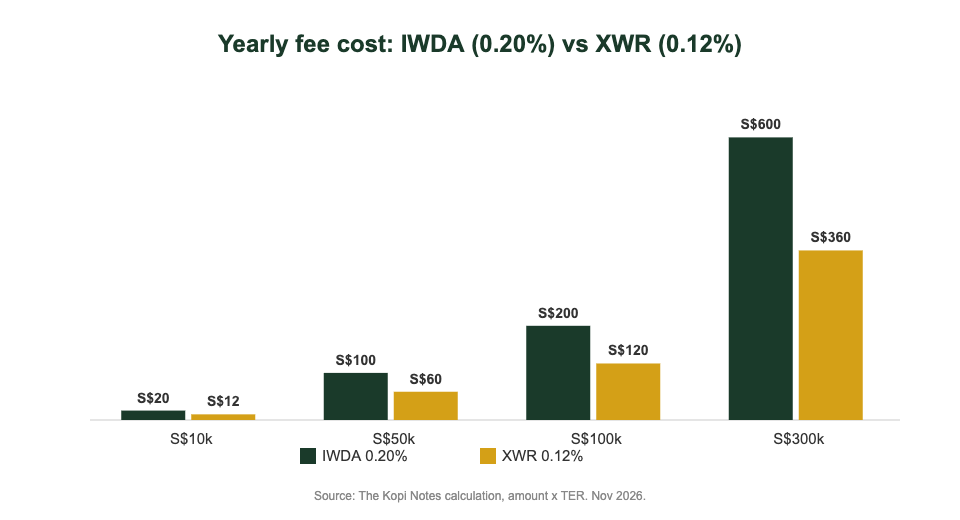
XWR is 0.08 percentage points a year cheaper than IWDA. That sounds small, so here it is in money, before any growth:
| Amount invested | IWDA at 0.20% / year | XWR at 0.12% / year | Yearly difference |
|---|---|---|---|
| S$10,000 | S$20 | S$12 | S$8 |
| S$50,000 | S$100 | S$60 | S$40 |
| S$100,000 | S$200 | S$120 | S$80 |
| S$300,000 | S$600 | S$360 | S$240 |
Source: The Kopi Notes calculation: amount × TER. Excludes trading costs and tracking difference.
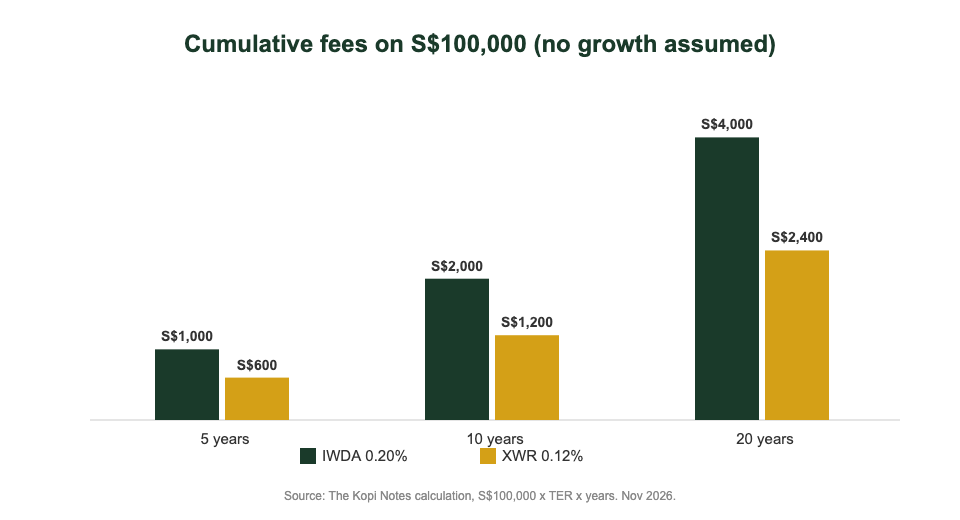
Over 20 years the gap compounds. On a steady S$100,000 holding, 0.08% a year is roughly S$1,600 in fees alone, and more once the money that would have stayed invested is counted.
The fee is not the whole story, though. What you earn relative to the index is the tracking difference, which also reflects securities lending income and dividend handling. The Xtrackers fund has historically tracked MSCI World within about 0.1% a year. Our tracking difference guide explains why this number matters more than the headline fee.
Does Trading in SGD Remove Currency Risk?
No. XWR is priced in SGD, but it owns shares priced mostly in US dollars, yen, pounds and euros. If those currencies weaken against the Singapore dollar, XWR falls in SGD terms, just as IWDA would once you convert it back.
What SGD trading removes is the conversion step at your broker. To buy IWDA you first change SGD into USD, and on a large deposit the broker’s FX spread can cost more than several years of fee difference. With XWR you pay in SGD and the conversion happens inside the fund’s price.
Fund Size, Spreads and Liquidity
IWDA is one of Europe’s biggest ETFs, at about €133 billion, and its London line trades heavily with tight spreads. The Xtrackers fund behind XWR is smaller at about US$31 billion, but that is still a very large fund. Neither is at any risk of closing for lack of assets.
For you, the number that matters is the bid-ask spread on the line you actually trade. XWR’s SGX line is new and relies on market makers, so its spread can be wider than IWDA’s in London, especially near the open and close. Check the live spread, use limit orders, and avoid the first and last few minutes of the session.
Should You Switch From IWDA to XWR?
Switching means selling IWDA and buying XWR. Singapore has no capital gains tax, so the cost is mainly two sets of commissions and spreads, an FX conversion and a few days out of the market.
| Your IWDA holding | Yearly fee saved (0.08%) | If switching costs 0.2% in total | Years to break even |
|---|---|---|---|
| S$20,000 | S$16 | S$40 | 2.5 years |
| S$50,000 | S$40 | S$100 | 2.5 years |
| S$100,000 | S$80 | S$200 | 2.5 years |
| S$100,000, switching costs 0.4% | S$80 | S$400 | 5 years |
Source: The Kopi Notes calculation. 0.2% is an illustrative round-trip cost; your actual cost depends on your broker and the spreads on the day.
The break-even is quicker than for XUS vs CSPX, because the fee gap is twice as large. Even so, for most existing holders the cleaner move is to keep the IWDA units you have and send new money to whichever line suits you. That avoids timing risk and the urge to second-guess a sale.
Three checks before buying XWR
- The live spread. A few cents of spread can cost more than a year of fee savings. Use limit orders.
- Your broker’s SGX minimum fee. On a S$200 monthly buy, a S$0.99 minimum is about 0.5% of the order. Fewer, larger buys keep it down.
- SRS support. SRS-eligible on paper does not mean every SRS operator has switched it on. Ask before moving SRS cash.
Which One Fits Which Investor
| You are… | Consider | Why |
|---|---|---|
| Investing SRS money in global shares | XWR | SGX-listed and SRS-eligible; IWDA is not available through the usual SRS route |
| Making small monthly buys in SGD | XWR | No FX conversion, SGX commissions, one-unit lots |
| Already holding IWDA | Keep IWDA; consider XWR for new money | Avoids selling costs; same index and tax treatment |
| Investing large lump sums with cheap USD conversion | IWDA | Deepest liquidity and tightest spreads |
| Wanting emerging markets in one fund | An all-world fund instead | MSCI World holds no emerging markets |
Source: The Kopi Notes, November 2026
Neither is a bad choice. They hold the same companies under the same Irish tax treatment. For more on why Irish domicile matters, read why Irish ETFs pay 15% withholding tax, not 30%, and see our IWDA ETF Singapore guide for more on IWDA itself.
Where to Buy XWR and IWDA in Singapore
XWR (SGX, SGD). Any broker with SGX access can buy it like a local stock. moomoo was the exclusive distributor during the pre-listing offer. Longbridge and FSMOne also offer SGX trading.
- moomoo referral code and welcome offer
- Longbridge referral code and welcome rewards. As an example, Longbridge charges a 0.03% platform fee (minimum S$0.99) on SGX trades plus SGX fees; see our Longbridge fees guide.
- FSMOne referral code
IWDA (LSE, USD). You need a broker with London Stock Exchange access and a USD balance.
- IBKR referral link
- moomoo and Longbridge (links above) also give LSE access; compare costs in our best brokerage for ETF investing guide.
Prefer not to pick ETFs yourself? Robo-advisers build global portfolios for you; see our Endowus and Syfe pages. Whichever route you take, use our Singapore retirement calculator to see what a monthly habit adds up to.
Disclaimer: This article is for educational purposes and is not a recommendation to buy or sell any security. ETF fees, fund sizes and broker offers change; check the latest factsheets and broker pages before investing. The Kopi Notes may earn referral fees from some brokers mentioned.
Frequently Asked Questions
What is XWR on SGX?
XWR is the SGX-listed, SGD-traded line of the Xtrackers MSCI World UCITS ETF. It is Ireland-domiciled, accumulating, charges 0.12% a year and began trading on SGX on 13 October 2026.
Is XWR the same as IWDA?
They track the same MSCI World index under the same Irish tax treatment, but they are different funds from different managers. XWR is cheaper (0.12% vs 0.20%) and trades in SGD on SGX; IWDA is larger and trades in USD on the LSE.
Should I sell IWDA to buy XWR?
Usually not. The saving is 0.08% a year, about S$80 on S$100,000. If switching costs around 0.2%, break-even takes about two and a half years, and only if XWR tracks as well as IWDA.
Can I buy XWR with SRS?
SGX described the four Xtrackers ETFs, including XWR, as SRS-eligible at listing. Confirm with your SRS operator and broker before placing an order.
Does XWR include emerging markets?
No. MSCI World covers 23 developed countries only. For emerging markets too, you need an all-world fund or a separate emerging-markets ETF.
Does buying XWR in SGD protect me from currency moves?
No. XWR owns shares priced in USD, yen, pounds and euros, so its SGD price moves with those currencies. It only saves the broker currency conversion.
Is XWR exposed to US estate tax?
No. XWR is an Irish-domiciled fund, so Singapore investors holding it are not exposed to US estate tax, the same as with IWDA.
This article was researched with the help of AI. While we strive to keep all information accurate and up to date, there may be errors. If you notice any discrepancies, please contact us.