VWRA Index Rebalancing: How FTSE All-World Changes Affect Your ETF (2026 Guide)
What triggers a VWRA rebalancing event, how the changes actually happen inside the fund, and whether Singapore investors need to do anything about it.
VWRA tracks the FTSE All-World Index, which FTSE Russell reviews every March, June, September and December, adding and removing stocks after the close on the third Friday of each review month. Because VWRA is a passively managed, physically replicating UCITS ETF, these changes happen automatically inside the fund. Singapore investors holding VWRA don’t need to trade, rebalance their own portfolio, or take any action when the index changes.
Not financial advice. All figures are for educational reference only. Data as at September-November 2026 unless noted, sourced from Vanguard’s official fund page.
Table of Contents
Contents — Click to expand
- What Is Index Rebalancing, and Why Does VWRA Do It?
- VWRA Key Facts at a Glance
- FTSE Russell’s Quarterly Review Schedule
- How Index Changes Actually Flow Through to VWRA
- What a Rebalancing Event Looks Like in Practice
- Does Rebalancing Cost VWRA Investors Anything?
- What Should Singapore Investors Do?
- Frequently Asked Questions
What Is Index Rebalancing, and Why Does VWRA Do It?
VWRA (Vanguard FTSE All-World UCITS ETF) tracks the FTSE All-World Index, a free-float market-capitalisation-weighted benchmark covering large- and mid-cap companies across developed and emerging markets. FTSE Russell, the index provider, reviews the index four times a year as part of its Global Equity Index Series (GEIS) methodology, to keep the benchmark an accurate, investable representation of the global equity market.
Two of these reviews — March and September — are “semi-annual reviews.” FTSE Russell re-screens the entire eligible universe against market capitalisation, free-float and liquidity thresholds, which can add or remove individual stocks and, less often, reclassify an entire country between developed, emerging and frontier status. June and December are lighter “quarterly reviews” that mainly capture new IPOs that have become eligible mid-cycle and adjust each company’s free-float shares outstanding (for buybacks, placements or other share-count changes) — they don’t re-screen the full universe from scratch.
Because VWRA is a passive, physically replicating fund (it buys the actual underlying shares rather than using derivatives), every index change has to be mirrored inside the ETF’s actual holdings. That mirroring process is what this guide calls “rebalancing.”
VWRA Key Facts at a Glance
| Metric | Detail |
|---|---|
| Full Name | Vanguard FTSE All-World UCITS ETF (USD) Accumulating |
| Ticker (LSE, USD) | VWRA (ISIN IE00BK5BQT80) |
| Benchmark / Index Provider | FTSE All-World Index, FTSE Russell (LSEG) |
| TER (OCF) | 0.14% p.a. |
| Fund Holdings vs Benchmark | 3,821 stocks held vs 4,203 in the benchmark (representative sampling) |
| Annualised Tracking Error | 1Y: 0.07% · 3Y: 0.07% · 5Y: 0.08% |
| Domicile / Structure | Ireland, Irish UCITS, accumulating |
| Total Fund Assets | Approx. US$88.8 billion |
Source: Vanguard UK Professional fund page, portfolio data as at 30 September 2026, pricing/assets as at 4–5 November 2026.
FTSE Russell’s Quarterly Review Schedule
Unlike an ETF that tracks a benchmark with irregular, event-driven changes (more on that comparison below), VWRA’s underlying index runs on a fixed, published calendar. Every review takes effect after market close on the third Friday of the review month, giving fund managers and authorised participants advance notice to prepare.
| Review Month | Review Type | What Typically Changes |
|---|---|---|
| March | Semi-annual (full) | Full universe screening; country classification reviews; largest batch of additions/deletions |
| June | Quarterly | Free-float and shares-outstanding updates; eligible new IPOs added |
| September | Semi-annual (full) | Same full screening as March |
| December | Quarterly | Free-float and shares-outstanding updates; eligible new IPOs added |
Source: FTSE Russell Global Equity Index Series (GEIS) ground rules and review calendar, lseg.com. Exact 2026 implementation dates are published closer to each quarter on FTSE Russell’s index review calendar.
How Index Changes Actually Flow Through to VWRA
VWRA uses representative sampling rather than buying literally every one of the roughly 4,200 names in the FTSE All-World Index — as at 30 September 2026 it held 3,821 stocks, deliberately skipping the smallest, least liquid constituents whose combined weight and performance contribution are negligible. This keeps trading costs down without materially affecting how closely the fund tracks its benchmark (annualised tracking error has stayed at just 0.07–0.08% over one, three and five years).
When a review adds a new stock, Vanguard’s portfolio managers buy it in proportion to its target index weight, funded through two channels: ordinary cash flows from new ETF unit creations (when authorised participants deliver cash or a basket of shares to Vanguard in exchange for new VWRA units), and proceeds from stocks the same review has removed. Deleted stocks are simply sold down to zero and the proceeds redeployed into the post-review index.
None of this requires anything from you as an investor. You don’t receive a notice, you don’t need to submit instructions to your broker, and the number of VWRA units in your account doesn’t change. All that changes is what’s sitting inside the fund’s underlying portfolio — the same way your unit count in any index fund stays constant while the index itself evolves underneath it.
What a Rebalancing Event Looks Like in Practice
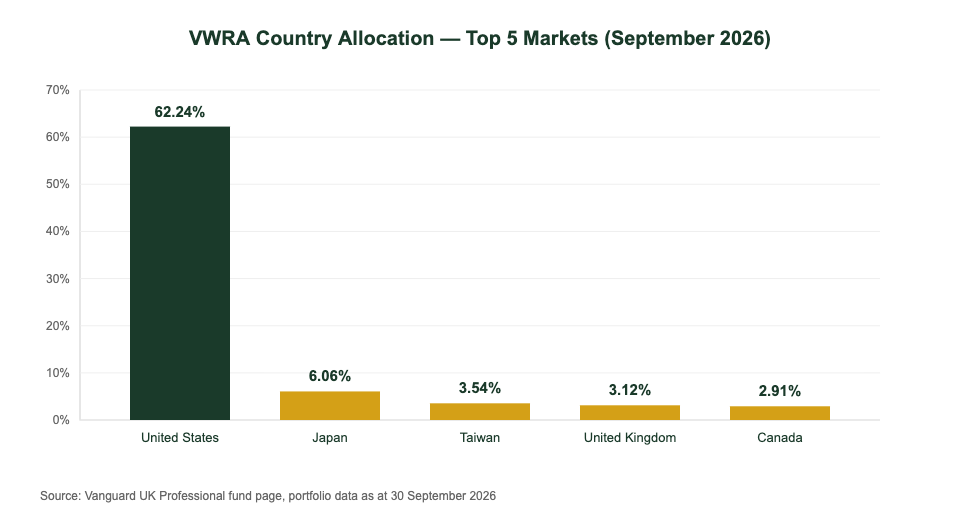
As at 30 September 2026, VWRA’s country allocation was led by the United States at 62.24% of the fund, followed by Japan (6.06%), Taiwan (3.54%), the United Kingdom (3.12%) and Canada (2.91%). These weights are not set by any committee — they fall out automatically from free-float market capitalisation, so if US megacap stocks continue rising faster than the rest of the world, the US weighting mechanically climbs at the next review without FTSE Russell making an active “overweight US” decision.
At the stock level, the fund’s five largest individual positions as at the same date were NVIDIA (5.01%), Apple (4.52%), Microsoft (3.58%), Amazon.com (2.27%) and Taiwan Semiconductor Manufacturing (1.78%) — a reminder that even a 3,800-stock “global” fund can carry meaningful single-name concentration at the top. Readers who want the full breakdown of how concentrated VWRA’s top holdings have become can see the VWRA Magnificent Seven concentration risk analysis and the complete VWRA holdings breakdown for a full country, sector and stock-level view.
Does Rebalancing Cost VWRA Investors Anything?
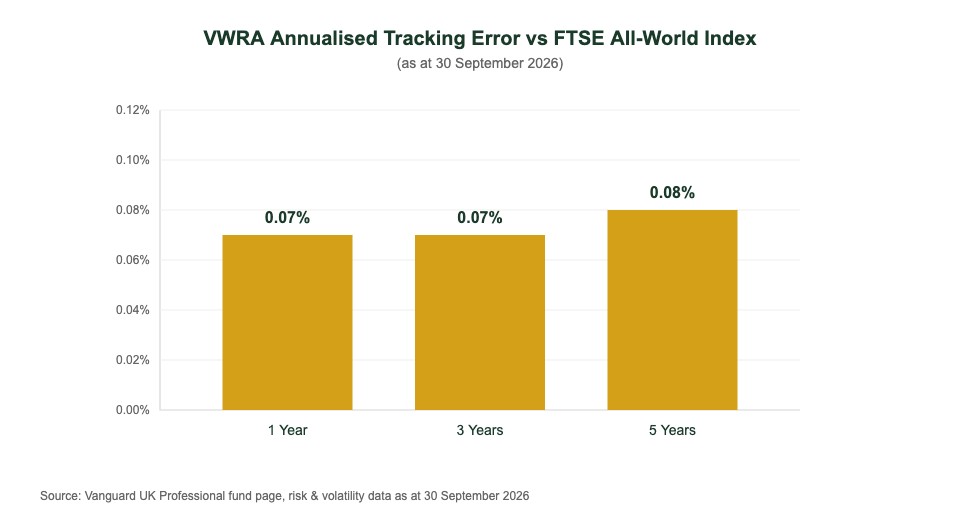
In practice, no meaningful cost shows up in your returns. VWRA’s annualised tracking error — the gap between the fund’s return and the FTSE All-World Index’s return — has held at just 0.07% over one and three years and 0.08% over five years as at 30 September 2026. That is a very tight tracking record for a fund holding nearly 3,800 individual stocks across 49 countries, and it reflects a genuinely low annual portfolio turnover rate: Vanguard only needs to trade the small subset of names added or removed at each quarterly review, not the whole portfolio.
The internal trading costs of a rebalancing event (brokerage, bid-ask spread, any applicable stamp duty on the underlying shares) are absorbed inside the fund and reflected, if at all, in a marginal drag on NAV — not charged to you directly as a fee or a taxable event. Compare that with VWRA’s TER of 0.14% per annum, which is the explicit, disclosed cost of running the fund day to day.
It’s worth contrasting this fixed quarterly calendar with how CSPX’s S&P 500 benchmark changes: additions and deletions there happen irregularly, whenever S&P Dow Jones Indices announces a specific company change (a bankruptcy, an acquisition, or a reconstitution decision), rather than on fixed dates. See the CSPX index rebalancing guide for how that event-driven process works, and the CSPX and VWRA tracking difference guide if you want to compare how tightly each fund tracks its own benchmark.
What Should Singapore Investors Do?
Nothing operationally. VWRA’s rebalancing is entirely a fund-level, back-office process — there’s no action for a unit holder to take around any of the four review dates, no need to time your buy or sell orders around them, and no impact on how your accumulating units keep compounding returns internally. If you’re dollar-cost averaging into VWRA through Interactive Brokers, Saxo, MooMoo or a brokerage like Syfe referral code and sign-up bonus, continue on exactly the same schedule.
If you’re simply curious what’s currently inside the fund, Vanguard publishes updated factsheets and full portfolio holdings monthly on its fund page — a faster way to check than waiting for the next quarterly review headline. VWRA itself isn’t CPF-OA investable, though it can be bought through SRS funds with brokers that support SRS-linked trading; if you’re mapping VWRA into a broader retirement plan, the Singapore retirement calculator is a useful starting point for sizing your overall equity allocation.
Frequently Asked Questions
How often does VWRA rebalance?
VWRA’s benchmark, the FTSE All-World Index, is reviewed four times a year — March, June, September and December — with changes taking effect after market close on the third Friday of each review month. March and September are larger “semi-annual” reviews with full universe screening; June and December are lighter quarterly updates.
Does VWRA rebalancing cost me money as an investor?
Not directly. Rebalancing-related trading happens inside the fund and is absorbed within VWRA’s 0.14% per annum TER and its very low tracking error (0.07–0.08% annualised as at September 2026). You aren’t charged a separate fee, and it isn’t a taxable event for you as a unit holder.
Do I need to do anything when VWRA's index is rebalanced?
No. Rebalancing is handled entirely by Vanguard’s fund managers and authorised participants. Your VWRA unit count stays the same, and you don’t need to place any trades, submit any instructions, or adjust your dollar-cost averaging schedule around review dates.
What's the difference between VWRA's rebalancing and CSPX's?
VWRA’s FTSE All-World Index changes on a fixed quarterly calendar (March, June, September, December). CSPX’s S&P 500 benchmark instead changes irregularly, whenever S&P Dow Jones Indices announces a specific addition or deletion — there’s no fixed review date. See the CSPX index rebalancing guide for the full mechanics of that process.
Why doesn't VWRA hold all 4,203 stocks in its benchmark?
VWRA uses representative sampling, holding 3,821 of the roughly 4,200 stocks in the FTSE All-World Index as at 30 September 2026. It deliberately excludes the smallest, least liquid names, whose combined effect on performance is minimal, in order to keep internal trading costs low while still achieving a very tight 0.07–0.08% annualised tracking error.
Where can I check what's currently inside VWRA?
Vanguard publishes an updated factsheet and full portfolio holdings list monthly on its official fund page (vanguard.co.uk) under the “Portfolio data” tab for the FTSE All-World UCITS ETF. This is the most current and authoritative source, ahead of any third-party guide.
Ready to Start Investing in ETFs?
Open a brokerage account and buy VWRA or other LSE ETFs today. Use our referral links for exclusive sign-up bonuses.
This article was researched with the help of AI. While we strive to keep all information accurate and up to date, there may be errors. If you notice any discrepancies, please contact us.