What Is an Endowment Plan? Singapore Guide [2026]
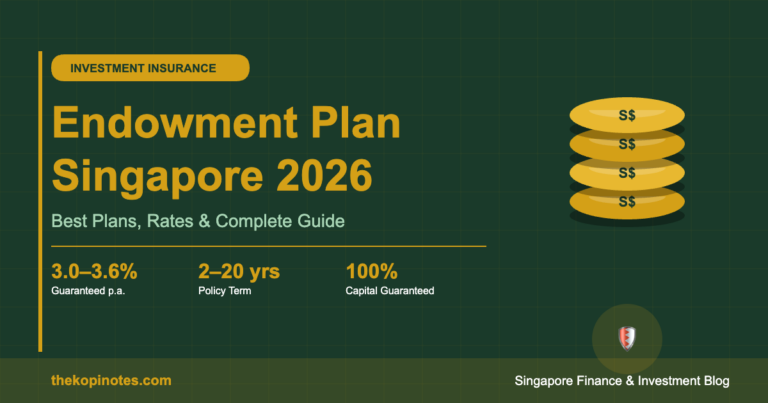
An endowment plan is a life insurance policy in Singapore that combines a savings component with a death benefit. You pay regular or single premiums over a fixed term — typically 10 to 25 years — and receive a lump-sum payout at maturity. Participating (par) plans add non-guaranteed bonuses from the insurer’s par fund, potentially boosting total returns to 3–4.5% p.a. They are regulated by the Monetary Authority of Singapore (MAS) and covered under SDIC up to S$100,000.
Not financial advice. All figures are for educational reference only. Data verified as at November 2026.
Table of Contents
Jump to a section ▼
- What Is an Endowment Plan in Singapore?
- How Does an Endowment Plan Work?
- Types of Endowment Plans in Singapore
- Key Features of Endowment Plans
- Endowment Plan Returns: What to Expect
- Endowment Plan vs Other Financial Products
- Pros and Cons of Endowment Plans
- Who Should Consider an Endowment Plan?
- How to Buy an Endowment Plan in Singapore
- Frequently Asked Questions
What Is an Endowment Plan in Singapore?
An endowment plan — sometimes called an endowment insurance policy — is a life insurance product with a built-in savings element. Unlike pure protection insurance (such as term life), an endowment plan is designed to accumulate a lump sum that is paid out at the end of a specified term. You get your money back at maturity (plus returns), and the policy also pays out a sum to your beneficiaries if you pass away during the policy term.
In Singapore, endowment plans are sold by licensed insurers such as Prudential, AIA, Manulife, Great Eastern, NTUC Income, Aviva, and Tokio Marine. All these insurers are regulated by the Monetary Authority of Singapore (MAS), which means the products must meet strict disclosure and suitability requirements.
The key elements of an endowment plan are:
- Premium payments: You pay a fixed amount — monthly, quarterly, annually, or as a single lump sum — for a set number of years (the “premium payment term”).
- Policy term: The period from policy start to maturity. This can range from 2 years (short-term) to 25+ years (long-term).
- Sum assured: The base amount guaranteed to be paid out on death or maturity (though some plans pay more on maturity through bonuses).
- Maturity value: The total payout at the end of the policy term, including guaranteed and non-guaranteed components.
Endowment plans are particularly popular in Singapore because they offer a structured, disciplined way to save — with guaranteed returns that sit above standard savings accounts — while also providing life insurance coverage. They are a common vehicle for retirement planning, children’s education funding, and medium-to-long-term wealth accumulation.
How Does an Endowment Plan Work?
Here is the step-by-step mechanics of a typical endowment plan in Singapore:
- Policy inception: You sign up for an endowment plan with an insurer and agree to a premium amount, payment frequency, and policy term (e.g., pay S$500/month for 10 years, policy matures at year 20).
- Premium allocation: Each premium you pay is split: a portion goes toward the cost of insurance (the protection element), and the rest is invested or credited into the savings/investment pool.
- Accumulation: For participating plans, your premiums (net of insurance costs) go into the insurer’s participating (par) fund — a pooled investment portfolio. The insurer declares annual bonuses (reversionary bonuses) based on the par fund’s performance. These bonuses, once declared, are added to your policy value and cannot be taken away.
- Maturity: At the end of the policy term, you receive the sum assured plus any accumulated bonuses (for par plans) or the guaranteed maturity value (for non-par plans), plus a terminal bonus if declared.
- Death benefit: If you pass away before maturity, your beneficiaries receive the death benefit — typically 100–105% of the sum assured, plus any bonuses accrued to date.
The chart below illustrates how the payout components build up over a 20-year policy term:
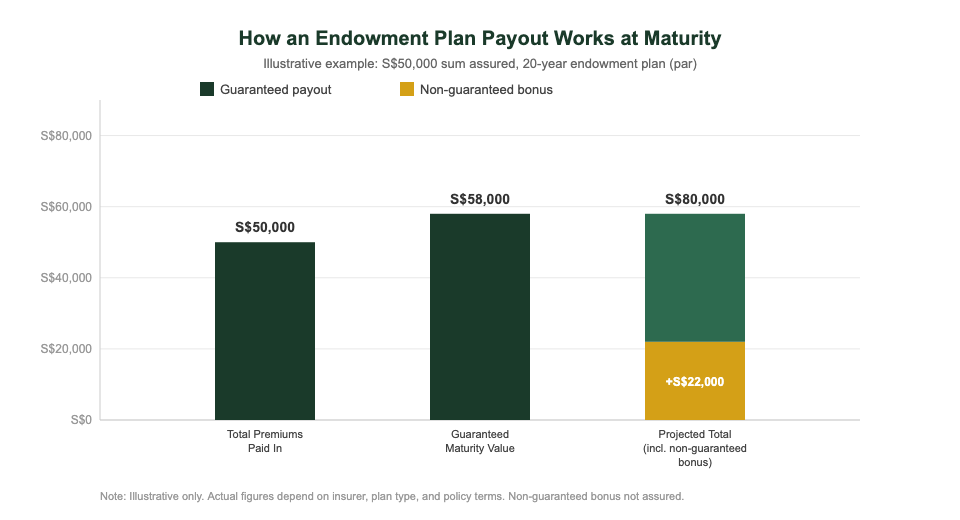
Source: Illustrative example based on typical Singapore endowment plan structures, November 2026. Non-guaranteed bonus not assured.
Types of Endowment Plans in Singapore
Not all endowment plans are the same. Here are the main categories you will encounter in the Singapore market:
1. Participating (Par) Endowment Plans
The most common type. Your premiums go into the insurer’s par fund, which invests in a diversified portfolio of bonds, equities, and property. Bonuses are declared annually based on fund performance and are non-guaranteed but tend to be relatively stable over time. Most major Singapore insurers’ flagship endowment plans are par plans. Examples include Prudential’s PRULink Assurance Account, AIA’s SmartWealth, and Great Eastern’s GELive series.
2. Non-Participating (Non-Par) Endowment Plans
These plans offer fully guaranteed returns — no bonuses, no par fund. What you are promised at inception is exactly what you get at maturity. Returns are typically lower than par plans (reflecting the certainty), but there is no risk of disappointing bonus declarations. Short-term endowment plans (2–3 years) are almost always non-par. Examples include Aviva’s MyEndowmentPlan and various bank-distributed short-term endowment tranches.
3. Short-Term Endowment Plans (2–3 Years)
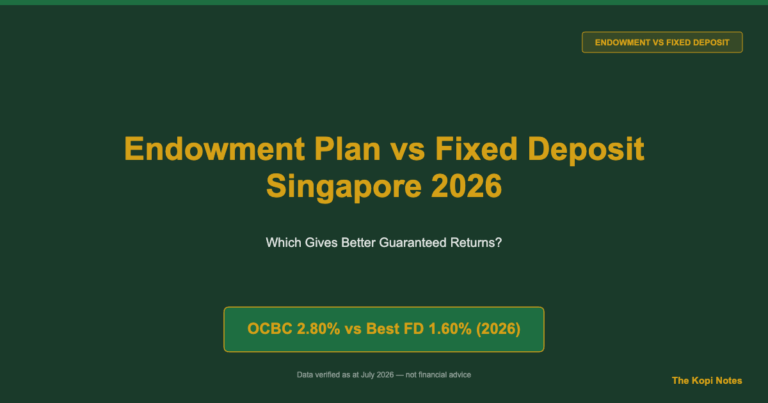
Designed as a fixed-deposit alternative, these plans offer guaranteed returns over a short term. In 2026, typical short-term endowment plans offer guaranteed returns of 1.5–2.5% p.a. for a 2-year policy, or up to 2.8% p.a. for a 3-year policy. They are non-par and are available in limited tranches (sell out quickly). They have no investment risk but are illiquid — surrendering early means a loss.
4. Long-Term Endowment Plans (10–25 Years)
Designed for wealth accumulation and legacy planning, long-term par endowment plans aim to build wealth steadily over decades. They typically offer a higher projected total return (3–4.5% p.a. including non-guaranteed bonuses) than short-term plans, but require patience and commitment. The combination of compounding bonuses and time makes these suitable for education funding or retirement savings.
5. Single-Premium Endowment Plans
You pay a one-time lump sum upfront and receive the maturity payout at the end of the term. Good for those who have a lump sum to invest (e.g., from a bonus, CPF withdrawal, or property sale) and want a structured return. Single-premium plans can be par or non-par.
6. Regular-Premium Endowment Plans
You pay premiums over a period (often shorter than the policy term — for example, pay for 10 years but the policy matures at year 20). This is the most common structure and suits those who want to build wealth through disciplined monthly savings.
Key Features of Endowment Plans
Here is a summary of the core features to compare when evaluating an endowment plan:
| Feature | Details |
|---|---|
| Policy Term | 2–3 years (short-term) or 10–25 years (long-term) |
| Premiums | Monthly, quarterly, annual, or single-premium |
| Guaranteed Returns | Typically 1.5–2.5% p.a. (guaranteed component only) |
| Total Projected Return (Par) | 3–4.5% p.a. (includes non-guaranteed bonus — not assured) |
| Death Benefit | 100–105% of sum assured + accrued bonuses (par plans) |
| Surrender Value | Available after 2–3 years; early surrender typically results in a loss |
| SDIC Protection | Up to S$100,000 per life assured per insurer |
| Free Look Period | 14 days from policy delivery to cancel and receive full refund |
| CPF Eligible | Selected plans are CPFIS-approved (OA or SA monies) |
Source: MAS Insurance FAQ, SDIC website, typical Singapore insurer product terms, November 2026.
Endowment Plan Returns: What to Expect
Returns are the most important consideration for any endowment plan. Here is a breakdown of what to expect in 2026:
Guaranteed vs Non-Guaranteed Returns
Endowment plans in Singapore must clearly separate guaranteed and non-guaranteed components in the product illustration. The guaranteed maturity value is the minimum you will receive — even if the par fund performs badly or the insurer hits difficulty (up to SDIC limits). The non-guaranteed bonus represents the upside — but can be lower than illustrated if par fund performance disappoints.
Illustrative benchmarks for 2026 (indicative; varies by insurer and plan):
- Short-term non-par (2Y): ~1.7–2.3% p.a. guaranteed
- Short-term non-par (3Y): ~2.0–2.8% p.a. guaranteed
- Long-term par (20Y): ~1.5–2.0% p.a. guaranteed + 1.5–2.5% p.a. non-guaranteed bonus
The chart below compares these indicative returns against alternatives like T-bills and SSB:
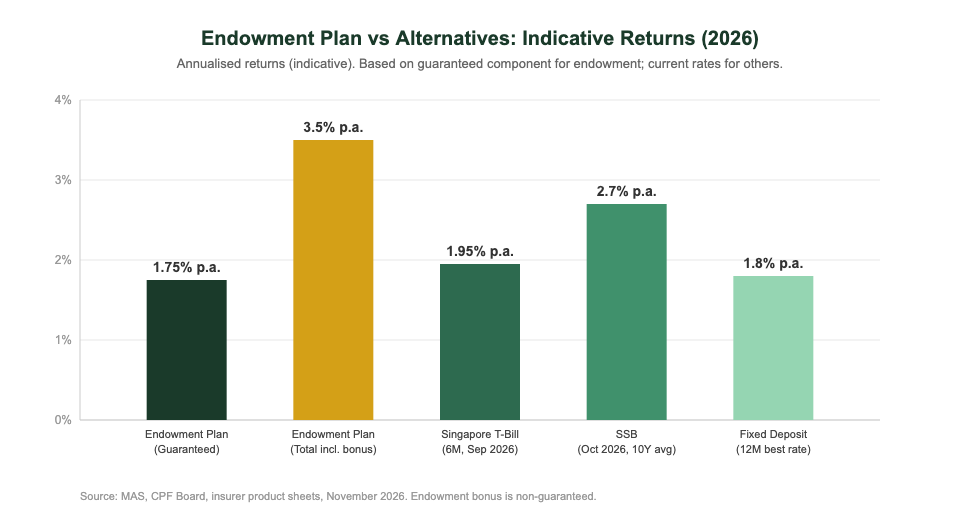
Source: MAS, CPF Board, insurer product illustrations, November 2026. Non-guaranteed bonus not assured.
If you are comparing endowment plans against Singapore T-bills 2026 or Singapore Savings Bonds, note the key differences: T-bills and SSBs are capital-guaranteed with no insurance component and can be redeemed more flexibly. Endowment plans offer higher projected long-term returns (especially par plans) but are far less liquid — surrendering early locks in a loss.
Endowment Plan vs Other Financial Products
How does an endowment plan stack up against the alternatives commonly discussed by Singapore investors?
| Product | Returns | Liquidity | Protection | Best For |
|---|---|---|---|---|
| Endowment Plan (Short) | 1.7–2.8% p.a. (guaranteed) | Low (locked in) | Death benefit | FD alternative, 2–3Y |
| Endowment Plan (Long, Par) | 3–4.5% p.a. (projected) | Very low (10–25Y) | Life insurance | Retirement, education |
| Singapore T-Bill (6M) | ~1.95% p.a. (cut-off yield) | High (6M only) | None | Short-term parking |
| SSB (Oct 2026) | ~2.70% p.a. (10Y avg) | High (redeem any time) | None | Medium-term savings |
| Fixed Deposit (12M best) | ~1.80% p.a. | Low (locked in) | None | 1Y capital preservation |
| Robo-Advisor (e.g. Syfe, Endowus) | 3–7%+ p.a. (not guaranteed) | Medium (T+3) | None | Long-term wealth (risk tolerance required) |
Source: MAS, CPF Board, typical insurer product illustrations, November 2026.
For those looking at robo-advisors as an alternative, platforms like Syfe and Endowus offer diversified portfolios with higher potential returns — but without the guaranteed component or life insurance coverage that endowment plans provide. The right choice depends on your risk tolerance, investment horizon, and whether you need the insurance element.
Pros and Cons of Endowment Plans
Here is an honest look at the advantages and disadvantages of endowment plans for Singapore investors:
Pros
- Guaranteed minimum return: The guaranteed component ensures you will receive at least a specified amount at maturity, regardless of market conditions. This is a powerful feature for risk-averse savers.
- Forced savings discipline: Premium commitments prevent impulsive withdrawals — ideal for those who struggle to maintain savings independently.
- Life insurance coverage: You get a death benefit while your money grows — two financial goals in one product.
- SDIC protection: Up to S$100,000 of your policy value per insurer is covered by Singapore’s insurance compensation scheme.
- Non-guaranteed upside (par plans): If the par fund performs well, reversionary and terminal bonuses can significantly boost total returns — historically delivering 3–4.5% p.a. over long terms.
- CPF compatibility: Selected plans are approved for CPFIS, allowing you to invest CPF-OA monies.
Cons
- Illiquidity: Surrendering before maturity almost always results in a financial loss — particularly in the early years. This is the biggest risk for those whose financial circumstances might change.
- Non-guaranteed bonuses may disappoint: Par plan illustrations show both a “favourable” and an “unfavourable” scenario. Historical par fund performance has been relatively stable, but future bonuses are never guaranteed.
- Lower returns than equities: Over the long run, a diversified equity portfolio (via ETFs or robo-advisors) is likely to outperform endowment plans. The trade-off is accepting market risk.
- Cost of insurance: Part of every premium pays for the insurance coverage, reducing the amount that accumulates as savings. This drag is higher for older policyholders.
- Complex product structure: The combination of guaranteed/non-guaranteed, reversionary/terminal bonuses, and policy fees can make endowment plans difficult to compare.
Who Should Consider an Endowment Plan?
Endowment plans are not for everyone — but they are genuinely useful for specific financial profiles:
- Conservative savers seeking certainty: If you want to know with certainty how much you will receive at a future date — for a child’s university fees, a home down payment, or a retirement lump sum — the guaranteed maturity value of an endowment plan is uniquely reassuring.
- Parents saving for children’s education: A 15–20 year endowment plan started when a child is born can mature just as university tuition fees are due. Many parents use this as a disciplined, structured approach to education funding. See our retirement planning calculator for related projections.
- Those who need dual protection + savings: If you want life insurance AND savings growth in one product (rather than buying separately), a long-term par endowment plan can be efficient.
- Retirees or near-retirees seeking stable income: Short-term endowment plans (2–3 years) can be a yield-enhancing alternative to fixed deposits for idle cash, with slightly better rates and SDIC protection.
- High-income earners with SRS funds: Certain endowment plans can be funded using SRS (Supplementary Retirement Scheme) contributions, offering an additional layer of tax efficiency.
Endowment plans are typically not the best choice for those who need flexibility (may need to access funds before maturity), those with high risk tolerance (better served by equity ETFs), or those who already have sufficient life insurance coverage and are purely optimising investment returns.
How to Buy an Endowment Plan in Singapore
If you have decided an endowment plan suits your financial goals, here is how to proceed:
- Determine your goal and horizon: Are you saving for 2–3 years (short-term non-par) or 10–20 years (long-term par)? Define the target amount and when you need it.
- Compare insurers and plans: Get benefit illustrations (BI) from at least 2–3 insurers. Focus on: guaranteed maturity value, illustrated total maturity value (4.75% and 3.25% scenarios per MAS requirements), total premiums payable, and surrender value schedule.
- Check the Bundled Product Disclosure Document (BPDD): All endowment plans sold in Singapore must come with a BPDD summarising key features and risks. Read it carefully.
- Buy through a licensed Financial Adviser or insurer directly: You can buy through tied agents (insurer’s own salesforce), independent financial advisers (IFAs), or direct-purchase platforms. IFAs must assess your financial needs (FS Act requirements).
- Exercise the 14-day free look period: After receiving your policy documents, you have 14 days to change your mind and receive a full premium refund.
- Review regularly: For par plans, review your policy’s annual bonus declaration each year and assess whether the plan is still meeting your savings goals.
For those interested in a robo-advisory alternative, check out our guides on Syfe or Endowus — both regulated platforms that provide diversified portfolio access for Singapore investors. For a full picture of passive income strategies beyond endowment plans, see our guide on passive income in Singapore.
Frequently Asked Questions About Endowment Plans in Singapore
Is an endowment plan the same as life insurance?
Can I withdraw money from an endowment plan early?
Are returns from endowment plans taxable in Singapore?
What is the difference between a par and non-par endowment plan?
How much of my endowment plan is protected by SDIC?
Can I use CPF money to buy an endowment plan?
What is the free look period for an endowment plan?
Explore More on The Kopi Notes
Understanding what an endowment plan is is just the starting point. Explore related guides to build your complete financial strategy:
- Endowment Plan SDIC Protection — What’s Covered?
- Passive Income Singapore 2026 — All Your Options
- Singapore Retirement Planning Calculator
- Singapore Savings Bonds 2026 — Complete Guide
Disclaimer: This article is for informational and educational purposes only and does not constitute financial advice. Please consult a licensed financial adviser before making any investment decisions. All data is indicative and as at November 2026.
Get Free Insurance Advice
Speak with a licensed insurance advisor. No obligation, no cost.
By submitting this form, you agree to our Privacy Policy.
This article was researched with the help of AI. While we strive to keep all information accurate and up to date, there may be errors. If you notice any discrepancies, please contact us.