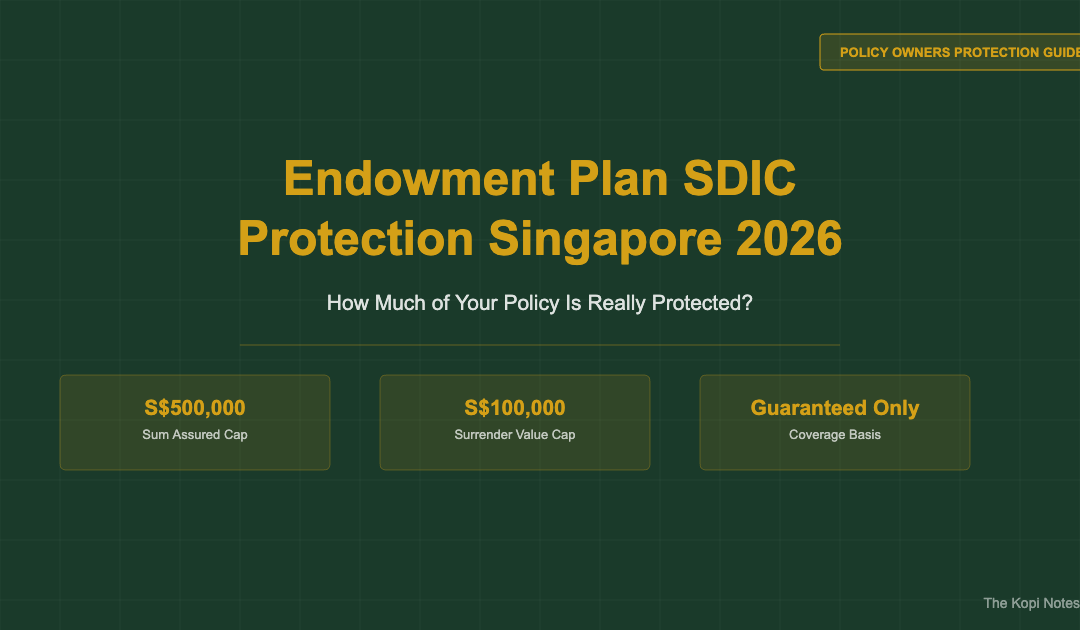
Endowment Plan SDIC Protection Singapore 2026: How Much of Your Policy Is Really Protected?
Everything you need to know about the PPF Scheme caps, what is and is not covered, and how to check your real protection level.
Your endowment plan in Singapore is protected by the Policy Owners’ Protection (PPF) Scheme, administered by SDIC. If your life insurer fails, guaranteed benefits are covered up to S$500,000 for aggregated sum assured and S$100,000 for aggregated surrender value — per life assured, per insurer. Non-guaranteed bonuses such as reversionary and terminal bonuses are excluded. If you hold multiple endowment plans with the same insurer, these caps apply across all your policies combined.
Not financial advice. All figures are for educational reference only. Data verified as at November 2026 from SDIC official website (sdic.org.sg) unless noted.
Table of Contents
Click to expand
- What Is the Policy Owners’ Protection (PPF) Scheme?
- Are Endowment Plans Covered by the PPF Scheme?
- How Much of Your Endowment Plan Is Protected?
- What Is NOT Covered Under the PPF Scheme?
- How to Check If You Are Over the Protection Limit
- What Happens If Your Insurer Fails?
- Is My Insurer a PPF Scheme Member?
- Frequently Asked Questions
What Is the Policy Owners’ Protection (PPF) Scheme?
The Policy Owners’ Protection (PPF) Scheme is a statutory protection scheme administered by the Singapore Deposit Insurance Corporation (SDIC). It protects policy owners of life and general insurance policies if their licensed insurer — a mandatory PPF Scheme member — fails or cannot meet its obligations.
The scheme was established under the Deposit Insurance and Policy Owners’ Protection Schemes Act and operates separately from the bank Deposit Insurance (DI) Scheme, which covers savings deposits up to S$100,000. All life insurers licensed by MAS to conduct insurance business in Singapore are required by law to be PPF Scheme members — there is no opt-out.
Your endowment plan, whole life, term life, and annuity policies with any MAS-licensed life insurer are automatically covered under the PPF Scheme. You do not need to register, apply, or pay separately for this protection. The scheme is funded by annual levies collected from member insurers, held in dedicated PPF Funds separate for life insurance and general insurance.
In the event of an insurer’s failure, MAS and SDIC have several tools: they may arrange a transfer of the insurer’s portfolio to a solvent insurer, manage the failed insurer’s business in run-off mode, or terminate policies with compensation. All outcomes offer meaningful protection — but compensation is subject to the scheme’s coverage caps and applies only to guaranteed benefits. Singapore has not experienced a life insurer failure requiring PPF Scheme activation since the scheme’s inception.
Are Endowment Plans Covered by the PPF Scheme?
Yes. Individual and group endowment plans are explicitly listed as covered policy types under the PPF Scheme. According to the SDIC scope of coverage page, the following types of individual life insurance policies are protected:
- Individual and group term life policies
- Individual and group whole life policies
- Individual and group endowment policies
- Individual and group annuities
- Individual and group long-term A&H policies
Coverage applies to policies issued in Singapore by a licensed life insurer to residents and non-residents. One important exception: policies issued by an overseas branch of a Singapore-incorporated life insurer are not covered. If you purchased your plan through an overseas branch, verify with your insurer whether the policy qualifies for PPF protection.
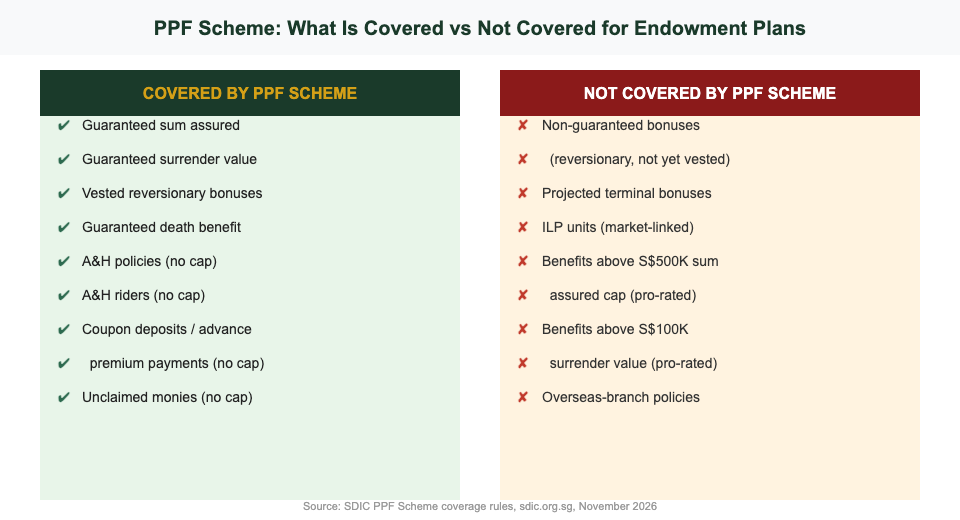
Accumulated values on coupon deposits, advance premium payments, premium refunds, and unclaimed monies under insured policies are also covered under the scheme — and these are covered without any cap.
How Much of Your Endowment Plan Is Protected?
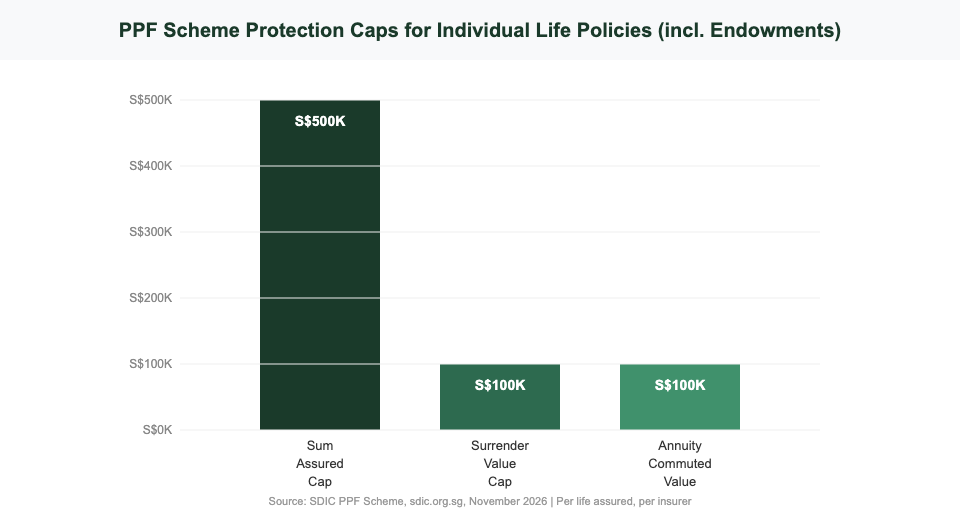
This is the most critical question for any Singapore investor with substantial endowment plan coverage. The PPF Scheme protects only guaranteed benefits — and only up to the applicable caps per insurer. The table below summarises the protection limits for individual life policies, which include individual endowment plans:
| Protection Category | Cap Amount | Applied Per |
|---|---|---|
| Aggregated Guaranteed Sum Assured | S$500,000 | Life assured, per insurer |
| Aggregated Guaranteed Surrender Value | S$100,000 | Life assured, per insurer |
| Annuity Commuted Value (guaranteed) | S$100,000 | Life assured, per insurer |
| A&H Policies (individual) | No cap | N/A |
| Coupon Deposits / Advance Premiums | No cap | N/A |
Source: SDIC PPF Entitlement, sdic.org.sg, November 2026. Caps apply per life assured per insurer.
These caps are applied on an aggregate basis. If you hold two or three endowment plans with the same insurer, the S$500,000 cap covers all those policies combined — not each policy individually. Caps apply per life assured (not policy owner), which matters for joint policies or child endowment plans where the parent is owner but the child is life assured.
Worked example: Two endowment plans with Insurer A — Plan 1: S$300,000 guaranteed sum assured, S$70,000 surrender value; Plan 2: S$250,000 guaranteed sum assured, S$60,000 surrender value. Combined totals: S$550,000 sum assured and S$130,000 surrender value — both exceeding the caps. SDIC applies a protection ratio: sum assured 90.9% (S$500K/S$550K); surrender value 76.9% (S$100K/S$130K). You receive only 90.9% and 76.9% of respective claims — not the full amounts.
This is why Singaporeans with significant endowment plan holdings benefit from spreading policies across different MAS-licensed insurers. Each insurer’s policies are assessed independently for the cap calculation.
What Is NOT Covered Under the PPF Scheme?
Understanding the exclusions is just as important as knowing the coverage. The following items are not protected — directly affecting the actual security of many endowment plan projections:
| Item Not Covered | Reason / Notes |
|---|---|
| Non-guaranteed reversionary bonuses (not yet vested) | PPF covers guaranteed benefits only |
| Projected terminal bonuses | Non-guaranteed; not part of policy contract |
| ILP units tied to underlying fund NAV | Market-linked; not guaranteed benefits |
| Policies from overseas branches of SG insurers | Only Singapore-issued policies are covered |
| Benefits above applicable caps (pro-rated) | Protection ratio applied; shortfall borne by owner |
Source: SDIC PPF Scheme documentation, sdic.org.sg, November 2026.
The most consequential exclusion for par (participating) endowment plan holders is non-guaranteed bonuses. Most par endowment benefit illustrations show both a guaranteed maturity value and a higher projected maturity value including non-guaranteed bonuses. The projected portion — which can represent 30–50% of the total illustrated maturity value — is not protected by the PPF Scheme.
When evaluating your endowment plan’s exposure, look at the guaranteed sum assured column in your policy document — exclude projected non-guaranteed amounts. For a detailed analysis of guaranteed vs projected returns and break-even timeline, our article on endowment plan break-even analysis explains how to evaluate the numbers properly.
How to Check If You Are Over the Protection Limit
If you hold multiple life insurance policies with the same insurer, verify whether your combined guaranteed benefits exceed the PPF Scheme caps. Here is a practical three-step process:
- List all policies per insurer. Group your policies by insurer — AIA, Great Eastern, Prudential, Manulife, NTUC Income, Singlife, etc. Focus on the life assured: for child endowment plans where a parent is owner but the child is life assured, the cap applies to the child’s policies.
- Sum the guaranteed benefits per insurer. Add up the guaranteed sum assured and guaranteed surrender value across all policies where the same person is the life assured. Use the “Guaranteed Benefits” table in your policy document — exclude all projected non-guaranteed bonus amounts.
- Compare against caps: S$500,000 (sum assured) and S$100,000 (surrender value). If either total exceeds the cap for any insurer, you carry some unprotected exposure. Consider directing future policies to a different MAS-licensed insurer to maximise total PPF coverage.
For most Singaporeans with one or two endowment plans, the PPF Scheme provides complete protection. The caps matter primarily for high-net-worth individuals with multiple large par policies with the same insurer. Use our Singapore retirement calculator to see how your guaranteed endowment maturity values fit your overall retirement projection alongside CPF and other savings.
What Happens If Your Insurer Fails?
In the event of a licensed life insurer’s failure, MAS has three primary options, coordinated with SDIC:
- Transfer: MAS arranges for the failed insurer’s portfolio to be transferred to a solvent insurer. Policy owners’ policies continue with the new insurer — the most protective outcome.
- Run-off: SDIC manages the failed insurer’s remaining business until all policies mature or claims are paid. Policy owners receive PPF-covered benefits as claims arise over time.
- Termination with compensation: Policies are wound up and SDIC compensates policy owners based on their protected entitlement — guaranteed benefits up to the applicable caps, subject to any protection ratio.
SDIC will compensate for: claims already filed at time of failure (death, disability, critical illness); surrenders already in process; and policies already matured awaiting payment. Singapore life insurers are required to maintain minimum Capital Adequacy Ratios and participate in MAS stress tests. No MAS-licensed life insurer has failed since the PPF Scheme was established.
Is My Insurer a PPF Scheme Member?
All MAS-licensed life insurers in Singapore are mandatory PPF Scheme members. This includes AIA Singapore, Great Eastern Life, Prudential Assurance, Manulife Singapore, NTUC Income Insurance, Singlife, Tokio Marine Life Singapore, and others. Verify your insurer’s membership status on the SDIC PPF Scheme Members page.
Many Singaporeans complement endowment plan holdings with investment accounts that diversify across asset classes. To invest CPF-OA and SRS funds via the Endowus platform for a different risk profile from insurer-backed guaranteed returns, see the Endowus referral code page. For robo-advisory investing alongside your insurance savings, the Syfe referral code page covers available promotions and account types.
For beneficiary arrangements on your endowment plan, our article on endowment plan nomination strategies explains statutory nomination versus S.49M trust so dependants receive the maximum PPF-covered amount directly. If you recently purchased an endowment plan and are reconsidering, the endowment plan free look period guide covers the 14-day exit window.
All data verified as at November 2026. Always refer to SDIC documentation at sdic.org.sg for current PPF Scheme caps and coverage rules.
Frequently Asked Questions
Is my endowment plan protected if my insurer goes bankrupt?
Yes. If your MAS-licensed insurer fails, your endowment plan is covered under the PPF Scheme administered by SDIC. Guaranteed benefits are protected up to S$500,000 for sum assured and S$100,000 for surrender value per life assured per insurer. Non-guaranteed bonuses are not covered. MAS will typically arrange a portfolio transfer to another solvent insurer so your policy continues.
Does the S$500,000 cap apply per policy or across all my policies?
The S$500,000 sum assured cap is applied on an aggregate basis — it covers all your individual life policies with a single insurer combined, not each policy individually. If you have two endowment plans with the same insurer each with S$300,000 guaranteed sum assured (combined S$600,000), only S$500,000 is fully protected. A protection ratio of 83.3% applies to all claims. Spread large policies across different MAS-licensed insurers to maximise coverage.
Are non-participating endowment plans also covered by the PPF Scheme?
Yes. Both participating (par) and non-participating (non-par) endowment plans are covered under the PPF Scheme, as long as they are issued by an MAS-licensed insurer in Singapore. Non-par endowment plans are simpler from a PPF perspective because all their benefits are guaranteed — there are no non-guaranteed bonuses to exclude. The same caps apply: S$500,000 for guaranteed sum assured and S$100,000 for guaranteed surrender value per life assured per insurer.
What happens to my premiums if my insurer fails during the premium-paying period?
If your insurer fails while you are still paying premiums, MAS will typically arrange a transfer to another insurer. Your policy continues with the guaranteed benefit structure intact. If no transfer is possible and the policy is terminated, SDIC will compensate you based on the guaranteed surrender value at the time of failure, subject to the S$100,000 surrender value cap. Any advance premium payments and coupon deposits are covered without cap.
How do I verify if my insurer is a PPF Scheme member?
All MAS-licensed life insurers operating in Singapore are mandatory PPF Scheme members. The full list is publicly available on the SDIC website at sdic.org.sg. If your insurer appears on the MAS register of licensed life insurers, it is a PPF Scheme member. You can also contact SDIC directly at enquiries@sdic.org.sg or check the SDIC scheme members page for the current list.
Is the PPF Scheme the same as the Singapore Deposit Insurance Scheme?
No. These are two separate schemes administered by SDIC. The Deposit Insurance (DI) Scheme protects bank deposits at MAS-licensed banks up to S$100,000 per depositor per institution. The Policy Owners’ Protection (PPF) Scheme protects life and general insurance policies with MAS-licensed insurers, with different caps and coverage rules. Your endowment plan is covered under the PPF Scheme, not the DI Scheme.
Get Free Insurance Advice
Speak with a licensed insurance advisor. No obligation, no cost.
By submitting this form, you agree to our Privacy Policy.
This article was researched with the help of AI. While we strive to keep all information accurate and up to date, there may be errors. If you notice any discrepancies, please contact us.