Savings Plan Singapore 2026: How to Ladder Endowment Plans for Maximum Q4 Returns
A Singapore savings plan — or short-term endowment policy — lets you lock in a guaranteed return for 1 to 3 years, with zero stock market risk. After the US Federal Reserve’s 25bp rate hike on 17 September 2026, new endowment tranches in Singapore are repricing upward, with the best current offers reaching 3.60% p.a. guaranteed over 3 years. Laddering — splitting your capital across 2-year and 3-year plans — lets you capture today’s rates while freeing up capital for even higher-yield October tranches.
Not financial advice. All figures are for educational reference only. Rates are tranche-specific and subject to change. Data verified as at 30 September 2026. Always verify current rates and availability directly with the insurer before applying.
? Table of Contents
Jump to Section
The Q4 2026 Rate Environment — Why Now?
On 17 September 2026, the US Federal Reserve raised its benchmark rate by 25 basis points to a target range of 3.75%–4.00%. For Singapore investors, this is significant: endowment plan yields from local insurers are closely benchmarked against Singapore Overnight Rate Average (SORA) and global short-term rates, meaning new product tranches typically reprice upward within 4–10 weeks of a Fed move.
The immediate market impact was visible in the 6-month Singapore T-bill: the Singapore T-bills 2026 guide notes the 24 September 2026 cut-off yield came in at 1.92% p.a. — modest compared to what fixed-commitment endowment plans offer.
The bottom line: investors who lock in a quality endowment plan in late September or early October 2026 are positioned to outperform both T-bills and SSBs on a guaranteed, risk-free basis over a 2–3 year horizon.
What Is Endowment Laddering?
Laddering is a portfolio construction technique borrowed from fixed income investing. Instead of placing all your capital into a single product at one tenor, you split it across multiple maturity dates. Applied to Singapore savings plans, this typically means:
- Tier A (2-Year): Captures today’s strong rate and matures first — freeing capital to reinvest at potentially even higher Oct/Nov 2026 new tranche rates
- Tier B (2-Year, different insurer): Diversifies counterparty risk while maintaining similar liquidity profile
- Tier C (3-Year): Locks in a longer-duration guaranteed return — particularly valuable if rates begin to fall again in 2027–2028
Laddering solves a key investor dilemma: do I buy now or wait for October’s better rates? The answer is: do both. Allocate a portion today and reserve another tranche budget for October when new plans launch at higher yields.
This strategy also aligns with the Singapore retirement calculator framework — staggered capital release dates reduce the risk of being locked out when you need liquidity.
Best Savings Plans Open Now (September 2026)
Here are the major single-premium endowment plans available for new applications as at 30 September 2026, ranked by guaranteed yield:
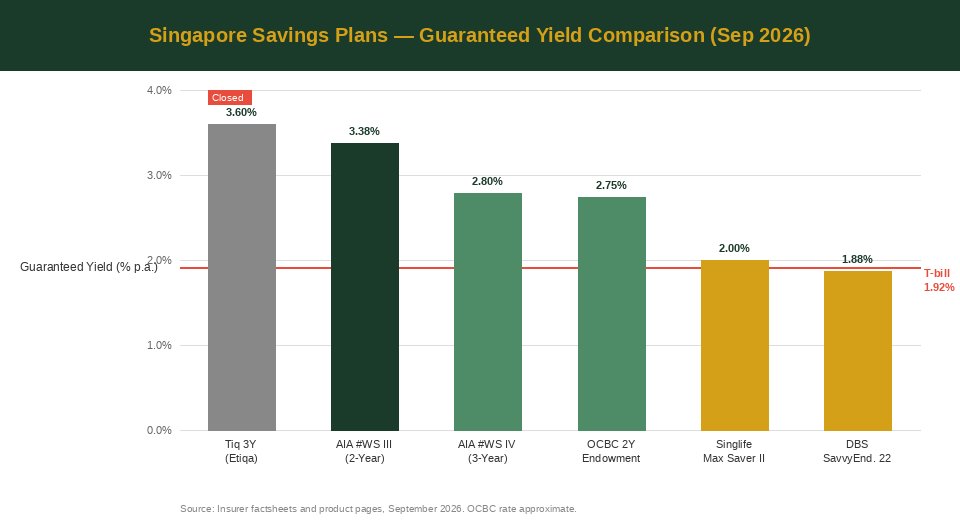
Source: Insurer factsheets and product pages, September 2026. OCBC rate approximate — verify current tranche rates directly. * Tiq 3-Year is fully subscribed as at time of writing.
Key Observations
- Best rate available today: AIA #Wealth Savvy (III) at 3.38% p.a. over 2 years — via AIA NOW digital platform, no adviser required
- Best 3-year rate (if you can wait): Tiq 3-Year Endowment at 3.60% p.a. — but it is fully subscribed. Register interest for the next tranche
- Lowest barrier to entry: DBS SavvyEndowment 22 at 1.88% p.a. with just S$5,000 minimum — useful for smaller capital allocations
- T-bill benchmark: 6-month T-bill at 1.92% (Sep 24 2026) — all dedicated endowment plans beat this on a 2–3 year basis
For investors considering robo-advisors as an alternative, Syfe’s referral code and sign-up bonus gives you access to Syfe Income+ (a cash-enhanced account) as a complement to endowment plans in your portfolio.
Yield Comparison Table: Singapore Savings Plans — 2-Year vs 3-Year (Sep 2026)
| Plan | Tenor | Guaranteed Rate | Min. Premium | SRS Eligible | Status |
|---|---|---|---|---|---|
| Tiq 3-Year Endowment (Etiqa) | 3 Years | 3.60% p.a. | S$5,000 | No | Fully Subscribed |
| AIA #Wealth Savvy (III) | 2 Years | 3.38% p.a. | S$10,000 | No | Open |
| AIA #Wealth Savvy (IV) | 3 Years | 2.80% p.a. | S$10,000 | No | Open |
| OCBC 2-Year Endowment | 2 Years | ~2.75% p.a. | S$10,000 | Yes | Open |
| Singlife Max Saver II | 2 Years | 2.00% p.a. | S$20,000 | Yes | Open |
| DBS SavvyEndowment 22 | 2 Years | 1.88% p.a. | S$5,000 | Yes | Open |
| 6-Month T-Bill (Benchmark) | 6 Months | 1.92% p.a. | S$500 | — | Rolling |
Source: AIA FAQs (Wealth Savvy III/IV), Singlife product page, DBS product page, OCBC product page (approximate), MAS T-bill results (Sep 24, 2026). OCBC rate is approximate — verify current tranche. All rates are guaranteed; non-guaranteed bonuses not included. Sep 30, 2026.
For investors looking for a platform to purchase endowment plans or compare providers, the FSMOne referral code provides access to their one-stop insurance marketplace alongside ETF and bond purchases.
Laddering Example: S$30,000 Across 3 Tiers
Let us walk through a concrete example. Assume you have S$30,000 available for savings plan allocation in Q4 2026. Here is how a laddering strategy compares to going all-in on a single plan:
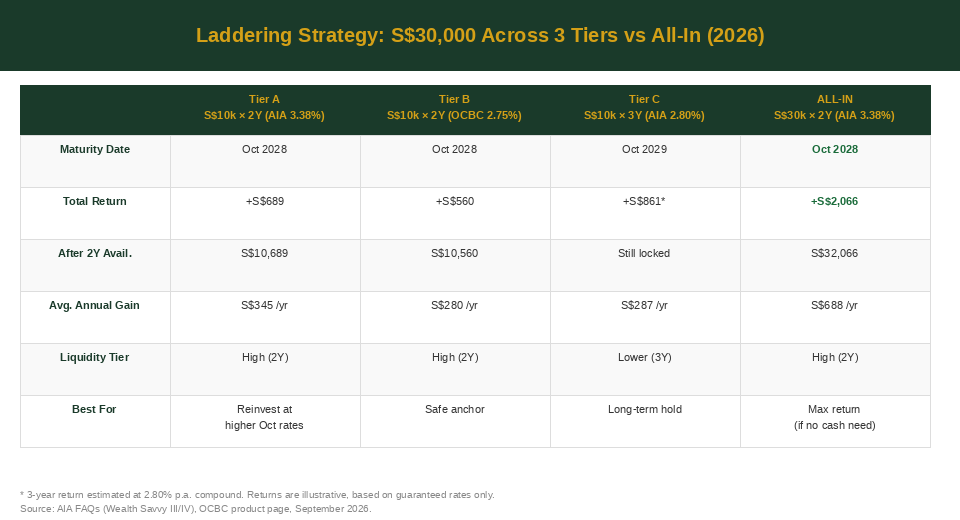
Note: Returns are illustrative, based on guaranteed rates only. Ladder example uses AIA Wealth Savvy III (3.38%), OCBC ~2.75%, and AIA Wealth Savvy IV (2.80%). All-in uses AIA Wealth Savvy III (3.38%) as the current best available rate. Consult a licensed financial adviser for personalised advice. Sep 30, 2026.
Reading the Table
The all-in strategy produces the highest total return at maturity (S$2,066 on S$30,000 over 2 years). However, it concentrates all capital in a single tranche of a single insurer — meaning if AIA launches a Wealth Savvy V in October 2026 at 3.80% p.a., you cannot participate without breaking your existing plan (early termination penalties apply).
The laddering approach yields slightly less in aggregate (approximately S$2,110 across all three tiers by 2029), but provides S$21,249 of capital returning in Oct 2028, which can be re-deployed into the then-current highest rate product. Tier C (3-year) at AIA Wealth Savvy IV continues to compound in the background.
This is the core logic of laddering: sacrifice a small amount of return efficiency today in exchange for flexibility to reinvest at future rates.
See TKN’s single vs regular premium savings plan comparison for how to approach the structure decision alongside the tenor choice.
Q4 October Repricing — What to Expect
Historically, Singapore endowment plan yields reprice within 4–10 weeks of a significant Fed rate move. With the September 17 hike now in the books, investors can expect:
- October 2026: New tranches likely to launch at 15–30bps higher than current best rates, potentially reaching 3.50%–3.90% p.a. for 2-year plans
- November 2026: Further repricing if major insurers (Etiqa, AIA, Manulife, Great Eastern) launch successor products
- Tiq reopening: The fully-subscribed Tiq 3-Year Endowment is expected to reopen in a new tranche — possibly at a higher rate given the rate hike
Should You Wait?
If you have capital available now and AIA Wealth Savvy III at 3.38% p.a. is open, there is a strong case to lock in at least a portion today. The opportunity cost of waiting 4–8 weeks for a hypothetical 3.60% plan is approximately S$36 per S$10,000 invested per year — meaningful, but small compared to the risk of rates softening again if the macro environment shifts.
The laddering strategy eliminates this guesswork: deploy half today, reserve half for October.
For CPF-related context on how savings plans interact with retirement planning, see the CPF investment strategy guide and the Singapore retirement calculator.
Who Should Use a Laddering Strategy?
A savings plan laddering approach suits:
- Conservative investors with S$30,000–S$150,000 in capital not needed for 2–3 years — maximises risk-free guaranteed return
- Near-retirees (50–62 years) who want capital preservation with predictable payout schedules aligned to retirement dates
- CPF OA account holders who have exhausted their CPF OA investment allocation and want a non-CPF guaranteed yield option
- SRS investors (OCBC and Singlife plans are SRS-eligible) — using Supplementary Retirement Scheme funds in laddered endowments defers income tax and compounds tax-free
Who should NOT ladder into endowment plans:
- Investors who may need the capital within 18 months — early termination penalties can reduce your return to near zero
- Those already well-covered by CPF LIFE and Singapore Savings Bonds — see the Singapore Savings Bonds guide for a full SSB allocation framework
- Investors seeking equity-linked upside — for dividend growth, consider the best S-REITs in Singapore 2026 as a complement
Frequently Asked Questions
What is the best savings plan in Singapore right now (September 2026)?
As at 30 September 2026, the highest guaranteed rate for an open plan is AIA #Wealth Savvy (III) at 3.38% p.a. over a 2-year single-premium term (min. S$10,000). The Tiq 3-Year Endowment by Etiqa offers 3.60% p.a. over 3 years but is currently fully subscribed. The next best available open plan for 2 years is OCBC’s 2-year endowment at approximately 2.75% p.a. Always verify current tranche availability with the insurer before applying, as tranches can close quickly.
What is a savings plan laddering strategy?
Laddering means splitting your capital across products with different maturity dates, rather than placing everything in one plan. For example, allocating S$10,000 each to a 2-year plan (AIA Wealth Savvy III), a second 2-year plan from a different insurer (OCBC), and a 3-year plan (AIA Wealth Savvy IV) creates three separate maturity events in 2028 and 2029. This lets you reinvest Tier A and B proceeds at whatever rates exist in October 2028, while Tier C continues to compound.
Are Singapore endowment plans safe?
Singapore endowment plans are regulated by MAS (Monetary Authority of Singapore) and protected under the Policy Owners’ Protection (PPF) Scheme administered by the Singapore Deposit Insurance Corporation (SDIC). Coverage is up to S$500,000 per life assured per insurer for death and maturity benefits. The guaranteed portion of your endowment plan is safe within this limit. Non-guaranteed bonuses (from participating plans) are not covered by PPF. Always check whether your plan is participating or non-participating.
Can I use SRS funds for Singapore savings plans?
Yes. Several endowment plans accept Supplementary Retirement Scheme (SRS) contributions, including OCBC’s 2-year endowment and Singlife Max Saver II. Using SRS funds in an endowment plan reduces your taxable income in the year of contribution (up to the SRS annual cap) and your maturity proceeds are only 50% taxable upon withdrawal at or after the statutory retirement age. This can create a meaningful compounding advantage versus a cash-funded plan.
What happens if I withdraw early from an endowment plan?
Early termination (surrendering before maturity) typically results in a surrender value below the premiums paid, especially in the first 12–18 months of the policy term. For single-premium short-term endowments, early surrender typically returns 95–98% of your capital, but you lose all guaranteed interest for the remainder of the term. Always check the surrender value schedule in the product summary document before committing capital that you may need before maturity.
How does the endowment plan rate compare to fixed deposits in Singapore?
As at September 2026, 2-year fixed deposit rates at major Singapore banks (DBS, OCBC, UOB) typically range from 2.5%–2.9% p.a. Best-in-class endowment plans — such as AIA Wealth Savvy III at 3.38% p.a. — outperform FDs on a guaranteed yield basis at equivalent tenors. However, FDs have no life insurance component and capital is fully accessible at maturity without penalty, while endowments carry a lock-up risk. For a full comparison, see the endowment plan vs savings account guide on TKN.
Start Your Savings Plan Journey
Ready to put your idle cash to work with a guaranteed, risk-free return? Use the platforms below to compare and purchase your chosen endowment plan:
- ? Endowus — Access multiple insurance savings plans and ETFs in one dashboard. Use the Endowus referral code 2V343 for a fee rebate.
- ? Syfe — Syfe Income+ complements your endowment ladder with flexible, higher-liquidity allocation. Use Syfe referral code SRPRFFFCD.
- ? FSMOne — Compare endowment plans and Singapore bonds side-by-side. FSMOne referral code for account opening rewards.
Not financial advice. Always consult a licensed financial adviser before making investment decisions. Referral links may earn TKN a referral fee at no cost to you.
Get Free Insurance Advice
Speak with a licensed insurance advisor. No obligation, no cost.
By submitting this form, you agree to our Privacy Policy.
This article was researched with the help of AI. While we strive to keep all information accurate and up to date, there may be errors. If you notice any discrepancies, please contact us.