FSMOne vs Trust Bank 2026: Save Your Cash or Invest It Yourself?
A head-to-head look at a self-directed investing platform versus a high-interest savings account for Singapore investors deciding where spare cash should go in 2026.
FSMOne (now FSM Global) is a self-directed brokerage for unit trusts, ETFs, bonds and stocks at 0% sales charge, while Trust Bank is a savings account paying up to 2.40% p.a. headline interest. They solve different problems: Trust Bank is for cash you need to keep safe and liquid (SDIC-insured to S$100,000), while FSMOne is for surplus cash you’re willing to invest for potentially higher long-term returns with no capital guarantee.
Not financial advice. All figures are for educational reference only. Data as at October 2026 unless noted.
Table of Contents
Contents — Click to expand
Quick Answer: FSMOne or Trust Bank?
For a Singapore investor comparing FSMOne vs Trust Bank, the honest answer is: they aren’t really competing for the same dollar. Trust Bank’s savings account is the right home for your emergency fund and near-term cash — it’s SDIC-insured up to S$100,000 and pays a realistic 0.75%–0.85% p.a. once you strip out the marketing-heavy “up to 2.40%” headline. FSMOne is the right home for money you don’t need for 3+ years and are willing to put at market risk through unit trusts, ETFs or bonds, at 0% sales charge. If you’re asking which platform to use for your entire savings, the better question is how to split your cash between the two — a buffer in Trust Bank, surplus in FSMOne.
Key Differences at a Glance
| Feature | FSMOne (FSM Global) | Trust Bank |
|---|---|---|
| What it is | Self-directed brokerage & fund supermart | Digital bank savings account |
| Regulator / licence | MAS CMS licence + FA licence (iFAST Financial) | Full bank licence (Standard Chartered + FairPrice Group JV) |
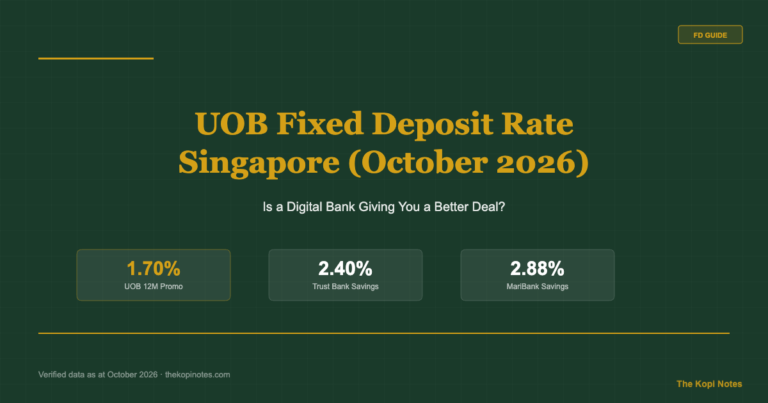
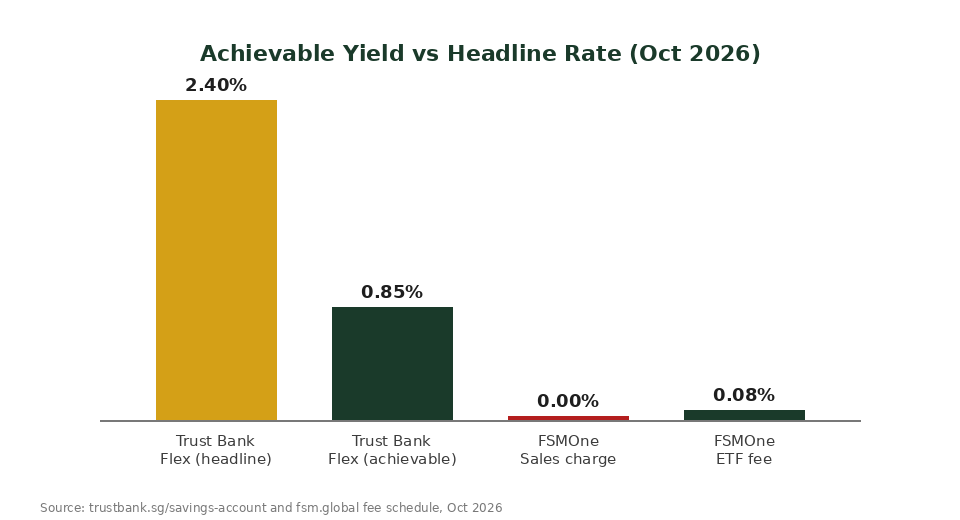
| Headline rate / fee | 0% unit trust sales charge; 0.08% ETF fee | Up to 2.40% p.a. (Flex plan, 3 of 8 scoops) |
| Realistic figure | Market-dependent total return, not fixed | 0.75%–0.85% p.a. without referrals or S$20k TrustInvest top-up |
| Capital protection | Not SDIC-insured; assets in segregated custodian trust | SDIC-insured up to S$100,000 |
| CPF support | Yes — CPFIS-approved, 0% platform fee on CPF | No |
| SRS support | Yes — invest SRS funds in unit trusts, ETFs, bonds | No — not an SRS operator (only DBS, OCBC, UOB hold SRS accounts) |
| Access speed | T+2 to T+4 settlement on sale proceeds typically | Instant via PayNow |
| Best for | Surplus cash, 3+ year horizon, hands-on investors | Emergency fund, short-term cash, zero-risk tolerance |
Source: fsm.global fee schedule and trustbank.sg/savings-account, October 2026.
Achievable Rate vs Actual Fee Structure
Trust Bank’s Flex plan markets “up to 2.40% p.a.”, but that figure needs three of eight monthly “scoops” stacked together, including options most people can’t repeat every month — referring a new Trust credit card customer (+1.20%) or investing a fresh S$20,000 into TrustInvest funds each month (+0.70%). Strip those out and a realistic saver is left with salary crediting via GIRO (+0.45%), 5 card spends of S$30 (+0.20% for NTUC Union members, +0.10% otherwise) and incoming PayNow transfers of S$1,500 (+0.15%) on top of the 0.05% base — landing at roughly 0.85% p.a. for Union members and 0.75% p.a. for everyone else, without referrals or lump-sum investing.
FSMOne doesn’t quote an interest rate at all, because it isn’t a deposit account — it’s a brokerage. Its “rate of return” is whatever the unit trust, ETF or bond you buy delivers, minus 0% sales charge on unit trusts or 0.08% (min S$8.80) per SGX ETF trade. There’s no guaranteed floor, but historically, diversified equity and REIT portfolios have outearned 0.85% p.a. over multi-year horizons — at the cost of volatility Trust Bank depositors never see. For readers comparing this against a managed robo option instead of a pure brokerage, our Syfe vs Trust Bank comparison covers the same Trust Bank rate mechanics against Syfe’s Cash+ and managed portfolios.
SDIC Insurance vs Custodial Protection
Trust Bank is a full bank, so Singapore dollar deposits are covered by the Singapore Deposit Insurance Corporation (SDIC) up to S$100,000 per depositor per bank by law. If Trust Bank were ever to fail, your deposit (up to that cap) is protected by statute, no questions asked.
FSMOne works differently because it isn’t a bank — it’s a brokerage and fund platform licensed by MAS. Your cash and holdings sit in segregated custodian/trust accounts, kept legally separate from iFAST Financial’s own balance sheet, which is the standard investor-protection model for CMS-licensed platforms rather than SDIC deposit insurance. In practice, this means your FSMOne holdings should be returned to you even if iFAST ran into financial trouble — but it is a different protection mechanism from a bank deposit guarantee, and it does nothing to protect you from market losses on the funds themselves.
CPF, SRS and Tax-Advantaged Investing
This is where the two platforms genuinely diverge rather than just competing on yield. FSMOne is CPFIS-approved, so CPF Ordinary Account savings above the required first-tier amounts can be invested in approved unit trusts and ETFs through FSMOne at a 0% CPF platform fee. FSMOne also accepts SRS (Supplementary Retirement Scheme) funds for investing in unit trusts, ETFs and bonds — useful since the SRS annual tax relief cap of S$15,300 only matters if you actually put the money to work rather than letting it sit idle.
Trust Bank cannot do either of these things. It is not one of the three banks authorised to open SRS accounts (only DBS, OCBC and UOB are SRS operators in Singapore), and its savings account has no CPF integration at all. If your goal is CPF or SRS tax-efficient investing, FSMOne is the only one of the two platforms that is even in the running — Trust Bank is purely a cash savings account sitting alongside, not inside, your CPF/SRS strategy. Readers building a broader SRS-funded portfolio may find our passive income Singapore guide useful for sequencing which asset classes to prioritise.
S$50,000 Worked Example: Parked vs Invested
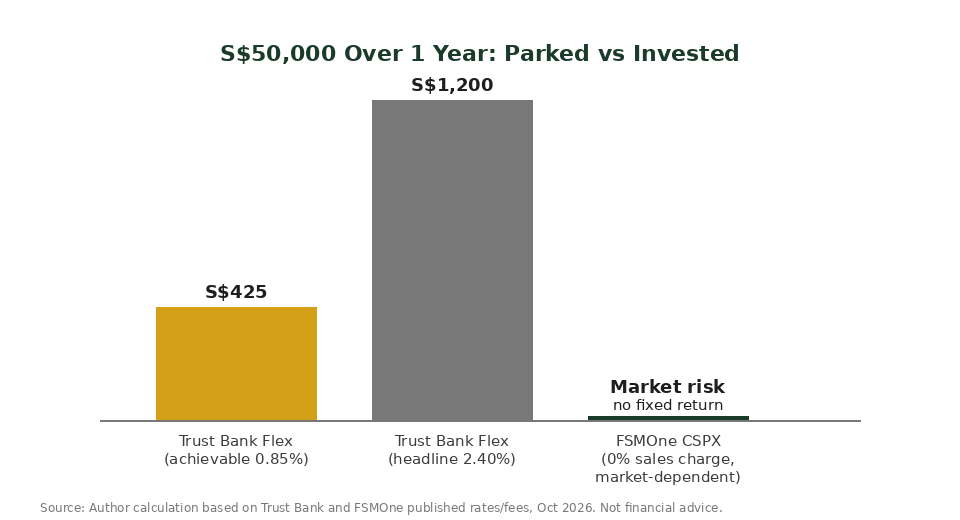
Say a Singapore investor has S$50,000 in spare cash with no specific need for it over the next 12 months. Parked in Trust Bank’s Flex plan at the realistic achievable 0.85% p.a. (Union member, all easy scoops hit), that S$50,000 earns about S$425 in interest over one year — guaranteed, SDIC-insured, and withdrawable instantly via PayNow at any time.
The same S$50,000 invested via FSMOne into a globally diversified ETF like CSPX at 0% sales charge and a one-off 0.08% trade fee (around S$40) carries no fixed return at all — it could be up double digits in a strong year, or down meaningfully in a correction, with no SDIC backstop and no guarantee of beating 0.85%. The point of this comparison isn’t that one option is “better” — it’s that they are not substitutes for the same job. Money you might need within 12 months belongs in Trust Bank. Money you can leave untouched for 3+ years, and can stomach seeing fall in value temporarily, is a candidate for FSMOne.
Who Should Pick Which?
Trust Bank is the better pick if: you need an SDIC-insured emergency fund with instant PayNow access; you want a fixed, predictable return with zero market risk; you can realistically hit the GIRO salary, card-spend and PayNow scoops each month without extra effort; or you simply have no appetite for seeing your balance fluctuate.
FSMOne is the better pick if: you have a 3+ year investing horizon and genuine surplus cash beyond your emergency fund; you want to invest CPF OA or SRS funds at 0% sales charge and the lowest ETF fees in the Singapore market; you’re comfortable constructing your own unit trust, ETF or bond portfolio rather than paying an advisory fee; or you’ve already parked a buffer elsewhere (Trust Bank, MariBank, or similar) and are deciding where the next dollar goes.
Many Singapore investors end up using both — a Trust Bank account for the emergency buffer and bill-paying cash, and an FSMOne account for CPF, SRS and cash-top-up investing. See our Endowus Cash Smart vs MariBank comparison for how a similar guaranteed-vs-projected decision plays out between two other platforms, and our retirement planning calculator to see how different cash-vs-invest splits affect your long-term numbers.
Source: fsm.global/sg, trustbank.sg/savings-account, sdic.org.sg — all figures verified October 2026. Not financial advice.
Frequently Asked Questions
Is FSMOne or Trust Bank better for Singapore investors?
Neither is universally “better” — they serve different purposes. Trust Bank is a savings account best for your emergency fund and near-term cash, offering SDIC insurance up to S$100,000 and a realistic 0.75%–0.85% p.a. return. FSMOne is a brokerage for investing surplus cash in unit trusts, ETFs and bonds at 0% sales charge, with no fixed return and no SDIC protection. Most Singapore investors benefit from using both for different pots of money.
Can I invest my CPF or SRS money with Trust Bank?
No. Trust Bank’s savings account has no CPF integration, and it is not one of the three authorised SRS operators in Singapore (only DBS, OCBC and UOB can open SRS accounts). FSMOne, by contrast, is CPFIS-approved and accepts SRS funds for investing in unit trusts, ETFs and bonds at a 0% CPF platform fee.
Is Trust Bank's 2.40% interest rate realistic?
Not for most savers. The 2.40% p.a. headline on Trust Bank’s Flex plan requires stacking three of eight monthly “scoops”, including options like referring a new credit card customer or investing S$20,000 fresh into TrustInvest funds every single month. A realistic achievable rate without referrals or lump-sum investing — combining salary GIRO crediting, card spends and incoming PayNow transfers — is closer to 0.75%–0.85% p.a.
Is my money safe with FSMOne if it's not SDIC-insured?
FSMOne is licensed by MAS with a Capital Markets Services licence and a financial adviser’s licence, and client assets are held in segregated custodian trust accounts separate from iFAST Financial’s own balance sheet — a standard investor-protection structure for brokerages, distinct from SDIC bank deposit insurance. This protects your holdings from the platform’s own insolvency, but it does not protect you from market losses on the unit trusts, ETFs or bonds you actually buy.
How much does FSMOne charge compared to Trust Bank?
FSMOne charges 0% sales charge on unit trusts (with a 0.0875% quarterly platform fee for equity/mixed cash and SRS funds), and 0.08% per SGX ETF trade with a S$8.80 minimum. Trust Bank charges no fees on its savings account but pays interest instead — up to 2.40% p.a. headline, though realistically 0.75%–0.85% p.a. for most savers. They aren’t directly comparable because one is a brokerage fee structure and the other is a deposit interest rate.
Should I keep my emergency fund in FSMOne or Trust Bank?
Trust Bank. An emergency fund needs to be liquid, capital-guaranteed and accessible instantly — all of which Trust Bank’s SDIC-insured savings account with PayNow access provides. FSMOne holdings in unit trusts, ETFs or bonds can fall in value and may take a few business days to settle and withdraw after a sale, which makes it unsuitable for money you might need at short notice.
Ready to Split Your Cash the Smart Way?
Open an FSMOne account for low-cost investing, or a Trust Bank account for your SDIC-insured cash buffer.
This article was researched with the help of AI. While we strive to keep all information accurate and up to date, there may be errors. If you notice any discrepancies, please contact us.