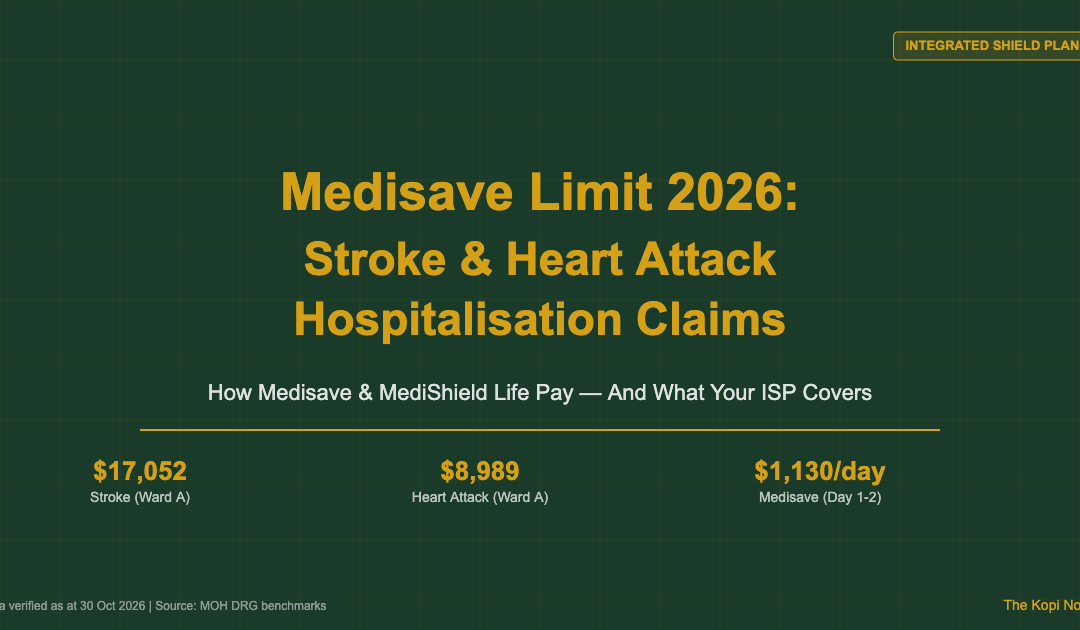
Medisave Limit 2026: How Stroke & Heart Attack Hospitalisation Claims Are Paid
What Medisave and MediShield Life actually pay — and where your ISP rider makes up the difference
When a stroke or heart attack lands you in a Singapore public hospital, Medisave starts paying from day one — but the amount it covers depends on the ward class you chose, how many days you stay, and whether you have an Integrated Shield Plan (ISP) rider. For 2026, the Medisave daily claim limit is $1,130 per day for the first two days and $400 per day from day three onwards. MediShield Life adds another $800 a day on top for normal ward stays. Without an ISP rider, you still face a significant out-of-pocket bill — especially in Ward A or private.
Not financial advice. All figures are for educational reference only. Data verified as at 30 Oct 2026 against MOH and CPF Board official sources.
In This Guide
- What Medisave Covers for Hospitalisation
- Medisave Daily Claim Limits in 2026
- Stroke Hospitalisation: Real Bill Benchmarks (B70A)
- Heart Attack Hospitalisation: Real Bill Benchmarks (F60A)
- How Much Medisave Actually Pays
- How Your ISP Rider Bridges the Gap
- Worked Example: Daniel’s Stroke at Ward B1
- Frequently Asked Questions
What Medisave Covers for Hospitalisation
Medisave is the CPF account earmarked for healthcare. When you are admitted as an inpatient to a Singapore hospital — whether for a stroke, a cardiac event, or any other condition — Medisave can be drawn down to pay for three main cost categories: ward and treatment charges, surgical fees (under the TOSP framework), and approved medical specialist outpatient treatment linked to the admission.
For stroke and heart attack patients, the hospital stay itself is typically the biggest cost. These are acute events that often require several days in hospital, sometimes including time in the High Dependency Unit (HDU) or Intensive Care Unit (ICU). Medisave covers your ward charges up to its daily limit; MediShield Life adds a separate daily claim on top; and your ISP rider — if you have one — pays much of whatever remains, subject to copayment.
To understand the full picture of Medisave daily hospitalisation limits in 2026, it helps to separate the three layers of coverage before looking at real bill figures.
Medisave Daily Claim Limits in 2026
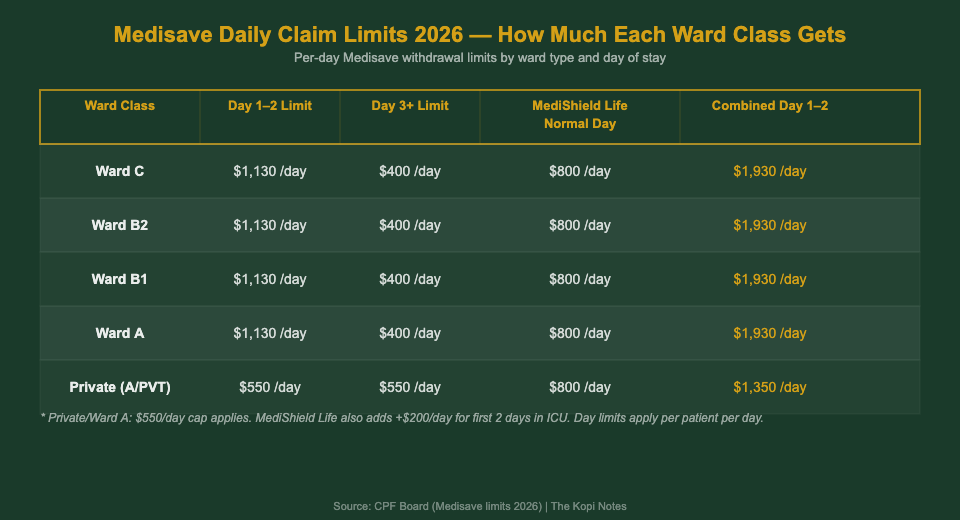
For 2026, the CPF Board sets the daily Medisave hospitalization withdrawal limits as follows. The higher rate applies for the first two days of each admission because early-stay costs — initial diagnostics, acute stabilisation — tend to be the most intensive. From day three onwards, the daily rate falls.
| Ward Class | Medisave Day 1–2 | Medisave Day 3+ | MediShield Life (Normal Ward) | Combined Day 1–2 |
|---|---|---|---|---|
| Ward C | $1,130/day | $400/day | $800/day | $1,930/day |
| Ward B2 | $1,130/day | $400/day | $800/day | $1,930/day |
| Ward B1 | $1,130/day | $400/day | $800/day | $1,930/day |
| Ward A / Private | $550/day | $550/day | $800/day | $1,350/day |
Source: CPF Board, Medisave hospitalisation withdrawal limits 2026. MediShield Life adds +$200/day premium for first 2 days in ICU; ICU daily benefit is $2,200/day.
Notice that the combined ceiling for Ward C/B2/B1 in the first two days is actually higher than for Ward A/Private. This is because higher subsidy wards qualify for the full $1,130/day Medisave pull, whereas Ward A and private hospital claims are capped at $550/day from Medisave. An ISP rider changes this calculus entirely — read about how new-generation ISP rider copayment works with Medisave to see how insurers handle this.
Stroke Hospitalisation: Real Bill Benchmarks (B70A)
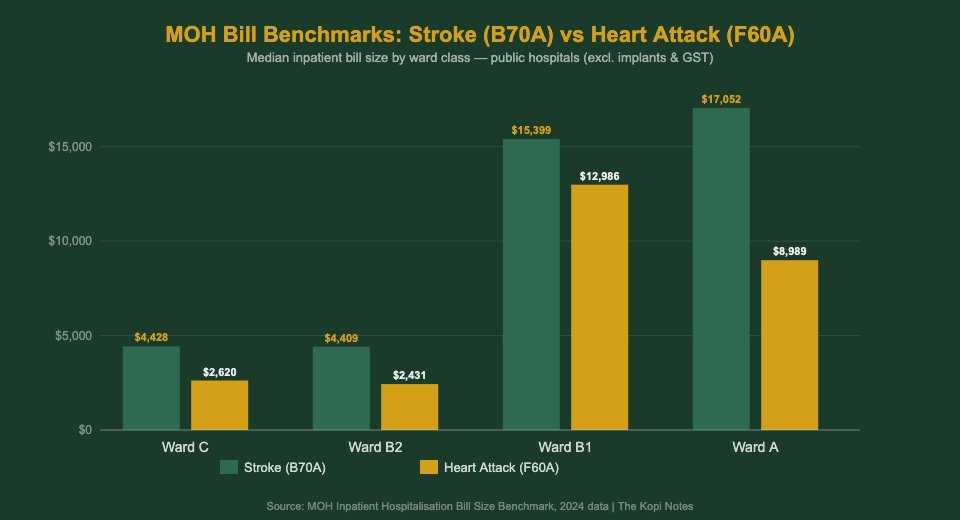
The MOH publishes Diagnosis Related Group (DRG) bill benchmarks — median inpatient bills at public hospitals — for hundreds of clinical conditions. For stroke, the relevant DRG code is B70A (medical management of stroke, without major complications). These are the 2024 benchmarks and represent the median patient, not the most complex case.
| Ward Class | Median Total Bill (B70A) | Typical LOS | Notes |
|---|---|---|---|
| Ward C | $4,428 | 5–7 days | Heavily subsidised; Medisave typically covers most |
| Ward B2 | $4,409 | 5–7 days | Partial subsidy; Medisave covers most of bill |
| Ward B1 | $15,399 | 5–7 days | No MOH subsidy; MediShield Life + ISP needed |
| Ward A | $17,052 | 5–7 days | Private room; ISP rider recommended |
| Private Hospital | $50,527 | 5–7 days | Medisave + MediShield Life covers a small fraction |
Source: MOH Inpatient Hospitalisation Bill Size Benchmark, 2024 data. Excludes implants and GST. B70A = stroke medical management without major complications.
A few things stand out from this table. First, the jump from Ward B2 ($4,409) to Ward B1 ($15,399) is dramatic — that is the subsidy cliff when you move out of the government-subsidised tiers. Second, the private hospital figure ($50,527) is in a different league entirely, and Medisave alone covers only a small fraction of it even with a full ISP rider at the top plan.
Heart Attack Hospitalisation: Real Bill Benchmarks (F60A)
For heart attack (acute myocardial infarction, DRG F60A — medical management without angioplasty or bypass), the MOH benchmarks show a somewhat different pattern. Cardiac medical admissions without intervention are typically shorter than stroke stays but carry higher per-day charges due to cardiac monitoring and medication intensity.
| Ward Class | Median Total Bill (F60A) | vs Stroke (B70A) |
|---|---|---|
| Ward C | $2,620 | Lower ($4,428 for stroke) |
| Ward B2 | $2,431 | Lower ($4,409 for stroke) |
| Ward B1 | $12,986 | Lower ($15,399 for stroke) |
| Ward A | $8,989 | Lower ($17,052 for stroke) |
Source: MOH Inpatient Hospitalisation Bill Size Benchmark, 2024 data. F60A = heart attack medical management without major interventional procedure.
Heart attack admissions at the median are somewhat less expensive than comparable stroke admissions, largely because stroke patients often require longer stays for neurological rehabilitation assessment. Note that if the cardiac event required PCI (stent) or CABG (bypass), the DRG code and cost would be substantially higher — the figures above are for medical management only. If your admission involved a procedure, check the separate surgical Medisave limits under the Medisave TOSP surgical claim framework.
How Much Medisave Actually Pays
Let’s calculate what Medisave and MediShield Life together would pay for a 6-day Ward B1 stroke admission (median bill: $15,399).
Working from the 2026 daily limits: days 1–2 attract the higher Medisave rate of $1,130/day plus the MediShield Life daily benefit of $800/day. Days 3–6 attract Medisave at $400/day plus MediShield Life at $800/day. Summing across 6 days:
- Days 1–2: ($1,130 + $800) × 2 = $3,860
- Days 3–6: ($400 + $800) × 4 = $4,800
- Total covered by Medisave + MediShield Life: $8,660
- Remaining bill: $15,399 − $8,660 = $6,739 out-of-pocket
That is a substantial gap — $6,739 — on a median Ward B1 stroke stay without any ISP rider. An individual without an ISP would pay this entirely from cash or supplementary Medisave (if available). This is the coverage gap that an ISP rider is designed to close.
For context, you can read more about how Medisave and MediShield Life cover ICU and HDU stays, where the daily benefit rates are higher and the calculations differ.
How Your ISP Rider Bridges the Gap
An Integrated Shield Plan is a private health insurance policy that integrates with MediShield Life. The plan itself (the “shield” layer) pays the hospital and surgical claims above what MediShield Life covers. An optional rider on top of the shield covers the copayment that would otherwise remain after the shield pays.
For a Ward B1 stroke stay at $15,399 with a full ISP plus rider:
- MediShield Life pays up to the MediShield Life benefit schedule
- ISP (shield layer) covers the gap up to the insured limit for the chosen ward class
- Rider pays the copayment (typically 5–10% under current MAS rules for new-generation riders)
- Your out-of-pocket is just the rider copayment — often $500–$2,000 depending on the plan
Understanding how ISP rider premiums and copayments are calculated is essential before choosing a plan, because the copayment percentage determines your worst-case out-of-pocket for a major event like stroke or cardiac admission. For new-generation riders (sold from 2019 onwards), MAS requires a minimum 5% copayment to discourage over-utilisation.
Worked Example: Daniel’s Stroke at Ward B1
Daniel, 54, is admitted to a public hospital after an ischaemic stroke. He stays 6 days in Ward B1, receiving neurological monitoring, physiotherapy assessment, and medication. His total bill comes to $15,200 (slightly below the median of $15,399). He has an ISP with a Ward B1/A rider and a new-generation rider with 5% copayment.
Bill breakdown:
- Total bill: $15,200
- MediShield Life pays (days 1–2 at $1,000 each, days 3–6 at $800 each): approximately $5,200
- ISP (shield layer) pays the next portion up to the plan limit: approximately $8,750
- Rider covers 95% of copayment: Daniel’s rider copayment = 5% × residual ≈ $625
- Daniel pays: ~$625 + any deductible already met
Without the rider, Daniel’s share would have been approximately $2,800–$3,500. Without the ISP at all (only MediShield Life and Medisave), Daniel would have faced over $6,700 out-of-pocket as calculated above. The ISP rider reduced a potentially destabilising expense to something manageable. This is why regular review of your ISP plan choice and rider status matters — especially after major life changes like turning 50 or retiring.
Frequently Asked Questions
How much does Medisave pay per day for a stroke hospitalisation in 2026?
For the first two days of any inpatient admission (including stroke), Medisave pays up to $1,130 per day for Ward C, B2, and B1 patients. From day three onwards, the limit drops to $400 per day. Ward A and private hospital patients face a lower per-day Medisave cap of $550 regardless of day. MediShield Life separately pays up to $800 per normal ward day on top of Medisave.
What is the MOH benchmark bill for a stroke hospitalisation in Singapore?
Based on MOH’s Inpatient Hospitalisation Bill Size Benchmark (DRG B70A — medical management of stroke without major complications), the median bill ranges from $4,428 in Ward C to $17,052 in Ward A and $50,527 in a private hospital. Ward B1 falls at $15,399 — the most common choice for those with a B1-rated ISP. These are 2024 data and exclude implants and GST.
Is a heart attack hospitalisation cheaper than stroke in Singapore hospitals?
For medical management (without stent or bypass surgery), yes. The MOH DRG F60A median bill for heart attack is lower than B70A stroke across all ward classes — for example, $8,989 vs $17,052 in Ward A, and $2,431 vs $4,409 in Ward B2. However, if the cardiac admission includes a procedure such as angioplasty (PCI), the bill will be substantially higher and falls under a different DRG code with separate Medisave claim limits.
Do I need an ISP to cover stroke hospitalisation in Singapore?
You do not legally need an ISP — MediShield Life provides a baseline that all Singaporeans are enrolled in. However, MediShield Life alone leaves a meaningful gap for Ward B1 and above. For a 6-day Ward B1 stroke stay at the median bill, MediShield Life plus Medisave covers approximately $8,660 of a $15,399 bill, leaving $6,739 out-of-pocket. An ISP with a rider would typically reduce this to a few hundred to a few thousand dollars in copayment.
Does Medisave cover rehab or physiotherapy after a stroke?
Medisave can be used for acute inpatient physiotherapy during the main hospital admission. Post-discharge rehabilitation — such as at a community hospital — falls under a different set of Medisave limits. For step-down care and community hospital claims, the daily Medisave limits and MediShield Life benefits differ from acute hospital rates. Check the Medisave community hospital and rehab claims guide for 2026 for the exact figures.
What happens if I am admitted to the ICU after a stroke or heart attack?
If your admission includes an ICU or HDU stay, higher daily Medisave limits and a higher MediShield Life daily benefit ($2,200/day for ICU) apply. MediShield Life also adds $200/day for the first two ICU days as a premium top-up. The total covered amount per ICU day is therefore significantly higher than for a normal ward day. See the full breakdown in the Medisave ICU and HDU coverage guide 2026.
Get Free Insurance Advice
Speak with a licensed insurance advisor. No obligation, no cost.
By submitting this form, you agree to our Privacy Policy.
This article was researched with the help of AI. While we strive to keep all information accurate and up to date, there may be errors. If you notice any discrepancies, please contact us.