Keppel DC REIT Sponsor Pipeline 2026: Will Keppel Corp’s Assets Boost Your DPU?
How KDC’s Right of First Refusal agreement powers long-term distribution growth
Keppel DC REIT (SGX: AJBU) holds one of Singapore’s most powerful structural growth engines: a Right of First Refusal (ROFR) over its sponsor Keppel Corporation’s global data centre pipeline. Since its 2014 IPO, KDC has grown from 8 to 21 data centres across 8 countries, with DPU rising over 50% — largely funded by sponsor acquisitions. Here’s what’s in the pipeline for 2026 and what it means for Keppel DC REIT share price and income investors.
Not financial advice. All figures are for educational reference only. Data as at October 2026 unless noted.
What Is a REIT Sponsor and Why Does It Matter?
A REIT sponsor is the developer or asset owner that seeds a REIT at IPO with an initial portfolio and continues to provide a pipeline of future acquisitions. In Singapore’s S-REIT ecosystem, the sponsor relationship is one of the most critical factors separating high-growth REITs from those with stagnant portfolios.
The sponsor’s role creates a virtuous cycle for income investors. When the sponsor develops or acquires a new asset, they can sell it to the REIT at a fair price — recycling their capital while giving the REIT accretive assets that grow DPU. For unitholders in the best S-REITs in Singapore, a strong sponsor pipeline is often the single biggest differentiator between REITs that grow distributions and those that stagnate.
Key benefits of a strong sponsor relationship:
- Priority access: ROFR ensures the REIT sees deals before third parties
- Asset quality control: Sponsor-built assets typically meet the REIT’s standards
- Reduced competition risk: Acquisitions come at negotiated prices, not auction premiums
- Long-term alignment: Sponsor typically retains a significant unitholder stake, aligning incentives
For Keppel DC REIT, the sponsor relationship has been the engine behind its 50%+ DPU growth since IPO — making it the standout performer among Singapore data centre plays. If you’re generating passive income in Singapore through REITs, understanding this dynamic is essential.
Keppel Corp: KDC’s Sponsor
Keppel Corporation Limited is KDC’s sponsor and majority manager shareholder. Keppel Corp is one of Singapore’s largest conglomerates, with operations spanning data centres, infrastructure, real estate, and energy. In the context of KDC, Keppel Corp plays three roles simultaneously: developer of new data centres, manager of the REIT (through Keppel DC REIT Management Pte. Ltd.), and anchor unitholder.
Keppel Corp’s data centre business spans Singapore, Australia, Europe, China, and Southeast Asia. The company has been aggressively expanding its data centre footprint, driven by AI and cloud computing demand — meaning the ROFR pipeline has never been larger. According to KDC’s investor presentations, Keppel Corp retains ownership of several data centres that have not yet been injected into the REIT, representing a meaningful acquisition pipeline at no auction premium.
Keppel Corp’s Stake in KDC
As at the latest available data, Keppel Corp holds approximately 23–25% of KDC’s units. This substantial stake means the sponsor’s interests are directly aligned with yours as a unitholder — when DPU grows, the sponsor earns more distribution income. This alignment is one reason why KDC has consistently pursued accretive acquisitions rather than dilutive empire-building. You can read more about KDC’s balance sheet and gearing to understand how acquisitions are funded.
The ROFR Agreement Explained
The Right of First Refusal (ROFR) is a contractual agreement between KDC and Keppel Corp. Under this agreement, if Keppel Corp wishes to divest any data centre asset, it must first offer it to KDC at the same price and terms it would offer to a third party. KDC’s board of directors then evaluates whether the acquisition is yield-accretive before proceeding.
This arrangement provides KDC with:
- Exclusive first look at any Keppel-owned data centre globally
- No auction premium — the REIT avoids competitive bidding that can destroy yield accretion
- Transparency on pricing, since the sponsor must disclose the same terms offered to third parties
- Built-in growth runway as long as the sponsor continues to develop new assets
Importantly, the ROFR does not obligate KDC to acquire every asset offered. Management must assess NPI yield, funding structure, and DPU accretion before proceeding. Historically, KDC has only pursued acquisitions where the deal is accretive on a DPU-per-unit basis — which explains why the KDC dividend history has been almost uninterrupted in its upward trajectory.
KDC’s Acquisition History from Keppel Corp
Since its 2014 IPO with 8 data centres, KDC has grown its portfolio to 21 assets across Singapore, Australia, Ireland, Italy, Netherlands, Germany, UK, and China. The majority of these acquisitions came directly from Keppel Corp or its subsidiaries via ROFR. Here is the key acquisition timeline:
| Year | Asset(s) Acquired | Location | Est. Value | DPU Impact |
|---|---|---|---|---|
| 2015 | Keppel DC Singapore 2 | Singapore | S$278M | +7.1% |
| 2016 | GV7 & T27 (Germany) | Germany | S$375M | +10.3% by 2017 |
| 2019 | Kelsterbach DC | Germany | S$383M | +3.5% |
| 2020 | KDC SGP 5, 6 & 7 (mega-deal) | Singapore | S$1.88B | +7.1% by 2021 |
| 2022 | KDC Guangdong 1 & 2 | China | ~S$280M | Neutral (rate headwind) |
| 2023 | KDC Dublin 1 & 2 + further expansion | Ireland / SG | ~S$580M | +3.6% |
Source: KDC REIT SGX announcements, annual reports. Values are approximate. DPU impact reflects full-year change vs prior year. The Kopi Notes research, October 2026.
[/et_pb_image]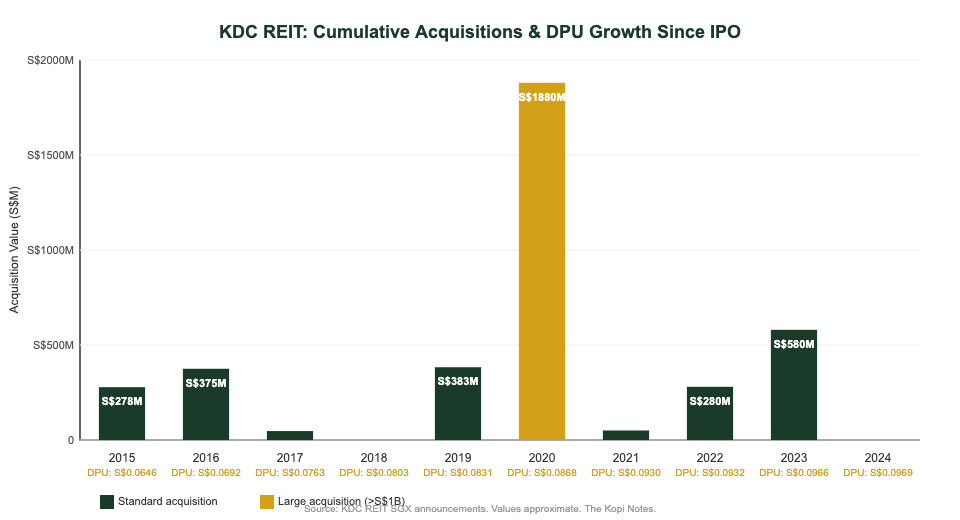
DPU Impact of Sponsor Acquisitions
The central question for KDC unitholders is not just whether KDC can acquire assets — but whether those acquisitions are DPU-accretive after accounting for dilution (new units issued) and financing costs. KDC’s track record here is largely positive:
| Financial Year | Annual DPU (S$) | YoY Change | Key Driver |
|---|---|---|---|
| FY2015 | S$0.0646 | — | IPO base year |
| FY2016 | S$0.0692 | +7.1% | KDC SGP 2 acquisition |
| FY2017 | S$0.0763 | +10.3% | German DCs full-year contribution |
| FY2018 | S$0.0803 | +5.2% | Organic rental growth |
| FY2019 | S$0.0831 | +3.5% | Kelsterbach DC contribution |
| FY2020 | S$0.0868 | +4.5% | SGP 5/6/7 partial year |
| FY2021 | S$0.0930 | +7.1% | SGP 5/6/7 full-year + rental growth |
| FY2022 | S$0.0932 | +0.2% | Rate hike headwind, China DCs |
| FY2023 | S$0.0966 | +3.6% | Dublin DCs, rental reversions |
| FY2024 | S$0.0969 | +0.3% | Rate cycle peak, hedging costs |
| FY2025E | ~S$0.097–0.098 | +0.5–1% | Rate cuts, organic growth |
Source: KDC REIT annual reports (SGX filings). FY2025 is an estimate. DPU values are approximate. Not financial advice.
2026–2027 Sponsor Pipeline Outlook
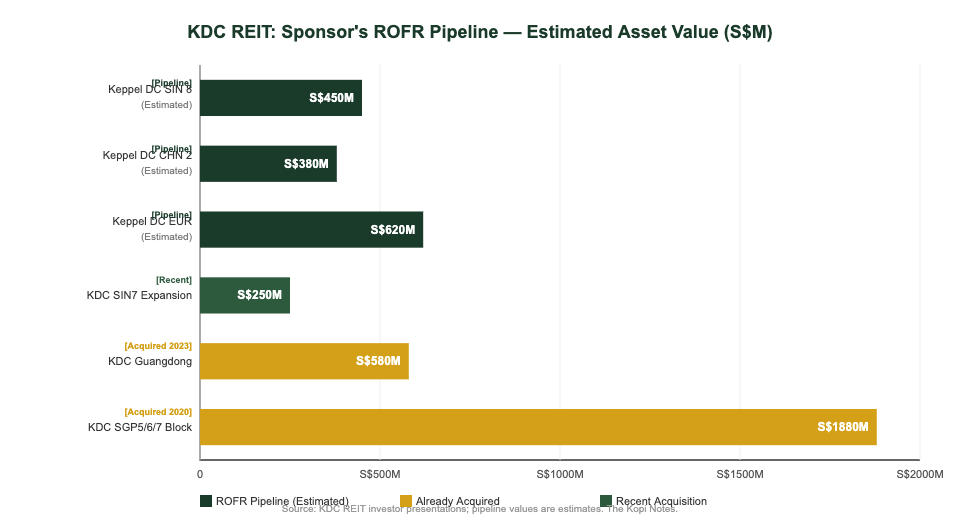
Looking ahead, Keppel Corp has signalled continued data centre development as part of its asset-light strategy. Here is what analysts and KDC’s own investor presentations suggest may be in the pipeline:
Singapore — KDC SGP 8 (Estimated)
Singapore’s Urban Redevelopment Authority (URA) has been cautiously granting new data centre permits after a moratorium period. Keppel Corp is positioned to develop at least one additional Singapore data centre. If injected into KDC at a ~5.5–6.5% NPI yield and funded via a mix of debt and equity, analysts estimate this could add S$0.003–0.005 to annual DPU — representing 3–5% accretion from a single deal. The AI-driven data centre demand surge makes new Singapore permits increasingly valuable.
Europe — Netherlands & UK Assets
Keppel Corp has been active in European data centre development. Any ROFR-eligible assets in the Netherlands or UK could bolster KDC’s European revenue, providing natural currency diversification against SGD. As rates normalise in Europe, the funding cost for EUR-denominated acquisitions has improved meaningfully in 2025–2026.
China Portfolio Expansion or Divestment?
The China exposure in KDC’s portfolio has been a point of investor concern. Keppel Corp retains additional China data centre assets. Whether these enter the REIT’s portfolio depends on occupancy stabilisation and macro-political risk appetite. KDC’s management has been transparent about the need for China assets to reach stable occupancy before any further injection. See the KDC Singapore vs overseas portfolio breakdown for the current revenue mix.
For a full yield and valuation context, see the KDC vs MIT peer comparison.
Risks: When Sponsor Acquisitions Can Hurt DPU
Not all acquisitions are beneficial for unitholders. Key risks to watch:
1. Dilution Risk
Large acquisitions (like the S$1.88B SGP 5/6/7 deal) typically require an equity fundraising, issuing new units that dilute existing holders. If the new asset’s NPI yield is only marginally above the cost of equity, DPU accretion is minimal. Always check the pro-forma DPU accretion disclosed in any acquisition announcement.
2. Funding Cost Risk
In a high interest rate environment (2022–2024), even accretive-looking deals can become neutral or dilutive once financing costs are fully loaded. KDC experienced this in FY2022, where DPU grew only 0.2% despite active portfolio growth. As rates decline, this headwind reverses. For context, KDC’s gearing is well within MAS’ 50% limit — see the detailed KDC gearing analysis.
3. Overpaying for Assets
The ROFR does not guarantee a below-market price — it guarantees the same price offered to third parties. If Keppel Corp’s internal pricing is aggressive, KDC could still overpay. Related-party transactions are scrutinised by KDC’s independent directors and require third-party valuations under MAS regulations.
4. Sponsor Capacity Risk
If Keppel Corp shifts its strategic focus away from data centres (unlikely given AI tailwinds), the pipeline could dry up. Unitholders should monitor Keppel Corp’s annual reports and capital allocation announcements for data centre development commitments.
Keppel DC REIT Share Price & Sponsor Pipeline: The Connection
Keppel DC REIT share price movements are closely tied to the market’s assessment of the sponsor’s acquisition pipeline. When KDC announces a new acquisition, the unit price typically reacts positively if:
- The NPI yield is accretive (above KDC’s current distribution yield)
- The funding structure minimises dilution (debt-funded over equity-funded)
- The asset is in a high-demand market (Singapore, Germany, UK)
Conversely, the share price tends to react negatively when acquisitions are perceived as expensive or when equity fundraising dilutes unitholders significantly. For income investors seeking passive income from Singapore REITs, the sponsor pipeline quality is as important as the current dividend yield.
As at October 2026, KDC trades at a forward yield of approximately 4.5–5.0% — a premium to the S-REIT average, reflecting the market’s confidence in the sponsor pipeline and AI-driven rental growth. Investors who want exposure to KDC can consider using a robo-advisor like Syfe (referral code: SRPRFFFCD) or a platform like Endowus (referral code: 2V343) for S-REIT portfolio construction.
Frequently Asked Questions: Keppel DC REIT Sponsor Pipeline
What is Keppel DC REIT’s relationship with its sponsor Keppel Corp?
How has the sponsor pipeline boosted Keppel DC REIT’s DPU since IPO?
What is a ROFR and how does it work for KDC?
Are KDC’s sponsor acquisitions always good for unitholders?
What data centre assets does Keppel Corp still hold that could enter KDC?
How does Keppel DC REIT’s sponsor compare to other S-REIT sponsors?
Start Building Your S-REIT Portfolio
Interested in adding Keppel DC REIT or other top S-REITs to your portfolio? These platforms make it easy:
✓ Syfe REIT+ (referral code: SRPRFFFCD) — Diversified S-REIT portfolio, auto-rebalanced
✓ Endowus (referral code: 2V343) — CPF, SRS or cash investing in curated REIT funds
✓ FSMOne (referral code: P0544985) — Direct stock and ETF trading in Singapore
This article was researched with the help of AI. While we strive to keep all information accurate and up to date, there may be errors. If you notice any discrepancies, please contact us.