Critical Illness Insurance for the Self-Employed in Singapore (2026 Guide)
No sick pay. No group insurance. If you freelance or run your own business in Singapore, a serious illness diagnosis could cost you everything — unless you plan ahead.
Critical illness (CI) insurance in Singapore pays a lump-sum benefit when you are diagnosed with one of the 37 severe conditions standardised by the Life Insurance Association (LIA). For self-employed Singaporeans — freelancers, business owners, consultants — it is the single most important insurance to own: you have no employer-paid sick leave, no group CI cover, and no salary during recovery. A CI payout keeps your bills paid and your family financially safe while you focus on getting well.
Not financial advice. All figures are for educational reference only. Data verified as at October 2026.
Table of Contents
Jump to Section ▼
- Why the Self-Employed Face a Bigger Financial Risk
- What Critical Illness Insurance Covers
- How Much CI Coverage Do You Need?
- Severe CI vs Early Critical Illness (ECI)
- Standalone Plan vs Rider
- Key Factors When Comparing CI Plans
- What Does CI Insurance Cost?
- 5 Tips Before You Buy
- Frequently Asked Questions
Why the Self-Employed Face a Bigger Financial Risk From Critical Illness
If you work for a company in Singapore, you enjoy a built-in safety net: paid sick leave (up to 14 days per year under the Employment Act), group hospitalisation insurance, and sometimes group CI coverage of 1–2 times your annual salary. When a serious illness strikes, your income does not stop immediately.
Self-employed Singaporeans — freelancers, sole proprietors, and business owners — have none of these protections. According to the Ministry of Manpower (MOM), approximately 220,000 Singaporeans are self-employed, representing around 12% of the workforce. When a doctor delivers a cancer or heart attack diagnosis, your income stops on day one.
Consider a concrete scenario: A 38-year-old freelance designer earning $72,000 per year is diagnosed with early-stage breast cancer. Treatment takes 8 months. Without CI insurance, she loses approximately $48,000 in income — on top of medical costs above MediShield Life limits. With a $300,000 CI payout, she can cover years of living expenses, pay off outstanding mortgage instalments, and focus entirely on recovery without financial anxiety.
This is precisely why CI insurance is not optional for the self-employed — it is the income-replacement mechanism that salaried employees take for granted.
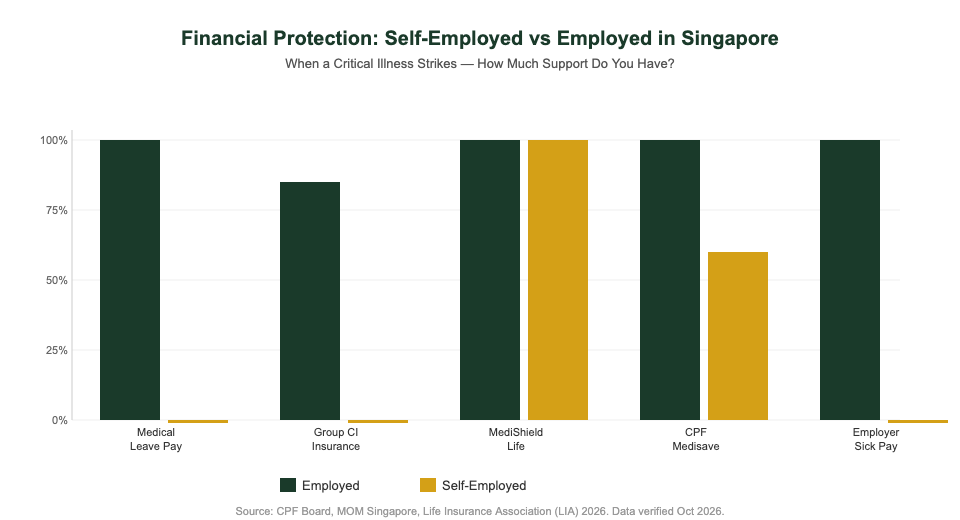
Source: CPF Board, MOM Singapore, Life Insurance Association (LIA) 2026. For illustrative purposes.
What Critical Illness Insurance Covers: The 37 LIA Standard Conditions
Under the LIA CI Framework 2024 (effective for new policies from October 2025), all participating insurers use standardised definitions for 37 severe-stage critical illnesses. This standardisation ensures the same condition triggers a payout regardless of which insurer you buy from — removing ambiguity at the point of claim.
| Category | Key Conditions | Stage Covered |
|---|---|---|
| Cancer | Major cancers (invasive, advanced stage) | Severe only |
| Heart & Cardiovascular | Heart attack, bypass surgery, heart valve surgery | Severe only |
| Brain & Neurological | Stroke with permanent deficit, Parkinson’s, Alzheimer’s | Severe only |
| Organ Failure | Kidney failure, liver failure, lung disease | Severe only |
| Physical Loss | Major burns, blindness, deafness, limb loss | Severe only |
| Other | HIV via blood transfusion, bacterial meningitis, aplastic anaemia | Severe only |
Source: Life Insurance Association (LIA) CI Framework 2024, effective October 2025. Individual insurer plans may cover additional conditions beyond the LIA minimum of 37.
For a deep dive into what each condition requires for a valid claim, read our full guide: Critical Illness Insurance Singapore: What Does It Cover? (2026 Guide)
How Much CI Coverage Do You Need as a Self-Employed Singaporean?
The LIA Protection Gap Study 2022 found that the average Singaporean has CI coverage of only 2.1 times annual income — well below the recommended benchmark of 3.5 to 5 times annual income. For the self-employed, this gap is typically even wider because group insurance is absent entirely.
Your CI sum assured should cover:
- 3–5 years of income replacement — the typical serious CI recovery timeline
- Outstanding debts — mortgage, business loans, hire purchase
- Medical costs above MediShield Life — private room, experimental therapies
- Business continuity buffer — paying key staff and overhead during your absence
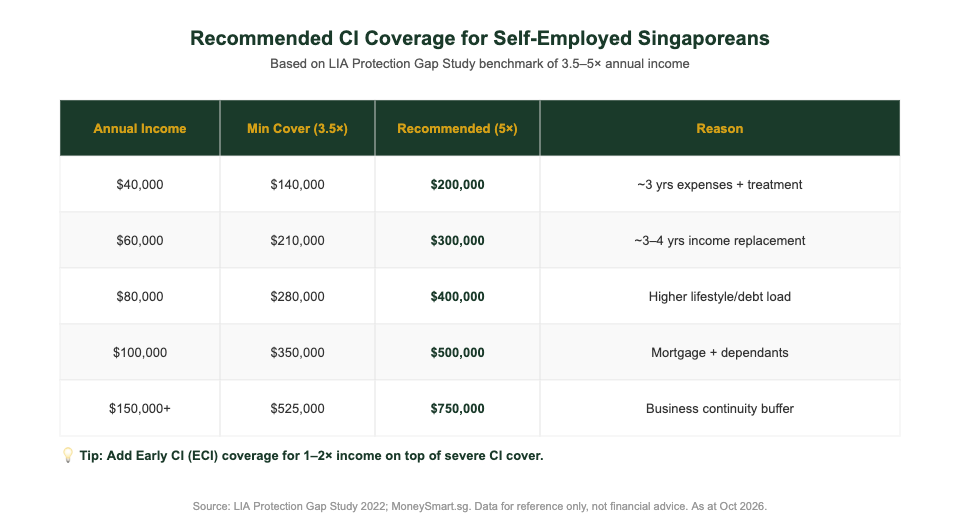
Source: LIA Protection Gap Study 2022; MoneySmart.sg. For illustrative purposes only. Consult a licensed financial adviser for personalised advice.
For a personalised calculation, use our retirement planning calculator. You can also read our in-depth breakdown: How Much Critical Illness Insurance Do You Need in Singapore?
Severe CI vs Early Critical Illness (ECI): Which Do You Need?
There are two main tiers of CI coverage in Singapore. Self-employed individuals should understand both:
| Feature | Severe CI Insurance | Early CI (ECI) Insurance |
|---|---|---|
| When it pays | Severe/advanced stage (e.g. invasive cancer) | Early or intermediate stage (e.g. Stage 1 cancer) |
| Conditions covered | 37 LIA standard conditions | 100+ conditions (varies by insurer) |
| Recommended sum | 3.5–5× annual income | 1–2× annual income |
| Relative premium | Lower | Higher (earlier payout trigger) |
| Best for | Core income/debt protection | Medical costs, treatment supplements |
Source: LIA; insurer product summaries, October 2026.
For self-employed Singaporeans on a tight budget: prioritise severe CI first. The lump sum is larger and protects against catastrophic income loss. Add ECI when budget allows — ideally while you are young and premiums are lower.
Standalone CI Plan vs Rider: Which Is Better for the Self-Employed?
CI coverage can be structured as a standalone policy or as a rider on a whole life or term life plan. For self-employed individuals, standalone CI plans are generally the better choice for three reasons:
- Portability: Your CI coverage exists independently. If you restructure your life insurance later, your CI protection is unaffected.
- Higher coverage limits: Standalone plans typically allow higher sum assured than riders.
- Simpler claims: A standalone policy means the CI claim does not interact with or reduce your life insurance sum assured.
That said, CI riders on whole life policies can have lower net premiums when bundled. Some riders are also MediSave-payable under specific product approvals — worth exploring if you hold whole life policies. Read the full comparison: CI Insurance: Standalone Plan vs Rider in Singapore (2026 Guide)
Key Factors When Comparing CI Plans in Singapore
With insurers including AIA, Prudential, Great Eastern, Singlife, FWD, Manulife, and NTUC Income all offering CI products, compare plans on these five criteria:
- Number of conditions covered: All plans must cover the 37 LIA standard conditions. Differentiation comes from additional ECI conditions — some plans cover 100+.
- Multi-claim benefit: Some modern CI plans allow claims across different condition categories within one policy. For the self-employed, multi-claim plans offer significantly better long-term value.
- Premium structure: Yearly renewable term (YRT) premiums start low but escalate sharply with age. Level premiums are fixed but higher initially. Self-employed individuals with variable income often start with YRT then switch.
- Premium waiver on claim: Upon a CI claim, future premiums should be waived. Confirm this is included — some budget plans exclude it.
- Exclusions and waiting periods: Pre-existing conditions and congenital conditions are commonly excluded. Most plans have a 90-day survival period after diagnosis before a claim is valid.
For premium cost data by age, see: Critical Illness Insurance Premium by Age in Singapore (2026)
What Does CI Insurance Cost for Self-Employed Singaporeans?
Premiums vary by age, gender, smoker status, sum assured, and plan type. As an indicative range for a non-smoking male seeking $300,000 of severe CI coverage:
| Age | Monthly Premium Range | Annual Cost | As % of $60k Income |
|---|---|---|---|
| Age 25 | $60–$100 | $720–$1,200 | 1.2–2.0% |
| Age 35 | $100–$160 | $1,200–$1,920 | 2.0–3.2% |
| Age 45 | $200–$340 | $2,400–$4,080 | 4.0–6.8% |
| Age 55 | $400–$600 | $4,800–$7,200 | 8.0–12.0% |
Source: Indicative ranges based on publicly available insurer premium schedules, October 2026. Actual premiums vary by insurer, plan type, gender, smoker status, and medical underwriting. Get quotes from a licensed financial adviser.
Key takeaway: buying CI insurance at 25 or 35 costs a fraction of what it costs at 45 or 55. Do not wait.
5 Tips Before You Buy CI Insurance as a Self-Employed Singaporean
- Start early and lock in lower premiums. A healthy 28-year-old pays a fraction of what a 42-year-old pays for the same coverage. Buy when you are healthy — pre-existing conditions can lead to exclusions or loading later.
- Aim for at least 3.5× your annual income. Use the table in §3 as a starting guide, then adjust for your specific debts and dependants.
- Add ECI coverage on top. Early CI pays at Stage 1 or 2 — when treatment outcomes are best but costs are still high. Adding 1–2× income in ECI cover provides a meaningful bridge.
- Disclose all pre-existing conditions honestly. Non-disclosure is a ground for claim denial in Singapore. An exclusion clause is far better than a denied claim.
- Review coverage when income grows significantly. If your business grows from $60,000 to $120,000, your CI cover may need to double. Review insurance every 2–3 years.
Alongside CI insurance, building passive income streams via dividend-paying portfolios helps create an income buffer during recovery. Explore Syfe (code: SRPRFFFCD) or Endowus (code: 2V343) to get started.
Frequently Asked Questions
Do self-employed Singaporeans get any group CI coverage?
No. Group CI insurance in Singapore is an employer benefit. If you are self-employed — a freelancer, sole proprietor, or small business owner — you receive no group CI coverage. You must source and pay for your own individual CI policy.
Can I use CPF MediSave to pay CI insurance premiums?
CPF MediSave can be used for certain MediSave-approved insurance products and selected riders. Pure standalone CI insurance policies are generally not MediSave-payable. However, some CI riders attached to whole life policies may qualify under specific MAS/MOH product approvals. Check with the CPF Board or your insurer for the latest approved product list.
What is the difference between CI insurance and disability income insurance?
Critical illness insurance pays a lump sum upon diagnosis of a covered condition — you receive the full amount in one payment. Disability income (DI) insurance pays a monthly income replacement if you cannot work due to illness or injury. For self-employed Singaporeans, both are valuable: CI covers big-ticket costs and debt payoff, while DI replaces your ongoing income month by month. If budget is limited, prioritise severe CI insurance first.
How many CI conditions are covered under LIA standards?
The LIA mandates 37 standard severe-stage critical illness conditions under the LIA CI Framework 2024 (effective October 2025). Individual insurers typically offer additional conditions beyond this — some plans cover 100+ conditions when Early CI benefits are included. The 37 LIA standard conditions include major cancers, heart attack, stroke, kidney failure, and other serious diseases.
Does CI insurance cover pre-existing conditions?
Generally no. Policies exclude conditions known at the time of application. If you have been treated for cancer, heart disease, or diabetes previously, the insurer may exclude that condition, apply premium loading, or decline coverage. This is a key reason to buy CI insurance when you are young and healthy, before conditions arise.
What happens to my CI insurance if I become an employee later?
Your individual CI policy is fully portable and remains in force regardless of your employment status. If you later join a company with group CI cover, you will have both — stacked coverage. You may choose to reduce your individual sum assured at renewal to lower premiums, but do not cancel your individual policy entirely, as group cover typically ends when you leave that employer.
Build Your Financial Safety Net
While CI insurance protects your downside, building passive income through dividend investing or robo-advisors creates an income buffer during recovery. Explore TKN’s recommended platforms:
Get Free Insurance Advice
Speak with a licensed insurance advisor. No obligation, no cost.
By submitting this form, you agree to our Privacy Policy.
This article was researched with the help of AI. While we strive to keep all information accurate and up to date, there may be errors. If you notice any discrepancies, please contact us.