Do You Need Life Insurance If You’re Single With No Dependents? (Singapore 2026)
If nobody relies on your income, life insurance can feel pointless. But “single” doesn’t always mean “no financial risk.” Every working CPF member already has a small safety net called the Dependants’ Protection Scheme (DPS) — and it shrinks as you age. Here’s exactly what you’re covered for, what you’re not, and when term life insurance genuinely earns its premium.
Not financial advice. All figures are for educational reference only. Data verified as at 11 August 2026 against CPF Board, MOH and legal sources cited throughout.
- You already have S$70,000 of free DPS life cover, dropping to S$55,000 at 60 and ending at 65 — enough for a funeral, not much else.
- Your general debts don’t pass to your family when you die in Singapore. Joint debts and co-signed loans are the exception.
- If you have a mortgage without Home Protection Scheme (HPS) cover, or support aging parents, you likely still need your own term life policy.
Table of Contents
Contents — Click to expand
- The Common Myth: No Dependents, No Insurance
- What DPS Already Gives You (and Where It Runs Out)
- Your Mortgage: HPS vs a Policy of Your Own
- Do Your Debts Die With You? Singapore’s Actual Rule
- The Dependant Nobody Talks About: Your Parents
- When You Genuinely Might Not Need Life Insurance
- So, Should You Buy Term Life Insurance?
- FAQ
Key Takeaways
- DPS gives every working CPF member S$70,000 of automatic term cover until age 60, dropping to S$55,000 until 65 — no application needed.
- General debts (credit cards, personal loans, car loans) do not transfer to your family in Singapore. They’re settled from your estate.
- Joint debts are different — a mortgage or loan co-signed with a parent or sibling makes the survivor solely liable for what’s left.
- The Home Protection Scheme (HPS) is compulsory only if you use CPF Ordinary Account savings to pay your HDB flat’s loan instalments. It doesn’t apply to private property or cash-paying HDB owners.
- Funeral costs in Singapore typically run S$4,000–S$12,000 — DPS alone usually covers this comfortably.
- If you support aging parents, co-signed a loan, or carry a mortgage HPS doesn’t cover, a modest term life policy closes a real gap.
The Common Myth: “No Dependents = No Insurance Needed”
Most insurance marketing in Singapore targets breadwinners: the parent with a spouse and kids, the sole earner paying off a family home. If that’s not you, it’s easy to conclude insurance simply isn’t for you.
Here’s the thing. You’re not actually starting from zero. Every working CPF member already carries a baseline layer of term life cover through the CPF Dependants’ Protection Scheme (DPS) — most people just don’t realise how small it is, or when it disappears.
That’s the real question for a single person: not “do I need insurance,” but “does my automatic CPF cover already handle the financial mess I’d leave behind — and if not, what’s the actual gap?”
What DPS Already Gives You (and Where It Runs Out)
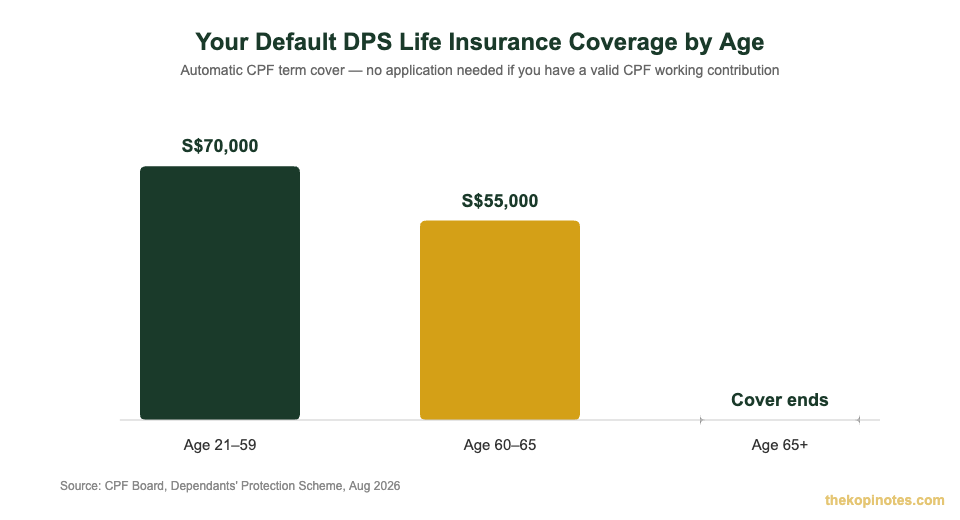
The Dependants’ Protection Scheme (DPS) is a low-cost term life insurance plan administered through CPF. If you’re a Singapore Citizen or PR aged 21 to 65 with a valid CPF working contribution and you’re in reasonably good health, you’re automatically covered — you don’t apply for it, and most people never think about it.
DPS pays out on death, terminal illness, or total permanent disability. But the payout shrinks as you get older, and it stops entirely once you turn 65.
| Age Band | DPS Sum Assured |
|---|---|
| 21 to 59 (end of policy year turning 60) | S$70,000 |
| 60 to 65 | S$55,000 |
| 65 and above | No DPS cover |
Source: CPF Board, Dependants’ Protection Scheme, Aug 2026.
S$70,000 sounds decent until you compare it to what it actually needs to do. It’s enough to cover funeral costs, which typically run S$4,000 to S$12,000 in Singapore depending on religion and the type of service, sometimes more for elaborate Buddhist or Taoist rites. It’s nowhere near enough to clear a mortgage, replace years of income for a parent you support, or pay off a joint loan.
For a deeper look at where DPS falls short and who actually needs to plug the gap, see our guide to the DPS coverage gap in Singapore.
Your Mortgage: HPS vs a Policy of Your Own
If you own a home, this is where most singles have a real blind spot. The Home Protection Scheme (HPS) is CPF’s mortgage insurance for HDB flats — but it’s not automatic for everyone.
HPS is compulsory only if you use your CPF Ordinary Account (OA) savings to pay your monthly HDB flat instalments, whether the loan itself is from HDB or a bank. If you’re insured under HPS and you pass away, become terminally ill, or suffer total permanent disability, HPS pays off your outstanding HDB loan so your family isn’t left holding the flat’s debt. Cover runs until the loan is fully repaid or you turn 65, whichever comes first.
Here’s the gap: if you pay your instalments fully in cash, HPS is optional — you can opt in, but nobody’s making you. And if you own private property instead of an HDB flat, HPS doesn’t exist for you at all. There’s no equivalent scheme. You either buy your own mortgage insurance (decreasing term, sized to your loan) or your outstanding balance has no dedicated protection whatsoever.
This matters even more if you’ve bought your home jointly with a parent or sibling rather than a spouse — a common setup for singles in Singapore. If something happens to you, the co-owner could be left servicing the full loan alone, on top of losing you.
Do Your Debts Die With You? Singapore’s Actual Rule
A lot of singles worry their family will be chased for their credit card bill or car loan after they’re gone. In Singapore, that’s largely a myth — with one important exception.
Your next-of-kin are not personally responsible for debts you incurred alone. Whether it’s a credit card balance, a personal loan, or medical bills, these liabilities don’t transfer to your spouse, children, or parents. Instead, your appointed executor or administrator settles outstanding debts from your estate — the assets you actually leave behind — before anything gets distributed to beneficiaries.
The exception that catches people out: joint debts and guarantees. If you’ve co-signed a mortgage, car loan, or personal loan with a family member, that person becomes solely liable for the remaining balance as the sole surviving debtor. The same applies if you’ve stood as a guarantor for someone else’s loan.
If your estate turns out to be insolvent — meaning your debts exceed your assets — funeral and administration expenses get paid first, followed by debt repayment in a set legal order. Your family won’t personally owe the shortfall, but they also won’t inherit anything until debts are cleared.
Source: SingaporeLegalAdvice.com, “What Happens to Your Debts When You Die?”, 2026.
The Dependant Nobody Talks About: Your Parents
Here’s the blind spot in the “single = no dependants” logic. Plenty of singles in Singapore give their parents a monthly allowance, help cover MediSave shortfalls for medical bills, or are quietly the backup plan if a parent’s own retirement savings run thin.
If your income stops, that support stops too. Your parents may not be legal dependants for tax purposes, but they can absolutely depend on you financially — which is exactly the risk life insurance exists to cover.
There’s also a separate, often-missed issue: CPF nomination. Your CPF savings don’t automatically go to whoever you’d expect. If you haven’t made a CPF nomination, your CPF monies are distributed by the Public Trustee under intestacy rules after you pass — which may not match who you actually want to receive them, and can take longer to process. This is different from a life insurance policy nomination, and worth checking separately if you want your parents (rather than default legal heirs) to receive your CPF savings quickly.
Use our insurance gap calculator to see how a few hundred dollars a month in support to your parents translates into a coverage number.
When You Genuinely Might Not Need Life Insurance
To be fair to the “singles don’t need insurance” camp, there are real situations where extra term life cover isn’t worth the premium.
You’re likely in this category if: you rent rather than own, you carry no joint debt or loan guarantees, your parents are financially independent with their own retirement savings, and your existing savings plus DPS would comfortably clear any personal (non-joint) debts you’d leave behind.
In that case, your money is probably better spent building an emergency fund or investing, rather than paying premiums for a payout nobody is waiting on. Insurance should close a real financial gap — not sit on your expense list out of habit or a salesperson’s suggestion. Revisit the decision whenever your situation changes: buying a home, taking on a joint loan, or your parents’ finances shifting.
So, Should You Buy Term Life Insurance? A Simple Framework
Let’s put real numbers to this. Say you’re 30, single, and you’ve bought an HDB resale flat jointly with a parent using a bank loan, paying instalments in cash rather than through CPF OA. That means HPS doesn’t apply — there’s zero automatic protection on that loan.
Your outstanding loan balance is S$250,000. Here’s what actually stands between that debt and your co-owner if something happens to you:
| Coverage Source | Amount |
|---|---|
| Outstanding joint mortgage balance | S$250,000 |
| DPS payout (age 30) | S$70,000 |
| HPS payout (cash-paid loan, not enrolled) | S$0 |
| Uncovered gap left to your co-owner | S$180,000 |
Illustrative example based on CPF DPS and HPS rules as at Aug 2026. Actual figures depend on your loan, age, and CPF enrolment status.
That S$180,000 gap is precisely what a decreasing (mortgage-style) term life policy is built to close — the sum assured falls roughly in line with your outstanding loan, which keeps premiums low since you’re only insuring what’s actually still owed.
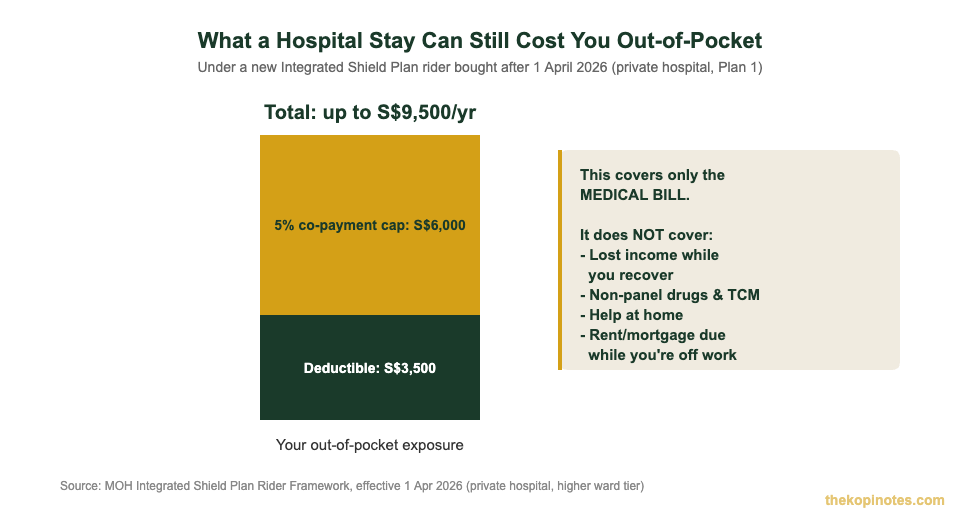
It’s also worth remembering that a mortgage payout only solves the debt problem. If you’re hospitalised rather than deceased, even a well-chosen Integrated Shield Plan rider still leaves you exposed to the plan’s deductible and co-payment, which since 1 April 2026 can run up to S$9,500 a year under the new MOH rider framework — before accounting for lost income while you recover. That’s a separate gap from a mortgage payout, and one CPF’s DPS and HPS schemes were never designed to fill.
Practical next steps if the framework above applies to you:
- Check whether you’re enrolled in HPS by logging into your CPF account — don’t assume.
- Size any additional term life policy to your actual uncovered gap, not a round number. Our guide to how much term life insurance you need walks through the calculation.
- Compare plans using our best term life insurance in Singapore comparison, or look at affordable term life insurance options if budget is the main concern — decreasing term for a mortgage is typically the cheapest structure available.
- If you’re weighing term against a savings-style policy, see term vs whole life insurance in Singapore — for a pure gap-closing need like this, term almost always wins on cost.
FAQ
Does everyone in Singapore get DPS automatically?
Yes, if you’re a Singapore Citizen or PR aged 21 to 65 with a valid CPF working contribution and you’re in reasonably good health at the point of auto-enrolment. You can opt out if you don’t want it, and you can opt back in later subject to health underwriting.
What happens to my CPF savings if I die single with no will?
Your CPF savings go to whoever you’ve named under a CPF nomination. If you haven’t made one, they’re distributed by the Public Trustee’s Office under intestacy rules, which may not match who you’d actually want to receive them and can take longer to process. This is separate from any life insurance policy nomination.
Do I still need life insurance if I rent and have no debt?
Probably not much, if any. If you have no joint debt, no dependants relying on your income, and your DPS cover plus savings would clear your personal debts, extra term life insurance may not be worth the premium. Revisit the decision if you buy property, take on a joint loan, or start supporting family members financially.
Will my family have to pay off my credit card debt if I die?
No. In Singapore, general debts like credit card balances, personal loans, and car loans are settled from your estate, not inherited personally by your family. The exception is joint debts and loan guarantees, where the co-borrower or guarantor remains liable for what’s left.
Does the Home Protection Scheme cover a bank loan for my HDB flat?
Yes. HPS is compulsory whenever you use your CPF Ordinary Account savings to pay your HDB flat’s monthly instalments, regardless of whether the loan is from HDB or a bank. It does not apply if you pay your instalments fully in cash, and it doesn’t cover private property at all.
How much term life insurance should a single person consider?
Size it to your actual uncovered gaps rather than a round number: any joint or co-signed loan balance not covered by HPS, plus a buffer if you financially support aging parents or other family members. See the earlier coverage-amount worked example above for the full calculation.
Being single doesn’t wipe out financial risk — it just changes its shape. Check what DPS and HPS actually cover for your situation, confirm whether any of your debts are joint, and size a policy to the real gap if one exists. If it doesn’t, put the premium into your investments instead.
Further reading: MOH, New Requirements for Integrated Shield Plan Riders · CPF Board, Home Protection Scheme · Singapore Funeral Committee, Average Funeral Cost
Get Free Insurance Advice
Speak with a licensed insurance advisor. No obligation, no cost.
By submitting this form, you agree to our Privacy Policy.
This article was researched with the help of AI. While we strive to keep all information accurate and up to date, there may be errors. If you notice any discrepancies, please contact us.