SRS Withdrawal Strategy Singapore 2026: How to Minimise Tax When You Withdraw
A practical guide to optimising your SRS account withdrawals — age rules, 50% tax exemption, and worked examples for a SGD 200,000 balance.
Your SRS account balance can be withdrawn penalty-free from age 62 — Singapore’s statutory retirement age — with a 50% tax exemption on every dollar you take out. The critical strategy: rather than taking a lump sum (which pushes you into a higher tax bracket), spread withdrawals over 10 years to keep your annual taxable SRS income below the zero-tax threshold. A SGD 200,000 SRS balance withdrawn over 10 years can attract zero income tax, versus roughly SGD 14,400 in tax if taken as a single lump sum.
Not financial advice. Figures are illustrative and based on 2026 IRAS rates, assuming no other taxable income. Consult a licensed financial adviser or tax professional for personalised planning.
Table of Contents
SRS Withdrawal Rules: Age, Timeline and Penalties
The Supplementary Retirement Scheme (SRS) is a voluntary savings programme designed to supplement CPF for retirement. Unlike CPF which has mandatory contribution rates, SRS is entirely opt-in — and crucially, how you withdraw it is also up to you. Understanding the rules governing withdrawals is the first step to minimising your tax burden in retirement.
| Rule | Detail |
|---|---|
| Penalty-free withdrawal age | 62 (statutory retirement age at time of most contributors’ first contribution) |
| Early withdrawal penalty | 5% penalty on amount withdrawn + full amount taxable (no 50% exemption) |
| Tax exemption (qualifying withdrawal) | 50% of withdrawal amount is permanently exempt from income tax |
| Withdrawal window | Up to 10 years from the statutory retirement age at time of first contribution |
| Approved early withdrawals (no penalty) | Terminal illness, permanent disability, bankruptcy, or death of account holder |
| SRS operator banks | DBS, OCBC, UOB |
Source: IRAS Singapore, CPF Board — SRS scheme rules as at 2026.
One important nuance: the 10-year window starts from the statutory retirement age that was in effect when you made your first SRS contribution. If you started contributing before the retirement age was raised (Singapore’s retirement age has been rising gradually), your window still runs from 62. Verify your specific deadline with your SRS operator bank.
If you are still building your SRS balance before retirement, our guide on SRS account investment options in Singapore covers how to grow your balance through ETFs, unit trusts, and Singapore Government Securities.
The 50% Tax Exemption Explained
When you withdraw from SRS at or after the statutory retirement age, only 50% of the amount you withdraw counts as chargeable income. The other 50% is completely exempt — no conditions, no income cap, no means-testing.
This exemption applies to:
- The principal you contributed (post-tax money you put in, which you already got a tax deduction on when contributing)
- Investment returns generated within SRS — interest, dividends, and capital gains all benefit from the same 50% exemption when withdrawn
Worked calculation: You withdraw SGD 30,000 from SRS. Taxable portion = SGD 15,000. If your only other income is CPF LIFE of SGD 1,400/month (SGD 16,800/year, which is tax-exempt), your chargeable income is just SGD 15,000 — well below Singapore’s zero-tax threshold of SGD 20,000. Tax payable: SGD 0.
Compare this to withdrawing SGD 30,000 without the 50% exemption (e.g., an early withdrawal with a 5% penalty). Your chargeable income jumps to SGD 30,000, and you owe approximately SGD 200 in income tax plus the SGD 1,500 penalty. The difference adds up significantly over a multi-year retirement.
Use our Singapore retirement calculator to estimate how long your SRS balance will last across different withdrawal rates and projected investment returns.
Optimal Withdrawal Strategy: Lump Sum vs Spreading
The most important decision you will make with your SRS account is not how to invest it — it is how to take the money out. Withdrawal timing directly determines your tax bill across a decade of retirement.
Strategy 1: Lump Sum
Withdrawing your entire SRS balance in one year is the simplest option and the most tax-expensive. A SGD 200,000 lump sum means SGD 100,000 of taxable income — pushing most retirees into the 11.5% to 15% bracket. Total tax: approximately SGD 14,400. You also lose 10 years of potential tax-deferred compounding inside SRS.
Strategy 2: Equal Annual Withdrawals Over 10 Years
Divide your balance into 10 equal tranches and withdraw one per year. For a SGD 200,000 balance, that is SGD 20,000/year — with only SGD 10,000 taxable after the 50% exemption. Since Singapore’s zero-tax threshold is SGD 20,000, this results in zero income tax (assuming no significant other income). This is the most widely recommended strategy for SRS holders.
Strategy 3: Tapered Withdrawals
Vary the annual withdrawal to match your income profile. Withdraw more in years with lower other income (before CPF LIFE starts), less in years with higher income (after CPF LIFE begins or if you have rental income). This requires planning but maximises tax efficiency for people with variable income in retirement.
For Singapore investors who used SRS to invest in Singapore T-bills or cash-equivalent instruments, see our guide on Singapore T-bills 2026 for context on current short-duration yields available within SRS.
Worked Example: SGD 200,000 SRS Balance
Let’s run the numbers concretely. Assume you retire at 62 with SGD 200,000 in your SRS account. You have no employment income. Your CPF LIFE has not yet started (it defaults to 65, or later if deferred). Here is how four withdrawal strategies compare using 2026 IRAS income tax rates:
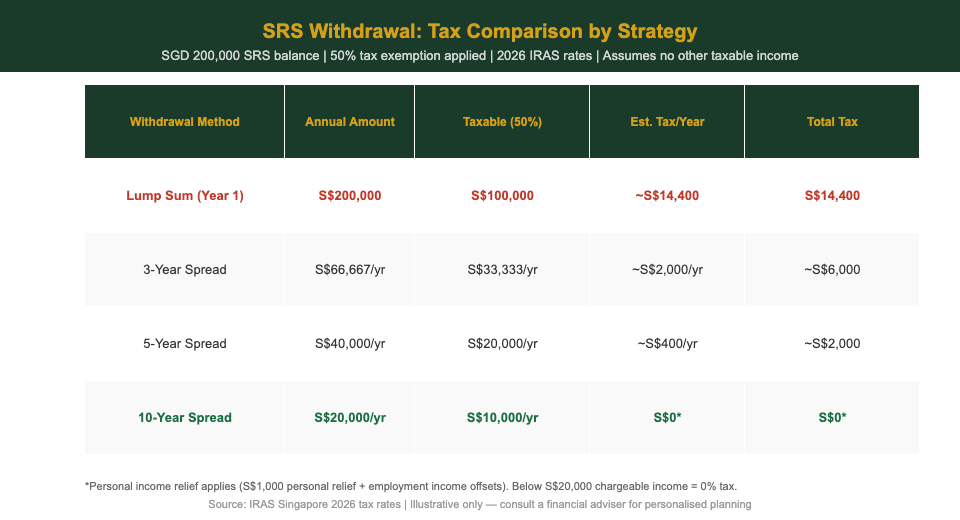
The 10-year spread strategy produces zero income tax for a SGD 200,000 SRS balance — a saving of SGD 14,400 versus the lump-sum approach. Even a 5-year spread cuts the total tax bill by 86%, from SGD 14,400 to approximately SGD 2,000.
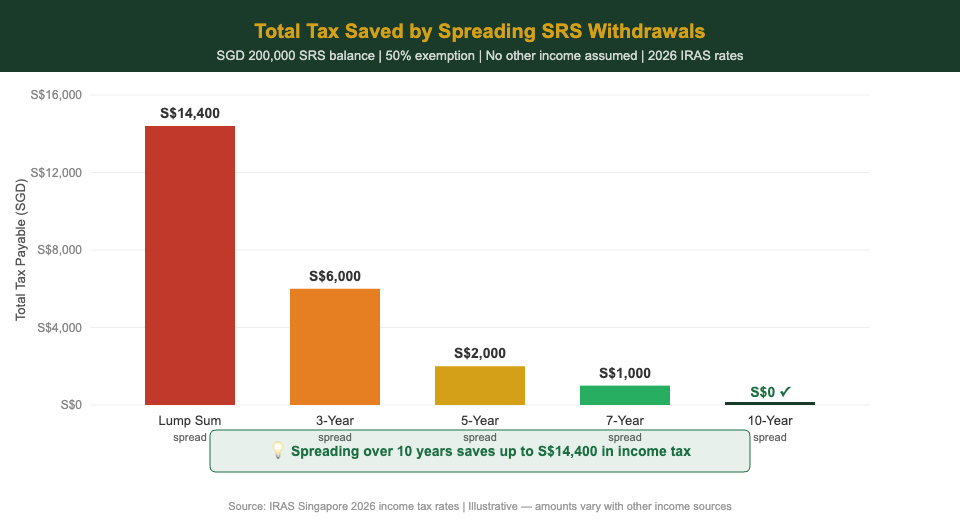
Note: These figures assume no other taxable income. If you have rental income, freelance income, or SRS investment gains from dividends reinvested outside SRS, adjust your annual withdrawal amount downward to stay below the next tax bracket threshold.
When to start withdrawing: Starting at 63–65 is typically optimal. This allows one to three more years of compounding inside SRS, while still leaving you a full 7–9 years to spread withdrawals before the window closes at 72.
SRS Withdrawals vs CPF LIFE Payouts
CPF LIFE monthly payouts are completely tax-exempt and do not count towards your chargeable income. This is a crucial distinction — it means you can receive CPF LIFE income on top of SRS withdrawals without pushing yourself into a higher bracket, as long as the SRS withdrawal amount (x 50%) stays below the relevant tax threshold.
| Feature | SRS Withdrawals | CPF LIFE Payouts |
|---|---|---|
| Taxability | 50% of withdrawal is taxable income | 100% tax-exempt |
| Duration | Up to 10 years from age 62 | For life |
| Flexibility | You choose amount and timing | Fixed monthly payout |
| Investment control | Your choice of instruments inside SRS | CPF Board manages the pool |
| Optimal sequencing tip | Front-load withdrawals before CPF LIFE starts to keep total income low | Defer start to 70 for maximum monthly payout |
Source: CPF Board, IRAS Singapore 2026.
The recommended sequencing for most retirees: start SRS withdrawals at 62–65, before CPF LIFE kicks in. Keep annual SRS withdrawals to SGD 20,000–40,000 depending on your balance and bracket. Once CPF LIFE begins at 65+ (or 70 if deferred), reduce SRS withdrawals to compensate for the new income stream. For CPF optimisation prior to retirement, see our CPF investment strategy guide.
Common Mistakes to Avoid
Even well-informed SRS contributors make costly errors when it comes to withdrawal planning. Here are the five most common mistakes:
1. Taking a lump sum withdrawal — The most expensive mistake, generating up to SGD 14,400 in unnecessary tax on a SGD 200,000 balance. Default to the 10-year spread unless there is a compelling specific reason.
2. Starting withdrawals too late — The 10-year window starts at age 62 (or the retirement age at your first contribution), not when you begin withdrawing. Waiting until 70 to start leaves only two years of spreading, forcing large annual withdrawals and higher tax.
3. Leaving SRS in cash — SRS cash earns near-zero interest at most operator banks. Investing through platforms that accept SRS funds — such as the Endowus platform (referral code 2V343) or Syfe (referral code SRPRFFFCD) — allows your balance to grow in ETFs or managed portfolios before retirement, giving you more to spread over the 10-year window.
4. Not accounting for other income — If you have rental income, freelance work, or large dividends from investments outside SRS in a given year, adding SRS withdrawals on top can breach your tax bracket. Adjust the withdrawal amount downward in high-income years.
5. Confusing SRS and CPF — CPF LIFE payouts are tax-free; SRS withdrawals are 50% taxable. Planning that conflates the two leads to incorrect tax estimates. Treat them as separate income streams with different tax treatments, then model your total annual income.
Frequently Asked Questions
What is the SRS withdrawal age in Singapore 2026?
The penalty-free SRS withdrawal age in Singapore is 62, based on the statutory retirement age at the time most current account holders made their first SRS contribution. Withdrawals before 62 attract a 5% penalty on the withdrawal amount plus full income tax with no 50% exemption. Singapore’s retirement age has been rising incrementally, so if you opened your SRS account recently, verify your specific penalty-free age with your SRS operator bank (DBS, OCBC, or UOB).
How much tax will I pay on SRS withdrawal in Singapore?
Only 50% of your SRS withdrawal is taxable income. The amount of tax depends on your total chargeable income that year (SRS taxable portion plus any other taxable income). If you withdraw SGD 20,000/year from SRS with no other income, your taxable amount is SGD 10,000 — below Singapore’s zero-tax threshold, so you pay no tax. A SGD 200,000 lump sum generates approximately SGD 14,400 in income tax at 2026 IRAS rates. The 10-year spread strategy typically reduces total lifetime SRS tax to zero for balances below SGD 400,000.
Can I withdraw SRS money before retirement age?
Yes, but it is costly. An early SRS withdrawal (before age 62, or before the statutory retirement age at your first contribution) incurs: (1) a 5% penalty on the amount withdrawn, and (2) the full withdrawal amount is taxable as income — the 50% exemption does not apply. Exceptions with no penalty include terminal illness, permanent disability, bankruptcy, and death. There are also specific approved circumstances such as voluntary winding up for foreign SRS account holders who return home permanently.
What happens to SRS after 10 years?
Any SRS balance remaining after the 10-year withdrawal window expires is deemed to be fully withdrawn on the last day of that period. The entire deemed withdrawal (after the 50% exemption) is added to your income for that tax year. This can result in a very large one-off tax bill. To avoid this, plan your annual withdrawals so your SRS balance reaches zero before the window closes. Track your balance and withdrawal schedule regularly — especially if your SRS investments have grown significantly.
Is there a minimum annual SRS withdrawal amount?
No, IRAS does not impose a mandatory minimum annual SRS withdrawal. You have complete flexibility over the amount and timing of each withdrawal within the 10-year window. The only constraint is the window end date — all funds must be out by then. Individual SRS operator banks (DBS, OCBC, UOB) may have minimum transaction amounts, but these are typically very low (SGD 1 or no minimum). This flexibility is what makes the spreading strategy so effective: you can adjust each year’s withdrawal to stay in the optimal tax bracket. Use our retirement planning calculator to map out your schedule.
This article was researched with the help of AI. While we strive to keep all information accurate and up to date, there may be errors. If you notice any discrepancies, please contact us.