Medisave Limit 2026: When ISP Premiums Rise, Here’s How to Protect Your Coverage
A practical guide to managing your Integrated Shield Plan as premiums keep increasing — and how your Medisave limit fits into the picture.
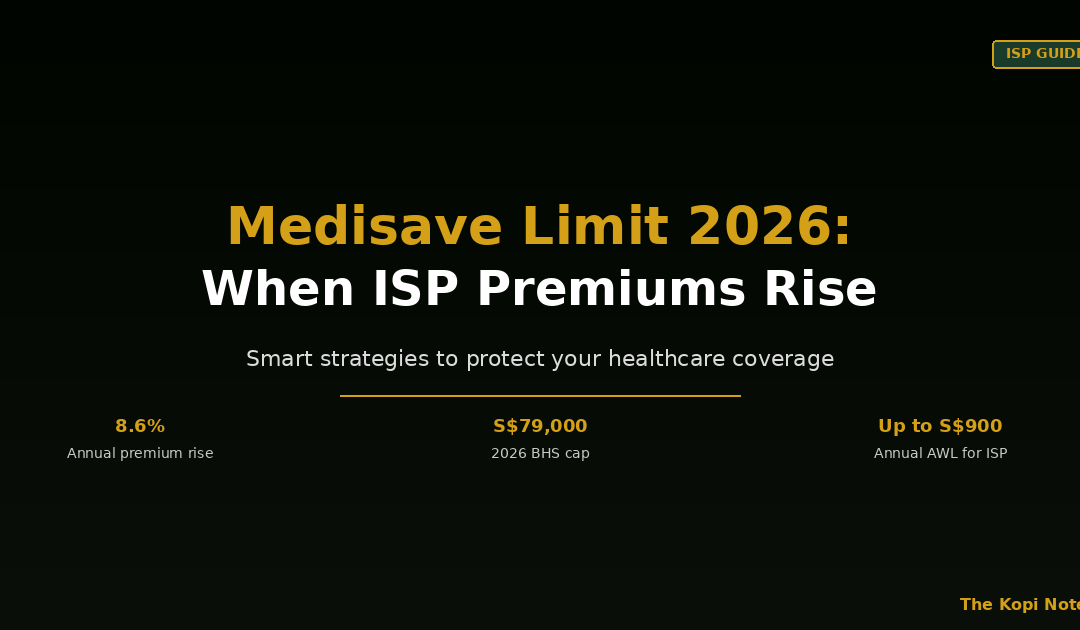
The 2026 Medisave limit (Basic Healthcare Sum) is S$79,000 — but with Integrated Shield Plan base premiums rising an average of 8.6% per year since 2021, many Singapore policyholders are finding that their Medisave Additional Withdrawal Limit (AWL) of S$300–S$900 per year barely dents their actual ISP bill. This guide explains how the Medisave limit works alongside your ISP premium, what to do when premiums outpace your AWL, and four strategies to protect your coverage without downgrading.
Not financial advice. All figures are for educational reference only. Data verified as at 13 October 2026.
Table of Contents
Contents — Click to expand
- How Much ISP Premiums Have Actually Gone Up
- The 2026 Medisave Limit: What the BHS Cap Means for You
- Your AWL: The Medisave You Can Actually Use for ISP Premiums
- When Your ISP Premium Exceeds the AWL: The Cash Gap Problem
- The April 2026 Rider Changes and What They Mean for Your Premium
- 4 Strategies to Keep Your ISP Coverage Without Overpaying
- Frequently Asked Questions
How Much ISP Premiums Have Actually Gone Up
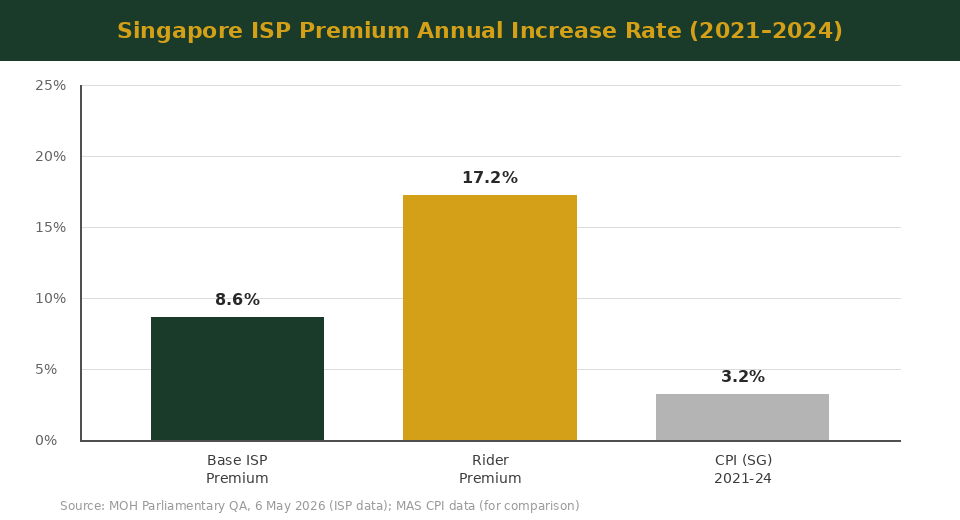
If your Integrated Shield Plan renewal notice has been arriving with a higher number every year, you are not imagining it. According to a May 2026 Ministry of Health (MOH) parliamentary response, private hospital Integrated Shield Plan base premiums rose every single year between December 2021 and December 2024, averaging 8.6% per year. The rider component fared even worse — rider premiums increased at an average of 17.2% per year over the same period.
To put those figures in concrete terms: a policyholder paying S$1,000 per year in 2021 for a private hospital base ISP would be looking at roughly S$1,280 per year by 2024 — a 28% cumulative increase in just three years. Riders that cost S$400 in 2021 could have climbed to around S$630 by 2024.
MOH has attributed the increases to rising private healthcare costs and claims experience. You can read the full breakdown of how ISP base premiums have increased across all five insurers for more detail on insurer-specific changes. What matters here is how this ongoing premium increase interacts with your Medisave withdrawal limits.
| ISP Component | Avg Annual Increase (2021–2024) | Cumulative 3-Year Increase |
|---|---|---|
| Base ISP Premium (private hospital) | 8.6% p.a. | ~28% |
| Rider Premium | 17.2% p.a. | ~61% |
| Singapore CPI (general inflation, for reference) | ~3–4% p.a. | ~10–12% |
Source: MOH Parliamentary Q&A, 6 May 2026 sitting (ISP figures); MAS/Singstat CPI data (for reference comparison).
The 2026 Medisave Limit: What the BHS Cap Means for You
The “Medisave limit” that most Singaporeans refer to is the Basic Healthcare Sum (BHS) — the maximum amount you are encouraged to accumulate in your Medisave Account (MA) before excess contributions flow to your other CPF accounts. For 2026, the BHS is set at S$79,000 (effective 1 January 2026), up from S$75,500 in 2025 and S$71,500 in 2024.
It is important to clarify what the BHS does and does not control:
- It is a savings target, not a spending cap. Having S$79,000 in your MA does not automatically tell you how much you can spend on ISP premiums per year.
- It does NOT set your annual withdrawal limit. The amount you can withdraw from Medisave each year for your ISP premium is governed by a separate rule called the Additional Withdrawal Limit (AWL).
- Accumulating above the BHS is limited. Medisave contributions that push your balance above S$79,000 will be redirected to your Special Account (below age 55) or Retirement Account (55 and above).
Understanding this distinction is critical when people panic that “my Medisave limit won’t cover my rising premiums.” The real issue is not whether you have enough money in Medisave — most working adults do — but whether the annual withdrawal rules allow you to use enough of it. That is where the AWL comes in. For a full walkthrough of your integrated shield plan Singapore guide, read our comprehensive overview.
Your AWL: The Medisave You Can Actually Use for ISP Premiums
Every year, you can use Medisave to pay two components of your ISP premium:
- MediShield Life (MSL) component: The base MediShield Life premium is fully payable via Medisave with no annual cap beyond the actual MSL premium amount.
- Private insurance top-up (the ISP above MSL): This is subject to the Additional Withdrawal Limit (AWL), which is capped by your age.
The AWL amounts for 2026, as published by the CPF Board, are:
| Age Next Birthday | AWL (Annual Medisave Cap for ISP Top-Up) | Amount Above AWL |
|---|---|---|
| 1 to 40 | S$300 | Must be paid in cash |
| 41 to 70 | S$600 | Must be paid in cash |
| 71 and above | S$900 | Must be paid in cash |
Source: CPF Board, Additional Withdrawal Limits for Integrated Shield Plan Premiums (accessed October 2026).
Note that rider premiums — the add-on that reduces your co-payment and deductible — cannot be paid via Medisave at all. They must be paid entirely in cash. This means as rider premiums have risen 17.2% per year, Singaporeans have been absorbing 100% of that increase out of pocket.
When Your ISP Premium Exceeds the AWL: The Cash Gap Problem
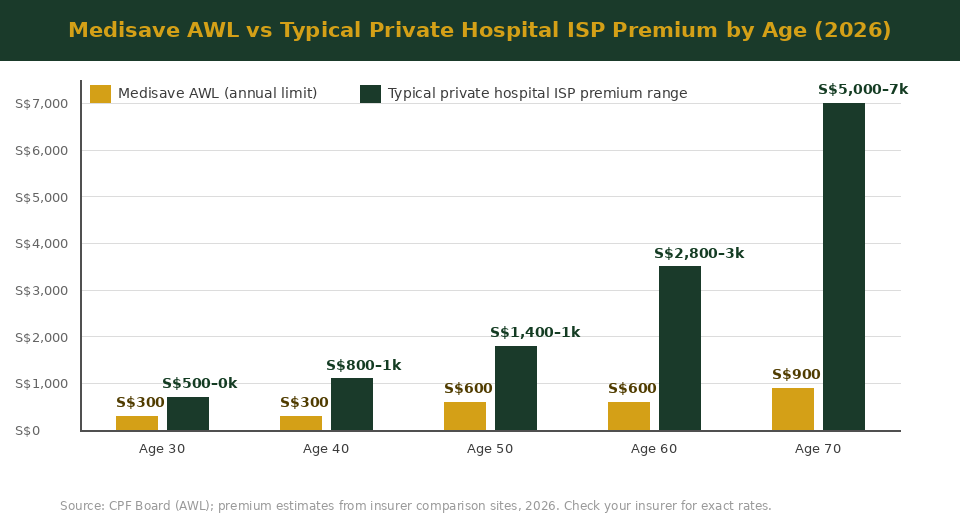
Here is where the Medisave limit tension becomes real. Private hospital ISP base premiums vary by insurer and age, but typical annual figures for full private hospital ward (ward A/private) coverage give a clear picture of the growing cash gap:
| Age Group | AWL (Medisave) | Typical ISP Base Premium Range | Estimated Cash Top-Up Needed |
|---|---|---|---|
| Age 30 | S$300 | S$500–S$700/yr | ~S$200–S$400/yr |
| Age 40 | S$300 | S$800–S$1,100/yr | ~S$500–S$800/yr |
| Age 50 | S$600 | S$1,400–S$1,800/yr | ~S$800–S$1,200/yr |
| Age 60 | S$600 | S$2,800–S$3,500/yr | ~S$2,200–S$2,900/yr |
| Age 70 | S$900 | S$5,000–S$7,000/yr | ~S$4,100–S$6,100/yr |
Source: CPF Board (AWL); ISP premium ranges estimated from insurer comparison sites for private hospital ward A/Private coverage, October 2026. Check your individual insurer for exact current rates. The “cash top-up needed” figures shown are for base ISP premiums only; rider premiums are additional.
The table makes the math stark: even with the highest AWL of S$900 (age 71+), a typical 70-year-old with a private hospital plan is funding the vast majority of their ISP premium in cash. This is why the ISP downgrade statistics have been rising — many policyholders, particularly retirees on fixed incomes, are finding the out-of-pocket cash burden unsustainable. For a data-led look at how this plays out by age, see our ISP premium by age 2026 analysis.
Worked example (a 50-year-old Singapore resident):
Assume an annual base ISP premium of S$1,600 for private hospital coverage. The Medisave AWL is S$600. This means S$600 is withdrawn from the Medisave Account, and S$1,000 must be paid in cash. If there is also an ISP rider costing S$800 per year, the total out-of-pocket cash outlay is S$1,800 per year — S$150 per month. At the historical 8.6% increase rate, that S$1,600 base premium will reach approximately S$1,740 by next year, adding another S$140 to the annual cash burden while the AWL stays fixed at S$600.
The April 2026 Rider Changes and What They Mean for Your Premium
On 1 April 2026, MAS introduced new co-payment requirements for ISP riders. While the policy change itself is separate from the Medisave limit, it directly affects the economics of keeping a rider.
MOH noted in parliament that policyholders who switch from legacy riders to the new co-payment rider specifications can save an average of 35% to 40% in rider premiums. Given that rider premiums had risen 17.2% per year for three consecutive years, this repricing offers meaningful relief — though it comes with a trade-off: new riders require co-payment (typically 5% to 10% of eligible bills), whereas legacy “as-charged” riders covered 100%.
The key decision point: if your legacy rider now costs S$1,500 per year and a new co-payment rider costs S$900–S$975 per year (35–40% less), you save S$525–S$600 per year in cash premiums. That saving needs to be weighed against your likely annual claims exposure under the co-payment structure. For a full breakdown, read our guide on new ISP rider co-payment rules explained.
Critically, none of this rider change affects your Medisave AWL — rider premiums remain 100% cash-only regardless of whether you have a legacy or new rider. But switching to a new rider reduces the overall cash outflow, which may help policyholders maintain their base ISP coverage without reducing their ward class.
4 Strategies to Keep Your ISP Coverage Without Overpaying
Given that Medisave AWL limits are fixed and base premiums keep rising, here are four evidence-based strategies Singapore policyholders can use to manage the gap.
1. Switch from a Legacy “As-Charged” Rider to a New Co-Payment Rider
As noted above, MOH data shows 35–40% savings on rider premiums for those who switch. If you are currently on a legacy rider and hospitalisation claims are infrequent, this switch reduces your cash outflow significantly. The trade-off is bearing 5–10% co-payment on future claims. Run the numbers: if you save S$600/year in rider premiums, you would need a claim of at least S$6,000–S$12,000 in a single year just to break even on the co-payment. For the full pros and cons, see our guide on ISP rider vs no rider in 2026.
2. Downgrade Ward Class — but Strategically, Not Reflexively
Downgrading from private hospital coverage to ward A or ward B1 can cut base premiums substantially — often by 50–60% for younger age groups. The catch: you lose access to private hospitals and your choice of specialist. For Singaporeans who are comfortable using restructured hospitals (with ward A entitlement under an A-class ISP), this is often the most cost-effective option. Before you downgrade, check if your existing specialists are panel doctors under the relevant ISP; if they are, your practical experience may differ less than you expect. Our detailed guide on medisave for private hospital bills covers what changes when you drop a ward class.
3. Ensure You Are Maximising Your AWL Before Paying Cash
Some policyholders do not realise that they can use both the MediShield Life Medisave deduction and the AWL top-up — these are two separate layers. Make sure your ISP insurer has correctly split your annual premium into the MSL base component (Medisave-payable, no AWL cap) and the private top-up component (Medisave-payable up to AWL). If your insurer’s billing is not set up correctly, you may be paying more in cash than you legally need to. Contact your insurer or financial adviser to confirm the deduction breakdown on your policy.
4. Review Your ISP During Open-Enrolment, Not Just at Renewal
ISP portability rules allow Singapore policyholders to switch insurers without medical underwriting, as long as they move to an equivalent or lower tier of coverage. If your current insurer has raised premiums significantly, comparison shopping during the 30-day window before your renewal date can yield meaningful savings. MOH requires insurers to notify policyholders at least 30 days before any premium change takes effect — use that window to compare rates on the MOH ISP comparison page and across all five approved insurers.
Disclaimer: Premium comparison should always factor in your health history, existing conditions, and your preferred hospitals and doctors. Always consult a licensed financial adviser before making any policy changes.
Frequently Asked Questions
What is the Medisave limit for 2026 in Singapore?
The 2026 Basic Healthcare Sum (BHS) — the maximum Medisave balance target — is S$79,000, effective 1 January 2026. This is the amount CPF aims for members to have in their Medisave Account by age 65. Contributions that push your Medisave above S$79,000 flow to your Special Account (below 55) or Retirement Account (55 and above). The BHS is not the same as your annual ISP withdrawal limit, which is governed by the Additional Withdrawal Limit (AWL).
How much Medisave can I use for my ISP premium every year?
You can use Medisave for (1) your MediShield Life premium in full, and (2) the private top-up portion of your ISP up to the Annual Additional Withdrawal Limit (AWL): S$300 per year for ages 1–40, S$600 for ages 41–70, and S$900 for ages 71 and above. Any ISP base premium above this AWL must be paid in cash. Rider premiums cannot be paid via Medisave at all — they are 100% cash.
Why has my ISP premium gone up so much in recent years?
According to MOH’s May 2026 parliamentary statement, private hospital ISP base premiums rose an average of 8.6% per year from December 2021 to December 2024, and rider premiums rose 17.2% per year over the same period. The primary drivers are rising private healthcare costs, increased claims frequency after the COVID-19 disruption period, and higher treatment costs at private hospitals. These increases significantly exceed general Singapore CPI inflation of around 3–4% per year.
Can I avoid paying ISP premiums in cash by topping up my Medisave?
Topping up your Medisave — either via voluntary contributions or CPF top-ups — does not increase your AWL. The AWL is a fixed annual cap set by CPF based on age, not your Medisave balance. So even if your Medisave has S$79,000 in it, you can still only withdraw S$300–S$900 per year for the private ISP top-up portion. Rider premiums remain non-Medisave-payable regardless of your balance.
Should I downgrade my ISP plan if premiums keep rising?
Downgrading from private hospital to ward A coverage can cut premiums by 50–60% and is worth evaluating carefully rather than reflexively. Key considerations: how often do you use private hospitals versus restructured hospitals? Do you have preferred specialists who are panel doctors? Is your out-of-pocket cash burden genuinely unmanageable? If you are primarily seeking cost relief from rider premiums, switching to a new co-payment rider (saving 35–40%) may achieve that without sacrificing your base ward coverage.
What are the new ISP rider rules from 1 April 2026?
From 1 April 2026, MAS requires new ISP riders to include a co-payment element (typically 5–10% of eligible bills), ending the sale of new “as-charged” riders that covered 100% of bills with no co-payment. Existing legacy riders remain valid, but insurers have repriced them upward. Policyholders switching from legacy to new co-payment riders can save 35–40% on annual rider premiums according to MOH. Rider premiums continue to be 100% cash-only and are not payable via Medisave.
Does Singapore's Medisave BHS increase every year?
Yes. The BHS is reviewed and adjusted annually. It was S$71,500 in 2024, S$75,500 in 2025, and S$79,000 in 2026. Members who reached age 65 in a prior year keep the BHS amount that was set in the year they turned 65 — it is locked at that cohort figure for life. So a member who turned 65 in 2024 has a lifetime BHS of S$71,500, not the 2026 figure of S$79,000. The AWL amounts for ISP premiums (S$300/S$600/S$900 by age bracket) are separate from the BHS and have been unchanged in recent years.
Review Your ISP Coverage Today
Use our tools and guides to make sure you are getting the most out of your Medisave and healthcare coverage.
Get Free Insurance Advice
Speak with a licensed insurance advisor. No obligation, no cost.
By submitting this form, you agree to our Privacy Policy.
This article was researched with the help of AI. While we strive to keep all information accurate and up to date, there may be errors. If you notice any discrepancies, please contact us.