MediSave Limit 2026: Life-Stage Planning Guide for Every Singaporean
From your first payslip to retirement — how to build, protect, and maximise your MediSave at every stage of life.
The MediSave limit for 2026 is $79,000 — the Basic Healthcare Sum (BHS) set by CPF Board as the maximum you can hold in your MediSave Account (MA) before age 65. But this cap affects Singaporeans very differently depending on their life stage: a 28-year-old with $8,000 saved has entirely different priorities than a 60-year-old racing toward the limit. This guide maps out what the $79,000 cap means for your ISP premiums, top-up strategy, and healthcare planning at every decade of your life.
Not financial advice. All figures are for educational reference only. Data verified as at 7 October 2026 unless noted.
Table of Contents
Contents — Click to expand
What Is the MediSave Limit in 2026?
The MediSave limit — officially called the Basic Healthcare Sum (BHS) — is the maximum amount that can accumulate in your CPF MediSave Account before you turn 65. For 2026, the BHS is set at $79,000, up from $75,500 in 2025. This $3,500 increase reflects CPF Board’s annual adjustment to keep pace with rising healthcare costs.
Here is what the limit means in practice:
- Under 65: Your MediSave cannot exceed $79,000. Any CPF contributions that push your balance above $79,000 automatically overflow to your Special Account (if you are below 55) or your Retirement Account (if you are 55 and above).
- Turning 65 in 2026: Your BHS is locked permanently at $79,000 for life, regardless of future increases.
- Already 65 or older: Your BHS was locked at the prevailing amount the year you turned 65 — ranging from $49,800 to $75,500 depending on your birth year.
| Year You Turn 65 | BHS (Locked for Life) |
|---|---|
| 2022 | $66,000 |
| 2023 | $68,500 |
| 2024 | $71,500 |
| 2025 | $75,500 |
| 2026 | $79,000 |
Source: MOH newsroom, CPF Board BHS announcement, January 2026
One important point that many Singaporeans misunderstand: hitting the BHS does not stop your Integrated Shield Plan (ISP) premiums from being deducted via MediSave. The Annual Withdrawal Limit (AWL) — the amount you can use from MediSave each year for ISP premiums — operates independently. For more detail on how ISP premiums interact with the BHS, see our guide on MediSave limit and ISP premiums when you hit $79,000.
In Your 20s: Building the Foundation
If you are in your 20s, the $79,000 BHS likely feels remote — the average 25-year-old fresh graduate earning $3,500/month contributes roughly $280/month to MediSave through mandatory CPF deductions. At that rate, hitting the $79,000 cap takes over 20 years of contributions before accounting for investment returns and withdrawals.
What your MediSave covers in your 20s:
- Your Integrated Shield Plan base premium — typically $300–$600/year for a Class A ward plan, fully covered by your AWL of $300/year (ages 1–40)
- Hospitalisation bills not covered by MediShield Life (deductibles, co-insurance)
- Approved outpatient treatments: chemotherapy, dialysis, approved vaccinations
- Day surgeries
Should you voluntarily top up MediSave in your 20s? Generally, no — unless you have excess savings and specifically want the tax relief. In your 20s, the priority should be building your Ordinary Account for housing and your Special Account for retirement, while MediSave grows organically through mandatory contributions.
The one exception: if your MediSave balance is too low to cover potential hospitalisation deductibles (typically $2,000–$3,000 for public Class A wards), a small top-up to create a buffer is prudent healthcare planning.
In Your 30s–40s: Family Stage and ISP Costs Rise
Your 30s and 40s are when MediSave earns its keep. This is the decade of family formation — weddings, pregnancies, children — and each brings legitimate MediSave withdrawals:
- Maternity hospitalisation: Up to $900 in MediSave per delivery (the hospitalisation component under the Medisave Maternity Package)
- Children’s MediShield Life premiums: Automatic deductions from your MediSave for each insured child
- Your own ISP premiums: Increasing as you age — from ~$600/year at 35 to ~$1,400/year at 45 for a typical Class A ward plan
By your mid-40s, a meaningful gap begins to open between your AWL ($300/year for ages under 41; $600/year for ages 41–70) and your actual ISP premium. For a 45-year-old paying $1,400/year for an ISP, MediSave covers $600 — leaving $800 to be paid in cash. This ISP deductible and premium gap grows significantly with age.
MediSave is also now being used more intensively for hospitalisation. If a 40-year-old requires day surgery, the MediSave withdrawal can easily run to $1,000–$2,000 in a single year, temporarily dipping the balance. This is normal and expected — MediSave is designed to absorb these shocks, which is exactly why building your balance in your 20s and 30s matters.
Key action for this stage: Review your ISP plan tier and rider. If your balance is comfortably growing, ensure you have an ISP with a rider that caps your out-of-pocket exposure. Budget for the growing cash component of ISP premiums from your mid-40s onwards.
In Your 50s: Racing Toward the Cap — and Catching Up
Your 50s are the most strategically important decade for MediSave planning. Here is why:
The accumulation window is closing. If you are 52 today earning $6,000/month, your CPF contributions allocate roughly $540/month to MediSave. At this rate, you could reach $79,000 within 5–7 years — at which point overflow goes to your Retirement Account, which earns 4–5% interest (better than your Ordinary Account’s 2.5%) but cannot be used for healthcare.
ISP premiums are rising sharply. A 55-year-old on a Class A ward ISP with a rider can expect to pay $2,500–$3,500/year in total premiums. MediSave covers $600/year (AWL for ages 41–70). The cash shortfall of $1,900–$2,900 must come from your own pocket every year — and it will only grow.
The MMSS opportunity. If you are aged 55–70, have average monthly income of $4,000 or less, and your MediSave balance is below 50% of the BHS (i.e., below $39,500 in 2026), you may qualify for the Matched MediSave Scheme (MMSS) — a government initiative that matches your voluntary cash top-ups dollar-for-dollar, up to $1,000 per year. For an eligible 58-year-old, this means a $1,000 cash top-up becomes $2,000 in MediSave, immediately.
The 50s are also when you should be thinking about topping up your MediSave with cash, particularly if your balance is below the BHS. Cash top-ups earn up to $8,000 in income tax relief per year (combined across your own top-up and top-ups for family members), making them one of the most tax-efficient moves available to Singaporeans in their peak earning years.
| Scenario at Age 55 | MediSave Balance | Recommended Action |
|---|---|---|
| Balance at or near $79,000 | $75,000–$79,000 | Stop voluntary top-ups; contributions overflow to RA earning 4–5% |
| Balance well below BHS | Below $40,000 | Check MMSS eligibility; make annual $1,000 top-up for government match |
| Moderate balance, high ISP premiums | $40,000–$60,000 | Consider cash top-up for tax relief; budget for growing cash premium component |
Source: CPF Board, MOF Budget 2026 guidelines | The Kopi Notes editorial analysis, October 2026
At 65 and Beyond: Fixed BHS and Overflow Planning
At 65, two things happen to your MediSave:
- Your BHS is locked at the prevailing amount when you turn 65 — for those turning 65 in 2026, this is $79,000. Future BHS increases do not apply to you.
- CPF contribution rates drop significantly. From your mid-60s onwards, both you and your employer contribute less to CPF — the total rate falls from 37% (for under-55s) to just 12.5% (for those above 65 to 70) and lower for those above 70. Your MediSave allocation within those contributions also falls.
At this stage, the ISP premium burden becomes the central concern. A 70-year-old on a Class A ward ISP with a rider may face annual premiums of $7,000–$9,000. The MediSave AWL for those above 70 increases to $900/year — but this covers less than 15% of a typical premium at this age. The remainder — $6,000–$8,000 per year — must be paid in cash.
This is why financial planning for healthcare in retirement is not just about having the right ISP — it is about having sufficient liquid savings to pay the cash portion of premiums every year for decades. For more on managing hospitalisation costs at this stage, see our common MediSave planning mistakes guide.
New for mid-2026: Flexi-MediSave now covers selected restorative dental procedures (such as dentures and dental implants) for Singaporeans aged 60 and above at CHAS-accredited dental clinics. This is a meaningful expansion for seniors managing multiple healthcare costs.
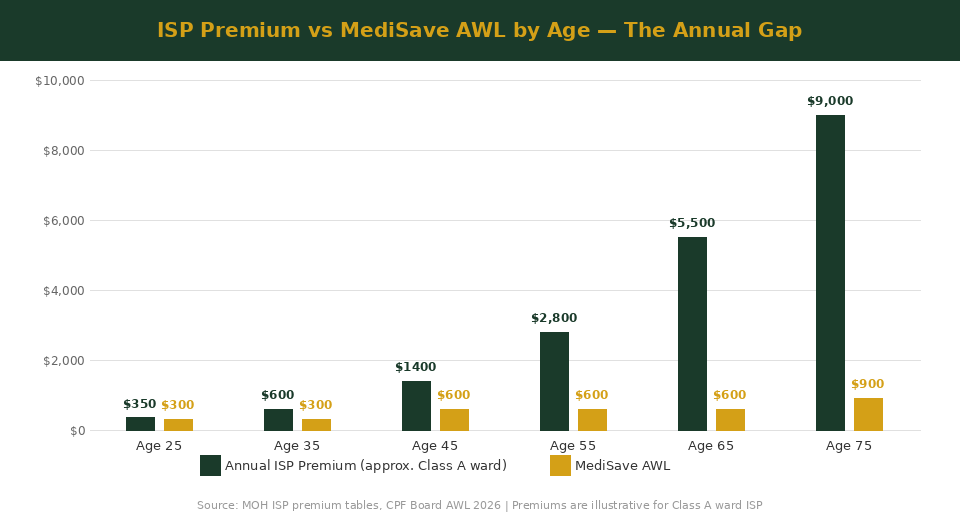
Approximate annual ISP premiums (Class A ward, with rider) vs MediSave Annual Withdrawal Limit by age group. Gap must be paid in cash. Source: MOH ISP comparison, CPF Board AWL rates 2026. Premiums are illustrative.
The ISP Premium Gap by Age — What MediSave Actually Covers
One of the most misunderstood aspects of MediSave is exactly how much it covers toward your ISP premium. The Annual Withdrawal Limit (AWL) is the annual cap on how much you can withdraw from MediSave for ISP premiums. In 2026, the AWL tiers are:
| Age Group | Annual Withdrawal Limit (AWL) | Approx. Class A ISP Premium | Cash Shortfall |
|---|---|---|---|
| Ages 1–40 | $300/year | $300–$700/year | $0–$400 |
| Ages 41–70 | $600/year | $1,200–$7,000/year | $600–$6,400 |
| Ages 71+ | $900/year | $7,000–$12,000/year | $6,100–$11,100 |
Source: CPF Board AWL rates 2026; MOH ISP premium ranges (illustrative, Class A ward plan with rider). Actual premiums vary by insurer and plan type.
The data reveals a stark truth: by your 70s, MediSave covers less than 10% of your ISP premium. This is why reviewing your ISP plan tier as you approach retirement is not just an insurance decision — it is a fundamental cashflow planning exercise. Some Singaporeans choose to downgrade to a Class B1 or B2 plan in their 60s to reduce premiums, accepting lower private-hospital coverage in exchange for sustainability.
Top-Up Strategies and Tax Relief in 2026
Voluntary cash top-ups to MediSave remain one of Singapore’s most underused tax strategies. Here is a structured overview of every top-up mechanism available in 2026:
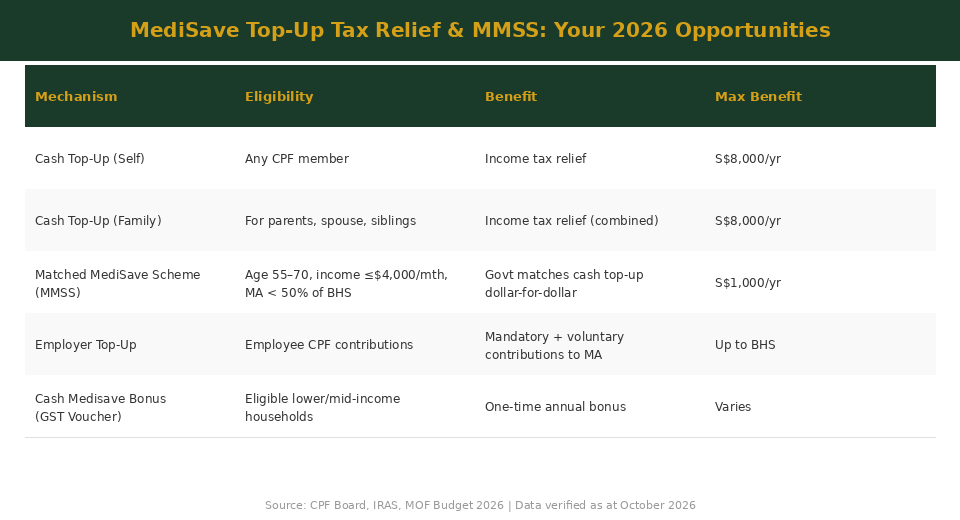
MediSave top-up mechanisms available in 2026, eligibility criteria, and maximum tax/financial benefits. Source: CPF Board, IRAS, MOF Budget 2026.
Income tax relief on MediSave top-ups is available up to $8,000 per year in combined relief for top-ups to your own MediSave and top-ups to your parents’, spouse’s, siblings’, grandparents’, or in-laws’ accounts. This $8,000 is a combined cap shared with CPF top-ups to other accounts, so plan accordingly.
For example, a 45-year-old in the 15% tax bracket who tops up $5,000 to their own MediSave saves $750 in income tax that year — a guaranteed, risk-free 15% return on cash. This compares favourably with most fixed-income options available in 2026.
Important constraints:
- You cannot top up beyond the BHS ($79,000). If your balance is already at $79,000, top-up relief is unavailable.
- MediSave funds are not withdrawable as cash — they can only be used for approved healthcare expenses. Treat any top-up as long-term healthcare savings, not liquid savings.
- For the MMSS matching scheme, contact CPF Board directly to check eligibility, as the pilot programme has specific conditions and annual enrollment periods.
If you are in your 50s and still have room below the $79,000 BHS, combining an annual MMSS top-up with a separate cash top-up for tax relief is the most powerful double-benefit available. Top up $1,000 (MMSS match doubles it to $2,000) and top up an additional $4,000 for tax relief — that is $6,000 of MediSave benefit from $5,000 in cash, before tax savings on the full $5,000.
Frequently Asked Questions
What is the MediSave limit (BHS) for 2026?
The Basic Healthcare Sum (BHS) for 2026 is $79,000. This is the maximum balance you can hold in your MediSave Account before age 65. The BHS increased from $75,500 in 2025. Once you turn 65, your BHS is permanently locked at the amount prevailing that year — those turning 65 in 2026 will have a lifelong BHS of $79,000.
What happens to my CPF contributions when my MediSave hits $79,000?
When your MediSave balance reaches the $79,000 BHS, any new contributions that would push you above the limit are automatically redirected to your Special Account (if you are below 55) or your Retirement Account (if you are 55 and above). Both accounts earn higher interest than your Ordinary Account — the SA and RA earn at least 4% per annum. You do not lose any money; it simply flows to another CPF account.
How much can I withdraw from MediSave for my ISP premium each year?
The MediSave Annual Withdrawal Limit (AWL) for Integrated Shield Plan premiums depends on your age: $300/year for ages 1–40, $600/year for ages 41–70, and $900/year for those above 70. The AWL applies regardless of your MediSave balance — even if your account holds $79,000, you can only use up to the AWL for ISP premiums in any given year. Any premium above the AWL must be paid in cash.
Should I voluntarily top up my MediSave if I'm in my 30s?
In most cases, a voluntary MediSave top-up in your 30s is low priority compared to other financial goals. Your mandatory CPF contributions are already building the account, and your ISP premiums are likely still covered by the AWL. The exception: if you want to reduce your income tax burden (top-ups attract up to $8,000 in combined relief), or if your MediSave balance is too low to comfortably cover a hospitalisation deductible — a buffer of $5,000–$10,000 above your annual premium obligations provides peace of mind.
What is the Matched MediSave Scheme (MMSS) and who qualifies?
The Matched MediSave Scheme (MMSS) is a government initiative that matches voluntary cash top-ups to your MediSave dollar-for-dollar, up to $1,000 per year. To qualify, you must be aged 55–70, have average monthly income of $4,000 or less, and have a MediSave balance below 50% of the BHS (i.e., below $39,500 in 2026). The scheme targets lower-income older Singaporeans who may not have adequate healthcare savings, making it one of the most generous top-up incentives available.
Can I use my parents' MediSave to pay my ISP premium, or vice versa?
No. Each individual’s MediSave can only be used to pay for their own approved healthcare expenses, including their own ISP premiums. However, you can voluntarily top up a family member’s MediSave using your own cash (not from your MediSave), and that cash contribution qualifies for income tax relief up to the combined $8,000 cap. The family member then uses their own topped-up MediSave balance for their own healthcare costs.
Does reaching the BHS affect my MediShield Life coverage or ISP plan?
No. Hitting the $79,000 BHS has no effect on your MediShield Life coverage or your Integrated Shield Plan coverage. Both remain fully active. The only impact is that new CPF contributions overflow to other accounts rather than accumulating in your MediSave. ISP premiums continue to be deducted from MediSave via the AWL, and your balance may dip temporarily below $79,000 — which is normal and expected. CPF contributions will then top it back up toward the cap over subsequent months.
Review Your ISP and MediSave Plan Today
The right ISP at the right tier — aligned with your life stage and MediSave balance — is one of the most valuable financial decisions you can make.
Get Free Insurance Advice
Speak with a licensed insurance advisor. No obligation, no cost.
By submitting this form, you agree to our Privacy Policy.
This article was researched with the help of AI. While we strive to keep all information accurate and up to date, there may be errors. If you notice any discrepancies, please contact us.