Critical Illness Insurance for Singapore HDB Mortgage Holders: Don’t Let a Diagnosis Cost You Your Home (2026)
The complete 2026 guide to calculating your CI coverage gap as an HDB owner — and closing it before a diagnosis forces a fire sale.
Table of Contents
Jump to Section
- Why HDB Mortgage Holders Face a Unique CI Risk
- The Two Coverage Gaps You Must Close
- HDB Loan Scenarios: How Much CI You Actually Need
- Standalone CI vs CI Rider: Which Suits HDB Owners?
- Your CI Coverage Formula (Step-by-Step)
- Common Mistakes HDB Owners Make
- Take Action: Getting the Right Cover
- Frequently Asked Questions
If you have an HDB mortgage in Singapore, a critical illness diagnosis doesn’t just threaten your health — it threatens your home. Critical illness (CI) insurance pays a lump sum when you’re diagnosed with cancer, heart attack, stroke or other major conditions. For HDB mortgage holders, that payout must do two jobs at once: replace lost income during your recovery and keep mortgage payments running while you can’t work.
Not financial advice. All figures are for educational reference only. Data as at October 2026 unless noted.
Why HDB Mortgage Holders Face a Unique CI Risk
Most Singaporeans know they need health insurance. But there is a critical gap that a standard life insurance needs analysis often misses: the compounding effect of a CI diagnosis on an HDB mortgage.
CPF contributions stop when you stop working. Most HDB owners service their mortgage using CPF Ordinary Account (OA) contributions. When you are on long-term medical leave or have stopped work entirely, CPF inflows stop. You must either switch to cash payments immediately or risk late-payment charges from HDB.
Recovery from major CI conditions takes 2–5 years. Cancer treatment, cardiac rehabilitation, and stroke recovery are not quick. Many patients require 2–3 years of active treatment and reduced working capacity. During this period, you cannot rely on CPF to cover your HDB loan.
MediShield Life and your Integrated Shield Plan don’t cover your mortgage. Your hospitalisation insurance pays for medical bills only. In April 2026, the ISP co-payment was revised: policyholders now face 5% co-pay capped at S$6,000 per year (up from S$3,000). Out-of-pocket healthcare costs are rising, adding pressure alongside your mortgage.
MRTA is not CI coverage. Some HDB owners have a Mortgage Reducing Term Assurance (MRTA) policy. MRTA pays out only on death or total permanent disability — not on a CI diagnosis. You can be alive, unable to work, and still owe your full HDB loan with zero MRTA protection.
The Two Coverage Gaps You Must Close
The Life Insurance Association (LIA) Singapore’s Protection Gap Study found that the average Singaporean is significantly under-insured for critical illness, with a CI protection gap benchmark of approximately 3.9x annual income. For HDB mortgage holders, the gap is even wider because they carry a large liability that must also be covered.
Gap 1 — Income Replacement. If you cannot work for 3–5 years, you need to replace your income to cover daily living expenses. The LIA benchmark is 3.9x your annual income as a minimum CI coverage amount. For someone earning S$60,000 per year, that’s S$234,000 in CI coverage for income replacement alone.
Gap 2 — Mortgage Buffer. On top of income replacement, you need a buffer to cover your HDB mortgage repayments during the recovery period. The prudent approach is to add enough CI coverage to cover 3–5 years of mortgage payments — or the full outstanding loan balance if affordable. A 4-room HDB owner with a S$350,000 outstanding loan needs an additional S$57,240–S$95,400 in CI coverage just to cover 3–5 years of mortgage payments.
This dual-coverage approach is what most standard CI calculations miss. A standard CI recommendation based on income alone consistently underestimates the coverage need for mortgage holders.
HDB Loan Scenarios: How Much CI You Actually Need
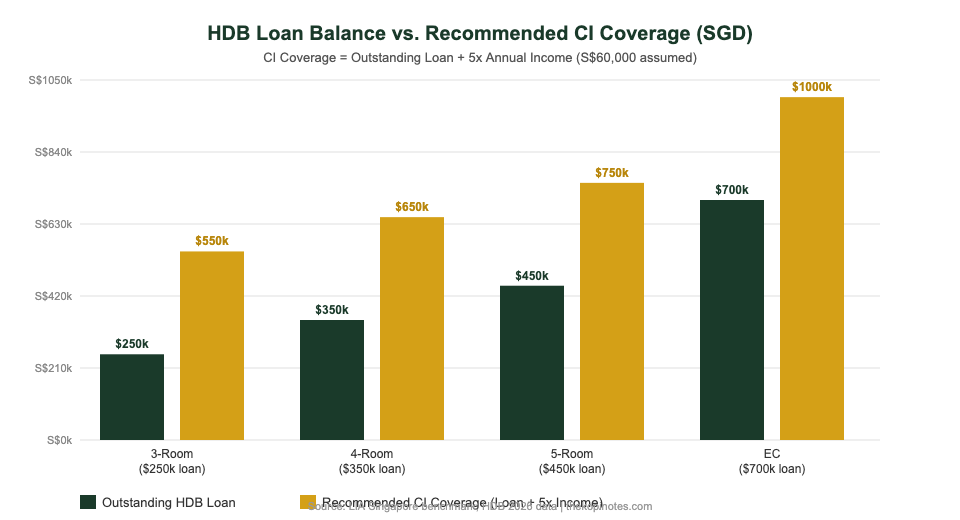
The table below shows the total CI coverage gap for HDB owners across different flat types, assuming a household gross annual income of S$72,000. All monthly payments use the HDB concessionary loan rate of 2.6% p.a. (pegged at CPF OA rate + 0.1%) over a 25-year tenure.
| Flat Type | Typical Loan | Monthly Repayment (2.6%) | 3-Year Mortgage Cost | Income Replacement (3.9×) | Total CI Gap |
|---|---|---|---|---|---|
| 3-Room HDB | S$250,000 | S$1,136/mth | S$40,896 | S$280,800 | S$321,696 |
| 4-Room HDB | S$350,000 | S$1,590/mth | S$57,240 | S$280,800 | S$338,040 |
| 5-Room HDB | S$450,000 | S$2,043/mth | S$73,548 | S$280,800 | S$354,348 |
| EC / Condo | S$700,000 | S$3,394/mth* | S$122,184 | S$280,800 | S$402,984 |
*Bank loan at indicative 3.2% p.a. Source: HDB 2026 concessionary rate 2.6%; bank mortgage rates Q3 2026. Household income assumption S$72,000/year. CI gap = 3-year mortgage cost + LIA 3.9x annual income. Indicative only — speak to a licensed financial adviser.
The takeaway: most dual-income HDB households need S$300,000–S$400,000 in CI coverage once the mortgage buffer is factored in — significantly more than the S$100,000–S$200,000 that many standard plans offer as defaults.
Standalone CI vs CI Rider: Which Suits HDB Owners?
When it comes to critical illness insurance in Singapore, you have two broad structural options: a standalone CI plan or a CI rider attached to a whole life or term policy. For HDB mortgage holders who need a large, specific sum, each has real trade-offs.
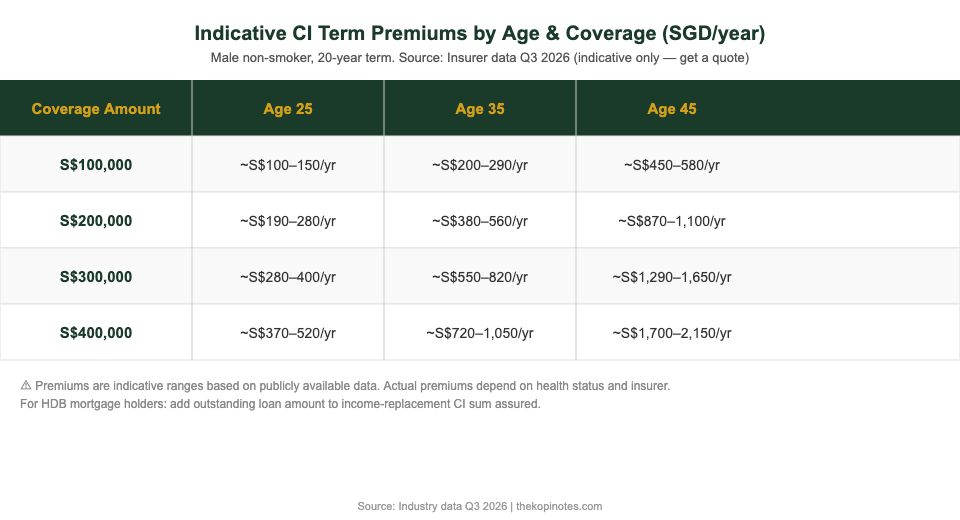
Standalone CI Term Plan. A standalone CI term plan provides pure CI coverage — a lump sum payout on diagnosis with no cash value or investment component. Because you are paying purely for CI protection, you get significantly more coverage per premium dollar compared to a whole life CI rider. This structure works well for HDB mortgage holders because you can set the coverage amount to exactly match the outstanding loan plus your income replacement need, and reduce coverage as the loan pays down over time.
CI Rider on a Whole Life or Term Policy. A CI rider accelerates the death benefit — meaning a CI payout reduces the amount paid on death. If you have a S$300,000 whole life policy with a CI rider and make a CI claim for S$300,000, your surviving family receives nothing. For HDB mortgage holders who need both mortgage coverage and estate protection, this structure can create gaps. CI riders are more cost-efficient for smaller top-ups (e.g. S$50,000–S$100,000) on an existing policy. For the large coverage amounts HDB mortgage holders typically need (S$300,000+), a standalone CI term plan is generally more transparent and better value.
Your CI Coverage Formula (Step-by-Step)
Use this four-step formula to calculate exactly how much CI coverage you need as an HDB mortgage holder. This builds on the standard CI coverage calculation for Singapore by adding the mortgage-specific layer.
Step 1: Note your gross annual income (before CPF deductions).
Step 2: Multiply by 3.9 (LIA minimum CI benchmark) — this is your income replacement target.
Step 3: Add your outstanding HDB loan balance as the mortgage protection amount.
Step 4: Subtract any existing CI coverage from employer group insurance, personal policies, or your spouse’s group plan.
Example Calculation (4-room HDB, dual-income household):
| Item | Amount | Notes |
|---|---|---|
| Annual household income | S$72,000 | S$6,000/month combined |
| × LIA 3.9x benchmark | S$280,800 | LIA minimum CI protection target |
| + Outstanding HDB loan | S$350,000 | 4-room HDB, 10 years into a 25-yr loan |
| Total CI required | S$630,800 | Before deducting existing cover |
| − Employer group CI | −S$80,000 | Typical group plan; not portable on resignation |
| CI gap to fill (personal policy) | S$550,800 | Buy a standalone CI term plan for this amount |
Source: LIA Singapore Protection Gap Study; HDB loan data 2026. Illustrative only. Consult a licensed financial adviser.
Use our Singapore retirement planning calculator to model how a CI event could affect your long-term financial plan, not just your immediate mortgage payments.
Common Mistakes HDB Owners Make with CI Insurance
These are the most costly planning errors that HDB mortgage holders make with CI insurance:
Mistake 1: Relying entirely on employer group CI. Most employer group CI plans provide S$50,000–S$100,000 in coverage. This is non-portable — you lose it the moment you change jobs, are made redundant, or take a career break. For an HDB mortgage holder, that is exactly when you are most financially vulnerable. Always have a personal CI policy that you own regardless of employment.
Mistake 2: Getting CI via a rider that reduces the death payout. If you buy a CI rider that accelerates your life insurance sum assured, a CI claim will eliminate your family’s death benefit. HDB mortgage holders typically need both CI coverage AND life insurance — don’t let one destroy the other. Use a standalone CI plan or a supplementary (non-accelerating) CI rider.
Mistake 3: Assuming CPF will cover the mortgage during illness. CPF contributions require active employment income. During a CI recovery period, if you are on long-term no-pay leave or have resigned, your CPF OA contributions stop. Without a CI payout to fund cash mortgage payments, you may default on your HDB loan.
Mistake 4: Not reviewing CI coverage after an HDB upgrade. Moving from a 4-room to a 5-room HDB (or to a condo) significantly increases your mortgage liability. Your CI coverage amount should be updated to reflect the new outstanding loan balance — yet most policyholders set their coverage once and never review it.
Take Action: Getting the Right Cover
Once you’ve worked out your CI coverage gap, the next step is ensuring your investment portfolio is also working hard. Pair CI insurance (for protection) with a low-cost platform (for growth). Use our referral links for exclusive sign-up bonuses:
Frequently Asked Questions
Can I use CPF to pay for CI insurance premiums?
Does MediShield Life cover my HDB mortgage payments if I get critically ill?
What is the difference between early-stage and advanced-stage CI coverage?
Should I buy CI insurance before or after buying my HDB flat?
How much does CI insurance cost for a 35-year-old in Singapore?
What are the most common CI claims in Singapore?
Can I buy CI insurance if I already have a pre-existing health condition?
Should I consider MRTA instead of CI insurance for my HDB?
Disclaimer: This article is for educational and informational purposes only. It does not constitute financial advice. CI insurance and mortgage planning are complex; consult a licensed financial adviser before making any decisions. Premium data is indicative based on publicly available information as at Q3 2026. The Kopi Notes may earn a referral fee if you use our referral codes. Sources: LIA Singapore; HDB.gov.sg; LIA.org.sg; HDB.gov.sg.
Get Free Insurance Advice
Speak with a licensed insurance advisor. No obligation, no cost.
By submitting this form, you agree to our Privacy Policy.
This article was researched with the help of AI. While we strive to keep all information accurate and up to date, there may be errors. If you notice any discrepancies, please contact us.