Critical Illness Insurance for Self-Employed Singapore 2026: Why Your Gap Is 3x Bigger
No employer group CI. No paid sick leave. No employer CPF during recovery. Here is how to close all three gaps.
Data verified as at 25 Sep 2026. This article describes insurance structures and how they work. It does not constitute financial advice. Speak to a licensed adviser for a recommendation specific to your situation.
You are running your own business. When a cancer diagnosis lands, three income streams stop simultaneously: your project fees, any employer group CI payout, and your paid sick leave. The last two never existed. That is the coverage gap specific to self-employed workers in Singapore, and it is larger than most people calculate.
Critical illness insurance pays a lump sum on diagnosis of one of the 37 LIA-standard severe conditions. For self-employed workers, this lump sum has to cover income replacement, treatment co-payments, and business continuity costs that salaried employees never face alone.
Table of Contents
1. The Three Gaps Self-Employed Workers Face
2. How Much CI Coverage Do Self-Employed Workers Need?
3. CI Premium Benchmarks by Age
4. Which CI Plan Structure Works Best?
5. The LIA Standard 37 Conditions
6. Frequently Asked Questions
The Three Gaps Self-Employed Workers Face
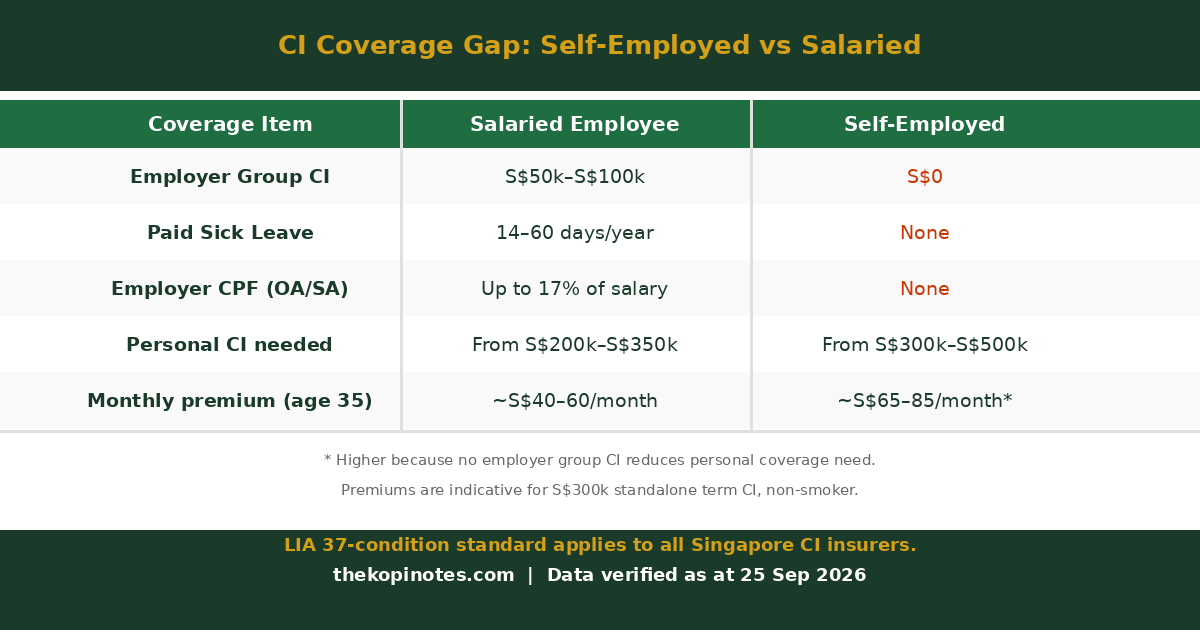
Salaried employees in Singapore typically receive three layers of income protection their employer provides automatically. Self-employed workers start from zero on all three.
Gap 1: No Employer Group CI
Most medium-to-large Singapore employers include group critical illness cover in their benefits package. Coverage ranges from S$50,000 to S$100,000, paid by the employer, with no medical underwriting required. A self-employed person has no employer — so this safety net does not exist.
This means your personal CI policy has to cover the full amount, not just the top-up above what your employer provides.
Gap 2: No Paid Sick Leave
Under the Employment Act, salaried employees are entitled to 14 outpatient and 60 hospitalisation days of paid sick leave annually. Freelancers, sole proprietors and partners are not covered by the Employment Act’s sick leave provisions. Income stops the day you stop working.
Cancer treatment in Singapore typically involves 12 to 24 months of active therapy before a return to full productivity. That is one to two years of full income replacement from your own savings — unless a CI payout bridges the gap.
Gap 3: No Employer CPF Contributions During Illness
Self-employed persons are required to contribute Medisave at 6 to 10.5% of their net trade income (above S$6,000 per year), depending on age. But CPF Ordinary Account and Special Account contributions are voluntary for the self-employed. More importantly, there is no employer adding an extra 17% to your CPF while you recover.
A salaried employee who goes on hospitalisation leave still receives employer CPF contributions. A self-employed person who stops billing receives nothing from an employer — because there is no employer.
Together, these three gaps mean self-employed workers typically need 30 to 50% more CI coverage than a salaried employee on the same income.
How Much CI Coverage Do Self-Employed Workers Need?
The standard LIA guideline for CI coverage is five years of annual income. For self-employed workers, a more precise calculation looks like this.
Step 1: Calculate your income replacement need. Take your average annual net income and multiply by five. A freelancer netting S$6,000 per month (S$72,000 per year) needs S$360,000 just for income replacement over five years.
Step 2: Add treatment co-payment costs. MediShield Life covers hospitalisation and selected outpatient treatments, but there are co-payments, deductibles and coverage limits. Budget an additional S$30,000 to S$80,000 for co-payments on treatment costs not fully covered by your integrated shield plan.
Step 3: Subtract group CI (if any). For most self-employed workers, this is zero. If you have retained any group CI from a prior employer via a conversion option, subtract that amount.
Example calculation — freelancer earning S$6,000/month net:
| Item | Amount |
|---|---|
| 5 years income replacement | S$360,000 |
| Treatment co-payments (est.) | S$50,000 |
| Less: employer group CI | S$0 |
| Minimum CI coverage needed | S$410,000 |
A salaried employee on the same income, with S$75,000 employer group CI, would need around S$335,000 of personal CI. The self-employed gap is S$75,000 wider before considering sick leave income.
Use the Insurance Gap Calculator to model your specific numbers.
CI Premium Benchmarks by Age
The good news: standalone term CI is one of the more affordable insurance products in Singapore. The following benchmarks are indicative for a non-smoker male with standard health, for a S$300,000 sum assured on a 25-year term policy covering the LIA standard 37 severe stage conditions. Female premiums are typically 10 to 20% lower.
| Age at entry | Monthly premium (approx.) | Annual cost (approx.) |
|---|---|---|
| 30 | ~S$45 | ~S$540 |
| 35 | ~S$65 | ~S$780 |
| 40 | ~S$100 | ~S$1,200 |
| 45 | ~S$150 | ~S$1,800 |
These are indicative figures from major Singapore CI insurers (AIA, Great Eastern, Prudential, Manulife, Singlife, Income). Actual premiums vary based on your health history, smoking status, sum assured, and policy term. Request quotes from at least two insurers before committing.
For context: S$780 per year at age 35 is roughly S$65 per month for S$300,000 of CI cover. Most self-employed workers earning S$5,000 or more per month can absorb this premium without adjusting their budget significantly. The income risk of not having it is far larger than the premium cost.
Which CI Plan Structure Works Best for Self-Employed?
Two main CI plan structures exist in Singapore: standalone term CI and whole life CI (or a whole life policy with a CI rider). For self-employed workers, the right choice comes down to one factor — portability.
Standalone Term CI — Best for Most Self-Employed Workers
A standalone term CI policy exists independently of any employer or base policy. You buy it directly, you own it, and it stays with you regardless of who you work for or whether you stay self-employed. The premium is pure protection: no cash value, no investment component, lower cost.
For a self-employed worker whose income and coverage needs may change year to year, this flexibility matters. You can adjust coverage independently, add an early-stage CI rider, or convert to a different policy without unwinding a whole life plan.
Whole Life with CI Rider — When It Makes Sense
A whole life policy with a CI rider provides permanent coverage and accumulates cash value. Premiums are higher, but cover lasts to age 99 rather than ending at a fixed term. This works well if you want life and CI protection combined in one policy and do not plan to adjust coverage frequently.
One important distinction: most CI riders on whole life policies reduce the death benefit by the CI payout amount. A standalone CI policy leaves your life cover intact. For self-employed workers with dependants, this matters when calculating total coverage.
The Sep 2026 rate environment has not meaningfully changed CI premiums for standalone term plans. The TKN article on CI insurance after Singapore’s rate hike covers the standalone vs rider comparison in more detail.
Early Stage CI — Worth Considering
The LIA standard 37-condition list covers severe stage conditions only. Early critical illness (ECI) policies pay out at a much earlier disease stage — early-stage cancer, for instance, before it meets the LIA severe definition. For self-employed workers who cannot afford a prolonged income disruption even during early treatment, an ECI rider on top of your standalone CI is worth pricing.
ECI premiums add roughly 30 to 50% to your total CI cost. Whether that cost makes sense depends on your savings buffer and income flexibility.
The LIA Standard 37 Conditions
The Life Insurance Association of Singapore mandates that all CI policies cover the same 37 severe-stage conditions. This standardisation means you are comparing premiums and terms — not wondering whether one insurer’s cancer definition is stricter than another’s.
The top three CI claim conditions in Singapore, by claims volume, are cancer, heart attack and stroke. These three conditions account for the majority of CI claims. The remaining 34 conditions include major organ failure (kidney, liver, heart), coronary artery bypass surgery, coma, total permanent disability and other severe illnesses.
For self-employed workers, the most financially damaging CI events are those requiring extended recovery: late-stage cancer with 18 to 24 months of chemotherapy, or a major stroke requiring 12-plus months of rehabilitation. Both eliminate your billing capacity entirely while expenses continue. The CI lump sum is what bridges that gap.
For a full breakdown of which CI plan covers which conditions at the best premium, see the best critical illness insurance Singapore 2026 comparison.
Setting Up Your CI Coverage as a Self-Employed Worker
Three practical steps before you buy.
Step 1: Check for existing CI coverage. Some self-employed workers retain group CI from a prior employer via a conversion option. Personal accident policies occasionally include limited CI provisions. Add these up before calculating your gap.
Step 2: Calculate your specific gap. Use the income replacement formula above: five years of net income plus S$30,000 to S$80,000 for treatment co-payments, minus any existing CI. The result is your minimum coverage target.
Step 3: Pair CI with disability income insurance. CI pays a lump sum on diagnosis. Disability income insurance pays a monthly benefit if illness or injury prevents you from working, regardless of a CI diagnosis. Self-employed workers without either are exposed on both fronts. The DPI guide for self-employed workers in Singapore covers how to structure this pairing.
The right CI sum assured for a self-employed worker is almost always higher than the rule-of-thumb applied to salaried employees. Three to five years of net income is the floor, not the ceiling, when you account for no employer group CI and no paid sick leave.
Frequently Asked Questions
Do self-employed workers in Singapore need critical illness insurance?
How much critical illness coverage does a self-employed person need?
Can self-employed persons in Singapore use Medisave to pay CI premiums?
What is the difference between critical illness insurance and disability income insurance for self-employed workers?
Is standalone CI better than a CI rider for self-employed workers?
What are the LIA standard 37 conditions covered by critical illness insurance in Singapore?
Can self-employed persons claim tax relief on CI insurance premiums?
Does early critical illness insurance cover more conditions than standard CI?
At what age should a self-employed person in Singapore buy CI insurance?
Tools and Guides Referenced in This Article
Get Free Insurance Advice
Speak with a licensed insurance advisor. No obligation, no cost.
By submitting this form, you agree to our Privacy Policy.
This article was researched with the help of AI. While we strive to keep all information accurate and up to date, there may be errors. If you notice any discrepancies, please contact us.