ILP Sub-Fund Switching Singapore 2026: Post Rate-Hike Strategy Guide
Updated September 2026
Table of Contents
Click to expand contents
An investment-linked policy (ILP) in Singapore lets you switch between sub-funds inside your policy at low or no cost — and that flexibility matters now more than ever. The US Federal Reserve raised rates by 25 basis points to 3.75-4.00% in September 2026. That move directly affects how bond and equity sub-funds inside your ILP perform. Knowing when and how to switch can protect your policy value without triggering unnecessary charges.
Not financial advice. All figures are for educational reference only. Data verified as at 19 September 2026.
- Rising rates hurt bond sub-funds. If your ILP is heavy in fixed-income, consider switching to lower-duration or equity sub-funds.
- Most Singapore insurers give you 4-6 free switches per year. Use them strategically rather than reactively.
- Check your policy’s Reduction in Yield (RIY) before switching — fees eat returns before any sub-fund gain shows up.
What Is ILP Sub-Fund Switching?
An ILP pools your premium into one or more sub-funds — think of them as mini unit trusts managed by your insurer. You choose which ones to invest in when you buy the policy. Over time, you can shift your allocation between funds. That process is called sub-fund switching.
Unlike selling a unit trust in your brokerage account, switching inside an ILP does not trigger capital gains events or stamp duty. The insurer sells units in your old sub-fund and buys units in the new one on the same business day.
MAS classifies regular premium ILPs as Complex Investment Products (CIP). Under the 2026 framework, your insurer must provide a Key Information Document (KID) showing the Reduction in Yield (RIY) — the percentage your annual return shrinks due to fees. For most regular premium ILPs, the RIY ranges from 2.5% to 4.5% per annum in the early years.
That fee drag means your sub-fund needs to outperform its benchmark by at least the RIY just to break even. Choosing the right sub-fund is therefore more critical than in a direct unit trust.
How the Sep 2026 Rate Hike Affects ILP Sub-Funds
The US Federal Reserve raised its target rate by 25 basis points on 17 September 2026 to a range of 3.75-4.00%. Here is the key mechanism: when interest rates rise, bond prices fall. The longer a bond fund’s average duration, the more its price drops for every 1% rate increase.
A bond fund with an average duration of 7 years typically loses about 7% of its value for every 1% rate increase. For a 25bp move, that translates to roughly 1.75% in value erosion from the rate move alone — on top of any credit or liquidity risk already priced in.
Equity sub-funds react differently. Companies with strong pricing power and low debt tend to hold up better in a rising-rate environment. Global equity and Asia equity funds with broad diversification have historically outperformed pure bond funds when rates moved higher.
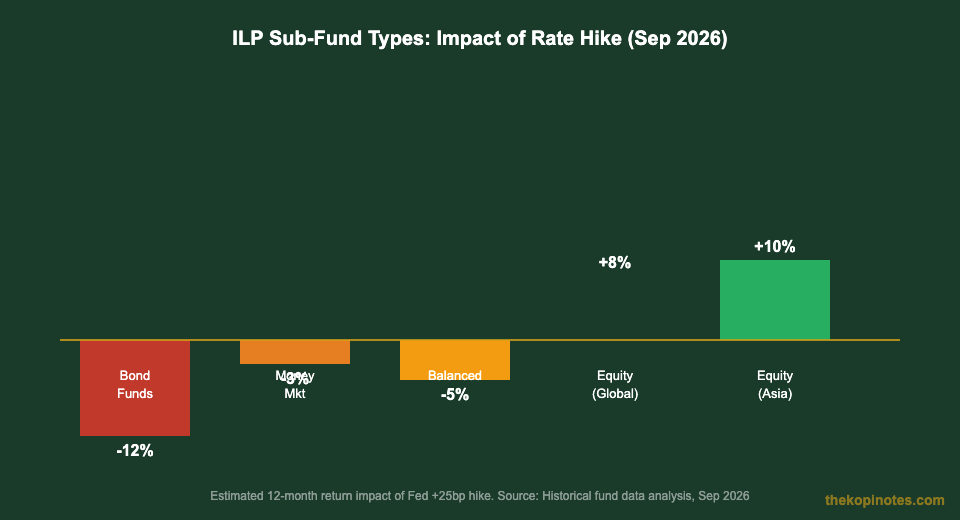
Source: Historical fund-type sensitivity analysis. Illustrative estimates based on a 25bp rate move. Actual returns will vary by fund. September 2026.
Bond vs Equity Sub-Funds in a Rising Rate Environment
Not all sub-funds respond the same way to rate moves. Here is a practical breakdown to guide your switching decision.
| Sub-Fund Type | Rate Sensitivity | Expected Impact | Action |
|---|---|---|---|
| Global Bond Fund | Very High | Negative | Consider reducing allocation |
| Money Market Fund | Low | Slightly Positive | Good short-term parking fund |
| Balanced Fund | Moderate | Mixed | Review equity-bond split inside fund |
| Global Equity Fund | Low | Positive | Solid long-term holding |
| Asia Equity Fund | Low | Positive | Benefits from Asia rate divergence |
Source: Standard rate-sensitivity analysis based on fund duration and asset class behaviour. September 2026. Not financial advice.
The key question is your time horizon. If your ILP still has 10 or more years to run, a short-term bond fund dip may not justify switching. But if you are within 5 years of planned surrender, protecting your policy value from further bond erosion makes more sense.
How to Switch ILP Sub-Funds: Step by Step
Switching sub-funds in your ILP is simpler than most policyholders realise. Here is how it works across most Singapore insurers in 2026.
Step 1: Log in to your insurer portal. AIA, Prudential, Great Eastern, Manulife, and Singlife all have digital customer portals where you can initiate a fund switch online. No need to call your agent.
Step 2: Review your current sub-fund allocation. Check your account value split across funds. If more than 40% of your policy value sits in a pure bond or fixed income fund, the rate hike is working against you.
Step 3: Select the sub-funds you want to switch from and to. You can do a partial switch — for example, move 50% of your bond fund into a global equity fund — or a full switch. Be specific about the percentage.
Step 4: Confirm the switch is within your free limit. Check how many free switches you have used this policy year. Going beyond the free limit usually costs S$25 to S$50 per additional switch.
Step 5: Submit and verify. Most insurers process the switch within 2-3 business days. Log back in to confirm the new allocation is reflected correctly.
Free Switching Limits by Major Singapore Insurer
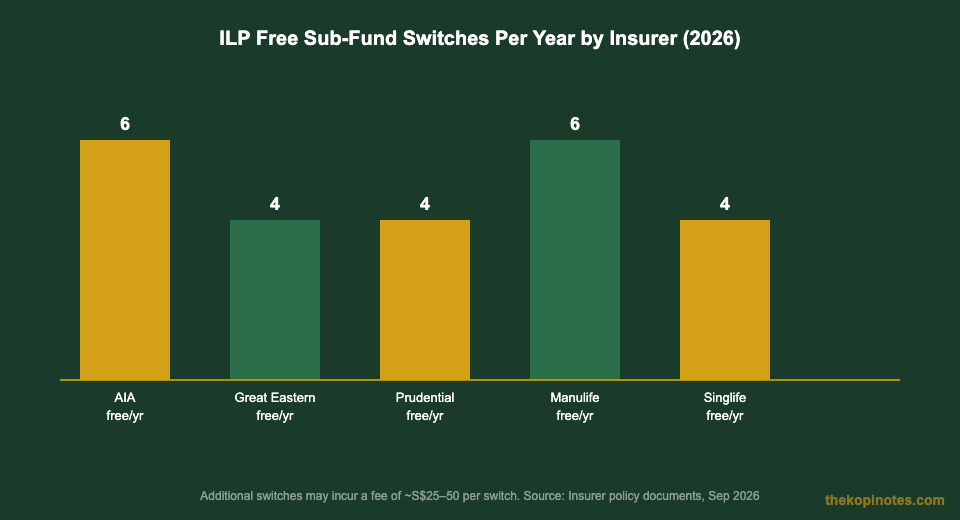
Every major insurer in Singapore allows at least 4 free sub-fund switches per policy year. Here is the current breakdown.
| Insurer | Free Switches / Year | Additional Switch Fee | Processing Time |
|---|---|---|---|
| AIA | 6 | S$25 | 2-3 business days |
| Great Eastern | 4 | S$30 | 3-5 business days |
| Prudential | 4 | S$25 | 2-3 business days |
| Manulife | 6 | S$25 | 2-3 business days |
| Singlife | 4 | S$50 | 3 business days |
Source: Insurer policy documents and customer portals, September 2026. Verify with your own policy document as terms vary by product.
When Should You NOT Switch?
Sub-fund switching sounds straightforward, but reactive trading is a trap. Here are four situations where staying put is usually the better call.
You are in the early years of a regular premium ILP. In the first 5 years, a large portion of your premium pays for insurance charges and distribution costs. Switching actively in this phase adds friction without meaningfully changing outcomes.
The rate move is already priced in. Markets often anticipate Fed moves weeks in advance. If bond prices have already fallen, selling now may mean you realise a loss right before a recovery. Check whether the market had already moved before you act.
You are close to a loyalty bonus milestone. Many ILPs offer loyalty units at specific anniversaries — typically year 10 or year 15. Switching too aggressively can, in some products, disqualify you from these bonuses. Read your policy terms carefully.
The switch fee exceeds the expected gain. If you have used your free switches and the additional cost is S$50, you need the switch to generate at least S$50 in returns just to break even. For small policy values, this arithmetic rarely works.
Better Alternatives Worth Considering
If you are reviewing your ILP and wondering whether there is a better way to invest, the answer often comes down to your goal. ILPs bundle insurance and investment together. If you want pure investment exposure without the insurance wrapper, you typically get lower fees and more flexibility elsewhere.
For CPF-funded investing, Endowus referral code and sign-up bonus (code: 2V343) lets you invest your CPF OA and SRS balances in institutional-class unit trusts at much lower all-in costs than a typical ILP. The platform charges 0.25-0.60% p.a. compared to the 2.5-4.5% RIY of most regular premium ILPs.
For cash-based investing, Syfe referral code and sign-up bonus (code: SRPRFFFCD) offers globally diversified equity and income portfolios with no switching fees and annual costs well below 1%.
That said, if your ILP is already past year 10 and you have built up meaningful cash value, surrendering it early triggers surrender charges and you lose the insurance coverage. The switching strategy in this article is often the smarter move than exiting altogether.
For a full comparison, see our guide on ILP vs Buy Term Invest the Rest. Use the Singapore retirement calculator to model different scenarios for your own planning.
Frequently Asked Questions
Does switching ILP sub-funds have tax implications in Singapore?
How long does an ILP sub-fund switch take?
Can I partially switch ILP sub-funds, or does it have to be all-or-nothing?
What is the Reduction in Yield (RIY) and why does it matter when switching?
Should I surrender my ILP and invest in ETFs instead after the rate hike?
Get Free Insurance Advice
Speak with a licensed insurance advisor. No obligation, no cost.
By submitting this form, you agree to our Privacy Policy.
This article was researched with the help of AI. While we strive to keep all information accurate and up to date, there may be errors. If you notice any discrepancies, please contact us.