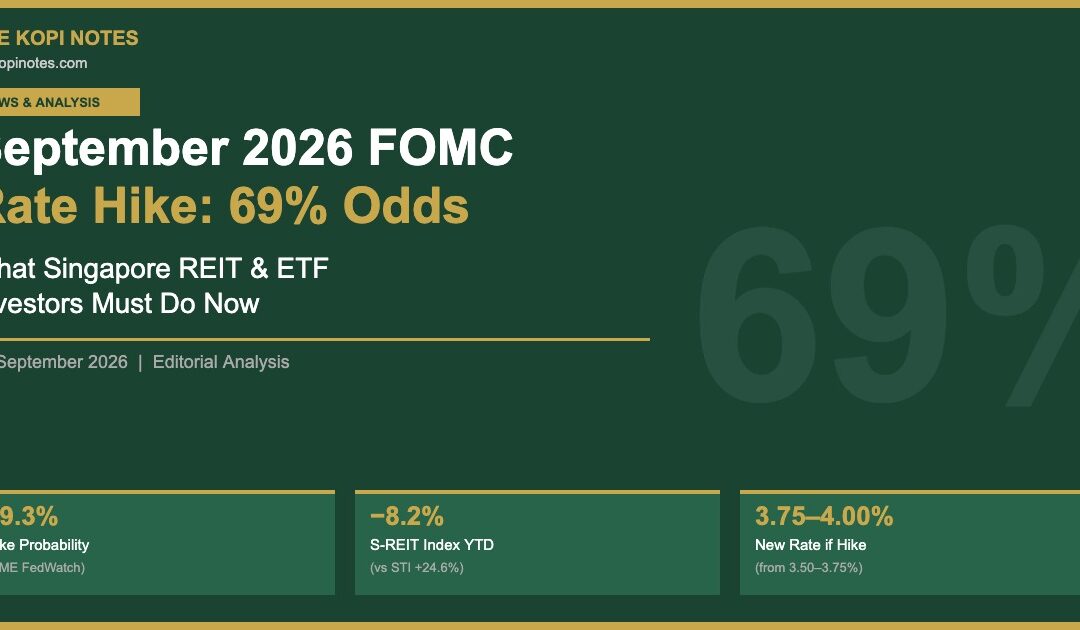
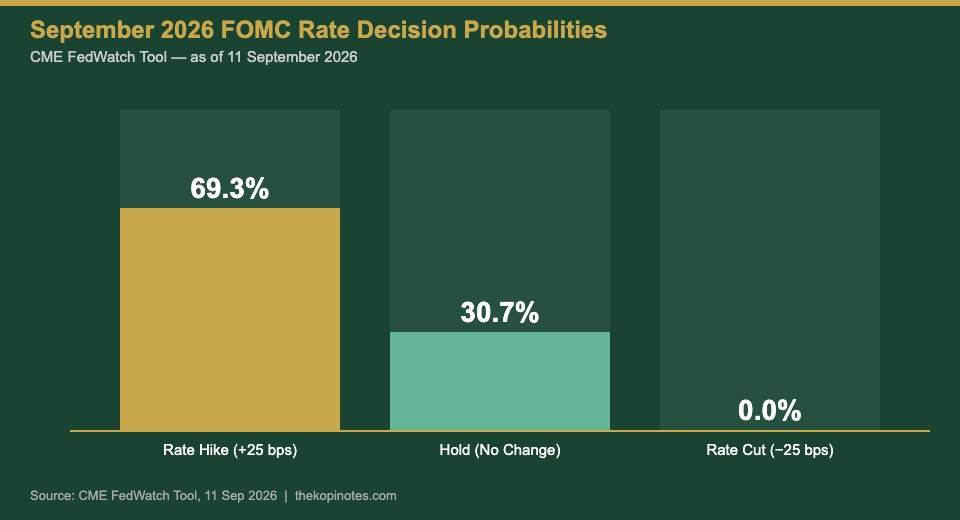
As of September 11, 2026, CME FedWatch is pricing a 69.3% probability that the US Federal Reserve will raise interest rates by 25 basis points at its September 15–16 FOMC meeting — a full reversal from the rate cut expectations that dominated the first half of 2026. If the hike materialises, Singapore REIT investors, ETF holders, and anyone with a floating-rate mortgage will feel the impact within weeks. Here is exactly what you need to know before the decision lands.
This is an editorial analysis. Not financial advice. Data verified as at 12 September 2026.
What the September 2026 FOMC Is Actually Deciding
The Federal Open Market Committee (FOMC) meets on September 15–16, 2026, with Fed Chair Kevin Warsh set to announce the rate decision on September 16 at 2:00 PM ET (September 17, 2:00 AM Singapore time). This is the seventh meeting of the year, and it comes at a pivotal moment.
The Federal Reserve has held its benchmark federal funds rate at 3.50%–3.75% for five consecutive meetings stretching back to late 2025. For most of that period, Wall Street assumed cuts were coming. Inflation was moderating, the labour market was cooling, and the dot plot suggested the Fed would ease before year-end.
That narrative crumbled in the second quarter of 2026.
The US-Iran conflict that erupted in late February 2026 pushed Brent crude oil above US$89 per barrel by mid-2026 — a 24% rise from pre-conflict levels. By early September 2026, fresh vessel attacks in the Strait of Hormuz were threatening to push prices back above US$100. Roughly one-fifth of global oil and gas shipments transit the Strait of Hormuz. When that supply is under threat, energy prices spike, and inflation re-accelerates globally.
The result: what was supposed to be a “rate cut year” for the Fed has become a “will they hike?” drama.
Why the Odds Flipped to a Rate Hike
Three factors shifted the market’s view from “cut” to “hike” in a matter of weeks.
1. Hawkish FOMC dissenters in July. At the July 29 FOMC meeting, the committee held rates steady — but three officials dissented and voted for an immediate 25 bps hike. That level of dissent was unusual and sent a clear signal that patience within the committee is running thin. Fed Chair Warsh acknowledged in the July statement that “inflation remains somewhat elevated” and that future decisions would depend on incoming data and the balance of risks.
2. Warsh’s Jackson Hole signals. At the August Jackson Hole symposium, Fed Chair Kevin Warsh delivered remarks that markets read as unambiguously hawkish. He stressed that the Fed would not allow the energy-driven inflation re-acceleration to become entrenched in inflation expectations. Hike odds, which were below 50% in early August, surged past 69% in the days following his speech.
3. Persistently elevated inflation data. The MAS in Singapore and the Fed in the US are both watching the same numbers: core inflation in Singapore ticked up to 1.6% in June (from 1.4% in May), and the MAS has now tightened monetary policy at both its April and July 2026 review meetings — the first back-to-back tightenings since 2022. Meanwhile, US CPI data released in August showed energy components were leading inflation higher again.
As of September 11, 2026, the CME FedWatch probability breakdown for the September 16 decision is:
September 2026 FOMC Rate Decision Probabilities
Source: CME FedWatch Tool, 11 September 2026
What a Rate Hike Means for S-REIT Investors
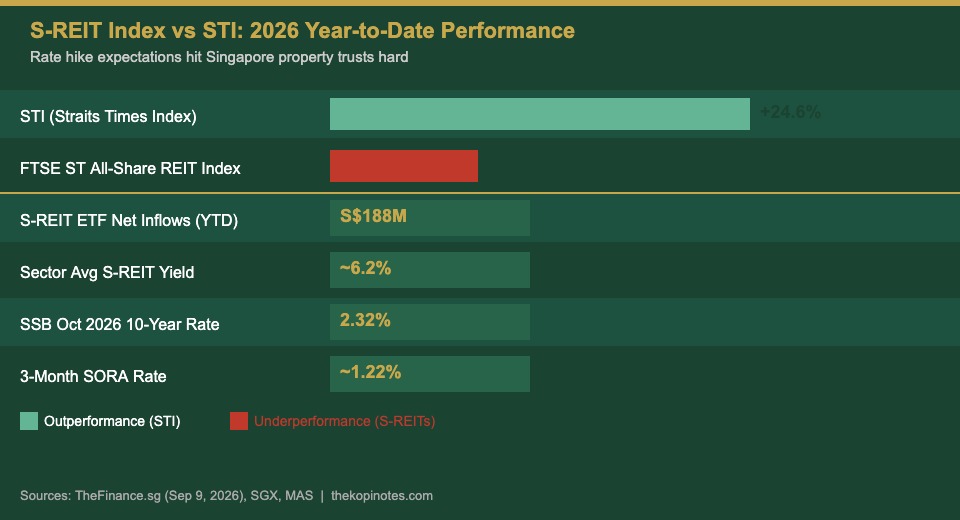
S-REITs have already been pricing in bad news all year. The FTSE Straits Times All-Share REIT Index is down approximately 8.2% year-to-date as of early September 2026, while the broader STI has surged 24.6% over the same period. That divergence tells you exactly where the market is putting rate-risk — squarely on rate-sensitive assets like property trusts.
A confirmed 25 bps rate hike from the Fed on September 16 would have several direct effects on Singapore’s REIT sector:
Higher borrowing costs. Most S-REITs hedge their interest rate exposure, but refinancing cycles mean rising rates eventually work their way into higher interest expenses. Higher borrowing costs reduce distributable income — the money that flows to unitholders as dividends. For REITs with higher leverage, the impact is more pronounced.
SORA will follow. Singapore’s benchmark overnight rate (SORA) currently stands at approximately 1.22% (as of September 4, 2026). SORA tracks global rate conditions with a lag; a Fed hike would add upward pressure on SORA over the coming weeks and months. For S-REITs with floating-rate debt tied to SORA, this translates into a squeeze on distribution per unit (DPU).
Yield spread compression risk. S-REIT yields today range from about 3.4% (Parkway Life REIT) to over 7% for smaller, more leveraged trusts, with the sector average around 6.0%–6.5%. Singapore’s 10-year government bond yield has already risen to 2.32% — a 14-month high. The yield spread between S-REITs and risk-free bonds, currently around 3.7–4.2 percentage points, is wide by historical standards. A rate hike and a further rise in bond yields could narrow this spread, making REITs look less attractive on a relative basis.
Not all S-REITs are equal. The biggest losers in a rate-hike scenario would be highly leveraged trusts or those with significant floating-rate exposure. The relative winners are REITs with fixed-rate debt locked in at lower rates, or those with strong asset quality and rental reversion potential. Explore our High Yield REITs Singapore 2026 guide and S-REIT Outlook 2026 for a sector-by-sector breakdown.
S-REIT Sector Performance vs. STI (Year-to-Date, 2026)
Sources: TheFinance.sg (Sep 9, 2026), SGX data
What a Rate Hike Means for ETF Investors
For Singapore investors holding broad-market ETFs like CSPX (iShares Core S&P 500 UCITS ETF), VWRA (Vanguard FTSE All-World ETF), or IWDA (iShares Core MSCI World ETF), the impact of a rate hike is more nuanced.
On the one hand, a rate hike signals that the US economy is running hot enough to withstand higher borrowing costs. S&P 500 companies in energy, financials, and industrials often outperform in rising-rate environments.
On the other hand, if the hike is driven primarily by a supply-side oil shock (rather than demand overheating), it risks tipping the US into a stagflationary environment — the worst outcome for risk assets. OCBC’s Singapore economics team has flagged rising recessionary risks tied to the Strait of Hormuz disruption, and Singapore’s official GDP growth forecast of 2%–4% for 2026 is already under review.
For SGX-listed ETF investors, the near-term watchpoints are:
- STI ETFs (SPDR STI ETF, Nikko AM STI ETF): Banks typically benefit from higher rates (wider net interest margins). A rate hike may extend bank outperformance vs. the REIT sector.
- S-REIT ETFs (Lion-Phillip S-REIT ETF, AUM S$878 million): Rate-hike headwinds apply. Be prepared for continued short-term unit price pressure.
- Global ETFs (CSPX, VWRA, IWDA): A single 25 bps hike, well-telegraphed at 69% odds, is largely priced in. The bigger risk is a “hawkish hold” where the Fed signals multiple future hikes.
Read our full guide on VWRA ETF for Singapore investors and the July 29 Fed hawkish hold analysis for background context.
SORA, Mortgages, and Your Singapore Loans
The 3-month compounded SORA rate stood at approximately 1.20%–1.26% in early September 2026. This is already nearly double the trough of around 0.65% seen in mid-2025, as the MAS tightening in April and July 2026 worked its way into domestic overnight rates.
A Fed rate hike would add further upward pressure on SORA over the next one to three months. For a Singapore homeowner with a S$1,000,000 floating-rate mortgage on a 25-year term, each 25 bps rise in the borrowing rate translates to roughly S$130–S$150 more per month in interest payments.
Singapore mortgage rates are currently starting from 1.39% p.a. for the best floating packages. If SORA climbs further post-hike, those advertised rates will edge higher at the next repricing date.
For fixed deposit and endowment plan holders, rising rates are actually a tailwind — FD rates have climbed to the 2.50%–3.30% p.a. range across Singapore banks, with the Singapore Savings Bond’s October 2026 10-year rate hitting 2.32%, a 14-month high. Check the SSB October 2026 guide and current fixed deposit rates comparison for the latest numbers.
How to Position Your Portfolio This Week
With the FOMC decision just days away and 69% of market probability pointing to a hike, here is a practical framework for Singapore investors.
If you hold S-REITs directly: Resist the urge to panic-sell. The sector is already down 8.2% YTD and the wide yield spread (3.7–4.2 ppts over government bonds) provides a margin of safety for patient investors. Focus on quality: REITs with fixed-rate debt, high occupancy rates, and rental reversion potential. Review our S-REIT Outlook 2026 for sector rankings.
If you hold S-REIT ETFs: Consider whether your asset allocation was set assuming a rate-cut environment — if so, a modest rebalance toward shorter-duration assets (SSBs, FDs) makes sense.
If you hold global ETFs (CSPX, VWRA, IWDA): A priced-in 25 bps hike is unlikely to derail your long-term dollar-cost averaging strategy. Stay the course. Monitor the Strait of Hormuz situation for oil price escalation risk.
If you have cash to deploy: With FD rates at 2.50%–3.30% and the SSB offering 2.32% for 10 years with zero credit risk, parking fresh funds while waiting for the post-FOMC dust to settle is a legitimate tactical move.
For CPF OA investors: CPF OA’s 2.5% guaranteed rate remains competitive. If you were considering deploying CPF into S-REITs or CPFIS-eligible ETFs, the post-FOMC picture may offer a cleaner entry point. See our guide on building an S-REIT portfolio for methodology.
Bottom Line for SG Investors
The September 16 FOMC rate decision is the single most important macro event for Singapore investors this week. With a 69.3% probability of a 25 bps hike, markets have already largely priced in the outcome. The real risk is not the hike itself but what signals the Fed sends about future hikes — if Warsh signals one or two more hikes before year-end, expect further pressure on S-REITs, bond prices, and rate-sensitive growth stocks.
Singapore’s domestic monetary policy (MAS) has already tightened twice in 2026. The combination of MAS tightening, a potential Fed hike, oil prices near US$100, and a Singapore 10-year bond yield at a 14-month high creates a challenging but navigable environment for long-term investors. Quality, diversification, and keeping cash earning 2.5%–3.3% in FDs/SSBs are the practical responses.
The announcement lands at 2:00 AM Singapore time on September 17. Set your alerts accordingly.
Frequently Asked Questions
What time is the FOMC September 2026 rate decision in Singapore?
The Federal Reserve will announce the September 2026 rate decision on Wednesday, September 16, 2026 at 2:00 PM US Eastern Time (ET). In Singapore Standard Time (SGT, UTC+8), this is 2:00 AM on Thursday, September 17, 2026.
What is the current US federal funds rate in September 2026?
The current US federal funds rate target range is 3.50%–3.75%, maintained since late 2025 through five consecutive unchanged meetings. If the September 2026 hike materialises, the rate would rise to 3.75%–4.00%.
How does a Fed rate hike affect S-REITs in Singapore?
A Fed rate hike typically puts upward pressure on Singapore’s SORA benchmark rate. Higher borrowing costs reduce the distributable income (DPU) that REITs pay to unitholders. REIT unit prices also tend to fall as the yield spread over risk-free government bonds narrows. However, REITs with mostly fixed-rate debt are more insulated than those with floating-rate debt exposure.
What is the current 3-month SORA rate in Singapore?
The 3-month compounded SORA rate stood at approximately 1.20%–1.26% as of early September 2026, having risen from a trough of around 0.65% in mid-2025. A Fed rate hike would add further upward pressure on SORA over the following one to three months.
Should I sell my S-REITs before the FOMC decision?
This is not financial advice, but consider: the S-REIT sector is already down 8.2% YTD and has significantly repriced in anticipation of higher rates. The yield spread versus Singapore government bonds (approximately 3.7–4.2 percentage points) remains wide by historical standards, implying a degree of safety margin. Retail investors have continued buying S-REIT ETFs, with net inflows of S$188 million YTD. Panic-selling after a sector has already declined substantially often results in locking in losses before any eventual recovery.
How does MAS monetary policy differ from the Federal Reserve?
Unlike the Federal Reserve, which controls policy by setting interest rates, the Monetary Authority of Singapore (MAS) manages monetary policy through the exchange rate — by adjusting the slope, width, and centre of the Singapore dollar nominal effective exchange rate (S$NEER) policy band. MAS tightened at both its April and July 2026 meetings by increasing the rate of appreciation of the S$NEER.
Are fixed deposits and Singapore Savings Bonds a good alternative to S-REITs right now?
With Singapore Savings Bond October 2026 10-year rates at 2.32% (a 14-month high) and fixed deposit rates at 2.50%–3.30% p.a. across major banks, cash equivalents are earning meaningful returns. For risk-averse investors, FDs and SSBs offer capital preservation with guaranteed returns. For long-term investors, the wide S-REIT yield spread may still justify holding the sector for income, even with near-term rate headwinds.
This article was researched with the help of AI. While we strive to keep all information accurate and up to date, there may be errors. If you notice any discrepancies, please contact us.