Critical Illness Insurance Singapore 2026: What the Lump Sum Actually Covers (And the Recovery Costs It Doesn’t)
Data verified as at 9 Sep 2026 | Sources: MOH, LIA
Critical illness insurance in Singapore pays a lump sum the moment you are diagnosed with a covered condition at the required severity stage. No hospital bill to submit, no receipts to collect. The money lands in your account and you decide how to use it.
That is where most policyholders stop thinking about it. But the lump sum is not a windfall — it is a replacement for income you will not earn while you recover, plus the medical costs your Integrated Shield Plan will not touch. If you size your critical illness insurance singapore coverage without understanding what the payout is actually for, you will likely underinsure yourself by a significant margin.
This guide walks through exactly what the lump sum is designed to cover, where your ISP draws the line, and the real costs of recovering from a serious illness that most people have never priced out.
1. How CI Insurance Actually Pays Out
Cancer accounts for 26.5% of all deaths in Singapore in 2024. Ischaemic heart diseases account for another 19.6%, and stroke 5.6%. Three conditions alone explain more than half of all deaths here — and all three trigger CI payouts under the LIA’s 37 standardised critical illness definitions.
The key word is diagnosis. Unlike a disability income policy, which requires you to be unable to work, CI insurance pays the moment a doctor confirms your condition at the specified stage. For most advanced-stage claims, the payout arrives within 30 days of claim submission.
What you receive is a single lump sum equal to your sum assured — typically S$100,000 to S$500,000. There is no itemised reimbursement, no co-payment, no waiting for bills to be processed. The insurer pays you, and you decide what the money is for.
That discretion is the feature, not a bug. CI insurance was designed this way precisely because the costs of a serious illness are not just hospital bills.
2. The Three Things CI Is Designed to Cover
Every CI insurance claim should be thought of as covering three separate financial gaps. Most policyholders only think about the first one.
Income replacement. If you earn S$5,000 a month and you are off work for 12 months recovering from cancer treatment, that is S$60,000 of income gone before you count a single medical expense. Your CI payout is what replaces that salary. MediShield Life and your ISP do not pay your salary. Neither does your employer after your sick leave runs out.
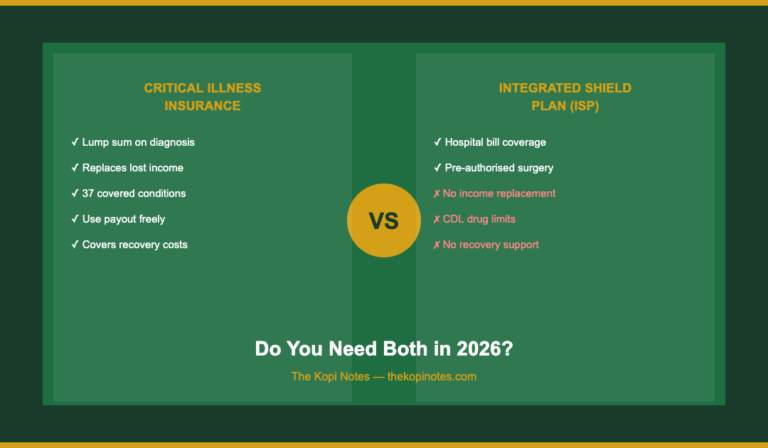
Medical costs above your ISP. An Integrated Shield Plan covers ward charges and surgery at your chosen hospital class. It does not cover all cancer drugs (many newer targeted therapies require pre-authorisation or are excluded outright), outpatient chemotherapy above your plan’s annual limit, or treatments at unempanelled facilities. The CI payout bridges those gaps.
Ongoing debt obligations. Your mortgage, car loan, and credit card minimum payments do not pause because you are in the hospital. A S$2,500/month mortgage continues for the full 12 to 18 months you are unable to work. CI insurance is often the only policy that hands you cash early enough to prevent those obligations from derailing your finances while you recover.
3. Where Your ISP Stops
Singapore’s Integrated Shield Plans are genuinely useful. If you are admitted to a private hospital for surgery, your ISP handles the ward, the operating theatre, and most of the specialist fees. For acute hospitalisation, they are excellent.
The problem starts when you leave the hospital. Here is what your ISP does not cover, even at the highest plan tier.
| Cost category | Covered by ISP? |
|---|---|
| Inpatient surgery and ward charges | ✓ Yes |
| Outpatient chemotherapy / radiotherapy | Partial — varies by plan and drug formulary |
| Home physiotherapy after discharge | ✗ Not covered |
| Home nursing care | ✗ Not covered |
| Foreign domestic worker (caregiver) | ✗ Not covered |
| Mental health counselling / psychology | ✗ Not covered under most plans |
| Home modifications (ramps, grab bars) | ✗ Not covered |
| Income lost during recovery | ✗ Not covered |
Every uncovered item in that table is real money out of your pocket during a period when you are not earning. That is the gap CI insurance is built to fill.
4. The Real Cost of Recovery
Most people price their CI coverage against their salary and their mortgage. Few account for what recovery itself costs month to month. The numbers add up faster than most policyholders expect.
| Recovery cost | Estimated monthly cost (SGD) | Notes |
|---|---|---|
| Home physiotherapy (2×/week) | S$800 – S$1,200 | Private rate ~S$100–150/session |
| FDW caregiver (salary + levy) | S$1,100 – S$1,300 | ~S$800–1,000 salary + ~S$265 levy |
| Mental health counselling (4×/month) | S$600 – S$800 | ~S$150–200/session at private clinics |
| Specialist outpatient follow-up (2×/month) | S$200 – S$500 | Varies by condition and hospital class |
| Home modifications (one-off) | S$3,000 – S$8,000 | Ramps, grab bars, bathroom modifications |
| Income lost (per month, if off work) | Your gross monthly salary | Not covered by any insurer |
Run the numbers over a 12-month recovery period at the conservative end, without counting income replacement: physiotherapy, a caregiver, and occasional counselling alone add up to roughly S$25,000 to S$30,000 that your ISP does not touch. A stroke patient who needs six months of intensive rehabilitation could easily spend S$40,000 to S$60,000 in out-of-pocket costs that no insurer will reimburse.
These figures explain why the LIA’s 2022 Protection Gap Study found that Singaporeans are underinsured for critical illness — not because people skip CI coverage, but because they buy less than they actually need. See our guide on how much critical illness insurance you need for the LIA framework in detail.
5. How to Size Your CI Coverage for Real Recovery
The LIA recommends a CI sum assured of at least 4 times your annual income. That baseline covers income replacement for roughly four years — enough to bridge a serious illness from diagnosis through treatment and back into full employment for most conditions.
But the 4x rule was not designed to include recovery costs on top. Here is a more complete calculation.
| Coverage component | Calculation | Example (S$5,000/month) |
|---|---|---|
| Income replacement (12 months) | Monthly income × 12 | S$60,000 |
| Medical gap (above ISP) | Estimate S$20,000 – S$50,000 | S$30,000 |
| Recovery costs (12 months) | ~S$2,000/month out-of-pocket | S$24,000 |
| Debt obligations (mortgage etc.) | Monthly obligations × months off | S$30,000 |
| Total needed | S$144,000 |
Someone earning S$5,000 a month who buys S$100,000 of CI coverage has already used their entire payout before their first follow-up appointment six months post-discharge. The LIA’s 4x rule implies S$240,000 for this person — which is closer to what the numbers actually require.
If you are considering whether a standard plan, a multi-pay plan, or a CI rider on your term policy provides the right structure, read our comparison: Multi-pay vs single-pay CI insurance in Singapore. For the LIA’s 37 covered conditions and staged definitions, see our LIA 2024 CI framework guide. You can also run the numbers directly in our Insurance Gap Calculator.
The premium cost of S$300,000 vs S$100,000 coverage is significant — our CI cost breakdown by age and coverage amount shows exactly how much more the additional protection costs at different life stages.
Frequently Asked Questions
Can I spend my CI lump sum on anything?
Does my Integrated Shield Plan cover the same things as CI insurance?
How long does a CI claim typically take in Singapore?
What if I recover faster than expected and don't need all the money?
Should I buy more CI coverage if I already have an ISP?
Is there a rule of thumb for how much CI coverage to buy?
Do CI payouts affect my other insurance claims?
What is the difference between a CI standalone plan and a CI rider?
Can I claim CI insurance if I am still working?
Calculate Your Insurance Gap
Use our free tools to size your CI coverage based on your income, mortgage, and recovery cost estimates.
This article is for general information only. It does not constitute financial advice. Insurance needs vary by individual circumstances. Consult a licensed financial adviser before purchasing any insurance policy. All recovery cost estimates are approximate and sourced from public Singapore market data.
Get Free Insurance Advice
Speak with a licensed insurance advisor. No obligation, no cost.
By submitting this form, you agree to our Privacy Policy.
This article was researched with the help of AI. While we strive to keep all information accurate and up to date, there may be errors. If you notice any discrepancies, please contact us.