Keppel DC REIT Portfolio Breakdown 2026: Countries, Tenants & Occupancy Analysis
A deep dive into KDC REIT’s 23 data centres across 9 countries — who the tenants are, where occupancy stands, and what it means for DPU sustainability.
Keppel DC REIT (SGX: AJBU) is Singapore’s largest pure-play data centre REIT, owning 23 data centres across 9 countries with a total AUM of approximately S$4.2 billion as at Q1 2026. The portfolio spans Singapore, Australia, Germany, Netherlands, UK, Ireland, Malaysia, Japan and Italy. With a committed portfolio occupancy of ~97.5% and a weighted average lease expiry (WALE) of approximately 6.2 years, KDC REIT’s income stream is one of the most resilient in the S-REIT universe — underpinned by hyperscale cloud tenants and mission-critical colocation customers.
Not financial advice. All figures are for educational reference only. Data as at Q1 2026 based on KDC REIT’s published results and business updates unless otherwise noted.
Table of Contents
Contents — Click to expand
What Is Keppel DC REIT?
Keppel DC REIT (ticker: AJBU) was listed on the Singapore Exchange (SGX) in December 2014 as Asia’s first pure-play data centre REIT. It is managed by Keppel DC REIT Management Pte. Ltd., a wholly owned subsidiary of Keppel Ltd. The REIT owns and operates a geographically diversified portfolio of data centres that provide colocation, wholesale, and powered-shell space to enterprise, government, cloud, and telecommunications customers.
Unlike many S-REITs that are sector-concentrated in retail or industrial properties, Keppel DC REIT’s assets serve as the backbone of the digital economy — housing servers for cloud computing, artificial intelligence workloads, streaming platforms, and financial institutions. This positions the REIT at the intersection of two secular growth themes: digitalisation and AI infrastructure demand.
As at Q1 2026, KDC REIT has expanded its portfolio to 23 data centres across 9 countries, making it one of the most geographically diversified data centre REITs listed in Asia Pacific. Investors who track the best S-REITs in Singapore 2026 consistently rank KDC REIT as a core holding given its long WALEs, high occupancy, and exposure to the AI-driven data centre demand cycle.
Portfolio at a Glance: Key Statistics
| Metric | Value (Q1 2026) |
|---|---|
| SGX Ticker | AJBU |
| Number of Properties | 23 data centres |
| Countries | 9 (SG, AU, DE, NL, UK, IE, MY, JP, IT) |
| Total AUM (Est.) | ~S$4.2 billion |
| Portfolio Occupancy | ~97.5% (committed) |
| WALE (by revenue) | ~6.2 years |
| Number of Customers | ~79 unique tenants |
| Market Capitalisation | ~S$3.6–3.9 billion |
| Gearing Ratio | ~37–40% |
Source: Keppel DC REIT Annual Report 2025 / Q1 2026 Business Update. Market cap is indicative; check SGX for live data.
Geographic Breakdown by Country
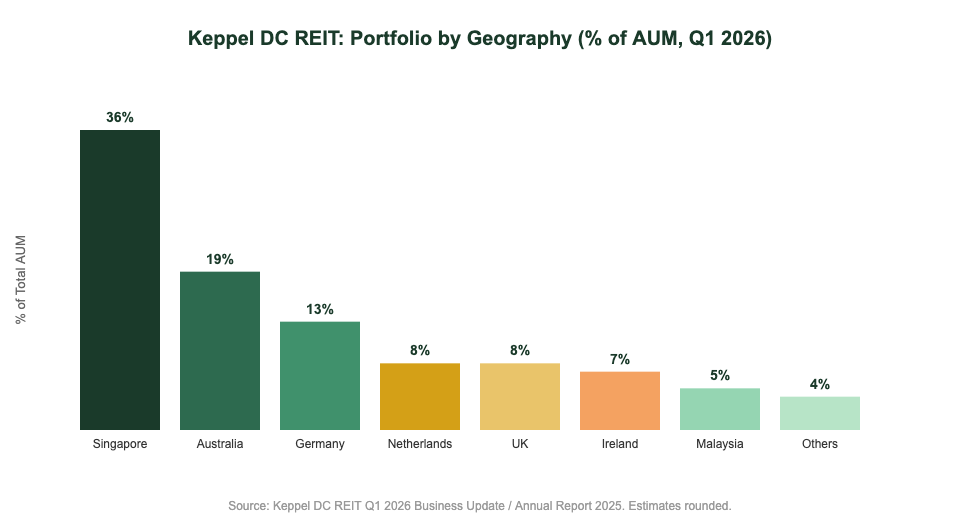
KDC REIT’s global footprint gives it exposure to data centre markets at different stages of maturity. Singapore remains the largest market by AUM (approximately 36%), housing flagship assets like KDC SGP 1 through KDC SGP 6. These Singapore assets benefit from the city-state’s position as Southeast Asia’s premier data centre hub, with strong connectivity to subsea cable networks and a stable regulatory environment under the IMDA’s data centre framework.
Australia (approximately 19% by AUM) is the second-largest market, with assets in Sydney and Melbourne serving major enterprises and government agencies. Europe (Netherlands, Germany, UK, Ireland) collectively accounts for approximately 36% of AUM, driven by hyperscale cloud demand from Amazon, Microsoft, and Google in key continental hubs.
| Country | Data Centres | Est. % of AUM | Key Assets |
|---|---|---|---|
| Singapore | 6 | ~36% | KDC SGP 1–6 |
| Australia | 4 | ~19% | KDC AUS 1–4 |
| Germany | 3 | ~13% | KDC DEU 1–3 |
| Netherlands | 2 | ~8% | KDC NLD 1–2 |
| United Kingdom | 2 | ~8% | KDC GBR 1–2 |
| Ireland | 2 | ~7% | KDC IRL 1–2 |
| Malaysia | 2 | ~5% | KDC MYS 1–2 |
| Japan | 1 | ~2% | KDC JPN 1 |
| Italy | 1 | ~2% | KDC ITA 1 |
Source: Keppel DC REIT Annual Report 2025 / Q1 2026 Business Update. AUM percentages are approximate and rounded.
Top Tenants & Customer Concentration
Understanding who KDC REIT’s tenants are is critical to evaluating its income stability. Unlike retail or office REITs where tenants cycle frequently, data centre leases are exceptionally sticky — once a hyperscaler or enterprise deploys its IT infrastructure in a data centre, the cost and operational disruption of moving is prohibitive. This drives multi-year and often decade-long lease renewals.
KDC REIT’s top customers include major global hyperscalers, telecommunications companies, and managed services providers. Based on available disclosures as at 2025:
| Customer Type | Est. % of Revenue | Key Characteristics |
|---|---|---|
| Hyperscalers (cloud) | ~30–35% | Long-term wholesale contracts, high MW commitments |
| Colocation (enterprise) | ~30–35% | Retail colo, multi-year contracts, diverse industries |
| Telco & ICT | ~20–25% | Carrier-neutral facilities, IX connectivity |
| Government / Public Sector | ~10–15% | Sovereign creditworthy, very long WALEs |
Source: Keppel DC REIT Annual Report 2025. Customer type breakdown is estimated based on disclosed segments.
The largest single tenant is estimated to contribute approximately 14–18% of total revenue — well below the 30% concentration risk threshold. Investors looking to build passive income in Singapore often favour KDC REIT partly for this diversified tenant profile.
Occupancy Rate Analysis by Geography
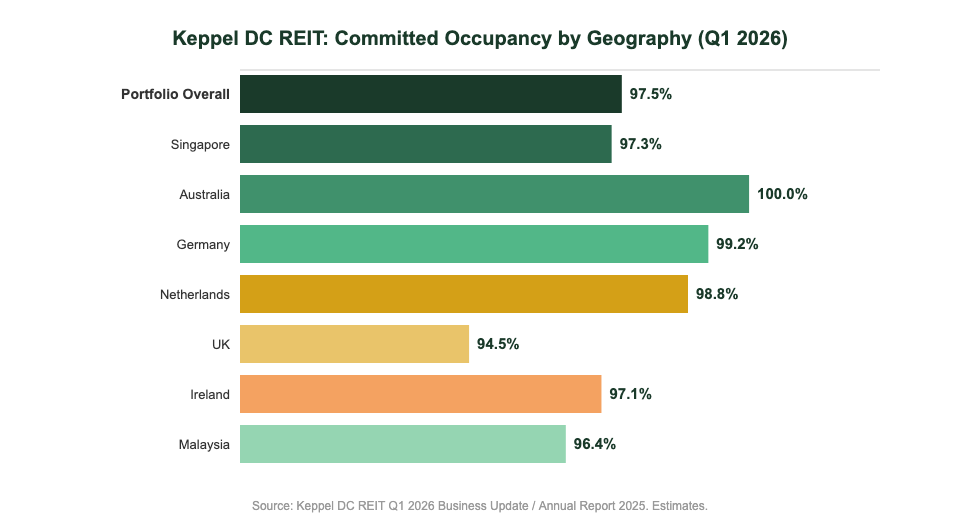
KDC REIT’s ~97.5% committed portfolio occupancy as at Q1 2026 is among the highest of any S-REIT category. Australia is notably at 100% occupancy, reflecting strong cloud and government demand in Sydney and Melbourne. Germany and Netherlands are also near-full at 99.2% and 98.8% respectively — driven by hyperscale expansion in Frankfurt and Amsterdam. The UK sits slightly lower at ~94.5%, partly reflecting lease rollovers at one asset.
Singapore at 97.3% is healthy but is worth monitoring given the government’s data centre moratorium history (lifted in 2022 under IMDA green guidelines). Ongoing supply constraints in Singapore actually support occupancy stability — new supply is tightly regulated, giving incumbents like KDC REIT a structural advantage.
WALE and Lease Expiry Profile
KDC REIT’s WALE of approximately 6.2 years (by revenue) as at Q1 2026 is one of the longest among Singapore REITs — compared to 1.5–3.0 years for retail REITs and 2–4 years for office REITs. A 6.2-year WALE means KDC REIT has a clear, highly predictable income runway extending well into 2031–2032 before any significant re-leasing risk materialises.
Data centre leases also typically include annual rental escalation clauses (commonly 2–3% per annum or CPI-linked) that help protect DPU against inflation — an important feature for investors focused on real income growth. This compares favourably to Singapore office or retail leases, which are often fixed for multi-year periods. For investors building a long-term Singapore retirement income plan, the WALE and escalation combination is a key quality differentiator.
How the Portfolio Drives DPU Stability
KDC REIT’s portfolio characteristics — high occupancy, long WALE, diversified tenants across 9 countries, and rental escalation clauses — translate directly into DPU resilience. Below is an indicative DPU trajectory:
| Financial Year | DPU (Singapore cents) | YoY Growth |
|---|---|---|
| FY2021 | 9.45¢ | — |
| FY2022 | 9.85¢ | +4.2% |
| FY2023 | 9.02¢ | -8.4% (higher financing costs) |
| FY2024 | 9.39¢ | +4.1% |
| FY2025 (Est.) | ~9.80–10.10¢ | +4–8% (AI demand uplift) |
Source: Keppel DC REIT Annual Reports 2021–2024. FY2025 is consensus analyst estimate range, not guaranteed. Past performance does not predict future results.
The FY2023 DPU dip was primarily driven by rising financing costs — not any fundamental weakness in portfolio occupancy. The recovery from FY2024 onwards reflects interest rate stabilisation and renewed AI-driven lease expansion. Investors can track KDC REIT’s income via the Singapore REIT ETF guide for diversified exposure.
Investment Verdict for 2026
KDC REIT’s portfolio is structurally sound: near-full occupancy, a 6.2-year WALE, diversified across 9 countries and multiple customer segments, and directly exposed to the AI and cloud infrastructure supercycle. The main risks to monitor are interest rate sensitivity (gearing ~37–40%), currency headwinds from AUD/EUR, new supply in Singapore from 2025–2027, and top customer concentration (~14–18% of revenue).
For a S$10,000 position in KDC REIT at a hypothetical yield of 4.5% p.a., an investor receives approximately S$450 per year in distributions. This is a useful baseline for comparing against Singapore T-bills and Singapore Savings Bonds for yield-seeking investors. Access KDC REIT through Syfe (code: SRPRFFFCD), FSMOne (code: P0544985), or Endowus (code: 2V343) for fund-based exposure.
Disclaimer: This analysis is for educational purposes only. It does not constitute financial advice. Always conduct your own due diligence and consult a licensed financial adviser before making any investment decision.
Frequently Asked Questions
How many data centres does Keppel DC REIT own in 2026?
As at Q1 2026, Keppel DC REIT owns 23 data centres across 9 countries: Singapore (6), Australia (4), Germany (3), Netherlands (2), UK (2), Ireland (2), Malaysia (2), Japan (1) and Italy (1). The portfolio has grown significantly from 8 assets at listing in 2014, driven by acquisitions in Europe and Asia Pacific. Singapore remains the largest market by AUM at approximately 36% of the total portfolio.
What is Keppel DC REIT's occupancy rate?
KDC REIT’s committed portfolio occupancy is approximately 97.5% as at Q1 2026, making it one of the highest-occupancy REITs on the SGX. Australia is at 100%, while Germany and Netherlands are above 99%. Singapore sits at 97.3%. The overall occupancy has remained above 95% throughout KDC REIT’s listed history, reflecting the mission-critical nature of data centre tenancies and the high cost to tenants of relocating IT infrastructure.
Who are Keppel DC REIT's main tenants?
KDC REIT does not publicly disclose the names of all individual tenants. However, its customer base includes major hyperscale cloud providers, telecommunications companies, enterprise colocation customers, and government bodies. Hyperscalers account for an estimated 30–35% of revenue, with colocation enterprise customers and telcos making up the remainder. The largest single customer contributes approximately 14–18% of total revenue — below the 30% concentration risk threshold.
What is Keppel DC REIT's WALE?
As at Q1 2026, KDC REIT’s WALE is approximately 6.2 years by revenue — one of the longest in the S-REIT sector. This compares with a typical WALE of 1.5–3 years for retail REITs and 2–4 years for office REITs. A long WALE means the income stream is highly predictable over a multi-year horizon. Most data centre leases also include annual rental escalation clauses of 2–3% per annum, providing a built-in DPU growth mechanism.
Is Keppel DC REIT a good long-term investment for Singapore investors?
KDC REIT is widely considered one of Singapore’s highest-quality REITs due to its structural tailwinds (AI, cloud, digitalisation), near-full occupancy, long WALEs, and geographically diversified portfolio. The main risks are interest rate sensitivity and currency translation risk from overseas assets. For long-term dividend investors, KDC REIT offers a balance of income stability and growth potential. However, it tends to trade at a premium to book value, so entry timing matters for yield-on-cost. This is not financial advice — consult a licensed adviser before investing.
Which countries contribute the most revenue to Keppel DC REIT?
Singapore is the largest contributor at approximately 36% of total AUM, followed by Australia at approximately 19%. The European portfolio (Germany, Netherlands, UK, Ireland combined) accounts for around 36% of AUM collectively. While Singapore dominates by headline size, the European assets often contribute disproportionately to income growth given rising data centre rents in Frankfurt, Amsterdam, London and Dublin. The APAC ex-Singapore assets (Malaysia and Japan) are smaller but growing, particularly as cloud providers expand in Southeast Asia.
Start Building Your S-REIT Portfolio
Access KDC REIT and other top S-REITs through leading Singapore brokers and robo-advisors. Use our referral codes for exclusive sign-up bonuses.
This article was researched with the help of AI. While we strive to keep all information accurate and up to date, there may be errors. If you notice any discrepancies, please contact us.