Endowment Plan vs Whole Life Insurance Singapore 2026: Which Builds More Wealth?
A plain-language comparison of Singapore’s two most popular savings-linked insurance products — covering guaranteed returns, premiums, flexibility, and who each product really suits.
An endowment plan is a savings-first product with a fixed tenor (typically 5–20 years) and a guaranteed maturity payout, while whole life insurance is a protection-first product that also builds cash value over your entire lifetime. For most Singapore savers prioritising wealth accumulation over a set timeline, an endowment plan offers more predictable, goal-linked payouts. Whole life insurance suits those who want lifelong death benefit coverage alongside a growing cash value they can tap later in retirement. Data verified as at October 2026.
Not financial advice. All figures are illustrative and for educational reference only. Actual returns depend on your insurer’s participating fund performance and product terms. Always compare benefit illustrations from a licensed financial adviser before committing.
Quick Answer: Endowment Plan vs Whole Life Insurance
Both products are sold by MAS-regulated life insurers in Singapore and both contain a savings element. But they serve fundamentally different financial goals.
An endowment plan is essentially a disciplined savings contract with life insurance attached. You pay premiums for a fixed period, and at the end of the term — say, 10 or 15 years — you receive a guaranteed maturity payout plus non-guaranteed bonuses from the insurer’s participating fund. The coverage period ends at maturity. If you die before the plan matures, your beneficiaries receive a death benefit.
Whole life insurance keeps you covered until age 99 or 100. It also builds up a cash value over time, part of which is guaranteed and part of which depends on the insurer’s participating fund performance. You can surrender the policy for cash, take a loan against it, or let the coverage run for life — giving it far more flexibility than an endowment.
The core trade-off: endowment plans offer clearer, more predictable wealth accumulation milestones; whole life insurance offers permanent coverage and greater long-run flexibility at a higher total cost.
Key Differences at a Glance
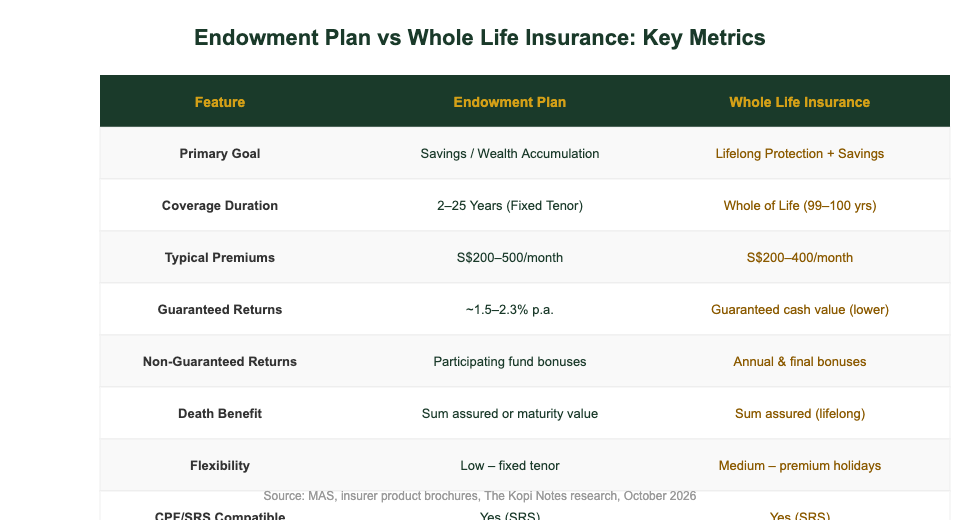
| Feature | Endowment Plan | Whole Life Insurance |
|---|---|---|
| Primary Purpose | Savings accumulation with a defined goal | Permanent life coverage + savings |
| Coverage Period | Fixed tenor: typically 2–25 years | Whole of life (age 99–100) |
| Typical Monthly Premium | S$200–500/month | S$200–400/month |
| Guaranteed Returns | Guaranteed maturity sum (typically ~1.5–2.3% p.a. effective) | Guaranteed cash value (typically lower in early years) |
| Non-Guaranteed Upside | Participating fund bonuses at maturity | Annual and terminal bonuses over policy life |
| Death Benefit | Sum assured or maturity value, whichever is higher | Sum assured (guaranteed for life) |
| Policy Flexibility | Low — early surrender triggers losses | Medium — premium holidays, policy loans available |
| SRS Compatible? | Yes (for eligible products) | Yes (for eligible products) |
| Best Suited For | Goal-specific savers (education fund, home, retirement lump sum) | Breadwinners needing lifelong coverage + legacy planning |
Source: MAS licensed insurer product brochures, Singapore consumer finance guides, October 2026. Figures are indicative ranges only.
What Is an Endowment Plan?
An endowment plan is a participating life insurance product that combines forced savings with a modest death benefit. You commit to paying premiums for a set number of years — the policy term — and at the end, the insurer pays you the guaranteed sum plus whatever bonuses the participating fund has accumulated.
In Singapore, endowment plans are popular for specific financial milestones: building a university fund for a child born today, setting aside a home renovation budget in five years, or locking in a guaranteed lump sum for retirement. The guaranteed maturity sum provides certainty; the non-guaranteed bonuses offer upside.
Structure breakdown: A portion of each premium pays for the death benefit protection, the rest goes into the insurer’s par fund. The par fund is invested in a diversified portfolio of bonds, equities, and other assets managed by the insurer. MAS-regulated benefit illustrations show projected values at assumed returns of 3.00% p.a. (lower illustration) and 4.25% p.a. (upper illustration) — both figures are non-guaranteed.
Common endowment plan features in Singapore include:
- Single-premium vs regular-premium — you can pay a lump sum upfront or spread premiums over 3, 5, or 10 years
- Participating vs non-participating — par plans share in the insurer’s fund performance; non-par plans have fully guaranteed returns but no upside
- Short-term options (2–3 years) — popular during rate-hike cycles as alternatives to fixed deposits, though guaranteed yields are typically lower than T-bills and Singapore Savings Bonds over the same period
For a deeper look at how to structure multiple endowment plans to generate income at different life stages, see our guide on the endowment plan laddering strategy.
What Is Whole Life Insurance?
Whole life insurance is a permanent protection product. Unlike term insurance — which covers you for a fixed period and pays nothing if you survive — whole life keeps you covered until age 99 or 100. In exchange for this lifelong guarantee, the policy builds a cash value over time that you can access during your lifetime.
In Singapore, whole life policies are sold as either participating (par) or non-participating (non-par) plans. Par plans are more common — they share in the insurer’s investment returns through annual and terminal bonuses, making the long-run projected value significantly higher than the guaranteed cash value alone.
The cash value component grows slowly in the early years — your guaranteed surrender value may be less than your total premiums paid for the first decade. This is the key risk of whole life insurance: if your financial circumstances change and you need to surrender the policy early, you could lose a significant portion of what you put in.
The key advantages of whole life over an endowment plan:
- Lifelong protection — no re-underwriting risk if your health changes after age 65, unlike term insurance
- Policy loans — you can borrow against your cash value without surrendering the policy, typically at 5–6% p.a. interest
- Premium holidays — some policies allow you to pause premiums for a period using built-up cash value
- Legacy planning — the death benefit is paid out tax-free in Singapore and can be nominated directly to beneficiaries, bypassing estate administration
If you are unsure how much total life coverage you need before deciding between whole life and term, our Singapore retirement calculator can help you model your long-term income replacement needs.
Returns & Wealth Accumulation Comparison
This is where most Singapore savers get confused: both products belong to the “insurance savings” category, but they accumulate wealth very differently.
Endowment plan returns are most relevant at the maturity date. The guaranteed maturity sum is fixed from day one. On top of that, the insurer credits reversionary bonuses annually — once allocated, these bonuses cannot be taken away, which provides a degree of predictability. A terminal bonus may also be declared at maturity, depending on the par fund’s performance.
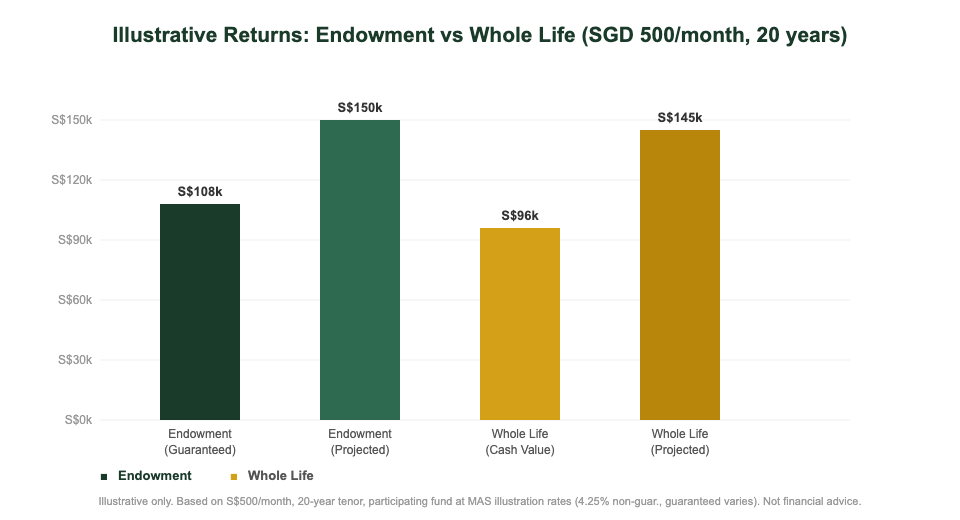
As a worked example: a Singapore resident aged 35 paying S$500 per month into a 20-year regular-premium endowment plan (total premiums: S$120,000) might receive a guaranteed maturity value of around S$108,000–S$115,000, with a non-guaranteed total illustrated value of S$145,000–S$155,000 at the 4.25% illustration rate. This represents an illustrative effective return of approximately 2–4% p.a. — the exact figure depends heavily on the insurer, product structure, and participating fund performance.
Whole life cash value accumulates differently: the focus is on building a sustainable pool that supports the lifelong death benefit, not on maximising the value at any single date. In the early years, the cash surrender value may be only 60–80% of premiums paid. By year 20–25, it typically surpasses total premiums paid, and by retirement age, a well-performing par fund can generate substantial non-guaranteed bonuses.
The key takeaway: endowment plans are better for specific-date wealth targets; whole life plans are better for building a lifelong financial asset that grows in the background. Neither is inherently “better” — they answer different financial questions.
For context on how these insurance savings products compare with investment alternatives, our ILP vs ETF comparison shows how the returns stack up when you include investment-linked policies in the mix.
Premiums, Fees, and Surrender Value
Both endowment plans and whole life insurance carry high early-surrender costs. This is the single most important risk to understand before buying either product.
In the first three years, surrendering an endowment plan will typically return significantly less than your premiums paid — sometimes 40–70% of what you put in. The insurer’s cost structure front-loads agent commissions and policy expenses, meaning you need to hold the plan to near-maturity to realise the full value.
The same applies to whole life insurance. Sun Life’s SunBrilliance Whole Life plan, for instance, structures guaranteed cash values that reach approximately 82% of total premiums paid over the policy’s lifetime, rising to around 100% from the 25th policy anniversary. This means surrendering before Year 25 may result in a net loss relative to total premiums contributed.
The cost differences between the two products:
| Cost Factor | Endowment Plan | Whole Life Insurance |
|---|---|---|
| Premium Commitment Period | Matches policy term (e.g., 10–20 years) | Limited pay (10/20/25 years) or whole life |
| Early Surrender Penalty | High in Years 1–5; gradually reduces | High in Years 1–10; cash value grows slowly |
| Agent Commission | Front-loaded; typically 20–40% of Year 1 premium | Front-loaded; typically higher total commission given longer policy life |
| Annual Management Fee | Embedded in par fund (not disclosed separately) | Embedded in par fund (not disclosed separately) |
| Policy Loan Rate | N/A (plan ends at maturity) | ~5–6% p.a. on outstanding loan balance |
Source: MAS Product Highlights Sheets, insurer product brochures, October 2026. Exact figures vary by insurer and product.
One important consideration: both products can be purchased using Supplementary Retirement Scheme (SRS) funds through eligible insurer platforms. This provides an upfront tax deduction on your SRS contributions and defers tax on the maturity payout until withdrawal — a meaningful advantage for higher-income earners. For a full guide on how to optimise your CPF investment strategy alongside insurance savings products, see our dedicated article.
Who Should Choose Which?
Choose an endowment plan if you:
- Have a specific savings goal with a defined timeline — a child’s university fees in 15 years, a home renovation in 5 years, or a retirement lump sum at 65
- Value predictability: you want to know the minimum you’ll receive at maturity
- Already have adequate term life or whole life coverage for your family’s protection needs
- Are comfortable locking your money away for the full term without needing early access
- Want to complement CPF LIFE with a supplementary lump sum at the same retirement horizon — using SRS funds to fund an endowment can be an effective tax-deferred accumulation strategy
Choose whole life insurance if you:
- Want permanent death benefit protection that doesn’t expire at age 70 or 75 like term insurance typically does
- Have dependants who will need financial support regardless of when you pass away
- Want to build a growing cash value that you can access through policy loans without surrendering coverage
- Are planning for legacy or estate purposes — the death payout is paid directly to nominees outside your estate, avoiding probate delays
- Can commit to premiums for 20–25 years without needing the policy’s cash value in the short term
A common Singapore strategy is to buy term insurance for high protection during your working years (ages 30–65), and separately buy a whole life policy with a limited-pay structure (e.g., pay for 20 years, covered for life) as a forced savings and legacy vehicle. Endowment plans then serve specific savings milestones layered on top. Using the Singapore retirement calculator to model how much guaranteed income you’ll need in retirement helps determine how much endowment savings is sufficient before adding whole life protection.
For Singapore investors who want to explore market-linked growth rather than insurance savings products, our guide on passive income in Singapore covers S-REITs, dividend stocks, and ETFs as alternatives.
Frequently Asked Questions
What is the main difference between an endowment plan and whole life insurance in Singapore?
The key difference is purpose and coverage period. An endowment plan is primarily a savings product with a fixed tenor — you contribute premiums for a set number of years and receive a guaranteed payout at maturity. Whole life insurance is primarily a protection product that covers you for your entire lifetime and also accumulates a cash value. Endowments suit specific financial goals; whole life suits permanent coverage with a long-run savings element.
Which has better returns — an endowment plan or whole life insurance?
Endowment plans typically offer clearer, more easily compared guaranteed returns at a specific maturity date, often in the range of 1.5–2.3% p.a. effective on the guaranteed sum. Whole life policies are harder to compare on returns alone because the cash value grows over a much longer period and includes both guaranteed and non-guaranteed components. If your goal is to maximise wealth at a specific future date, endowments generally provide more predictability. Whole life provides better value if you hold it for decades and factor in the lifelong death benefit.
Can I buy an endowment plan or whole life insurance with my SRS funds?
Yes — eligible endowment and whole life insurance products from MAS-licensed insurers can be purchased using your Supplementary Retirement Scheme (SRS) account. Premiums paid with SRS funds are already part of your annual SRS contribution deduction (up to S$15,300 for Singapore Citizens and PRs), and the maturity payout is only taxed upon withdrawal from your SRS account. This makes using SRS to fund insurance savings products an effective tax-deferral strategy for higher-income earners planning for retirement.
What happens if I surrender my endowment plan or whole life policy early?
Early surrender is the biggest risk of both products. In the first three to five years, your surrender value — the cash you receive back — will typically be well below your total premiums paid due to front-loaded agent commissions, policy expenses, and the time the par fund needs to accumulate. For endowment plans, surrendering before year five can mean receiving only 40–70% of premiums paid. For whole life policies, the guaranteed cash value may not exceed total premiums paid until year ten or later. Never buy an endowment or whole life policy if there is any chance you’ll need the money within five years.
Is whole life insurance worth buying in Singapore in 2026?
Whole life insurance is worth buying in Singapore if you need permanent life coverage beyond age 65 (where term insurance becomes very expensive or unavailable), you have lifelong dependants, or you want to build a growing cash value for legacy and estate planning purposes. It is generally not the best vehicle for pure wealth accumulation compared to a diversified investment portfolio. A common approach is to buy term insurance for high protection during your working years and use whole life for a smaller, permanent coverage layer with a savings element — rather than relying on whole life as your primary retirement savings strategy.
Which is better for retirement planning — an endowment plan or whole life insurance?
For retirement planning, an endowment plan works well as a targeted lump-sum accumulator — for example, setting up a 20-year plan that matures exactly when you turn 65 to supplement CPF LIFE payouts. Whole life insurance, on the other hand, provides both lifelong protection and a growing cash value you can access through policy loans in retirement without surrendering coverage. Many Singapore financial planners recommend layering both: an endowment for a specific lump-sum target, and whole life for permanent coverage. Complement this with the Singapore retirement calculator to model how much guaranteed income you need from these products relative to CPF LIFE.
Build Your Retirement Savings Strategy
Compare all your options — endowments, REITs, ETFs, and CPF — before committing to any single product.
Get Free Insurance Advice
Speak with a licensed insurance advisor. No obligation, no cost.
By submitting this form, you agree to our Privacy Policy.
This article was researched with the help of AI. While we strive to keep all information accurate and up to date, there may be errors. If you notice any discrepancies, please contact us.