How to Start Investing in Singapore as a Student (2026 Guide)
From Regular Savings Plans to robo-advisors — your practical first portfolio guide.
You don’t need a full-time salary to start investing in Singapore as a student. With platforms like moomoo and Tiger Brokers, you can invest from as little as USD $10 per order through Regular Savings Plans (RSPs). Starting even 10 years earlier can more than double your retirement wealth, thanks to compound growth. This guide shows you exactly how to start — safely and cheaply — in 2026.
Not financial advice. All figures are for educational reference only. Data verified as at October 2026.
📋 Contents
Show Table of Contents
Why Starting as a Student Gives You a Huge Edge
The most powerful force in investing isn’t stock picking or market timing — it’s time. The earlier you start, the longer compound growth works for you. And as a student in Singapore, time is your biggest advantage.
Here’s a concrete example: if you invest just SGD $200 per month starting at age 22, and earn an average annual return of 7% (roughly the long-run real return of a globally diversified equity portfolio), your portfolio will reach approximately SGD $520,000 by age 62. Start the same habit at 32, and you’d accumulate just SGD $241,000 — less than half, despite investing for only 10 fewer years.
That gap isn’t because of any special skill. It’s pure mathematics: compounding rewards early starters disproportionately because your gains begin earning their own gains. A 22-year-old student investing $200/month contributes a total of SGD $96,000 in principal over 40 years. Their portfolio at 62 is worth over five times that amount. Every year you wait costs you an increasingly large slice of that multiplier.
Beyond the maths, there are two other reasons students are in a uniquely strong position:
High risk tolerance with few obligations. You likely have no mortgage, no dependants, and a long career ahead of you. This means you can absorb short-term market volatility without being forced to sell at a loss — a luxury that evaporates quickly with life’s responsibilities.
Low barriers to entry in Singapore. With no minimum deposit brokerages, fractional shares, and RSPs starting from as little as USD $10 per order, there’s genuinely no excuse to wait. Singapore also has zero capital gains tax, meaning 100% of your investment growth belongs to you.
The best time to start investing in Singapore is right now. The second-best time was yesterday. Use our Singapore retirement calculator to see what your own numbers look like.
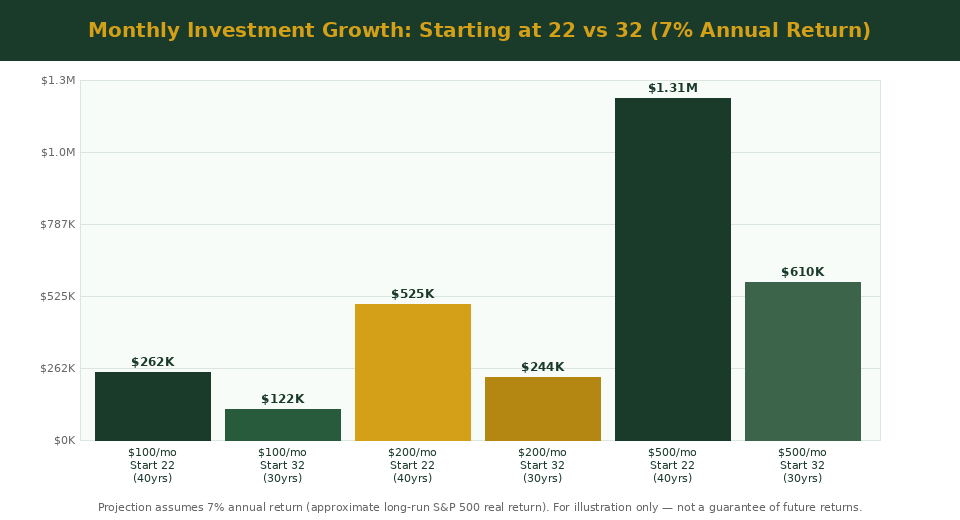
Source: Author calculations at 7% annual return. For illustrative purposes only — not a guarantee of future returns. Data as at October 2026.
How Much Money Do You Actually Need to Start?
One of the biggest misconceptions about investing in Singapore is that you need a large lump sum to get started. The reality is very different in 2026. Here’s a breakdown of starting minimums across the most popular routes:
Regular Savings Plans (RSPs) — from USD $10
moomoo Singapore offers RSPs with a minimum order of just USD $10 (approximately SGD $13), letting you invest in US stocks and ETFs automatically on a weekly or monthly schedule. This is the lowest barrier to entry for ETF investing in Singapore for students. Read our full moomoo Singapore review for an honest breakdown of its features and fees.
Tiger Brokers also offers RSP functionality with competitive minimums, and has a history of running student-friendly promotions including commission-free trades and welcome gifts.
FSMOne offers a Regular Savings Plan starting from SGD $50/month and covers a wide range of unit trusts and ETFs. It’s a good option if you want access to a wider product universe. You can use our FSMOne referral code P0544985 to get started.
Robo-Advisors — from SGD $1
Syfe allows you to start investing with as little as SGD $1 into its Core portfolios, which hold a globally diversified mix of ETFs. You don’t need to choose individual stocks or ETFs — the robo-advisor handles rebalancing automatically. Syfe is ideal for busy students who want a hands-off approach. Get started with Syfe referral code SRPRFFFCD for a fee waiver on your first few months.
Endowus allows you to invest your cash, CPF OA, and SRS savings (if eligible as a working student) with no minimum for cash investments. Use our Endowus referral code 2V343 when signing up.
Singapore Savings Bonds (SSBs) — from SGD $500
SSBs offer guaranteed returns backed by the Singapore Government, with interest ranging based on prevailing rates (currently 2–3% p.a. for the latest tranches, per MAS). The minimum application is SGD $500, and you can redeem early with no penalty. Ideal for your emergency fund or money you may need within 1–5 years. Not recommended as your only investment due to inflation risk over the long term.
T-Bills — from SGD $1,000
Singapore T-bills are short-term government bonds (6-month or 1-year) with very competitive yields. As of October 2026, the cut-off yield on 6-month T-bills fluctuates around 3–3.5% p.a. (verify the latest result on MAS.gov.sg). You apply through your bank’s internet banking with CPF OA funds (if you have them) or cash. This is not growth investing — it’s a better home for your short-term emergency fund than a standard savings account.
Best Investment Options for Students in Singapore
As a student, your priority should be simplicity, low costs, and diversification. Trying to pick individual stocks before you’ve built a foundation usually ends in expensive lessons. Here are the main options — ranked roughly from most suitable for beginners to more advanced:
| Investment Type | Min. Amount | Risk Level | Best For |
|---|---|---|---|
| Robo-advisor portfolios (Syfe, Endowus) | From SGD $1 | Low–Medium | Hands-off beginners who want auto-rebalancing |
| Global ETF via RSP (e.g. CSPX, VWRA) | From USD $10 (moomoo) | Medium | Students who want full control + low fees |
| STI ETF (ES3 / G3B) | ~SGD $3–5/unit | Medium | Singapore exposure; steady dividends |
| Singapore Savings Bonds (SSBs) | SGD $500 | Very Low | Emergency fund or money needed within 5 years |
| T-Bills | SGD $1,000 | Very Low | Short-term (6–12 months) cash parking |
| Individual Stocks | Varies | High | Only after building an ETF foundation first |
Source: Platform websites and MAS, October 2026. Minimum amounts subject to change.
Why Index ETFs Are the Smart Default for Students
The vast majority of professional fund managers underperform their benchmark index over 10+ year periods (this is well-documented in the SPIVA Scorecard published by S&P Global). If experts with Bloomberg terminals and research teams can’t consistently beat the market, the probability that you will as a part-time student investor is very low.
What index ETFs do instead: they capture the market return at minimal cost. A fund like CSPX (iShares Core S&P 500 UCITS ETF listed on the London Stock Exchange) gives you exposure to 500 of the largest US companies with a Total Expense Ratio (TER) of just 0.07% per year. There’s no withholding tax on dividends since it’s an accumulating fund domiciled in Ireland — important for Singapore investors.
For truly global diversification, VWRA (Vanguard FTSE All-World UCITS ETF Acc) covers over 3,700 companies across developed and emerging markets with a TER of 0.22%. Either makes an excellent core holding for a student portfolio.
Want to explore passive income through dividends? Check out our guide to passive income in Singapore 2026.
Best Brokerage Platforms for Student Investors in Singapore (2026)
Choosing your first brokerage matters — fees compound just as returns do, and a confusing platform can put you off investing entirely. Here’s an honest comparison of the top options for Singapore students:
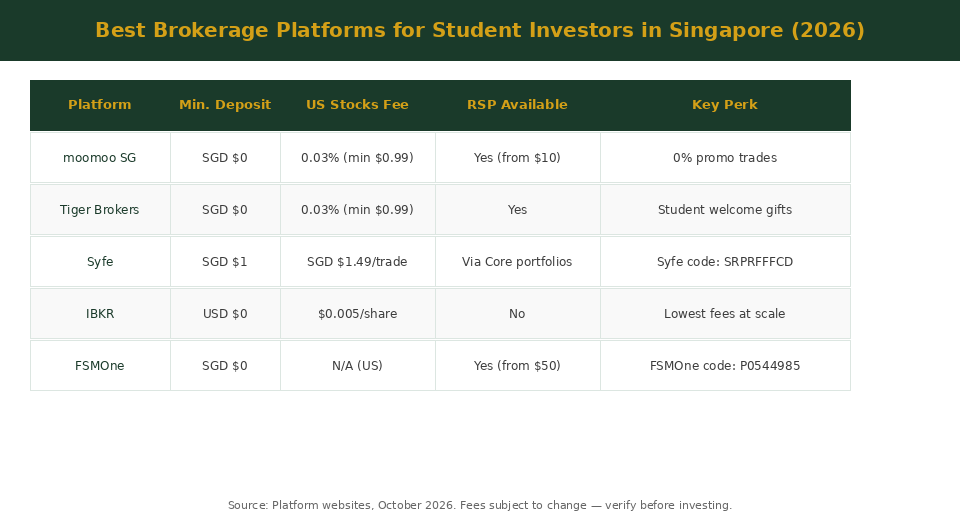
| Platform | Min. Deposit | US Stocks Fee | RSP Available | Key Perk |
|---|---|---|---|---|
| moomoo SG | SGD $0 | 0.03% (min USD $0.99) | Yes, from USD $10 | Promotional commission-free trades for new users |
| Tiger Brokers | SGD $0 | 0.03% (min USD $0.99) | Yes | Student welcome gifts and promotions |
| Syfe | SGD $1 | SGD $1.49/trade (Syfe Trade) | Via Core portfolios (auto-invest) | Fully automated; referral code SRPRFFFCD |
| IBKR (Interactive Brokers) | USD $0 | USD $0.005/share | No | Best for IBKR LSE ETFs (CSPX, VWRA); referral code jianxiong368 |
| FSMOne | SGD $0 | SGD $8.80/trade (US) | Yes, RSP from SGD $50/month | Wide fund selection; referral code P0544985 |
Source: Platform websites, October 2026. Fees subject to change — verify directly with each platform before investing.
Which Platform Should You Choose as a First-Time Student Investor?
If you want the simplest setup: Syfe. Open an account in 10 minutes with SingPass MyInfo, set a monthly auto-transfer, and let the robo-advisor handle the rest. Your money goes into a globally diversified portfolio of ETFs. This removes every decision except “how much each month”.
If you want more control and lower fees: moomoo Singapore. Set up an RSP into CSPX or an S&P 500 ETF, invest a fixed USD amount weekly or monthly, and your fees stay extremely low. Read our moomoo Singapore review before signing up.
If you have $1,000+ and want the absolute lowest long-run costs: IBKR. It has a steeper learning curve but the lowest commissions for buying CSPX and VWRA on the London Stock Exchange — the optimal route for Singapore investors due to Ireland-domicile tax advantages. Use referral code jianxiong368 when signing up.
Step-by-Step: Your First Month of Investing as a Singapore Student
Here’s a practical playbook for going from zero to invested in your first month, without overwhelming yourself:
Week 1: Build Your Financial Foundation First
Before investing a single dollar, make sure you have 3 months of living expenses in a high-yield savings account (e.g., DBS Multiplier, OCBC 360, or UOB One — check current rates before applying). This is your emergency buffer. If your laptop breaks or you lose your part-time job, you should never need to sell investments in a panic at a loss to cover expenses.
As a student with limited income, SGD $3,000–$5,000 in liquid savings is a reasonable target emergency fund. Once you have this, everything above it is eligible for long-term investment.
Week 2: Open Your Brokerage Account
If you’re going with moomoo, Tiger, or Syfe: download the app and open an account using SingPass MyInfo. The KYC process typically takes under 10 minutes and accounts are approved within 1–2 working days. You’ll need to be at least 18 years old and a Singapore citizen, PR, or Employment Pass / Student Pass holder.
Note: SRS (Supplementary Retirement Scheme) investing requires earned income — most full-time students won’t qualify until they start working. CPF OA investing (via CPFIS) is only available to those who already have CPF savings (typically from part-time work while paying CPF). Don’t worry if these don’t apply to you yet — cash investing through a brokerage is the right starting point.
Week 3: Fund Your Account and Set Up an RSP
Transfer a small initial amount — even SGD $100–$200 is enough to start. Then set up an RSP or recurring auto-invest with a fixed monthly amount you can consistently afford. The amount matters less than the habit. SGD $100/month started now compounds to more than SGD $500/month started 5 years from now.
Choose your starting ETF. For most students, one of these two is an excellent starting point:
- CSPX (iShares S&P 500 UCITS ETF, LSE) — large-cap US exposure, TER 0.07%, accumulating (no dividend withholding tax for SG investors)
- VWRA (Vanguard FTSE All-World UCITS ETF Acc, LSE) — global developed + emerging markets, TER 0.22%, accumulating
Week 4: Set Your Review Frequency and Forget It
Schedule a quarterly portfolio check-in — quarterly at most, monthly if you can resist checking daily. Your biggest enemy as a new investor isn’t the market. It’s yourself: selling during a dip, chasing a trending stock, or abandoning your plan because your portfolio is down 15% in a correction. The students who win long-term are the ones who set an RSP, leave it running, and check in a few times a year.
Once your portfolio grows, you can use our Singapore retirement calculator to see whether you’re on track for your long-term goals.
5 Common Mistakes Student Investors Make in Singapore
Avoiding these mistakes will put you ahead of most new investors — including many adults who’ve been “investing” for years:
1. Waiting Until You Have “Enough Money”
The most expensive mistake. There is no minimum threshold to start — SGD $50 in an RSP today is worth more to your future self than SGD $500 invested five years from now. The time cost of waiting always exceeds the benefit of saving up a larger starting amount.
2. Trading Too Frequently
Every trade has a cost: brokerage commission, FX spread, and your own emotional energy. A student who sets up an RSP and ignores it for 10 years will almost certainly outperform one who trades actively every week, net of fees and behavioural errors. Studies consistently show that the more investors trade, the worse their returns.
3. Confusing Speculation with Investing
Buying a meme stock, a crypto token, or a thematic ETF (AI stocks, clean energy, defence) based on what’s trending on social media is speculation. It feels like investing, but it’s closer to gambling if you don’t understand the fundamentals or the risk. Do this only with money you can afford to lose entirely — never as your core savings strategy.
4. Ignoring Currency Risk
CSPX and VWRA are priced in USD. When SGD strengthens against USD, your SGD-denominated returns are reduced. This is a known, manageable risk over long holding periods, not a reason to avoid global ETFs — but it’s worth understanding. Holding some exposure to Singapore-listed assets (like STI ETF) gives you some natural hedge.
5. Investing Money You Can’t Afford to Lock Up
Equities can fall 30–50% and take 2–3 years to recover. If you invest your exam fee, security deposit, or laptop fund, a market downturn can force you to sell at a loss at the worst time. Only invest money you genuinely don’t need for at least 5–10 years. Everything else belongs in savings accounts, SSBs, or T-bills.
Frequently Asked Questions
Can I invest as a full-time student in Singapore?
Do I need to pay tax on investment gains in Singapore?
What is the best investment for a student with SGD $100/month?
Can I use CPF to invest as a student?
Is it safe to start investing during a market downturn?
Should I invest in Singapore stocks or US stocks as a student?
What is a Regular Savings Plan (RSP) and how does it work?
Ready to Start Your Investment Journey?
The best move is the one you actually make. Open a brokerage account, set up a small RSP, and let compound growth do the heavy lifting over time.
This article was researched with the help of AI. While we strive to keep all information accurate and up to date, there may be errors. If you notice any discrepancies, please contact us.