Endowment Plan vs Money Market Fund Singapore 2026: Which Earns More?
In Singapore, endowment plans currently offer 3.20%–4.20% p.a. with lock-up periods of 2–25 years, while money market funds (MMFs) yield approximately 1.04%–1.64% p.a. with full liquidity. Endowment plans earn more — but only if you can commit to the full tenor without early surrender. MMFs are better suited for short-term cash parking where flexibility matters most. Data verified as at October 2026.
Not financial advice. All figures are for educational reference only. Data as at October 2026 unless noted.
What Is a Singapore Endowment Plan?
An endowment plan is an insurance-linked savings product sold by life insurers licensed under the Monetary Authority of Singapore (MAS). You pay premiums — either as a lump sum (single premium) or regularly — and receive a maturity payout at the end of the policy term, which typically ranges from 2 to 25 years.
Endowment plans come in two main structures. Non-participating plans offer a fixed, guaranteed return that is locked in at purchase — what you see is exactly what you get. Participating (par) plans invest in an insurer’s par fund and pay out both a guaranteed component and a non-guaranteed bonus that depends on investment performance.
Singapore’s major endowment plan providers in 2026 include NTUC Income, Etiqa Insurance, Manulife, Great Eastern, AIA, Prudential, and Tokio Marine. Short-term non-par plans (2–5 years) from Etiqa currently offer around 4.0%–4.2% p.a., while NTUC Income’s short-term plans come in at around 3.6%–3.8% p.a. Guaranteed returns on most plans sit in the 3.20%–3.55% p.a. range.
For a comprehensive overview of how endowment plans work, when to buy, and the best options by goal, see our Singapore endowment plan guide 2026.
What Is a Money Market Fund?
A money market fund (MMF) is a type of unit trust that invests exclusively in short-duration, high-quality instruments — Singapore government securities, AAA-rated bank deposits, short-term bonds, and commercial paper. In Singapore, they are regulated by MAS under the Collective Investment Schemes (CIS) framework.
Key features of Singapore SGD MMFs include full liquidity (redeem in 1–2 business days), no lock-up, low minimum investment (typically S$1,000–S$5,000), and near-stable NAV. They are accessible via platforms like Endowus, FSMOne, and Phillip Capital.
The most widely tracked SGD MMFs in 2026 include:
- Fullerton SGD Cash Fund — net yield approximately 1.04% p.a. (as at July 2026)
- LionGlobal SGD Money Market Fund — net yield approximately 1.25% p.a. (as at July 2026)
- Phillip SGD Money Market Fund — annualised return approximately 1.64% (as at February 2026)
MMF yields closely track the Singapore Overnight Rate Average (SORA) and are influenced by the MAS policy rate. In 2025, these same funds returned 2.19%–2.29% p.a. when rates were higher. The 2026 decline reflects easing monetary conditions.
Returns: How Much Do You Actually Earn?
The return gap between endowment plans and money market funds is substantial in 2026. Endowment plans are currently yielding 2–3× more than MMFs on an annualised basis — but that premium comes at a cost: your capital is locked away.
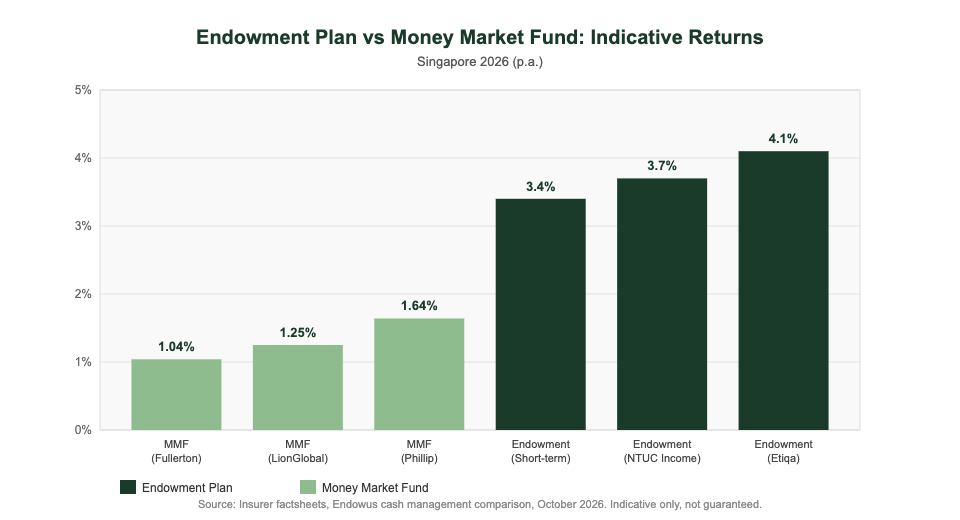
Source: Insurer factsheets, Endowus cash management comparison. October 2026. Indicative only — not guaranteed.
A worked example illustrates the difference clearly. If a Singapore investor parks S$50,000 in a 3-year endowment plan at 3.8% p.a., the maturity payout would be approximately S$55,774 — a gain of roughly S$5,774. The same S$50,000 in a MMF at 1.25% p.a. over 3 years would grow to around S$51,898 — a gain of approximately S$1,898. The endowment plan earns about 3× more over the same period.
However, this comparison only holds if you stay invested for the full term. Surrendering an endowment plan early typically wipes out all accumulated returns and may return less than you paid in. MMFs, by contrast, earn daily accrual from day one and can be redeemed at any point without penalty.
One useful benchmark: the Singapore 6-month T-bill cut-off was 1.92% p.a. at the 24 September 2026 auction. Most endowment plans comfortably beat the T-bill rate — but they require a much longer commitment. If you want Singapore T-bills 2026 guide information on shorter-duration government instruments, that remains a viable alternative between the two.
Liquidity: Can You Access Your Money Early?
Liquidity is where money market funds win decisively. MMFs in Singapore settle in 1–2 business days, have no exit fees, and impose no lock-up whatsoever. You can invest on Monday and redeem on Wednesday with no consequences.
Endowment plans are the opposite. If you surrender within the first 1–2 policy years, you typically receive a surrender value that is less than your total premiums paid — meaning you lose money. Even after year 3, the surrender value may only equal your breakeven amount. Only at or near maturity do you receive the full projected returns.
This illiquidity premium is why endowment plans pay higher returns. You are being compensated for the commitment. The insurer invests your premiums into longer-duration assets (bonds, equities in par funds) that carry higher returns precisely because they match the lock-up tenor.
Practical implication: never put money you might need in the next 2–3 years into an endowment plan. A good rule of thumb is to ensure you have 6–12 months of expenses in liquid instruments (MMFs or fixed deposits) before committing to any endowment plan. Use our Singapore retirement calculator to model how much you need to keep accessible.
Risk and Capital Protection
Both products are low-risk by the standards of the Singapore investing landscape, but they carry different risk profiles.
Endowment plans carry insurance risk — if the insurer becomes insolvent, there is exposure. Singapore’s Policy Owners’ Protection (PPF) Scheme, administered by SDIC, protects policy owners up to S$100,000 of surrender value and S$500,000 of death benefit per insurer. Non-par plans offer a fixed, contractually guaranteed return. Par plans introduce investment risk into the bonus element — non-guaranteed bonuses can be reduced if the par fund underperforms. Historically, major insurers maintain their par fund bonus levels, but they are not contractually fixed.
Money market funds invest in AAA-rated, investment-grade short-term instruments. While they are not capital-guaranteed in the legal sense, the NAV of a Singapore SGD MMF has never “broken the buck” (fallen below S$1 per unit). They are considered near-cash equivalents. MMFs themselves are not covered by SDIC, but the underlying holdings are high-quality government and bank paper.
For investors who cannot tolerate any uncertainty on their capital, a non-par endowment plan with a fully guaranteed return offers stronger contractual protection than an MMF — while paying a significantly higher yield.
Which Should You Choose?
The right choice depends entirely on your time horizon, liquidity needs, and savings goal.
Choose a money market fund if:
- You need access to funds within the next 12–24 months
- You are building or maintaining an emergency fund
- You want a temporary home for cash while deciding on longer-term investments
- You are investing via SRS and want a liquid, low-risk option within the SRS account
- You are retired and need regular income access
Choose an endowment plan if:
- You have a specific savings goal 3–10 years away (wedding, home downpayment, children’s education)
- You want contractually guaranteed returns higher than fixed deposits
- You prefer “set and forget” savings discipline — the lock-up removes the temptation to spend
- You want life insurance coverage built in alongside savings
- You are comparing against other low-risk instruments like SSBs and T-bills
Many Singapore investors use both: an MMF for the liquid portion of their cash reserves, and an endowment plan for a specific medium-term goal. Platforms like Endowus (referral code 2V343) offer access to institutional-priced MMFs at zero access fees, while insurers sell endowment plans directly or through licensed advisers. You can also access MMFs through Syfe (referral code SRPRFFFCD) via their Cash+ platform.
Side-by-Side Comparison Table
The following table summarises the key differences between endowment plans and money market funds for Singapore investors in 2026.
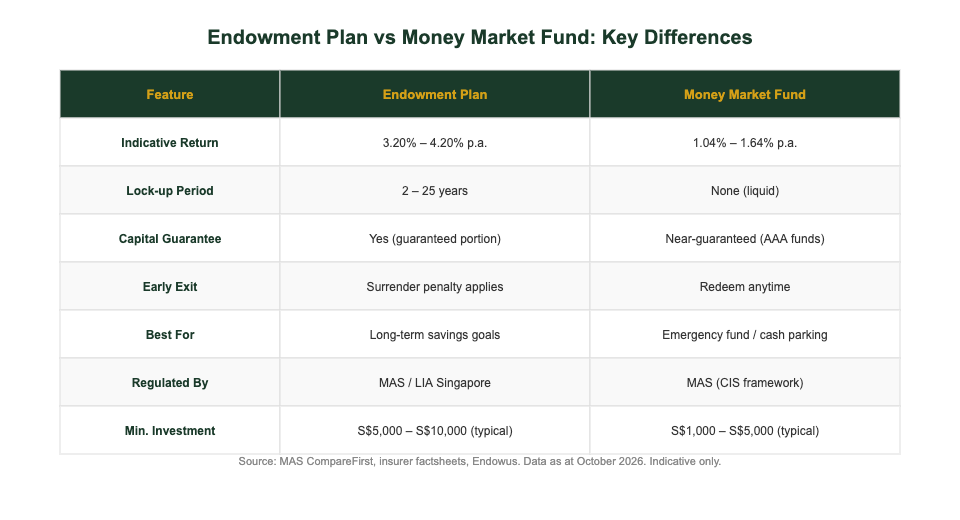
Source: MAS CompareFirst, insurer factsheets, Endowus. October 2026. Indicative only.
| Feature | Endowment Plan | Money Market Fund |
|---|---|---|
| Indicative Return | 3.20% – 4.20% p.a. | 1.04% – 1.64% p.a. |
| Lock-up Period | 2 – 25 years | None (fully liquid) |
| Capital Guarantee | Yes (guaranteed portion; full for non-par) | Near-certain (not legally guaranteed) |
| Early Exit | Surrender penalty; may lose money | Redeem anytime, no penalty |
| SDIC Protection | Up to S$100k surrender value | Not covered (high-quality holdings) |
| Best For | Specific 3–10 year savings goals | Emergency fund / short-term cash |
| Min. Investment | S$5,000 – S$10,000 (typical) | S$1,000 – S$5,000 (typical) |
| Regulated By | MAS / LIA Singapore | MAS (CIS framework) |
Source: MAS CompareFirst, insurer factsheets, Endowus cash management comparison. Data as at October 2026. Indicative only.
Also see our related guides: endowment plan par vs non-par Singapore and endowment plan vs annuity Singapore 2026 for more in-depth comparisons.
Frequently Asked Questions
Is an endowment plan better than a money market fund in Singapore?
What is the average return of a money market fund in Singapore in 2026?
Can I lose money in a Singapore endowment plan?
Are money market funds safe in Singapore?
Should I use SRS to invest in an endowment plan or money market fund?
Which endowment plan has the highest returns in Singapore 2026?
Get Free Insurance Advice
Speak with a licensed insurance advisor. No obligation, no cost.
By submitting this form, you agree to our Privacy Policy.
This article was researched with the help of AI. While we strive to keep all information accurate and up to date, there may be errors. If you notice any discrepancies, please contact us.