Endowment Plan Par vs Non-Par Singapore 2026: Which Structure Gives You More?
📋 Table of Contents
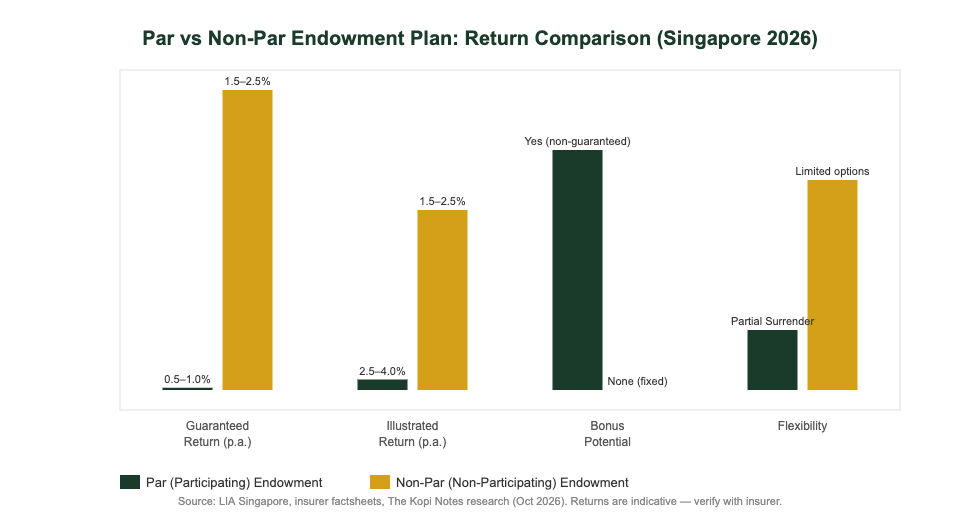
A par (participating) endowment plan pools your premiums into an insurer’s participating fund and shares investment profits as non-guaranteed bonuses on top of a low guaranteed base. A non-par endowment plan locks in a fixed, fully guaranteed return from day one — no bonuses, no surprises. In Singapore 2026, non-par plans typically guarantee 1.5–2.5% p.a. over 3–5 years, while par plans can illustrate 2.5–4.0% p.a. but only guarantee around 0.5–1.0% p.a.
Not financial advice. All figures are for educational reference only. Data as at October 2026 unless noted. Verify current rates with your insurer before committing. Data verified as at 18 October 2026.
If you have ever read an endowment plan brochure, you have almost certainly seen two sets of numbers side by side — one column in bold (the guaranteed payout) and one in grey (the illustrated payout if the insurer performs well). That split is the heart of the par vs non-par distinction, and understanding it can save you from being unpleasantly surprised at maturity.
This guide breaks down exactly how each structure works, what you are and are not promised, and which type fits different financial goals in Singapore.
What Is a Par (Participating) Endowment Plan?
A par endowment plan is structured so that a portion of your premiums goes into an insurer’s participating (par) fund — a pooled investment portfolio that typically holds a mix of bonds, equities, property, and alternative assets. The insurer manages this fund and, each year, declares a reversionary bonus to policyholders based on how well the fund has performed.
The key phrase is “non-guaranteed.” While the insurer illustrates an expected total payout (usually at two rates set by the Life Insurance Association of Singapore, or LIA), the bonus component is not promised. If the par fund has a poor year — say, due to rising interest rates depressing bond prices — the insurer can reduce bonuses or declare none at all.
How the Par Fund Works
In Singapore, the LIA mandates that insurers illustrate par plan returns at two scenarios:
- Upper scenario: 4.25% p.a. — optimistic par fund performance
- Lower scenario: 3.00% p.a. — conservative par fund performance
These are illustration caps, not guarantees. The actual illustrated yield to maturity (the policyholder’s real-money return after costs and distribution charges) typically sits below these caps — often in the 2.5–3.5% p.a. range for a policyholder who holds to maturity.
The guaranteed portion of a par plan is typically much lower — often 0.5–1.0% p.a. in terms of guaranteed IRR. Everything above that relies on the par fund’s performance and the insurer’s bonus declaration discretion.
Recent Par Fund Performance (Singapore 2025)
AIA Singapore’s participating fund returned approximately 10.9% in Singapore dollar terms in 2025, and the insurer declared an increase in bonus and dividend rates for some policies (effective for anniversaries on or after 1 July 2026), according to AIA’s 2025 par fund update. Manulife’s par fund grew to SGD 28.5 billion as at December 2025, driven largely by equity gains.
These are strong numbers — but remember that par fund performance is highly cyclical. A sharp equity sell-off or a prolonged period of rising interest rates can meaningfully reduce future bonus declarations.
What Is a Non-Par (Non-Participating) Endowment Plan?
A non-par endowment plan does not participate in an insurer’s investment fund. Instead, the insurer quotes you a fixed, fully guaranteed payout at maturity. There are no bonuses, no upside surprises, and no downside risks from the insurer’s investment performance. What is shown in the benefit illustration is exactly what you will receive — provided you pay all premiums and hold to maturity.
This makes non-par plans much simpler to evaluate: you compare the guaranteed IRR across products and pick the best rate for your tenor. Non-par plans are popular for shorter tenors (1–3 years) where the guaranteed certainty matters most, or when interest rates are high enough that the guaranteed rate alone is compelling.
What You Give Up with Non-Par
The trade-off is upside. If the insurer’s par fund delivers exceptional returns (as AIA’s did in 2025), par policyholders share in those gains through higher bonuses. Non-par policyholders receive exactly their contracted rate — no more. In a strong equity market environment, par plans can outperform non-par plans meaningfully.
Non-par plans also tend to offer less flexibility. Most do not allow partial surrenders, and surrendering early typically results in losing a portion of the guaranteed return (or even receiving less than total premiums paid in the early years).
Key Differences: Par vs Non-Par Compared
The table below summarises the structural differences between participating and non-participating endowment plans in Singapore.
| Feature | Par (Participating) | Non-Par (Non-Participating) |
|---|---|---|
| Guaranteed return | Low (≈0.5–1.0% p.a. IRR) | Higher (≈1.5–2.5% p.a. IRR in 2026) |
| Non-guaranteed bonus | Yes — from par fund performance | None |
| Illustrated total yield | 2.5–4.0% p.a. (illustrative) | 1.5–2.5% p.a. (guaranteed) |
| Investment risk | Shared with par fund | Borne entirely by insurer |
| Typical tenor | 5–25 years (longer) | 1–5 years (shorter) |
| LIA illustration cap | 4.25% (upper) / 3.00% (lower) | N/A (rate is fixed) |
| Surrender flexibility | Partial surrenders possible in some products | Limited; early exit costly |
| Examples (SG 2026) | Great Eastern Flexi-Cashbook, Manulife ReadyBuilder | AIA #Wealth Savvy, DBS Savvy Endowment, OCBC 2-Year |
Source: LIA Singapore, insurer product brochures, The Kopi Notes research (October 2026). Product availability and rates subject to change.
How Returns Are Calculated in Each Structure
Understanding the mechanics helps you read a benefit illustration without being misled by the headline illustrated figure.
Par Plan: Guaranteed + Reversionary Bonus + Terminal Bonus
A par plan’s total payout at maturity typically comes from three components:
- Guaranteed sum assured — the minimum payout promised regardless of par fund performance. This is the number you should anchor on.
- Reversionary bonus — a non-guaranteed amount declared annually and added to your policy value. Once added, it generally cannot be taken away (though future declarations can be zero or reduced).
- Terminal bonus — a non-guaranteed lump sum declared at maturity or surrender, reflecting the long-term par fund performance. This can be significant for policies held 15–25 years.
For a typical Singapore investor with a 10-year par endowment, the guaranteed IRR might be 0.8% p.a., while the illustrated total IRR (at the LIA 3.00% lower scenario) might be around 2.8% p.a. If you plan to surrender the plan early, the terminal bonus is forfeited, and reversionary bonuses may only be partially vested — which is why understanding the difference between guaranteed and non-guaranteed returns is critical before signing.
Non-Par Plan: Fixed IRR from Day One
With a non-par plan, the maths is straightforward. The insurer tells you: “Pay SGD X in premiums over Y years and receive SGD Z at maturity.” The guaranteed IRR is calculated from those three numbers. There is no illustration scenario, no bonus declaration, and no ambiguity. This is why non-par plans are popular among Singapore investors who want certainty — particularly for short-to-medium goals like an HDB BTO down payment fund or a 3-year bridge before a major expense.
If you are using an endowment plan as part of a broader CPF investment strategy, a non-par plan’s predictable cash flows integrate more cleanly into a retirement cashflow plan.
Worked Example: SGD 50,000 Premium Over 5 Years
Assume a Singapore investor puts a single premium of SGD 50,000 into each plan type for 5 years:
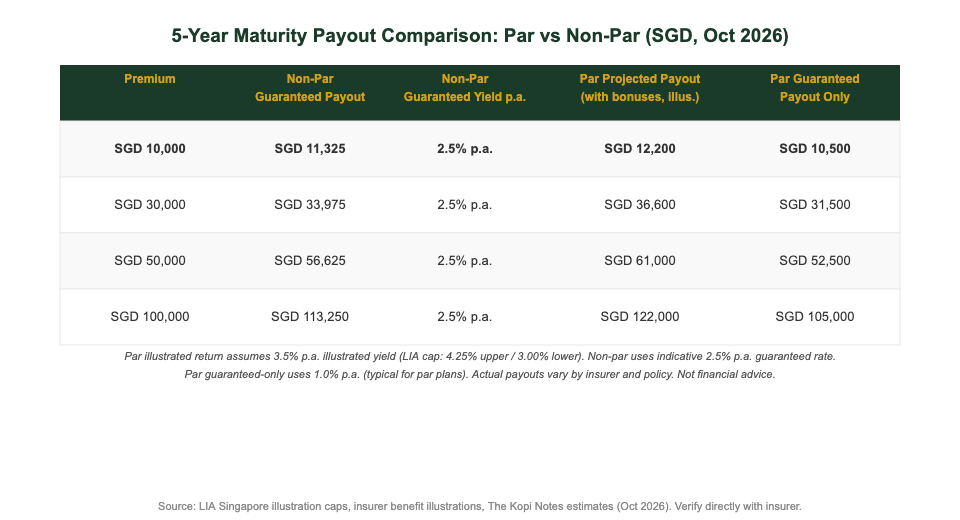
- Non-par plan (2.5% p.a. guaranteed): Receives SGD 56,625 at maturity — certain.
- Par plan (0.8% guaranteed + 3.5% illustrated): Receives SGD 52,050 (guaranteed) to SGD 61,000+ (illustrated with bonuses) — a wide range depending on par fund performance.
The non-par plan’s SGD 56,625 beats the par plan’s guaranteed floor of SGD 52,050, which is why many short-term savers prefer non-par. But if the par fund performs well (as it did in 2025 with AIA’s 10.9% return), the par plan’s total payout could significantly exceed the non-par figure.
Par and Non-Par Products Available in Singapore (October 2026)
The table below lists indicative products in each category. Rates and availability change frequently — always confirm with the insurer or a licensed financial adviser before purchasing.
| Product | Type | Tenor | Indicative Guaranteed Yield | Notes |
|---|---|---|---|---|
| AIA #Wealth Savvy (III) | Non-Par | 2 years | ~3.38% p.a. | Single premium; tranches may close |
| DBS Savvy Endowment | Non-Par | 2–3 years | ~2.5–3.0% p.a. | Regular tranche releases |
| OCBC 2-Year Endowment | Non-Par | 2 years | ~2.0–2.5% p.a. | Popular for short-term savings |
| PRUAssure Growth | Non-Par | 3 years | ~1.7% p.a. | Regular premium option |
| Manulife ReadyBuilder | Par | 10–25 years | ~0.8–1.2% p.a. (guaranteed) | Illustrated: 3.0–4.0% p.a. with bonuses |
| Great Eastern Flexi-Cashbook | Par | 5–20 years | ~0.5–1.0% p.a. (guaranteed) | Bonus varies with Great Eastern par fund |
| NTUC Income Gro Cash Flex Pro | Par | 10+ years | ~0.7–1.0% p.a. (guaranteed) | Cash coupons from year 3; partial surrenders available |
Source: Insurer product brochures and benefit illustrations, blog comparisons (indicative only). Rates as at Q3–Q4 2026; verify directly with insurer. Not financial advice.
If you’re comparing savings vehicles beyond endowment plans, platforms like Endowus (referral code 2V343) and Syfe (referral code SRPRFFFCD) offer unit trust and income portfolios that may suit investors looking for market-linked returns with more liquidity than either par or non-par endowment plans.
Who Should Choose Which?
The par vs non-par decision comes down to three factors: your time horizon, your tolerance for uncertainty, and your existing portfolio composition.
Choose a Non-Par Plan If:
- Your goal is short to medium term (1–5 years): HDB down payment, renovation fund, or emergency buffer
- You need certainty and cannot afford to receive less than projected at maturity
- You want a simple, transparent product without needing to understand par fund mechanics
- You are already exposed to equity risk through REITs, ETFs, or an ILP, and want a risk-free counterbalance
- The current guaranteed rate is high enough to meet your savings target without needing bonuses
Choose a Par Plan If:
- You have a long time horizon (10+ years) and can ride out par fund volatility
- You want some potential upside participation if markets and par funds perform well
- You are comfortable with the illustrated return being non-guaranteed and only anchoring on the guaranteed floor
- You want a product with partial surrender flexibility in later years (some par plans allow this)
- You are building for retirement income — par plans with cash coupons (like NTUC Income’s Gro Cash Flex Pro) can form a passive income layer in retirement
For retirement planning specifically, consider modelling your total projected income using the Singapore retirement calculator to see how an endowment plan maturity payout integrates with your CPF LIFE payouts and other income streams. You can also supplement with passive income strategies — see our guide on building passive income in Singapore for a holistic overview.
A Note on Comparing Par Plans Across Insurers
When comparing par plans, do not simply compare the illustrated total yield — that depends on how optimistic the insurer’s illustration assumptions are, and all insurers must use the same LIA caps (4.25% / 3.00%), so illustrated numbers alone reveal little. Instead, look at:
- Guaranteed IRR — the floor you are sure of
- Par fund track record — how the insurer’s par fund has actually performed historically (check each insurer’s annual par fund statement)
- Bonus smoothing policy — do they smooth bonuses or let them fluctuate year-to-year?
- Terminal bonus transparency — how much of the illustrated return comes from terminal bonus vs reversionary bonus?
For whole-of-life considerations and how endowment plans compare to other protection-savings hybrids, see our breakdown of endowment plan vs whole life insurance in Singapore.
Frequently Asked Questions
Is a par or non-par endowment plan safer?
Neither is “unsafe” in the sense of capital risk — both are regulated insurance products in Singapore and the insurer is obligated to pay the guaranteed sum. However, a non-par plan is more predictable because 100% of your payout is guaranteed. A par plan carries the risk that the non-guaranteed bonus component (which can form a large part of the illustrated payout) is lower than illustrated if the participating fund underperforms. If certainty is paramount, non-par is the safer choice. If you have a long horizon and want upside potential, a par plan’s risk-reward may suit you better.
Can I lose money in a par or non-par endowment plan?
You cannot lose money relative to the guaranteed payout if you hold to maturity. However, you can receive less than your total premiums paid if you surrender a par plan early (particularly in the first few years before bonuses accumulate) or surrender a non-par plan before maturity. For par plans, you can also receive less than the illustrated total payout if par fund performance is poor. Read the surrender value table in your benefit illustration carefully before committing.
What does the LIA illustration cap of 4.25% and 3.00% mean?
These are caps set by the Life Insurance Association (LIA) of Singapore on the rate insurers may use when illustrating future returns on participating plans. The upper scenario (4.25% p.a.) shows a relatively optimistic par fund return; the lower scenario (3.00% p.a.) shows a more conservative assumption. Neither is a guaranteed return — they are standardised scenarios to help policyholders compare products on an apples-to-apples basis. The actual yield to maturity you receive depends on the insurer’s real par fund performance and bonus declarations over the entire policy term.
Which big insurers in Singapore offer par endowment plans?
Most major Singapore life insurers offer par endowment products, including AIA, Manulife, Great Eastern, NTUC Income, Prudential, and Sun Life. Each insurer’s par fund is separate, and performance varies. AIA’s par fund returned approximately 10.9% in SGD terms in 2025; Manulife’s par fund grew to SGD 28.5 billion by end-2025. Check each insurer’s annual par fund performance statement — available on their websites — before comparing par plans across providers.
Are endowment plan payouts taxable in Singapore?
In Singapore, proceeds from life insurance policies (including endowment plans) are generally not subject to personal income tax. This applies to both the guaranteed maturity payout and any bonuses received. However, if you are self-employed and have deducted the premiums as a business expense, the proceeds may be taxable. Always confirm with a qualified tax adviser for your specific situation.
Should I buy a par or non-par plan through a bank or an insurer directly?
Whether you buy through a bank (e.g., DBS, OCBC, UOB offering their branded endowment products) or directly from an insurer, the product terms are the same. The difference lies in the sales process and the adviser’s remuneration structure. Bank-distributed products often have limited product choice (typically one insurer’s range), while going through an independent financial adviser (IFA) gives access to multiple insurers. Regardless of distribution channel, always request a benefit illustration and compare the guaranteed IRR — not just the illustrated figure.
Disclaimer: This article is for informational and educational purposes only and does not constitute financial advice. Past par fund performance is not indicative of future bonus declarations. All endowment plan rates are indicative as at October 2026 and subject to change. Speak to a MAS-licensed financial adviser before making any insurance or investment decision. The Kopi Notes may receive referral compensation from Endowus and Syfe when you sign up using our referral links.
Get Free Insurance Advice
Speak with a licensed insurance advisor. No obligation, no cost.
By submitting this form, you agree to our Privacy Policy.
This article was researched with the help of AI. While we strive to keep all information accurate and up to date, there may be errors. If you notice any discrepancies, please contact us.