Capital Guaranteed Insurance Savings Plan Singapore 2026: Best Plans, Returns & Complete Buyer’s Guide
Your complete guide to capital guaranteed insurance savings plans — how they work, which insurers offer the best returns, and whether they belong in your Singapore financial plan.
A capital guaranteed insurance savings plan is a participating (par) life insurance product that guarantees you will receive back at least 100% of your total premiums paid at the end of the policy term — plus a non-guaranteed bonus from the insurer’s par fund. Sold by insurers such as NTUC Income, Manulife, AIA, Great Eastern, Etiqa and Prudential, these plans target Singapore savers who want capital protection with a higher projected return (3.5–4.5% p.a.) than CPF OA, T-bills or fixed deposits, while keeping their principal safe.
Not financial advice. All figures are for educational reference only. Data as at June 2026 unless noted.
- Capital guaranteed means your premiums are 100% protected — you get back at least what you paid in, regardless of par fund performance.
- Projected (non-guaranteed) returns range from 3.8% to 4.5% p.a. depending on insurer and tenor — higher than SSB, T-bills and fixed deposits as at June 2026.
- Best used for medium-term goals (3–10 years) with a lump sum or regular premium you can commit to — early surrender forfeits capital protection.
Table of Contents
Contents — Click to expand
- What Is a Capital Guaranteed Insurance Savings Plan?
- How Capital Guarantee Works (Par Fund Mechanics)
- Best Capital Guaranteed Plans in Singapore 2026
- Returns: Guaranteed vs Non-Guaranteed Explained
- Surrender Value: What Happens If You Exit Early?
- Capital Guaranteed Plan vs Alternatives
- SRS and CPF Compatibility
- Who Should (and Should Not) Buy?
- How to Buy a Capital Guaranteed Plan in Singapore
- Frequently Asked Questions
What Is a Capital Guaranteed Insurance Savings Plan?
A capital guaranteed insurance savings plan is a type of participating (par) life insurance savings policy offered by MAS-licensed insurers in Singapore. The defining feature is simple: if you hold the policy to maturity, you are contractually guaranteed to receive back at least 100% of the total premiums you paid — no matter how the insurer’s par fund performs.
On top of that guaranteed floor, you receive a non-guaranteed bonus from the par fund. That bonus is based on investment returns from a diversified portfolio of bonds, equities and property that the insurer manages on policyholders’ behalf. The MAS requires insurers to publish two par fund return scenarios — 3.25% (lower) and 4.75% (higher) — so you can model the range of outcomes before you commit.
Capital guaranteed plans differ from regular endowment plans in one key way: not all endowment plans guarantee the full return of premiums. Some guarantee only a portion (e.g. 105% of premiums). A capital guaranteed plan explicitly promises 100% premium recovery at minimum. Always confirm the guaranteed maturity benefit in the product illustration before signing.
These plans are popular among Singapore savers who want more yield than a fixed deposit or SSB but are not comfortable with the volatility of equities or REITs. They sit in the middle of the risk-return spectrum: capital-safe, but with returns that depend partly on insurer discretion.
How Capital Guarantee Works (Par Fund Mechanics)
When you pay premiums into a capital guaranteed insurance savings plan, the insurer pools your money with other policyholders into a participating fund. The par fund invests primarily in investment-grade bonds (typically 60–80%), with the remainder in equities, property and alternative assets. Returns from this fund are distributed to policyholders in the form of reversionary bonuses (added annually) and a terminal bonus (paid at maturity or death).
The capital guarantee is funded through a combination of the insurer’s own reserves and the conservative bond-heavy allocation. Because the guarantee is backed by the insurer’s balance sheet, the financial strength of your insurer matters. Look for insurers with strong MAS solvency ratios (the MAS requires a minimum Financial Strength Rating — check each insurer’s annual report or MoneySense for their risk-based capital ratio).
Here is how the bonus structure typically works:
| Bonus Type | When Credited | Guaranteed? | What Drives It |
|---|---|---|---|
| Reversionary Bonus | Annually | Once declared, yes | Par fund returns |
| Terminal Bonus | At maturity/death/surrender | No | Par fund performance, policy duration |
| Special/Loyalty Bonus | At maturity (some plans) | No | Loyalty for holding to maturity |
| Guaranteed Maturity Value | At maturity | Yes | Contractually fixed at policy inception |
Source: MAS, Life Insurance Association Singapore (LIA), insurer product illustrations, June 2026
Best Capital Guaranteed Plans in Singapore 2026
Here is a side-by-side comparison of the leading capital guaranteed insurance savings plans available in Singapore as at June 2026. All figures are based on published product illustrations using the MAS 3.25%/4.75% par fund scenarios. Guaranteed maturity values assume premiums are paid in full and the policy is held to maturity.
| Insurer | Plan Name | Min Premium | Typical Tenor | Guaranteed Maturity | Projected Return (High) |
|---|---|---|---|---|---|
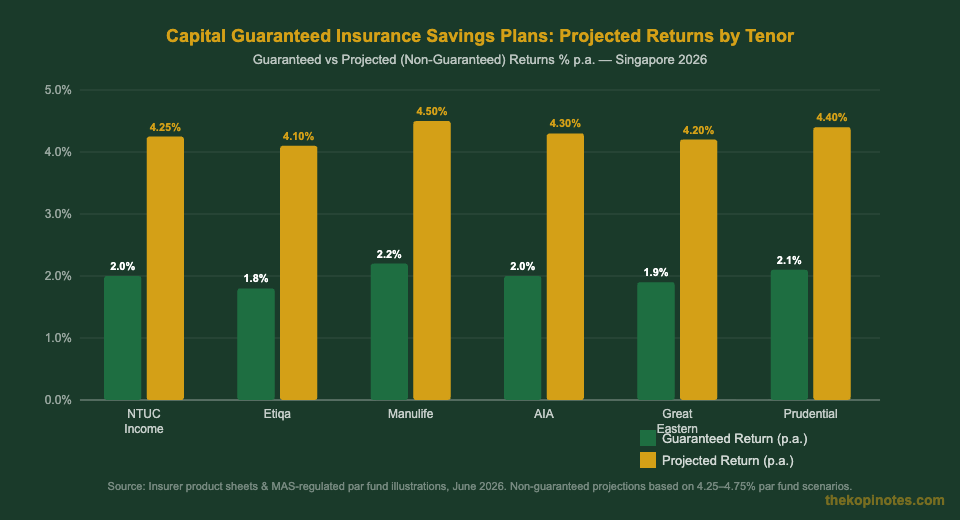
| NTUC Income | Gro Cash Sure | S$5,000 lump | 3–10 years | 100% of premiums | ~4.25% p.a. |
| Etiqa | ePROTECT savings | S$3,000 lump | 2–5 years | 100% of premiums | ~4.10% p.a. |
| Manulife | ManuSave Guaranteed | S$10,000 lump | 5–15 years | 100% of premiums | ~4.50% p.a. |
| AIA | AIA Guaranteed Protect Plus | S$5,000 lump | 5–10 years | 100% of premiums | ~4.30% p.a. |
| Great Eastern | GREAT Capital Sure | S$5,000 lump | 5–10 years | 100% of premiums | ~4.20% p.a. |
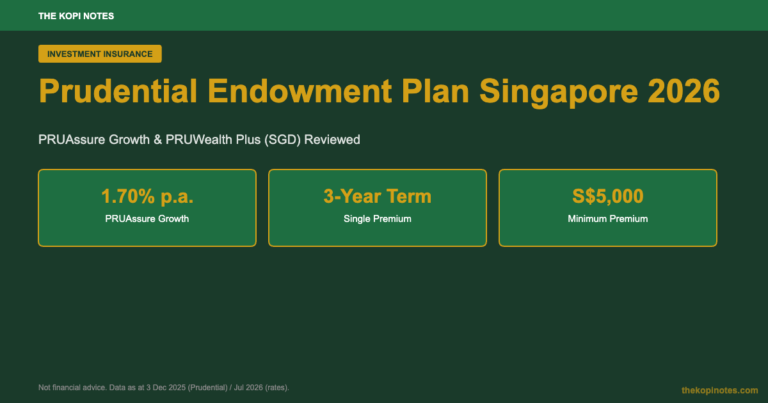
| Prudential | PRUWealth II | S$5,000 lump | 10–20 years | 100% of premiums | ~4.40% p.a. |
Source: Insurer product illustrations, MAS-regulated par fund scenarios (3.25%/4.75%), June 2026. Projected returns are non-guaranteed and depend on par fund performance. Past par fund returns do not guarantee future results.
For context, a Singapore investor placing S$50,000 into Manulife’s ManuSave Guaranteed for 10 years at the 4.75% par scenario would receive approximately S$80,100 at maturity — a gain of S$30,100 (60% total return). At the guaranteed floor alone, you receive S$50,000 back, so your downside is zero if you hold to maturity. This is the core appeal: asymmetric risk with a hard floor.
Returns: Guaranteed vs Non-Guaranteed Explained
The returns on a capital guaranteed plan come in two layers. You need to understand both before committing your money.
The guaranteed layer is fixed at policy inception. It is the contractual minimum payout at maturity — for capital guaranteed plans, this is always at least 100% of total premiums paid. This part is as safe as the insurer’s balance sheet. If the insurer is financially sound (check their MAS risk-based capital ratio), this guarantee is rock-solid.
The non-guaranteed layer is the bonus component. Reversionary bonuses are declared annually by the insurer’s board based on par fund performance. Once declared and credited to your policy, they are treated as guaranteed. However, the terminal bonus — often the largest component at maturity — remains discretionary until the day you claim it.
| Scenario | S$30,000 over 5 yrs | S$50,000 over 10 yrs | S$100,000 over 10 yrs |
|---|---|---|---|
| Guaranteed only (100% return) | S$30,000 | S$50,000 | S$100,000 |
| Low scenario (3.25% par) | ~S$34,800 (+16%) | ~S$65,200 (+30%) | ~S$130,400 (+30%) |
| High scenario (4.75% par) | ~S$37,800 (+26%) | ~S$80,100 (+60%) | ~S$160,200 (+60%) |
Source: Illustrative calculations based on MAS-mandated 3.25%/4.75% par scenarios. Actual returns will vary by insurer, plan, and year. Not a guarantee of future performance.
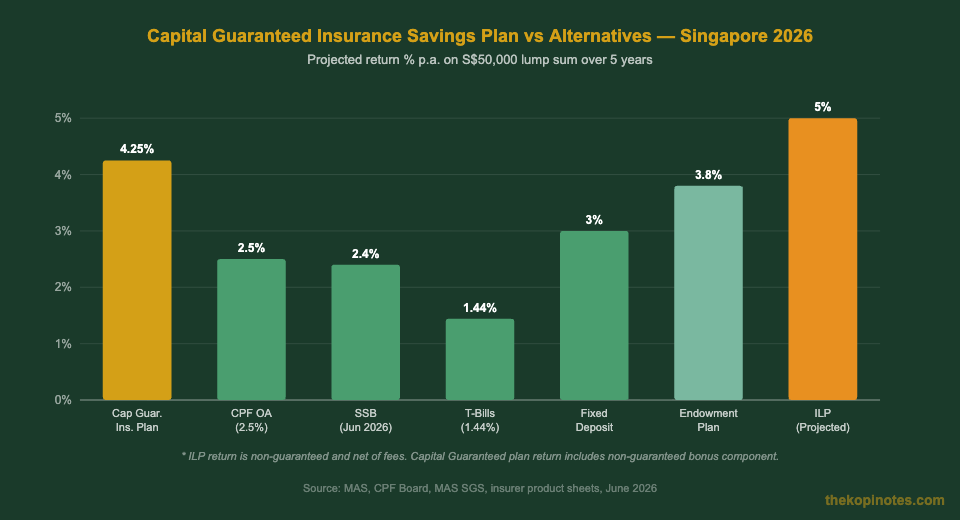
The key takeaway: even in the low scenario (3.25% par fund), you are ahead of what CPF OA (2.5%) and T-bills (1.44% as at June 2026) would have delivered over the same period. The guaranteed floor means you cannot lose principal if you hold to term — making these plans genuinely lower-risk than bonds or equities for the duration they are held. For more on how to compare fixed income alternatives, see our Singapore Savings Bonds guide and Singapore T-bills 2026 guide.
Surrender Value: What Happens If You Exit Early?
The capital guarantee only applies if you hold the policy to maturity. If you surrender early, the guaranteed maturity benefit does not apply. Instead, you receive the surrender value — which in the early years of the policy will be less than the premiums you paid in.
This is the biggest risk of capital guaranteed plans. Life circumstances change. If you need the money in year 2 of a 10-year policy, you could get back as little as 50–70% of premiums paid. Always ensure you are committing money you genuinely will not need until maturity.
| Policy Year | Approx. Surrender Value | vs Premiums Paid | Action |
|---|---|---|---|
| Year 1 | ~50–65% | Loss | Avoid surrendering |
| Year 3 | ~75–85% | Loss | Avoid surrendering if possible |
| Year 5 | ~90–98% | Near breakeven | Consider if urgent |
| At Maturity | ≥100% (guaranteed) | Guaranteed gain | Ideal — hold to term |
Source: Illustrative surrender values based on typical par fund product illustrations, June 2026. Actual values vary by insurer and plan.
One option if you face a cash crunch: some insurers allow you to take a policy loan against your accumulated surrender value — typically at 5–6% p.a. interest. This lets you access funds without fully surrendering, which preserves your capital guarantee. Check with your insurer before making any decision.
Capital Guaranteed Plan vs Alternatives
How does a capital guaranteed insurance savings plan stack up against the other savings and investment options available to Singapore investors? Here is an objective side-by-side.
| Product | Capital Safe? | Return p.a. (2026) | Liquidity | SRS Eligible? | Best For |
|---|---|---|---|---|---|
| Cap Guar. Plan | ✓ Yes (at maturity) | 3.8–4.5% (projected) | Low (penalty if early) | ✓ Yes | Medium-term goals |
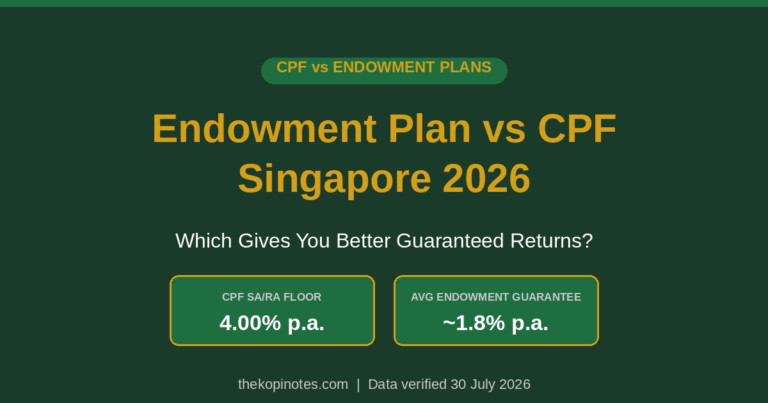
| CPF OA | ✓ Yes | 2.5% | Restricted | N/A | Retirement (CPF) |
| Singapore SSB | ✓ Yes | ~2.4% (Jun 2026) | High (redeem anytime) | ✗ No | Emergency buffer |
| T-Bills (6-month) | ✓ Yes | 1.44% (Jun 2026) | Locked 6 months | ✗ No | Short-term cash |
| Fixed Deposit | ✓ Yes (SDIC) | ~3.0% (1-year) | Locked term | ✗ No | Short-term parking |
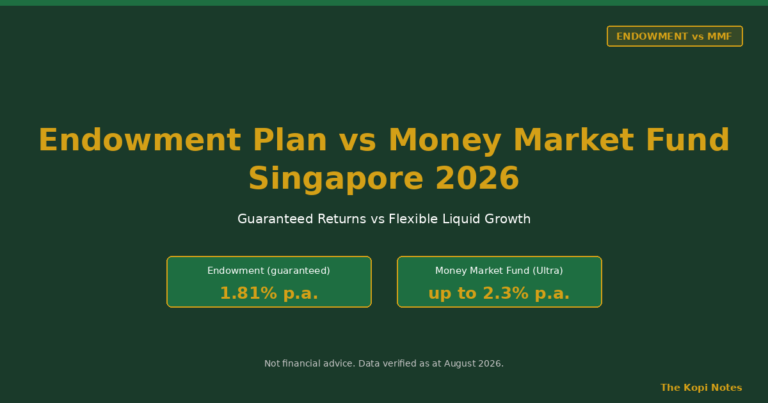
| Endowment Plan | Varies (some <100%) | 3.5–4.0% (projected) | Low | ✓ Yes | Long-term savings |
| S-REITs / ETFs | ✗ No | 5–7% (yield) | High | ✓ Yes (some) | Long-term wealth building |
Source: CPF Board, MAS, DBS/OCBC FD rates, insurer product illustrations, June 2026
The standout advantages of capital guaranteed plans over SSB and T-bills: significantly higher projected returns (up to 4.5% vs 1.44%) and SRS eligibility — which SSBs do not offer. The trade-off is liquidity: you must be willing to lock your money in until maturity to actually receive the capital guarantee. If you might need the money earlier, consider the Singapore Savings Bonds guide — SSBs allow penalty-free early redemption. For investors building broader passive income in Singapore, capital guaranteed plans can form the capital-protected core of a barbell portfolio alongside higher-yield S-REITs or dividend stocks.
SRS and CPF Compatibility
Capital guaranteed insurance savings plans are SRS-eligible. This is one of their most tax-efficient features for working Singapore residents. By funding a capital guaranteed plan using your Supplementary Retirement Scheme (SRS) account, you get a tax deduction on the contribution (up to S$15,300/year for Singapore citizens and PRs) while earning a competitive projected return on the saved amount.
For example, if you are a Singapore resident in the 11.5% income tax bracket and you top up S$15,300 into SRS and immediately deploy it into a capital guaranteed plan, you save approximately S$1,760 in income tax that year — before any investment return. Your effective first-year yield from tax savings alone is 11.5%. Combined with the 4–4.5% projected plan return, the blended yield in year 1 is exceptional. Use our SRS tax savings calculator to model your exact tax benefit.
Important SRS rules to note: withdrawals from SRS at statutory retirement age (currently 63) are subject to 50% tax concession — meaning only half the amount is taxable. If you spread withdrawals over 10 years, the effective tax rate can be very low. Capital guaranteed plans maturing after age 63 are ideal for this strategy. Also consult our CPF investment strategy guide for how CPF and insurance savings plans interact.
CPF compatibility: capital guaranteed insurance plans are generally not CPFIS-eligible. You cannot use CPF OA or SA to buy most par savings plans. A small number of par products are on the CPFIS-approved list — check the CPF Board website for the current list before assuming eligibility. For CPF-compatible investment options, see our dedicated CPF investment strategy guide.
Who Should (and Should Not) Buy?
Capital guaranteed insurance savings plans are the right product for a specific investor profile. They are not for everyone.
| Investor Profile | Suitable? | Reason |
|---|---|---|
| Conservative saver who wants more than FD/SSB without market risk | ✓ Yes | Capital protected + higher projected yield |
| SRS investor seeking tax-efficient returns near retirement | ✓ Yes | SRS eligible, tax deduction + projected return |
| Saver with a specific medium-term goal (e.g. child’s education, home renovation in 7–10 years) | ✓ Yes | Defined maturity date matches goal timeline |
| Investor who may need liquidity within 2–3 years | ✗ No | Early surrender value below 100% of premiums |
| Growth investor willing to accept volatility for higher returns | ✗ No | S-REITs or ETFs offer higher long-term return potential |
| Someone with no emergency fund yet | ✗ No | Lock-up period means you cannot access funds in emergencies |
A sensible allocation strategy: if you have S$100,000 in savings earmarked for medium-to-long-term goals, consider allocating 30–40% to a capital guaranteed plan (capital-protected foundation), 30–40% to best S-REITs in Singapore 2026 or dividend ETFs (income growth), and keeping 20–30% in SSBs or high-yield savings for liquidity. Use the Singapore retirement calculator to model how this allocation serves your retirement timeline.
How to Buy a Capital Guaranteed Plan in Singapore
There are two main routes to buying a capital guaranteed insurance savings plan in Singapore.
Route 1: Through a Financial Adviser (FA) — An MAS-licensed FA can compare plans across multiple insurers, advise on SRS funding strategy, and handle the paperwork. This is the most common route. Ensure your FA provides a product comparison across at least three insurers, and always read the Product Summary and Benefit Illustration before signing. Key things to verify: the guaranteed maturity value (must be ≥100% of premiums), the illustrated surrender value timeline, and any exclusion clauses.
Route 2: Direct Purchase (DPI) — Some insurers (NTUC Income, Etiqa) offer direct purchase channels online or at their service centres without going through an FA. You will not receive advice, but you also avoid any sales commissions that may be embedded in the premium. This suits experienced investors who already know what they want.
For investors using an online robo-adviser, platforms like Endowus (referral code: 2V343) and Syfe (referral code: SRPRFFFCD) offer insurance savings products alongside their investment portfolios, allowing you to manage everything in one place. Both platforms allow SRS and CPF-OA funding where applicable. You can also consider MariBank (referral code: 2DCT80WQ) for short-term cash parking alongside your longer-term insurance savings plan.
6-step buying checklist:
- Define your goal: how much do you need, by when?
- Check SRS eligibility and top up SRS if you have not used this year’s cap (S$15,300 for citizens/PRs).
- Compare at least 3 plans using MoneySense’s comparison tools or an FA.
- Read the Benefit Illustration — check guaranteed maturity value and the 3.25%/4.75% scenarios.
- Confirm you will not need the money before maturity (check your emergency fund is funded first).
- Sign and submit the application — a 14-day free-look period is required by law. You can cancel within 14 days for a full premium refund.
Disclaimer: The Kopi Notes may earn referral fees from the platforms linked above. This does not affect our editorial independence. All product information is verified from primary sources as at June 2026.
Frequently Asked Questions
What does 'capital guaranteed' mean in an insurance savings plan?
Capital guaranteed means that if you hold the policy to its maturity date, the insurer contractually guarantees you will receive back at least 100% of the total premiums you paid. You cannot lose your principal — as long as you do not surrender the policy early. Any bonus component (reversionary or terminal bonus) earned on top of this is non-guaranteed and depends on the par fund’s performance.
Are capital guaranteed insurance savings plans safe in Singapore?
Yes, with two important caveats. First, the capital guarantee is backed by the insurer’s balance sheet — you need to choose a financially strong insurer with a healthy MAS risk-based capital ratio. All Singapore life insurers are regulated by MAS and are required to maintain adequate reserves. Second, the guarantee only applies at maturity. If you surrender early, you may receive less than your premiums. Singapore insurance plans are also covered by the Policy Owners’ Protection Scheme (PPFS), which protects up to S$500,000 in guaranteed benefits per policyholder if an insurer fails.
Can I use my SRS funds to buy a capital guaranteed insurance savings plan?
Yes. Capital guaranteed insurance savings plans are SRS-eligible. You can fund your plan using your SRS account balance. This is a tax-efficient strategy — your SRS contributions are tax-deductible up to S$15,300 per year (Singapore citizens and PRs), and SRS withdrawals from age 63 benefit from a 50% tax concession. Many investors use an SRS-funded capital guaranteed plan as the conservative anchor of their retirement portfolio.
What happens if I surrender my capital guaranteed plan early?
If you surrender before maturity, the capital guarantee does not apply. You receive the surrender value instead, which is typically below 100% of premiums in the first few years. For example, surrendering in year 2 of a 10-year plan may return only 60–70% of your premiums. The surrender value increases over time and approaches 100% as you near maturity. Always check the surrender value table in your Benefit Illustration before buying, and only commit money you genuinely will not need until the policy matures.
How do capital guaranteed plans compare to Singapore Savings Bonds (SSBs)?
Both are capital-safe products, but they differ in key ways. SSBs currently yield around 2.4% p.a. (June 2026) and can be redeemed at any time without penalty — making them ideal for liquidity. Capital guaranteed plans offer higher projected returns (3.8–4.5% p.a.) but lock your money in until maturity. SSBs are not SRS-eligible; capital guaranteed plans are. If you need flexibility, SSBs win. If you can commit for 5–10 years and want higher returns with tax efficiency via SRS, a capital guaranteed plan is likely better.
Which insurer has the best capital guaranteed savings plan in Singapore 2026?
As at June 2026, Manulife’s ManuSave Guaranteed offers the highest projected return at approximately 4.50% p.a. under the high scenario, followed by Prudential PRUWealth II at ~4.40% and AIA Guaranteed Protect Plus at ~4.30%. However, the best plan depends on your tenor, premium amount, and whether you are funding via SRS or cash. Always compare at least three plans using an MAS-licensed financial adviser or MoneySense’s product comparison tools before committing.
Is the non-guaranteed bonus actually paid out in practice?
Most of the time, yes. Major Singapore insurers (NTUC Income, AIA, Manulife, Great Eastern, Prudential) have strong track records of paying out bonuses close to the illustrated projections. However, during periods of very low interest rates (2020–2022), some insurers reduced reversionary bonus rates. The non-guaranteed component is genuinely discretionary. For planning purposes, it is prudent to model based on the lower 3.25% par scenario as your baseline and treat the upside as a bonus.
Can I buy a capital guaranteed plan with CPF funds?
Generally, no. Most capital guaranteed insurance savings plans are not on the CPFIS (CPF Investment Scheme) approved list, which means you cannot use your CPF OA or SA funds to purchase them. A small number of participating par products are CPFIS-approved — check the CPF Board’s official CPFIS-approved investment list before assuming. If CPF-compatible investing is your priority, focus on CPF-eligible ETFs such as the Lion-Phillip S-REIT ETF (CLR) or direct SGX-listed securities via CPFIS-OA.
Ready to Grow Your Savings Tax-Efficiently?
Use SRS funds to maximise your capital guaranteed plan returns. Sign up via our referral links for exclusive bonuses.
Get Free Insurance Advice
Speak with a licensed insurance advisor. No obligation, no cost.
By submitting this form, you agree to our Privacy Policy.
This article was researched with the help of AI. While we strive to keep all information accurate and up to date, there may be errors. If you notice any discrepancies, please contact us.