Medisave for Home Nursing & Long-Term Care in Singapore (2026 Guide)
What you can claim for home care, MediSave Care, palliative services, and nursing homes — verified from MOH and CPF Board.
Medisave can be used to pay for home nursing visits, palliative care, long-term disability support, and nursing home fees in Singapore — but the rules differ for each service. Under MediSave Care, severely disabled Singaporeans aged 30 and above can withdraw up to $200 per month from their Medisave Account (MA). For home palliative care, there is no withdrawal limit when using your own MA. Here is exactly what each scheme covers and how to apply in 2026.
Not financial advice. All figures are for educational reference only. Data verified as at 26 September 2026 against MOH and CPF Board official sources.
Table of Contents
Contents — Click to expand
- What Counts as Home & Long-Term Care Under Medisave?
- MediSave Care for Severe Disability (Up to $200/Month)
- Home Palliative Care — Medisave Limits Explained
- Home Ventilation and Paediatric Home Care
- Nursing Homes: Costs, Subsidies & Medisave
- Flexi-Medisave for Seniors (60 and Above)
- How to Apply: Step-by-Step
- Your ISP and the Long-Term Care Gap
- Frequently Asked Questions
What Counts as Home & Long-Term Care Under Medisave?
Most Singaporeans know Medisave covers hospitalisation and surgery. Far fewer realise it also funds a range of home-based and long-term care services — a growing concern as Singapore’s population ages rapidly.
The Ministry of Health (MOH) groups Medisave-eligible home and long-term care into five main buckets:
- MediSave Care — monthly cash support for severe disability (30 years and above)
- Home palliative care — end-of-life nursing and medical support at home or in day hospice
- Home ventilation — mechanical breathing support for ventilator-dependent patients
- Paediatric home care — nursing and medical care for children with complex conditions at home
- Nursing home stays — inpatient residential care for the severely disabled or frail elderly
Your CPF Medisave Account — the healthcare savings component of your CPF — funds all of the above within the limits set by MOH. An Integrated Shield Plan rider generally does not cover long-term or home care, which makes understanding these Medisave rules especially important for families with ageing parents or disabled loved ones.
For a comprehensive look at all approved medical uses, see our full list of Medisave-approved treatments in 2026.
MediSave Care for Severe Disability (Up to $200/Month)
MediSave Care is a monthly withdrawal scheme for Singaporeans and PRs aged 30 and above who have severe disability — defined as being unable to perform at least three of six Activities of Daily Living (ADLs) independently.
The Six ADLs Assessed
To qualify, a MOH-accredited evaluator must confirm the person cannot perform three or more of:
- Washing (bathing without assistance)
- Dressing (putting on and removing clothing)
- Feeding (eating without assistance)
- Toileting (using the toilet independently)
- Walking or moving around indoors
- Transferring (moving from bed to chair)
Monthly Withdrawal Amounts
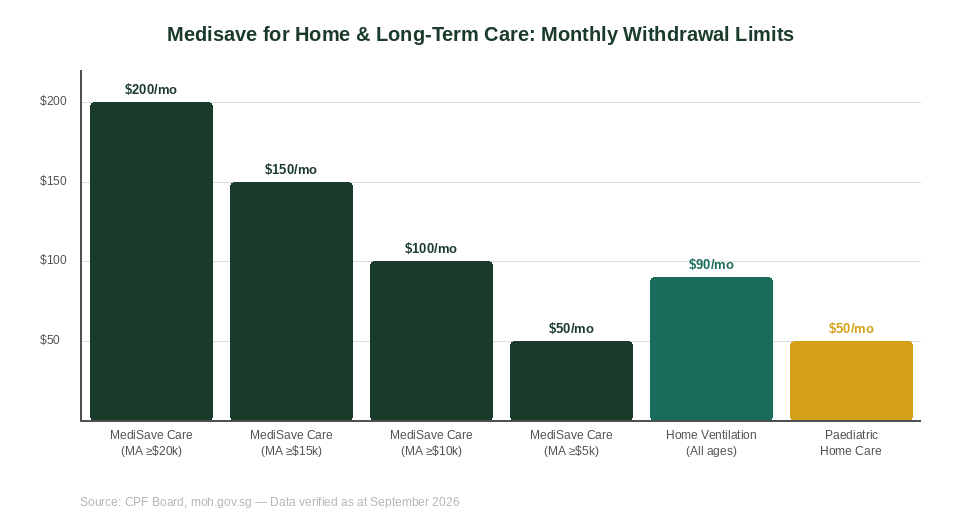
The amount you can withdraw each month depends on your Medisave Account balance at the time of application. Here are the four tiers, as published by CPF Board:
| Medisave Account Balance | Monthly Withdrawal | Annual Max |
|---|---|---|
| $20,000 and above | $200/month | $2,400 |
| $15,000 to $19,999 | $150/month | $1,800 |
| $10,000 to $14,999 | $100/month | $1,200 |
| $5,000 to $9,999 | $50/month | $600 |
| Below $5,000 | Not eligible | — |
Source: CPF Board, cpf.gov.sg — Data verified as at September 2026
Can a Spouse Top Up?
Yes. If the disabled person’s own Medisave balance is insufficient to reach the $200/month cap, a spouse can use their Medisave to supplement — up to a combined total of $200/month. This is particularly useful where one spouse depleted their MA paying for hospitalisation expenses.
What Can the Money Be Used For?
MediSave Care withdrawals can fund approved home care, day care, and residential long-term care services. This includes home nursing visits, day rehabilitation centres, adult disability day care centres, and nursing homes. The withdrawn amount is paid directly to the approved service provider — you do not receive cash in hand.
Tip: Check your current Medisave balance on the CPF website or via the CPF mobile app before applying. Maintaining at least $5,000 in your MA is recommended by CPF to ensure you still have funds available for ISP premiums and hospitalisation.
Home Palliative Care — Medisave Limits Explained
Palliative care at home — nursing visits, pain management, emotional support, and caregiver training — is one of the most generous Medisave categories. When you are paying from your own Medisave Account, there is no withdrawal limit for home palliative care and day hospice services. This means Medisave can cover the full cost of approved palliative services without any annual cap.
The rules change when a family member’s Medisave is used:
- A $2,500 lifetime limit per patient applies when drawing from a family member’s MA
- The same $2,500 lifetime limit applies for paediatric patients (children), even when using the child’s own MA
What Home Palliative Care Covers
MOH-approved home palliative care services that are Medisave-claimable include:
- Nurse-led home visits for pain and symptom management
- Wound dressing and tube care
- Medication reviews and administration
- Caregiver training and support
- Day hospice attendance (in-centre care during daytime)
Services must be provided by MOH-accredited palliative care providers for Medisave claims to be processed.
How Does This Compare to Inpatient Hospice?
For reference, Medisave limits for inpatient hospice are $250/day (general palliative) and $350/day (specialised palliative). If your loved one is in a hospice facility and you want to move them to home-based care, the unlimited withdrawal for home palliative care (using the patient’s own MA) can be a significant financial advantage.
Home Ventilation and Paediatric Home Care
Beyond the two main schemes above, Medisave also covers two specialised categories of home-based support.
Home Ventilation and Respiratory Support
Patients who are ventilator-dependent and are being cared for at home can claim $90 per month from Medisave for approved home ventilation and respiratory support services. This includes the ongoing cost of equipment rental, monitoring, and nursing support from MOH-accredited providers. The claim is made on behalf of the patient — the $90/month is a sub-limit within the broader long-term care framework.
Paediatric Home Care
Children with complex medical needs requiring nursing care at home are covered under a separate paediatric home care sub-limit of $50 per month. As mentioned in the palliative care section, when it comes to home palliative care specifically for paediatric patients, the $2,500 lifetime cap (rather than unlimited) applies — so it pays to plan ahead and use approved sub-limits strategically.
Quick-Reference: All Home and Long-Term Medisave Sub-Limits
| Scheme / Service | Limit | Notes |
|---|---|---|
| MediSave Care | Up to $200/month | Based on MA balance tier; age 30+; severe disability |
| Home Palliative Care (own MA) | No limit | Unlimited from patient’s own MA |
| Home Palliative Care (family MA) | $2,500 lifetime | Per patient; includes paediatric patients |
| Home Ventilation | $90/month | Ventilator-dependent patients at home |
| Paediatric Home Care | $50/month | Children with complex conditions |
| Day Rehabilitation | $25/day, max $1,500/year | Day rehab centres; physical/occupational therapy |
| Community Hospital Stay | $250/day | Post-acute inpatient rehabilitation |
Source: MOH (moh.gov.sg), CPF Board (cpf.gov.sg) — Data verified as at September 2026
Nursing Homes: Costs, Subsidies & Medisave
For Singaporeans whose loved ones need 24-hour residential care, nursing homes are the main option. The good news: a combination of government subsidies and Medisave can make this significantly more affordable than the rack rate suggests.
Nursing Home Costs Before Subsidy
The gross monthly fee at a subsidised nursing home in Singapore typically ranges from $2,000 to $4,500 per month depending on the facility, ward type, and level of care required. Private nursing homes can be higher.
The ILTC Subsidy: How Much Can You Get?
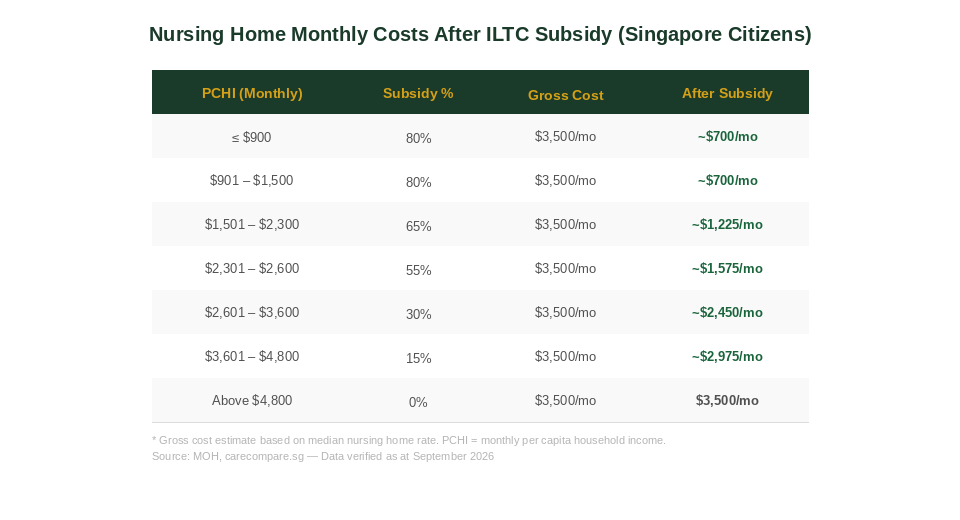
The Integrated Long-Term Care (ILTC) subsidy is means-tested, based on the patient’s monthly per capita household income (PCHI) — total household gross income divided by the number of people living in the household. For Singapore Citizens born in 1969 or earlier, the subsidy tiers are:
Worked Example
Say your 78-year-old father needs nursing home placement. His household has a combined monthly income of $6,000 across three people — a PCHI of $2,000. That qualifies for the 65% subsidy tier. Against a gross monthly fee of $3,500, the family pays roughly $1,225 per month. If he has severe disability, MediSave Care can contribute a further $50–$200/month, reducing the family’s out-of-pocket cost to as low as $1,025/month.
Note for Singapore Citizens born after 1969: Subsidy percentages are slightly lower across most tiers — contact AIC (1800-650-6060) or a hospital social worker to get the exact subsidy rate for your situation.
Using Medisave at a Nursing Home
Medisave can be used to pay subsidised nursing home fees for Singapore Citizens and PRs aged 30 and above with severe disability via the MediSave Care scheme. The monthly withdrawal (up to $200) is credited directly against the monthly nursing home bill. The means-tested ILTC subsidy is applied first, and Medisave contributes on top of that.
Flexi-Medisave for Seniors (60 and Above)
Flexi-Medisave is a separate outpatient scheme — not long-term care — but it matters for elderly Singaporeans managing chronic conditions at home. Singapore Citizens and PRs aged 60 and above can withdraw up to $400 per year from their Medisave Account for outpatient treatment, vaccinations, and health screenings at:
- Polyclinics
- Specialist Outpatient Clinics (SOC) at restructured hospitals
- Participating CHAS-registered GP clinics
This $400/year limit applies per patient, regardless of household income. For seniors managing multiple conditions at home — hypertension, diabetes, chronic kidney disease — Flexi-Medisave helps offset the regular GP and polyclinic visit costs that would otherwise come from cash or CPF Ordinary Account.
Note that Flexi-Medisave is separate from and stacks with the Chronic Disease Management Programme (CDMP) Medisave limits ($500–$700/year), so seniors on multiple chronic condition programmes can draw from both sub-limits in the same year.
How to Apply: Step-by-Step
Applying for MediSave Care
- Get a medical referral. Ask your loved one’s doctor at a hospital, polyclinic, or specialist clinic to refer you to a MOH-accredited severe disability assessor. You can also call AIC at 1800-650-6060.
- Complete the disability assessment. An AIC-accredited assessor evaluates the person against the six ADLs. The assessment determines eligibility and is not done by the family or self-assessed.
- Apply via AIC’s eFASS portal. Once assessed as having severe disability, apply for MediSave Care online through the AIC eFASS portal using Singpass. The application links the patient’s Medisave Account to the approved service provider for automatic monthly disbursement.
- Monthly withdrawals begin. Disbursements are made directly to the service provider — nursing home, home care agency, or day care centre. No cash changes hands.
Applying for the ILTC Subsidy (Nursing Home)
- Speak to a hospital or polyclinic social worker. They can initiate the means-testing and placement referral process. This is the fastest route if your loved one is being discharged from hospital to a nursing home.
- Submit means-testing documents. Provide household income documents (payslips, NOA) or declare zero income if applicable. The PCHI calculation determines your subsidy tier.
- AIC matches placement. AIC coordinates placement based on medical needs, preferred location, and bed availability. Wait times vary — starting early is important.
- Activate MediSave Care alongside. Once placed in a nursing home, apply separately for MediSave Care (if eligible for severe disability) to offset the monthly residual fee.
Your ISP and the Long-Term Care Gap
It is worth being clear about what your Integrated Shield Plan covers — and what it does not. ISPs are hospital insurance. They pay for inpatient hospitalisation bills, surgery, and in some plans, day surgery and certain outpatient specialist bills. They do not cover:
- Long-term home nursing visits (unless directly post-surgery and within a short discharge window)
- Nursing home monthly fees
- Day rehabilitation or day care centre fees
- Ongoing palliative home care
This is the long-term care gap — the period after acute hospitalisation ends, when the person needs ongoing support but is no longer in a hospital. Medisave Care, the ILTC subsidy, and CareShield Life are the three government tools designed to bridge this gap. CareShield Life pays a monthly disability benefit (starting at $600/month in 2020 and increasing annually) for as long as severe disability persists — this works alongside, not instead of, MediSave Care.
For those managing chronic conditions or cancer treatment at home, our guides on Medisave for cancer treatment and Medisave for mental health cover the relevant sub-limits for those conditions.
Planning ahead: Maintaining a healthy Medisave balance throughout your working years is the most direct way to ensure MediSave Care remains accessible at the highest tier ($200/month). For those with a Medisave balance near or below $5,000, explore topping up via CPF cash top-up or voluntary contributions before a care need arises.
Frequently Asked Questions
Can I use Medisave to pay for a home nurse to visit my elderly parent?
Yes, in limited circumstances. Home nursing visits from MOH-subvented providers can be funded through Medisave under the home palliative care sub-limit (if the patient has a terminal illness) or through MediSave Care monthly withdrawals (if the patient has severe disability and meets the ADL criteria). For private home nursing from non-subsidised agencies, Medisave cannot be used directly — you would pay out of pocket. The AIC at 1800-650-6060 can tell you which home nursing providers are approved for Medisave claims.
How much does MediSave Care pay per month, and is it enough to cover nursing home fees?
MediSave Care pays up to $200/month (if your Medisave Account balance is $20,000 or above). For a nursing home with an ILTC-subsidised fee of, say, $1,200/month after the government subsidy, MediSave Care contributes $200 — leaving $1,000 out of pocket per month. It is designed to supplement, not replace, other funding sources. CareShield Life payouts (minimum $600/month for those covered) can further reduce the family’s net cost.
Is there a minimum age to use Medisave for long-term care?
For MediSave Care, the minimum age is 30 years old. Most long-term and home care Medisave schemes do not have a minimum age restriction for the patient — home palliative care, home ventilation, and paediatric home care are all accessible regardless of age. The Flexi-Medisave outpatient scheme, however, applies only to those aged 60 and above.
Can I use a family member's Medisave to pay for home nursing?
For home palliative care, you can use a family member’s Medisave Account, but a $2,500 lifetime limit applies per patient. For MediSave Care (severe disability), a spouse’s Medisave can top up the patient’s own MA withdrawal, up to a combined total of $200/month. For nursing home fees in general, you cannot directly use a family member’s Medisave unless it falls under the MediSave Care scheme (spouse supplement).
Does CareShield Life cover home nursing and long-term care?
CareShield Life pays a monthly cash payout — not directly linked to specific services — once the insured person qualifies as severely disabled (unable to perform 3 of 6 ADLs). The payout starts at $600/month (for those who joined in 2020) and increases by 2% each year. This cash can be used for any long-term care purpose, including home nursing, nursing home fees, or caregiver expenses. It works alongside MediSave Care and the ILTC subsidy, not as a replacement. See our CareShield Life complete guide for payout tables and supplement plan options.
How do I find out which nursing homes and home care providers accept Medisave?
The Agency for Integrated Care (AIC) maintains a directory of MOH-subsidised and accredited nursing homes and home care providers in Singapore. You can search on the AIC website or call 1800-650-6060 for referrals. Providers must be MOH-approved for Medisave claims to be processed — always confirm Medisave eligibility with the provider before signing up for a care package.
Get Free Insurance Advice
Speak with a licensed insurance advisor. No obligation, no cost.
By submitting this form, you agree to our Privacy Policy.
This article was researched with the help of AI. While we strive to keep all information accurate and up to date, there may be errors. If you notice any discrepancies, please contact us.