CPF Full Retirement Sum (FRS) 2026: BRS, ERS & What You Need to Plan For
Singapore’s definitive CPF retirement sum guide — 2026 amounts, CPF Life payouts, and step-by-step top-up strategies.
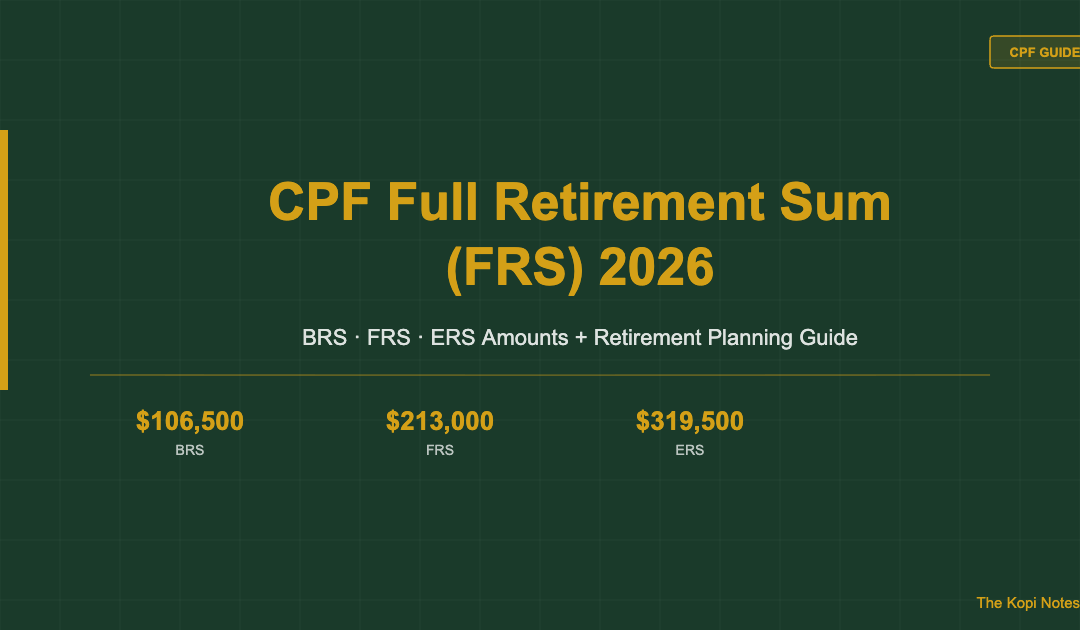
The CPF Full Retirement Sum (FRS) for 2026 is $213,000 — the benchmark amount Singapore residents aged 55 and above should aim to retain in their Retirement Account (RA) to receive approximately $1,850 per month from CPF Life from age 65. The Basic Retirement Sum (BRS) is $106,500 and the Enhanced Retirement Sum (ERS) is $319,500. Meeting a higher retirement sum means larger, guaranteed monthly payouts for life.
Not financial advice. All figures are for educational reference only. CPF Life payout estimates are illustrative and depend on individual circumstances. Data as at November 2026 unless noted.
Table of Contents
Contents — Click to expand
What Is the CPF Full Retirement Sum?
The CPF Full Retirement Sum (FRS) is a benchmark amount set by the CPF Board each year. It represents the amount of CPF savings a member should retain in their Retirement Account (RA) at age 55 to receive a monthly payout under CPF Life that approximates the desired retirement income level.
Singapore’s CPF system uses three retirement sum tiers:
- Basic Retirement Sum (BRS) — the minimum required; members who own property with sufficient remaining lease can pledge their property and withdraw savings above the BRS. Targets around half the FRS monthly payout.
- Full Retirement Sum (FRS) — the main benchmark, set at 2× the BRS. This is the amount CPF aims for members to accumulate for a comfortable retirement income.
- Enhanced Retirement Sum (ERS) — 3× the BRS; introduced from 2025, this voluntary cap allows members to set aside more for higher guaranteed monthly payouts for life.
These sums increase each year at approximately 3.5%, aligned with CPF’s long-term wage growth assumptions and to ensure purchasing power keeps pace with inflation. Members who turn 55 in any given year are assessed against that year’s retirement sums — so if you turn 55 in 2026, the 2026 figures apply to you.
Meeting the FRS is not compulsory — it is a target. However, any savings you withdraw above the BRS (or FRS if you do not pledge property) will reduce your CPF Life payout. Understanding these sums is essential to informed CPF investment strategy Singapore planning.
CPF Retirement Sums for 2026 (BRS, FRS, ERS)
The CPF Board announced the following retirement sums applicable to members who turn 55 in 2026:
| Retirement Sum | 2026 Amount | 2025 Amount | Change |
|---|---|---|---|
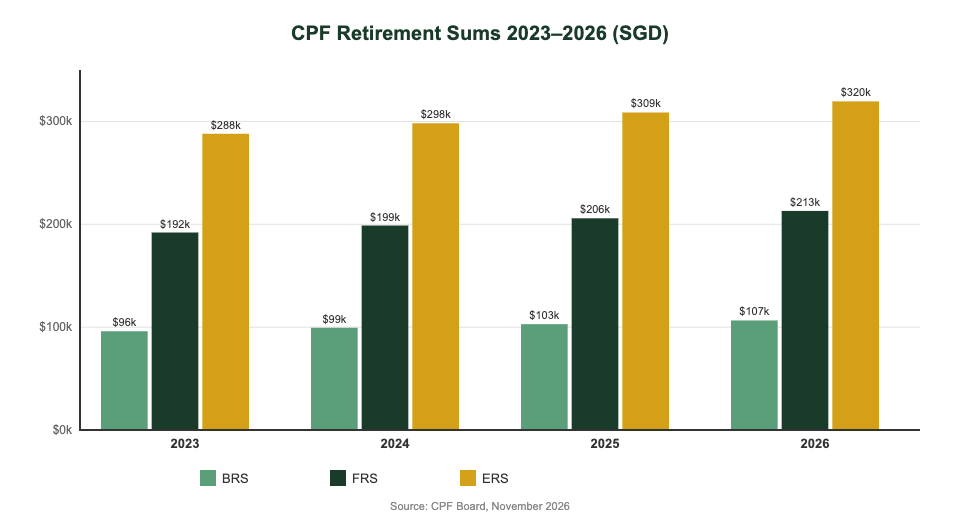
| Basic Retirement Sum (BRS) | $106,500 | $102,900 | +$3,600 (+3.5%) |
| Full Retirement Sum (FRS) | $213,000 | $205,800 | +$7,200 (+3.5%) |
| Enhanced Retirement Sum (ERS) | $319,500 | $308,700 | +$10,800 (+3.5%) |
Source: CPF Board, 2026. Amounts apply to members turning 55 in the calendar year 2026.
The FRS has increased steadily from $161,000 in 2019 to $213,000 in 2026 — a total rise of 32% over seven years. This consistent growth is by design: CPF calibrates retirement sums to inflation and wage growth so that the monthly payouts from CPF Life maintain real purchasing power in retirement.
CPF Life Payout Estimates for 2026
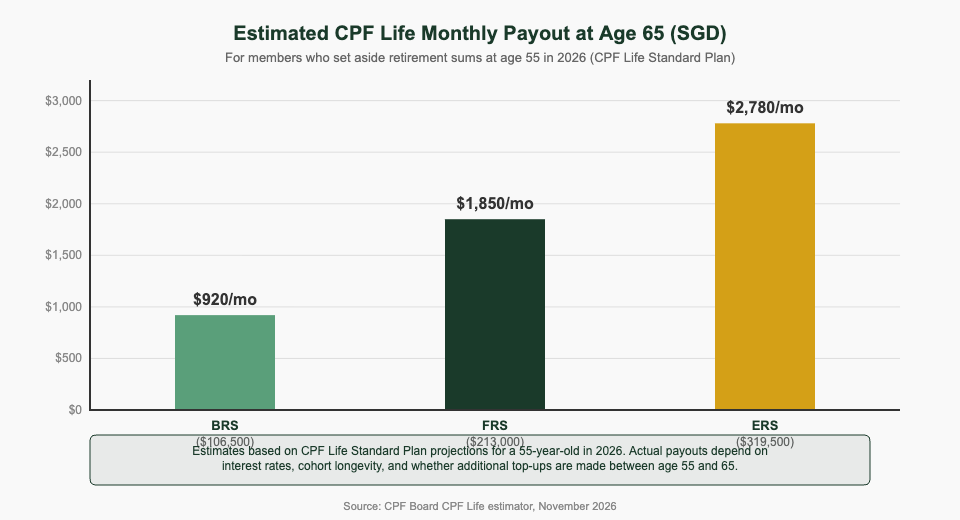
The most important question for most members is: how much monthly income will my CPF savings generate? The estimated payouts below are for a member who turns 55 in 2026 and sets aside the corresponding retirement sum, with payouts commencing at age 65 under the CPF Life Standard Plan:
| Retirement Sum | Amount Set Aside | Est. Monthly Payout from 65 | Annual CPF Life Income |
|---|---|---|---|
| BRS | $106,500 | ~$920/month | ~$11,040/year |
| FRS | $213,000 | ~$1,850/month | ~$22,200/year |
| ERS | $319,500 | ~$2,780/month | ~$33,360/year |
Source: CPF Board CPF Life estimator, November 2026. Estimates assume payouts begin at age 65, Standard Plan selected, 4% interest credited on RA balance between ages 55–65. Actual payouts may differ.
For context: Singapore’s median household expenditure in retirement is estimated at around $2,000–$2,500 per month for a single person living modestly. The FRS payout of ~$1,850/month covers the fundamentals for many retirees, particularly those who own their home and have no housing costs beyond maintenance. Those with dependants or higher lifestyle expectations — or who want to leave a bequest — should consider the ERS or supplementary income streams such as passive income Singapore strategies like dividend investing and S-REITs.
How Your Retirement Account Works
At age 55, CPF automatically creates a Retirement Account (RA) and transfers savings from your Special Account (SA) and Ordinary Account (OA) — in that order — up to the prevailing FRS. Here is how the process works:
- RA is created at 55 — CPF sweeps SA savings first into your RA (up to the FRS), then OA savings if SA is insufficient.
- Withdrawal above BRS or FRS — If your combined OA + SA exceeds the FRS (or BRS if you pledge your property), you can withdraw the surplus in cash at 55.
- RA earns 4% p.a. interest — Your RA balance grows at 4% p.a. between ages 55 and 65, significantly compounding the final CPF Life pool.
- CPF Life enrolment at 65 — You are enrolled into CPF Life (a national annuity scheme) and begin receiving monthly payouts for life.
One critical point: SA interest rates at 4% p.a. (2026 rate) make your RA a powerful risk-free savings vehicle. For many Singaporeans, topping up the RA to the FRS or ERS delivers better risk-adjusted returns than many investment alternatives, especially if you are close to 65 and have a shorter investment horizon. You can explore your options using the Singapore retirement calculator on The Kopi Notes.
How to Top Up Your RA to Hit the FRS or ERS
If your RA balance is below the FRS or ERS, you can top it up voluntarily — and this comes with meaningful tax benefits:
Method 1: CPF Cash Top-Up (Retirement Sum Topping-Up Scheme)
You can top up your RA (or a family member’s RA) using cash under the Retirement Sum Topping-Up Scheme (RSTU). Key details:
- Tax relief: Up to $8,000 in cash top-ups to your own RA, plus another $8,000 to parents’ or grandparents’ CPF accounts — total potential relief of $16,000 per year.
- Target cap: You can top up only up to the ERS ($319,500 in 2026).
- No withdrawal: Cash topped into the RA earns 4% p.a. but cannot be withdrawn as cash — it is locked in for CPF Life.
- How to top up: Log in to CPF Online Services → “Grow My CPF” → “Top-up my retirement savings”.
Method 2: CPF OA/SA Transfer to RA
If you have excess savings in your OA or SA (for those under 55), you cannot directly transfer to the RA — the RA only exists from age 55. However, building up your SA pre-55 (known as the SA Shielding strategy) means more SA funds will flow into your RA at 55. Note that following legislative changes that closed certain SA strategies from early 2025, the classic “SA shielding” approach is largely no longer possible — members should plan SA growth conservatively via the 4% p.a. interest compounding alone.
Method 3: Top Up Your Spouse or Parents’ RA
Top-ups to a spouse’s or parent’s RA qualify for the additional $8,000 tax relief annually. This is one of the highest-return tax arbitrage moves available to higher-income earners: at a 22% marginal income tax rate, an $8,000 cash top-up to your parent’s RA saves you $1,760 in taxes immediately, plus the RA earns 4% p.a. risk-free. Compare that to Singapore T-bills 2026 currently yielding around 2% or Singapore Savings Bonds at 2.7% — the 4% RA rate with a tax rebate is hard to beat for the risk level.
Retirement Planning Scenarios: Real SGD Examples
Here are three worked examples for Singapore residents turning 55 in 2026:
| Profile | RA Balance at 55 | Target | Top-Up Needed | Est. Monthly Payout at 65 |
|---|---|---|---|---|
| Conservative retiree (owns HDB, no dependants) |
$100,000 | BRS ($106,500) | $6,500 cash | ~$920/mo |
| Mid-income couple (joint expenses ~$3,600/mo) |
$170,000 | FRS ($213,000) | $43,000 cash | ~$1,850/mo |
| High earner (wants max guaranteed income) |
$250,000 | ERS ($319,500) | $69,500 cash | ~$2,780/mo |
Note: Top-up amounts are illustrative. Actual RA at 55 depends on CPF contribution history and investment returns. RA balance grows at 4% p.a. from 55–65 before CPF Life payouts begin.
For the mid-income couple scenario: if each spouse has $170,000 in their RA and both top up to the FRS, their combined CPF Life income would be ~$3,700/month — covering a comfortable joint retirement budget. This is why for dual-income households, prioritising CPF RA top-ups close to age 55 can be more impactful than deploying that capital elsewhere. Pair this strategy with dividend income from the best S-REITs in Singapore 2026 for a diversified retirement income base.
Should You Target the ERS?
The ERS ($319,500 in 2026) is entirely voluntary and not suitable for everyone. Here is a clear framework:
Consider the ERS if:
- You are in a high income tax bracket (22% or above) — the $8,000 annual cash top-up tax relief accelerates the value proposition.
- You want guaranteed, longevity-proof income and do not want to manage investments in your 70s and 80s.
- Your investment portfolio already covers most of your retirement needs (property, stocks, REITs) and the ERS provides a safety floor.
- You have a family history of longevity — CPF Life Standard Plan pays out for life, so the longer you live, the greater the value.
Stick to FRS (or BRS) if:
- You have higher-return deployment opportunities for that capital (e.g. you manage your own REIT portfolio via Syfe or Endowus referral code and consistently outperform 4% p.a.).
- You need liquidity for potential healthcare or family expenses before 65.
- You have large Singapore Savings Bonds and Singapore Savings Bonds guide positions already delivering steady income.
For most Singaporeans, the FRS represents the optimal target — it delivers meaningful monthly income while leaving room for other investment options. The ERS premium is best viewed as structured longevity insurance rather than pure investment return.
This article is for educational purposes only. CPF rules, amounts, and contribution rates can change. Always verify figures at CPF Board official website before making financial decisions.
Frequently Asked Questions
What is the CPF Full Retirement Sum (FRS) for 2026?
The CPF Full Retirement Sum (FRS) for 2026 is $213,000. This is the benchmark amount Singapore residents who turn 55 in 2026 should retain in their Retirement Account (RA) to receive approximately $1,850 per month from CPF Life starting at age 65. The FRS increases by approximately 3.5% each year in line with CPF’s long-term wage growth assumptions.
What is the Basic Retirement Sum (BRS) for 2026?
The Basic Retirement Sum (BRS) for 2026 is $106,500 — exactly half of the FRS. Members who own a property with sufficient remaining lease can pledge that property to CPF and only need to set aside the BRS in their Retirement Account. With the BRS, you can withdraw the difference between the FRS and BRS as a cash lump sum at age 55. The estimated CPF Life monthly payout for the BRS is approximately $920/month from age 65.
What is the Enhanced Retirement Sum (ERS) for 2026?
The Enhanced Retirement Sum (ERS) for 2026 is $319,500 — three times the BRS. The ERS is a voluntary upper cap that allows members to top up their RA beyond the FRS to receive a higher guaranteed CPF Life monthly payout. If you set aside the ERS, you can expect approximately $2,780/month from CPF Life at age 65 for life under the Standard Plan. The ERS is particularly attractive for high-income earners who want maximise their guaranteed retirement income and benefit from the 4% p.a. RA interest rate.
Can I withdraw my CPF savings at 55 if I have met the FRS?
Yes. Once you turn 55, CPF creates your Retirement Account and transfers savings from your SA and OA up to the FRS. Any savings above the FRS (or above the BRS if you pledge your property) can be withdrawn as a cash lump sum at age 55. For example, if you have $300,000 in your CPF at 55 and the FRS is $213,000, you may withdraw $87,000 in cash. The remaining $213,000 stays in your RA and grows at 4% p.a. until CPF Life payouts begin at 65.
How do I top up my CPF Retirement Account to reach the FRS?
You can top up your RA with cash under the Retirement Sum Topping-Up Scheme (RSTU). Log in to CPF Online Services, navigate to “Grow My CPF” and select “Top up my retirement savings.” Cash top-ups to your own RA provide up to $8,000 in income tax relief per year; top-ups to parents or grandparents qualify for another $8,000 relief. You can only top up to the prevailing ERS — you cannot exceed $319,500 in 2026. The RA does not allow cash withdrawals once topped up, so treat it as a long-term commitment.
Does the CPF FRS apply to Permanent Residents (PRs) in Singapore?
Yes. Permanent Residents (PRs) who contribute to CPF are subject to the same retirement sum rules as Singapore Citizens. When a PR turns 55, the same BRS, FRS, and ERS thresholds apply. However, PRs who leave Singapore and renounce their PR status can apply to withdraw their CPF savings in full, subject to CPF Board approval. PRs who remain in Singapore and continue working will follow the standard CPF Life and retirement sum framework like all other members.
Is hitting the CPF FRS better than investing in S-REITs or ETFs?
It depends on your risk profile and timeline. The CPF RA earns a guaranteed 4% p.a. — which outperforms Singapore T-bills (around 2% in late 2026) and Singapore Savings Bonds (around 2.7%) with zero credit risk. For members within 10 years of retirement, topping up to the FRS is generally the most efficient risk-adjusted move for the capital. For those further from retirement, a blended strategy — meeting the FRS first, then deploying surplus into S-REITs or diversified ETFs — often delivers better total outcomes. Use our Singapore retirement calculator to model your own scenarios.
Plan Your Retirement Income Beyond CPF
CPF Life covers the foundation — diversify with dividend stocks, REITs and passive income strategies to build a resilient retirement portfolio.
This article was researched with the help of AI. While we strive to keep all information accurate and up to date, there may be errors. If you notice any discrepancies, please contact us.