NTUC Income Rider 2026: Optima Care vs Essential Care — Which Should You Pick?
A practical Singapore guide to NTUC Income’s two new ISP riders — premiums, co-payments, and who each rider suits.
From 1 April 2026, NTUC Income replaced its old Deluxe Care rider with two new riders — Optima Care and Essential Care — in line with MOH’s new Integrated Shield Plan rules. Both are roughly 32% cheaper than the old rider. The key difference: Optima Care costs more but offers a lower 5% co-payment for panel visits, while Essential Care is cheaper but charges 7–10% co-payment. Neither covers your deductible.
Not financial advice. All figures are for educational reference only. Data verified as at 30 August 2026.
- Both new riders require you to pay a 5–10% co-payment on bills, capped at $6,000/year (deductible excluded).
- Optima Care = lower co-payment (5%) but higher premium. Essential Care = cheaper premium but higher co-payment (7–10%).
- If you bought your old Deluxe Care rider before 27 Nov 2025, you keep it until your first renewal after 1 April 2028.
Table of Contents
Contents — Click to expand
- Why MOH Changed ISP Riders in 2026
- What Is the NTUC Income Optima Care Rider?
- What Is the NTUC Income Essential Care Rider?
- Optima Care vs Essential Care: Head-to-Head Comparison
- Understanding the Deductible You Now Pay
- Are the New Riders Really Cheaper?
- What If You Have an Old Rider?
- Who Should Pick Optima Care vs Essential Care?
- Frequently Asked Questions
Why MOH Changed ISP Riders in 2026
Singapore’s Integrated Shield Plan (ISP) riders have been around for years. They sat on top of your ISP — which itself sits on top of MediShield Life — and used to cover almost everything. Bills were rising fast, partly because comprehensive riders removed any cost-sharing incentive. You went to a private hospital, your insurer paid 100%, and premiums climbed every year.
In November 2025, the Ministry of Health announced a fix. From 1 April 2026, all new ISP riders must:
- Include a minimum 5% co-payment on eligible bills
- Raise the annual co-payment cap from $3,000 to $6,000
- Stop covering the minimum IP deductible set by MOH
The result: riders got leaner and cheaper. Average premiums dropped by around 30% industry-wide. NTUC Income responded by launching two new riders — Optima Care and Essential Care — on 1 April 2026. For a full overview of how ISPs work, see our complete shield plan Singapore guide.
What Is the NTUC Income Optima Care Rider?
Optima Care is NTUC Income’s premium rider, designed for policyholders with an Enhanced IncomeShield Preferred plan. It offers the lowest co-payment rates among the two new options.
Here is what Optima Care covers:
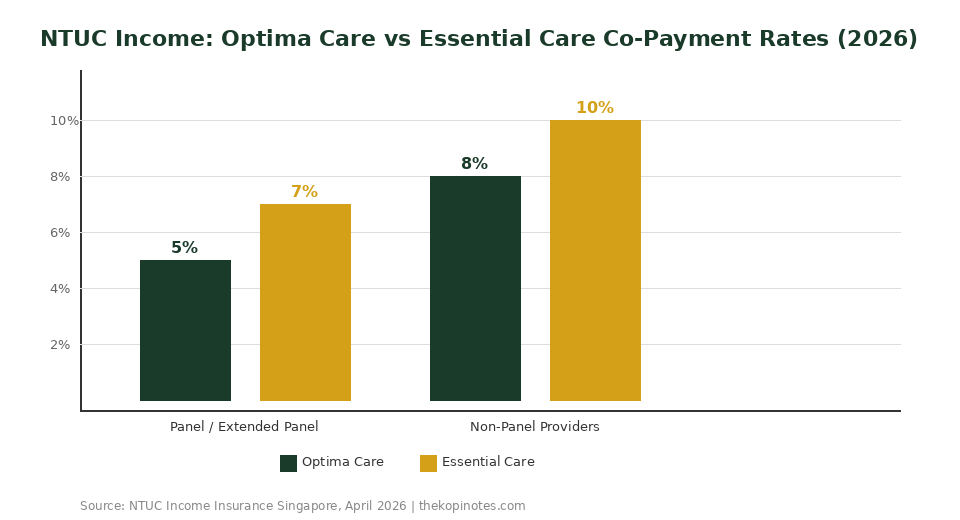
- Panel / Extended Panel providers: You pay 5% of eligible hospitalisation bills.
- Non-panel providers: You pay 8% of eligible bills.
- Annual co-payment cap: $6,000 per policy year. Once you hit this cap, Optima Care covers the rest (excluding the deductible).
- Deductible: Not covered. You pay this out of pocket or via MediSave.
Optima Care suits you if you value lower bills at each hospitalisation and are willing to pay a higher rider premium for that peace of mind.
What Is the NTUC Income Essential Care Rider?
Essential Care is the more affordable option. It has a higher co-payment rate than Optima Care but comes at a lower premium. It is available for all Enhanced IncomeShield plan tiers.
- Panel providers: You pay 7% of eligible hospitalisation bills.
- Non-panel providers: You pay 10% of eligible bills.
- Annual co-payment cap: $6,000 per policy year.
- Deductible: Not covered — you pay this separately.
Essential Care works well if your priority is keeping premiums low, and you are comfortable paying slightly more when you are hospitalised.
Optima Care vs Essential Care: Head-to-Head Comparison
Here is a side-by-side comparison of both riders to help you decide:
| Feature | Optima Care | Essential Care |
|---|---|---|
| Panel / Extended Panel Co-Pay | 5% | 7% |
| Non-Panel Co-Pay | 8% | 10% |
| Annual Co-Pay Cap | $6,000 | $6,000 |
| Covers Deductible? | No | No |
| Premium vs Old Rider | ~32% lower | ~40% lower |
| Welcome Discount (1st year) | 15% (Apr 2026 – Mar 2027) | 15% (Apr 2026 – Mar 2027) |
| Suitable Plans | Enhanced Preferred | All tiers |
Source: NTUC Income Insurance Singapore, April 2026. Data verified August 2026.
In practice, the co-payment difference matters most for large bills. For a $50,000 eligible hospitalisation bill, Optima Care caps your share at $2,500 (5%), while Essential Care caps it at $3,500 (7%) — before you hit the $6,000 annual cap.
You can also compare how other insurers structure their new riders in our AIA VitalHealth Pro rider review and Great Eastern SupremeHealth P Plus premium table.
Understanding the Deductible You Now Pay
This is the part many people miss. From 1 April 2026, no new rider can cover your IP deductible. That means before your rider kicks in at all, you pay the deductible out of pocket.
MOH sets a minimum IP deductible for each plan tier. The deductible ranges from $1,500 to $3,500 per policy year, depending on the plan tier and ward class used. For the Enhanced IncomeShield Preferred plan (private hospital coverage), the deductible for a private hospital stay can be up to $3,500 per year.
| ISP Plan Tier | Annual Deductible (indicative) |
|---|---|
| Enhanced IncomeShield Preferred (Private Hospital) | Up to $3,500 |
| Enhanced IncomeShield Advantage (Class A) | Varies by ward used |
| Enhanced IncomeShield Basic (Class B1) | Varies by ward used |
Source: Ministry of Health Singapore, November 2025. Actual deductible varies by plan tier, ward class used, and insurer. Check your policy documents for the exact amount.
The good news: you can use MediSave to pay the deductible (and the co-payment), subject to the prevailing MediSave withdrawal limits. So it does not necessarily mean a large cash outlay.
For NTUC Income’s Enhanced IncomeShield Preferred plan — which is the private hospital plan — you would pay a $3,500 deductible per year before your Optima Care or Essential Care rider covers any bills. After that, you pay 5–10% co-payment on the remaining eligible amount, up to the $6,000 annual cap.
To understand the full NTUC Income Enhanced IncomeShield plan structure, read our NTUC Income Enhanced IncomeShield review 2026.
Are the New Riders Really Cheaper?
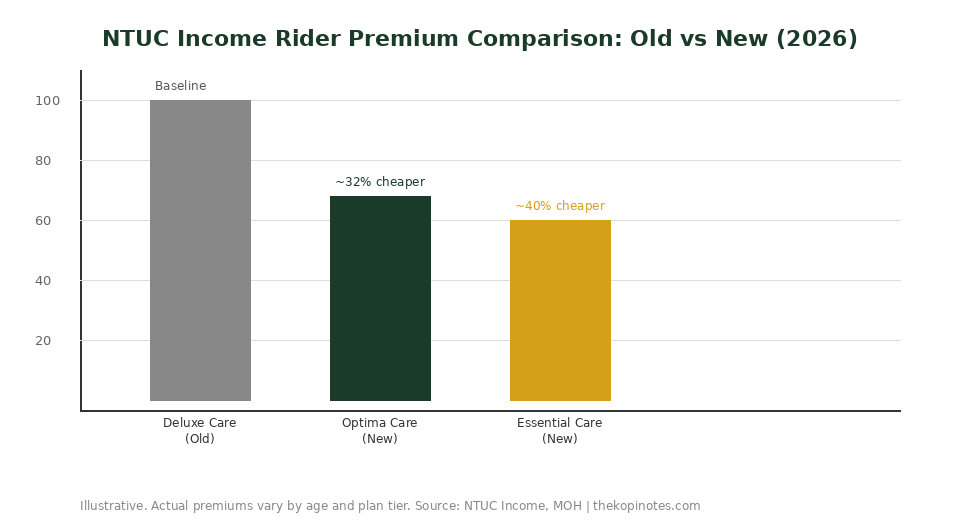
Yes — significantly. NTUC Income says the new Optima Care and Essential Care riders are on average 32% cheaper than the old Deluxe Care rider. Essential Care goes even further, coming in around 40% cheaper for some age bands.
Why the drop? The new riders no longer cover the deductible, and the higher co-payment means you shoulder more of each bill. That reduced exposure means lower insurance risk — and lower premiums for you.
NTUC Income is also offering a 15% first-year welcome discount for new applications between 1 April 2026 and 31 March 2027 (with no exclusions or premium loading applied). This applies to Enhanced IncomeShield Preferred, Advantage and Basic plans, as well as both Optima Care and Essential Care riders.
Over a 20-year period, the premium savings from switching to a new rider can be substantial — even after accounting for higher expected co-payments at each hospitalisation.
What If You Have an Old Rider?
If you bought a Deluxe Care rider (or any other legacy rider) before 27 November 2025, you are grandfathered. You can keep your existing rider with its current benefits — including full deductible coverage — until your first policy renewal after 1 April 2028.
After that date, your insurer will transition you to a compliant new rider. NTUC Income will communicate what this means for you well in advance.
Key rule: do not voluntarily cancel your old rider if you bought it before 27 November 2025. You would lose the grandfathering protection and be subject to the new rules immediately.
If you bought a rider on or after 27 November 2025, you should have been informed that it would transition to a compliant rider at your next renewal after 1 April 2026.
Who Should Pick Optima Care vs Essential Care?
Here is a simple framework to help you decide:
Choose Optima Care if:
- You use private hospitals regularly or have a preferred specialist.
- You want the lowest possible co-payment per bill (5% vs 7%).
- You are comfortable paying a higher rider premium for lower bill exposure.
- You have dependants and want predictable out-of-pocket costs.
Choose Essential Care if:
- You are generally healthy and hospitalisation is infrequent.
- Keeping monthly premiums low is your priority.
- You are comfortable paying a bit more when you are hospitalised.
- You have a solid MediSave balance to handle the deductible and co-payment.
For a broader view of which ISP plan and ward class suits your needs, check our guide to the best Class A ward shield plan in Singapore.
If you are comparing across insurers and want to see how Singlife’s new riders stack up, see the Singlife Shield Plan 1 review 2026.
Frequently Asked Questions
What is the difference between NTUC Income Optima Care and Essential Care riders?
Both are new ISP riders launched on 1 April 2026 in line with MOH’s requirements. Optima Care charges a 5% co-payment for panel visits and 8% for non-panel, while Essential Care charges 7% for panel and 10% for non-panel. Both have a $6,000 annual co-payment cap, and neither covers your deductible. Optima Care has a higher premium but lowers your bill exposure at each hospitalisation.
Do the new NTUC Income riders cover the deductible?
No. From 1 April 2026, MOH rules prohibit new ISP riders from covering the minimum IP deductible. For a private hospital plan, you pay $3,500 per year in deductible before your rider starts paying. You can use MediSave to cover this deductible, subject to prevailing MediSave withdrawal limits.
Can I still keep my old NTUC Income Deluxe Care rider?
If you bought your Deluxe Care rider before 27 November 2025, yes — you can keep it under grandfathering provisions until your first renewal after 1 April 2028. NTUC Income will communicate the transition timeline. Do not voluntarily cancel your old rider, as you would lose this protection.
How much cheaper are the new riders compared to the old Deluxe Care rider?
NTUC Income states the new riders are on average 32% cheaper than the old Deluxe Care rider, with Essential Care being even cheaper — around 40% lower for some age bands. There is also a 15% first-year welcome discount for new applications made between 1 April 2026 and 31 March 2027.
What is the co-payment cap for NTUC Income's new riders?
Both Optima Care and Essential Care have a co-payment cap of $6,000 per policy year. This cap excludes the deductible. Once you have paid $6,000 in co-payments in a policy year, your rider covers 100% of eligible costs above that (still excluding the deductible).
Can I use MediSave to pay the co-payment and deductible?
Yes. Both the deductible and the co-payment under the new riders can be paid using MediSave, subject to the prevailing MediSave withdrawal limits set by CPF. This means the new out-of-pocket costs under the April 2026 rules do not necessarily require cash payments.
Which NTUC Income shield plan can I pair with Optima Care?
Optima Care is designed for the Enhanced IncomeShield Preferred plan, which covers private hospital stays. Essential Care is available for all Enhanced IncomeShield tiers — Preferred, Advantage, and Basic. You can learn more about each plan tier in our NTUC Income Enhanced IncomeShield review.
Get Free Insurance Advice
Speak with a licensed insurance advisor. No obligation, no cost.
By submitting this form, you agree to our Privacy Policy.
This article was researched with the help of AI. While we strive to keep all information accurate and up to date, there may be errors. If you notice any discrepancies, please contact us.