Integrated Shield Plan Singapore 2026: What Changed and How to Choose
An Integrated Shield Plan (ISP) tops up your basic MediShield Life cover. It lets you choose a higher ward class — Class A or a private hospital — without paying a massive bill out of pocket. Singapore has 7 MOH-approved ISP insurers: AIA, Great Eastern, NTUC Income, Prudential, Singlife, HSBC Life, and Raffles Health Insurance. But from 1 April 2026, MOH changed the rules for ISP riders — and if you bought a rider before that date, your plan will eventually change too.
Not financial advice. All figures are for educational reference only. Data verified as at 23 August 2026 against MOH and insurer websites.
- ISPs top up MediShield Life so you can stay in a Class A or private ward without massive out-of-pocket costs.
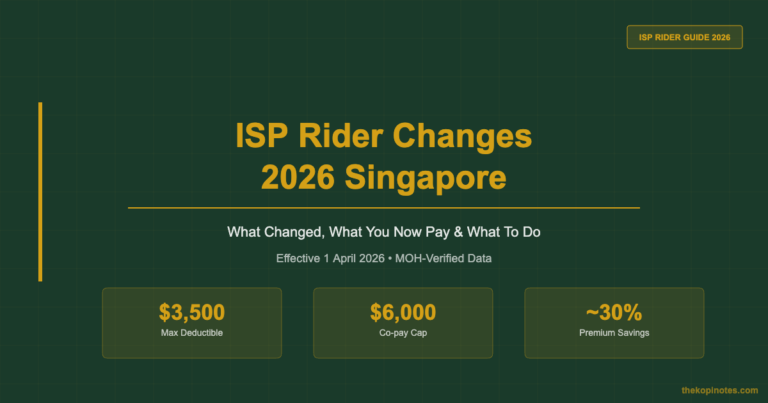
- From 1 April 2026, new ISP riders can no longer cover your deductible ($2,000–$3,500 depending on ward). You pay that yourself — but rider premiums are now ~30% cheaper.
- If you already have a rider, nothing changes until your policy renews after 1 April 2028.
What Is an Integrated Shield Plan?
MediShield Life is the basic health insurance every Singapore Citizen and Permanent Resident has. It covers ward Class B2 and below in a restructured (public) hospital. If you want more — Class B1, Class A, or a private hospital — you need an ISP.
Think of it like a sandwich. MediShield Life is the bottom slice: always there, covers the basics. Your ISP is the top slice: chosen by you, adds the extra coverage you want.
Here’s the key point: ISP premiums are paid partly from your MediSave and partly in cash. For most ages up to 40, you can pay the full base ISP premium from MediSave alone — no cash needed.
But once you add a rider (an add-on to your ISP), you pay the rider premium in cash only. MediSave cannot be used for riders.
The 7 MOH-Approved ISP Insurers in Singapore
MOH approves 7 private insurers to offer ISPs. Each pairs with MediShield Life (run by CPF Board) to form an integrated product.
| Insurer | Plan Name | Private Hospital? | Max Annual Limit |
|---|---|---|---|
| AIA | HealthShield Gold Max | Yes | S$2,000,000 |
| Great Eastern | Supreme Health | Yes | S$1,000,000+ |
| NTUC Income | Enhanced IncomeShield | Yes | S$1,000,000+ |
| Prudential | PRUShield | Yes | S$1,000,000 |
| Singlife | Shield Plan 1 / Plan 2 | Plan 1: Yes | S$2,000,000 |
| HSBC Life | Shield | Yes | S$1,000,000+ |
| Raffles Health Insurance | Raffles Shield | Yes | S$1,000,000+ |
Source: MOH ISP Comparison Page, August 2026. Annual limits are for the highest-tier plan of each insurer and may vary by plan tier.
Not sure which one to pick? The Shield Plan Singapore guide breaks down what to look for before you commit.
What Changed in April 2026: The New Rider Rules
This is the biggest change to ISPs in years — and many Singaporeans don’t realise it has already happened.
From 1 April 2026, MOH introduced new requirements for ISP riders. Here’s what changed:
1. Riders Can No Longer Cover Your Deductible
Before April 2026, many ISP riders covered the deductible — the first chunk of the bill you pay before insurance kicks in. That meant you could pay near-zero out of pocket.
From 1 April 2026, any new rider you buy cannot cover this deductible. You pay it yourself — from MediSave or cash. The deductible ranges from S$2,000 (Class C) to S$3,500 (Class A or private hospital).
2. Co-Payment Cap Raised to S$6,000
After the deductible, you also pay a portion of the remaining bill. This is called co-insurance. The cap on how much you pay in co-insurance per year has been raised to a minimum of S$6,000.
3. Rider Premiums Drop ~30%
The upside: new riders are significantly cheaper. MOH estimates new private hospital rider premiums will be about 30% lower than pre-April 2026 riders with maximum coverage. If you’re buying a rider for the first time, this is actually good news.
What If You Already Have a Rider?
If you bought your rider before 1 April 2026, nothing changes immediately. Your existing rider stays as-is until it is due for renewal after 1 April 2028 — at which point it will be converted to the new structure automatically.
If you bought a rider between 27 November 2025 and 31 March 2026, it will also eventually convert, but only when your policy renews after 1 April 2028.
Source: MOH Press Release, November 2025 and MOH New IP Riders page.
MediShield Life Deductibles in 2026
These are the amounts you pay before your MediShield Life (and ISP) cover kicks in. Updated figures effective 1 June 2026:
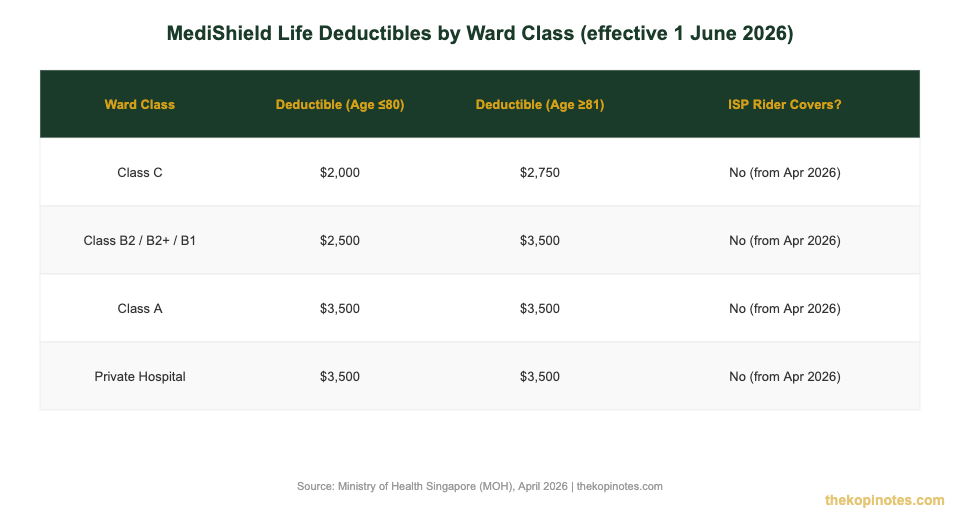
Important: from April 2026, your ISP rider can no longer cover these deductibles. You pay them out of MediSave or cash. This is why choosing the right ward class for your ISP matters — a private hospital ISP comes with a S$3,500 deductible you must pay yourself.
After the deductible, MediShield Life covers 90% of the remaining bill (within its claim limits). Your ISP then tops up what MediShield Life doesn’t cover, up to the ISP’s own limits.
How to Choose the Right Integrated Shield Plan
There’s no single “best” ISP. The right plan depends on your age, health, budget, and what kind of hospital experience you want.
Step 1: Decide Your Ward Preference
This is the most important decision. Each tier comes with higher premiums:
- Class B1 — 4-bed wards in public hospitals. Cheapest ISP premiums.
- Class A — single/2-bed rooms in public hospitals. Mid-range premiums.
- Private Hospital — your own room, choice of doctor, higher premiums. Best for those who want maximum choice.
Step 2: Compare Premiums at Your Current Age
ISP premiums rise significantly with age — especially from your 50s. A plan that looks affordable at 30 can become expensive by 60. Always check the full premium table from age 21 to 80 before signing up.
Step 3: Check the Panel of Doctors (If Relevant)
Some ISPs require you to use panel doctors to get full coverage. If you have a preferred specialist, check they’re on the insurer’s panel — or choose a plan with no panel restrictions.
Step 4: Decide Whether to Add a Rider
Post-April 2026, riders are cheaper but cover less. You’ll pay the deductible yourself. A rider still makes sense if you want to cap your maximum yearly out-of-pocket costs at ~S$9,500 (deductible + co-insurance cap), rather than risking a potentially larger bill. See the Singlife Shield Plan guide and the PRUShield guide for per-insurer rider details.
Step 5: Use MediSave to Pay Where Possible
Base ISP premiums can be paid from MediSave (up to the Additional Withdrawal Limit — check CPF Board’s guidelines for current limits by age). Riders must be paid in cash. Budget accordingly.
Annual ISP Premiums by Age (2026 Estimates)
The chart below shows approximate annual base ISP premiums for a Class A ward plan, by age band. These are indicative — exact rates vary by insurer and plan tier. Always check the insurer’s latest premium schedule.
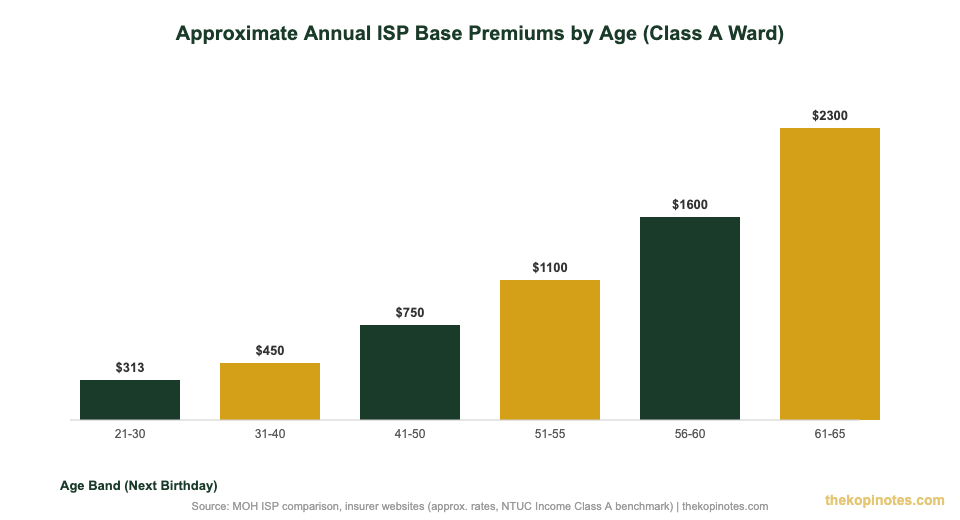
Source: NTUC Income Enhanced IncomeShield as benchmark; actual rates vary by insurer, gender, and smoking status. Check each insurer’s website for exact figures.
A few things stand out from this data:
- For ages 21–30, Class A ISP premiums start around S$313/year — fully payable from MediSave.
- Premiums roughly double every decade from age 40 onwards.
- By age 61–65, you’re looking at S$2,000+ per year for a Class A plan — and even more for private hospital coverage. This is why starting young matters: continuous coverage from a young age is generally cheaper long-term than buying at 50 or 60.
For a full breakdown of the Singlife Shield Plan premiums, including Plan 1 and Plan 2 rates, we have a dedicated article.
Should You Still Get an ISP Rider Post-2026?
This is the question everyone is asking since the April 2026 changes. Here’s a practical take.
The case for getting a rider:
- You cap your worst-case yearly out-of-pocket to ~S$9,500 (deductible + co-insurance). Without a rider, bills can be much higher.
- New riders are ~30% cheaper — so the cost-benefit has actually improved for newer buyers.
- If you’re in a private hospital, a prolonged stay can cost tens of thousands. The rider makes that manageable.
The case against:
- You still pay S$3,500 (private hospital deductible) out of pocket each time you’re admitted. For minor procedures, you might pay the deductible and get nothing back from the rider.
- Rider premiums are paid in cash only — adds a real monthly cost.
- If you have healthy MediSave savings and rarely get hospitalised, self-insuring the deductible may be fine.
The bottom line: riders still make sense for most people who choose Class A or private hospital coverage — especially if you have a family history of serious illness. But they’re no longer the “zero out-of-pocket” solution they once were.
For more on managing healthcare costs in retirement, use our Singapore retirement planning calculator to see how healthcare might fit into your long-term financial picture.
Frequently Asked Questions
What is an Integrated Shield Plan (ISP) in Singapore?
An ISP is a private health insurance policy that pairs with MediShield Life to give you access to higher ward classes — Class A or private hospital — in Singapore. Without an ISP, MediShield Life only covers Class B2 and below in a restructured hospital. ISPs are offered by 7 MOH-approved private insurers: AIA, Great Eastern, NTUC Income, Prudential, Singlife, HSBC Life, and Raffles Health Insurance.
Do I need an ISP if I already have MediShield Life?
MediShield Life is compulsory for all Singapore Citizens and PRs. But it only covers Class B2 wards and below. If you want to stay in Class A or a private hospital, you need an ISP. Without one, you’ll pay a very large out-of-pocket bill for private ward stays. Most Singaporeans with a preference for Class A or above should get an ISP.
What changed for ISP riders in April 2026?
From 1 April 2026, new ISP riders can no longer cover your deductible ($2,000–$3,500 depending on ward class). You pay the deductible yourself, from MediSave or cash. The co-payment cap also increased to a minimum of $6,000. The upside: new rider premiums are roughly 30% cheaper than before. If you already have a rider bought before April 2026, it stays as-is until renewal after 1 April 2028.
Can I use MediSave to pay for my ISP?
Yes — for the base ISP premium, up to the Additional Withdrawal Limit set by CPF Board (which varies by age). For most people under 40, the full base premium can be paid from MediSave with no cash outlay. However, rider premiums must be paid in cash — MediSave cannot be used for riders.
Which ISP is best for private hospital coverage?
There is no single “best” — it depends on your budget, preferred doctors, and risk tolerance. Singlife Shield Plan 1 offers a S$2,000,000 annual limit. Prudential PRUShield Plus has consistently competitive premiums for older age bands. NTUC Income is often the cheapest entry point for young adults. Use MOH’s official ISP comparison tool to compare benefits side by side.
What is the maximum deductible I pay under my ISP in 2026?
From 1 June 2026, the deductibles are: Class C — S$2,000 (age ≤80) / S$2,750 (age ≥81); Class B2/B2+/B1 — S$2,500 (age ≤80) / S$3,500 (age ≥81); Class A and private hospital — S$3,500. From April 2026, new ISP riders cannot cover this deductible — you pay it yourself.
Can I switch ISP providers?
Yes, you can switch ISP providers — but you should do so carefully. Some pre-existing conditions may not be covered by your new insurer. If you switch, you may lose continuous coverage protection. Always read the new insurer’s exclusions and check whether your health conditions are covered before switching. It is generally easier to switch when you are young and healthy.
This article is for general information only and does not constitute financial or insurance advice. ISP premiums and benefits change regularly — always verify current rates directly with your insurer or a licensed financial adviser. Data verified as at 23 August 2026.
Get Free Insurance Advice
Speak with a licensed insurance advisor. No obligation, no cost.
By submitting this form, you agree to our Privacy Policy.
This article was researched with the help of AI. While we strive to keep all information accurate and up to date, there may be errors. If you notice any discrepancies, please contact us.