SRS Withdrawal Age Singapore 2026: How It’s Locked In
Singapore’s retirement age rose from 63 to 64 on 1 July 2026 — here’s exactly how that affects when you can withdraw your SRS savings.
Your SRS withdrawal age is fixed at the statutory retirement age in force on the day you made your first SRS contribution — not today’s retirement age. Singapore’s retirement age rose from 63 to 64 on 1 July 2026, so your locked-in age now depends entirely on your contribution history. Withdraw before that age and you lose the tax break, plus pay a 5% penalty.
Not financial advice. All figures are for educational reference only. Data as at August 2026 unless otherwise noted.
- Your SRS withdrawal age = the statutory retirement age when you made your first contribution, not today’s age
- Singapore’s retirement age rose from 63 to 64 on 1 July 2026 — anyone contributing to SRS for the first time now is locked in at 64
- Withdraw early and 100% of the sum is taxable plus a 5% penalty; withdraw on time and only 50% is taxable, up to $40,000 a year tax-free
Free download: The Singapore Money Playbook — 7 money mindset shifts written for Singapore, with the CPF-adjusted retirement number most guides get wrong (PDF + Notion).
Table of Contents
Contents — Click to expand
- How Your SRS Withdrawal Age Is Actually Determined
- Singapore’s Retirement Age Rose to 64 on 1 July 2026
- Which Withdrawal Age Applies to You? Three Scenarios
- What You Get If You Withdraw at the Right Age
- What Happens If You Withdraw Too Early
- What to Do Now If You Haven’t Opened an SRS Account
- Frequently Asked Questions
How Your SRS Withdrawal Age Is Actually Determined
Most people assume their Supplementary Retirement Scheme (SRS) withdrawal age simply follows Singapore’s current statutory retirement age. That is not how it works.
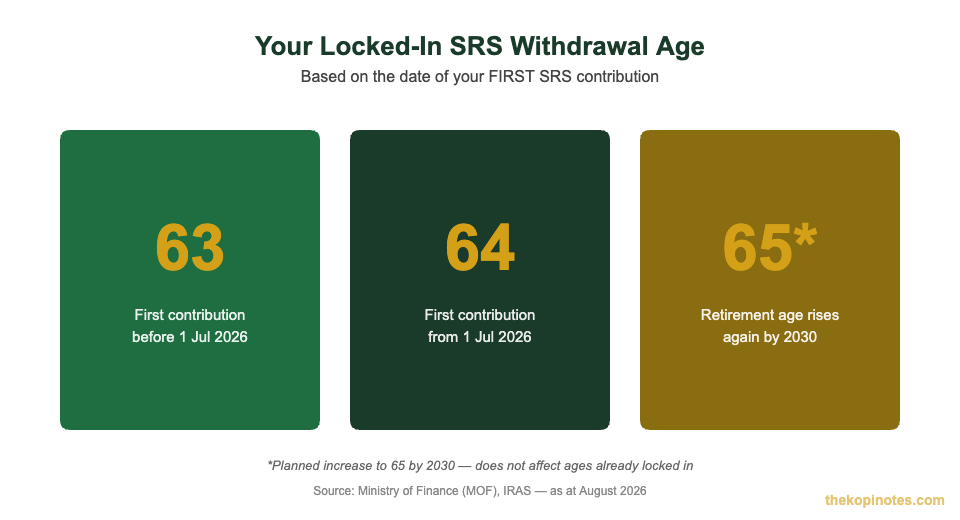
Your SRS withdrawal age is locked in on the day you make your first SRS contribution. Whatever the statutory retirement age is on that exact date becomes your personal withdrawal age — permanently. Later increases to the national retirement age do not move it.
This lock-in rule matters a lot right now. Singapore’s statutory retirement age rose from 63 to 64 on 1 July 2026. If you already had an SRS account before that date, you are still locked in at 63. If your first-ever SRS contribution happens from 1 July 2026 onward, you are locked in at 64 instead.
That means two people with identical SRS balances, both aged 45 today, can have completely different withdrawal ages — purely because one of them opened an account and put in $1 before the cut-off, and the other did not.
Singapore’s Retirement Age Rose to 64 on 1 July 2026
Here is the timeline you need to know. Singapore’s statutory retirement age moved from 63 to 64 on 1 July 2026, alongside a re-employment age increase from 68 to 69. The government has also flagged plans to raise the retirement age further, to 65, by 2030.
You do not need to relive the run-up to the 1 July 2026 change — we covered the pre-deadline urgency in our SRS deadline guide back when readers still had a window to lock in age 63. This article picks up from there: it is for anyone who wants to understand how the rule actually plays out now that the deadline has passed.
Which Withdrawal Age Applies to You? Three Scenarios
Work through these three situations to find your own locked-in age. Each one comes straight from the lock-in rule above.
| Your situation | First SRS contribution | Your locked-in withdrawal age |
|---|---|---|
| You already had an SRS account before 1 July 2026 | Any date before 1 July 2026 | 63 |
| You opened an SRS account and put in at least $1 before the 30 June 2026 cut-off | Before 30 June 2026 | 63 |
| You open an SRS account and make your first contribution from 1 July 2026 onward | On or after 1 July 2026 | 64 |
Source: Ministry of Finance (MOF), IRAS — as at August 2026
If you fall into the third row, you are not worse off in absolute terms — you simply work one more year before penalty-free access, matching the same rule everyone contributing from mid-2026 onward now faces. The people who benefited from locking in 63 were those who already had, or quickly opened, an account before the cut-off.
A Real Example: Two Colleagues, Two Withdrawal Ages
Say you and a colleague are both 40 years old today. You opened your SRS account back in 2023 and have been contributing every year since. Your colleague kept meaning to open one but never got around to it — and their first-ever contribution lands in September 2026.
Under the lock-in rule, you are locked in at age 63, because that was the statutory retirement age when you first contributed. Your colleague is locked in at 64, because that is the statutory retirement age now, after 1 July 2026. When you both turn 63, you can withdraw penalty-free — your colleague has to wait one more year.
Neither of you is being penalised by the system. You simply acted earlier, under an earlier rule, and that earlier rule stayed attached to your account. This is exactly why financial commentators pushed the “contribute $1 before 30 June” message so heavily earlier in 2026 — it was a genuine, low-cost way to lock in a lower withdrawal age before the window closed.
What You Get If You Withdraw at the Right Age
Withdraw on or after your locked-in age and SRS becomes genuinely generous. Only 50% of what you withdraw counts as taxable income. On top of that, you can withdraw up to $40,000 a year completely tax-free if you have no other taxable income that year.
Here is why that number matters. SRS withdrawals are normally spread over 10 years from your first withdrawal. If you keep each year’s withdrawal at or below $40,000 and have no other taxable income, the entire amount for that year falls within the tax-free band. Stagger $400,000 in SRS savings evenly across 10 years at $40,000 a year, and you could clear the whole balance without paying a cent of tax on it.
Most retirees are not living on SRS money alone — many draw a retirement calculator-modelled income from CPF LIFE, dividends and SRS together, which shifts the exact tax outcome. But the structure of the concession stays the same: the later and slower you withdraw, the less tax you pay.
What Happens If You Withdraw Too Early
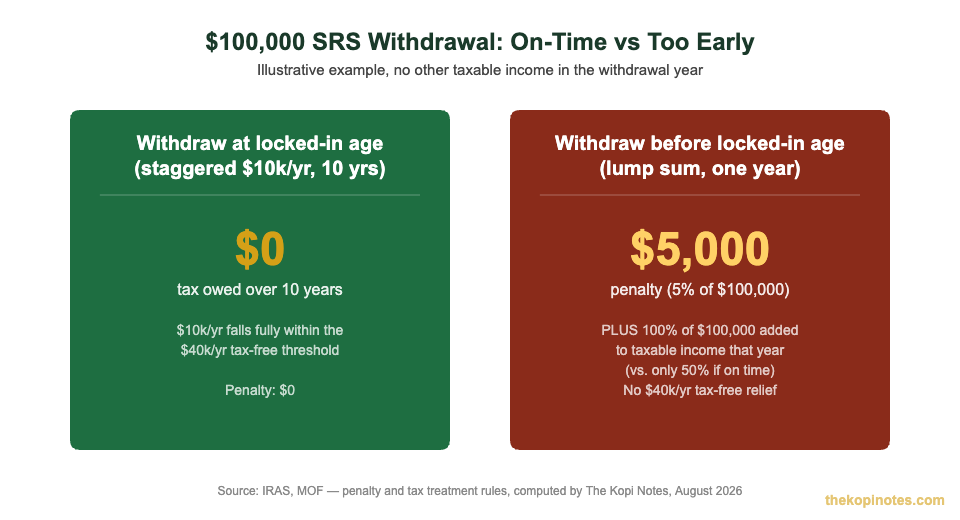
Withdraw before your locked-in age and both concessions disappear at once. You lose the 50% tax exemption — the full amount withdrawn is added to your taxable income for that year. On top of that, IRAS applies a 5% penalty on the withdrawal sum, with narrow exceptions such as bankruptcy, serious illness, or death.
Here is what that looks like on an SGD 100,000 balance, assuming no other taxable income in the withdrawal year:
| Item | Withdraw at locked-in age | Withdraw early |
|---|---|---|
| IRAS penalty | None | 5% of the withdrawal sum |
| Taxable portion | 50% of the amount withdrawn | 100% of the amount withdrawn |
| Annual tax-free relief | Up to $40,000/year if no other taxable income | Not available |
Source: IRAS, MOF — penalty and tax treatment rules as at August 2026. Actual tax payable on any income depends on your full-year chargeable income and prevailing resident tax rates.
The 5% penalty is a flat, guaranteed cost — on a $100,000 withdrawal, that is $5,000 gone before tax is even calculated. Losing the 50% exemption and the $40,000 tax-free band on top of that is what makes early withdrawal expensive for most people, not just the penalty on its own.
Quick Checklist Before You Contribute
- Check your own history first. Log in to your SRS operator’s portal (DBS, OCBC or UOB) and confirm the date of your very first contribution — that date, not your birth year, sets your withdrawal age.
- Don’t let SRS cash sit idle. SRS cash accounts typically pay a token interest rate far below inflation — investing through a robo-advisor or brokerage inside your SRS account is usually a better long-term fit than leaving it as cash.
- Plan withdrawals around the $40,000-a-year band. If you expect little or no other taxable income in retirement, staggering withdrawals close to $40,000 a year is what unlocks the full tax-free treatment.
- Don’t withdraw early just because you can. The combination of the 5% penalty and losing the 50% tax concession makes early withdrawal one of the more expensive mistakes an SRS holder can make.
What to Do Now If You Haven’t Opened an SRS Account
If you have not made your first SRS contribution yet, the 30 June 2026 cut-off for locking in age 63 has already passed. That is not a reason to skip SRS altogether — it just means your withdrawal age will be 64, the current statutory retirement age, once you start.
The tax relief on contributions works the same way regardless of your locked-in withdrawal age: every dollar you put into SRS (up to the annual cap) reduces your chargeable income for that year. The main decision left is where to invest the money once it is in your SRS account, since idle cash inside SRS earns a token interest rate.
Our step-by-step guide to opening an SRS account walks through the bank application process, while the buttons below let you compare two robo-advisors that invest SRS funds in globally diversified portfolios instead of leaving the cash to sit idle.
If you are also planning around your CPF Ordinary Account alongside SRS, our CPF Ordinary Account withdrawal guide covers the separate (and stricter) rules that apply there.
Ready to Start or Grow Your SRS Investments?
Compare how Endowus and Syfe let you invest your SRS funds instead of leaving them in cash.
Frequently Asked Questions
What is the SRS withdrawal age in Singapore in 2026?
It depends on when you made your first SRS contribution, not on today’s date. If you contributed before 1 July 2026, your locked-in withdrawal age is 63. If your first contribution is from 1 July 2026 onward, your locked-in age is 64.
Does the retirement age increase to 64 affect my existing SRS account?
No. Once you have made your first SRS contribution, your withdrawal age is frozen at whatever the statutory retirement age was on that date. Later increases to the national retirement age do not move your personal SRS withdrawal age.
What happens if I withdraw from SRS before my locked-in age?
You will pay a 5% penalty on the amount withdrawn, and 100% of the withdrawal is added to your taxable income for that year, instead of the 50% concession you would get by withdrawing on time.
How much can I withdraw tax-free from SRS each year?
Up to $40,000 a year is tax-free if you have no other taxable income that year, once you have reached your locked-in withdrawal age. Over the standard 10-year withdrawal period, that is up to $400,000 tax-free in total.
I missed the 30 June 2026 deadline — what age am I locked into now?
If your first SRS contribution happens on or after 1 July 2026, your withdrawal age is locked at 64, the current statutory retirement age.
Will the SRS withdrawal age rise again after 2026?
The government has flagged that the retirement age will rise to 65 by 2030. Anyone whose first SRS contribution is already on record before that change keeps whichever age was locked in at the time — the 2030 change will only affect people making their very first SRS contribution from that point on.
This article was researched with the help of AI. While we strive to keep all information accurate and up to date, there may be errors. If you notice any discrepancies, please contact us.