Copper ETF Singapore: How to Buy the AI Infrastructure Metal Play (2026 Guide)
Record prices, AI data centre demand, and the UCITS ETFs Singapore investors can buy today.
Copper ETFs give Singapore investors exposure to the metal now powering the AI data centre boom, from high-capacity power lines to cooling systems. Copper hit a record US$6.77 a pound on COMEX in August 2026, driven by surging AI infrastructure demand and tightening global supply. You can buy copper ETFs through LSE-listed UCITS funds like COPX and COPA, which avoid US estate tax exposure, or US-listed funds like CPER.
Not financial advice. All figures are for educational reference only. Data as at August 2026 unless noted.
- Copper hit record prices in August 2026 — US$6.77/lb on COMEX (7 August) and near its all-time LME high — driven by AI data centre demand and a Congo export ban that tightened supply.
- LSE-listed UCITS ETFs like Global X Copper Miners (COPX) and WisdomTree Copper (COPA) let you access copper without US estate tax exposure, unlike US-listed funds like CPER.
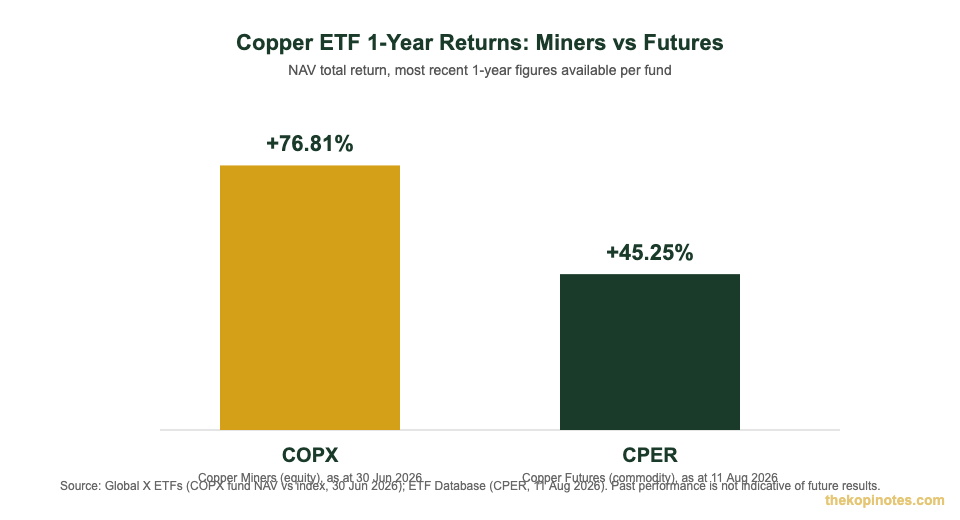
- Copper mining equity ETFs (COPX) have outpaced copper futures ETFs (CPER) over the past year, but they carry different risks — know which one you’re buying before you click “buy.”
Table of Contents
What Is a Copper ETF?
A copper ETF gives you exposure to copper prices or copper-mining companies without buying physical metal or opening a futures account. You buy one ticker on your brokerage platform, the same way you’d buy a stock.
There are two very different types of copper ETF, and mixing them up is the most common mistake investors make.
Commodity-tracking ETFs hold copper futures contracts or a copper-linked index. Your return tracks the copper price itself, minus fees and any cost from “rolling” futures contracts each month. CPER and WisdomTree Copper (COPA) work this way.
Copper mining equity ETFs hold shares of companies that dig copper out of the ground — miners like Freeport-McMoRan, BHP, and Glencore. Your return depends on copper prices, but also on each company’s costs, debt, and country risk. Global X Copper Miners UCITS ETF (COPX) works this way.
Miner ETFs tend to amplify copper price moves. When copper rises 10%, a profitable miner’s earnings — and share price — can rise by a lot more, because their costs stay roughly fixed. That cuts both ways: miner ETFs fall harder too, when copper drops.
Neither type currently pays a meaningful dividend. You’re buying these for capital growth exposure to an industrial metal, not income. Copper joins other critical-metal themes that have rallied in 2026 — see our silver ETF price surge guide and nuclear ETF Singapore guide for the wider AI-power-demand story.
Why Copper Is Trending in 2026
Copper is having its moment because of a demand story and a supply story hitting at the same time.
The demand story: AI data centres. An AI-focused data centre uses roughly 10 times more copper than a conventional one — for high-capacity power lines, transformers, and cooling systems. S&P Global’s copper demand analysis expects data centre copper demand to more than double, from about 1.1 million metric tons in 2025 to 2.5 million metric tons by 2040, with AI training workloads alone accounting for 58% of that demand. The four largest hyperscalers raised their combined 2026 AI capital expenditure budget to roughly US$750 billion.
| Metric | 2025 | 2040 (Projected) |
|---|---|---|
| Global data centre copper demand | ~1.1 million metric tons | ~2.5 million metric tons |
| Share from AI training workloads | Rising | ~58% of data centre demand |
| Combined hyperscaler AI capex (2026 budget) | — | ~US$750 billion |
Source: S&P Global copper demand analysis, cited via Yahoo Finance, July 2026.
The supply story: a real shortage. The Democratic Republic of Congo — one of the world’s largest copper producers — banned exports of copper concentrate and cobalt concentrate in 2026, tightening an already-stretched market. Global mine supply has struggled to keep pace with demand for years, and new mines take a decade or more to permit and build.
The result: copper futures on COMEX hit an all-time intraday high of US$6.77 a pound on 7 August 2026, above the previous record set in May 2026. On the London Metal Exchange, three-month copper touched around US$14,455 a tonne in early-to-mid August 2026 — closing in on its all-time high of US$14,527.50 a tonne, set on 29 January 2026.
Here’s the practical read for you as a Singapore investor: if you’d put SGD 10,000 into COPX back in June 2025, the fund’s roughly 76.8% one-year net return to 30 June 2026 would have grown that to around SGD 17,680. That’s a real illustration of how much leverage copper miners had to the metal’s 2026 rally. However, past performance never guarantees what happens next, and copper is a genuinely cyclical, volatile asset.
Best Copper ETFs for Singapore Investors
Four copper ETFs are realistically accessible to Singapore investors through brokers like Interactive Brokers, Saxo, and moomoo. Two are LSE-listed UCITS funds domiciled in Ireland or Jersey; two are US-listed funds domiciled in the United States.
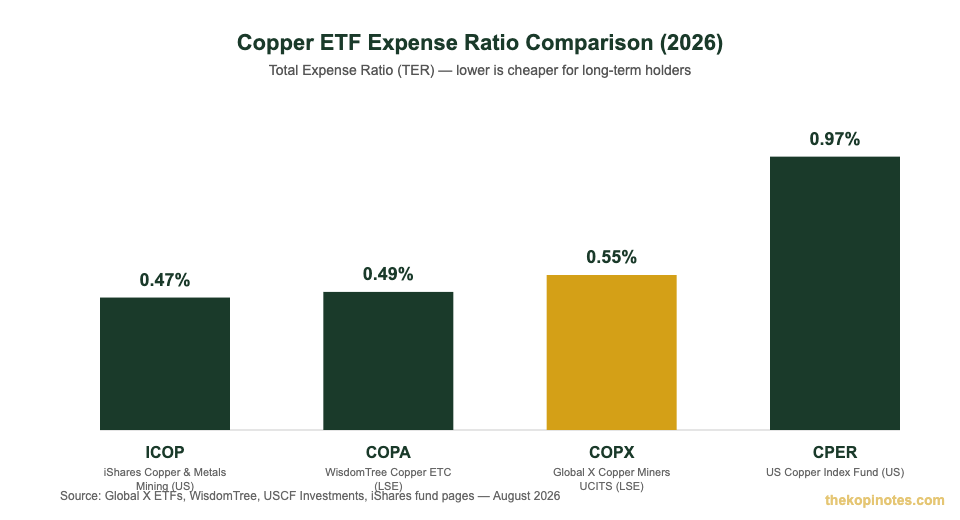
| ETF | Exchange | Domicile | Structure | TER | AUM |
|---|---|---|---|---|---|
| COPX — Global X Copper Miners UCITS ETF | LSE (COPX LN) | Ireland | Mining equities | 0.55% | ~US$1.29bn |
| COPA — WisdomTree Copper | LSE (COPA LN) | Jersey | Copper futures (ETC) | 0.49% | Not disclosed |
| CPER — US Copper Index Fund | NYSE Arca | USA | Copper futures | 0.97% | ~US$756m |
| ICOP — iShares Copper & Metals Mining ETF | NYSE Arca | USA | Mining equities | 0.47% | ~US$479m |
Source: Global X Copper Miners UCITS ETF factsheet, WisdomTree Copper factsheet, USCF Investments (CPER), ETF Database (ICOP) — data as at August 2026.
The domicile matters more than most investors realise. US-listed funds like CPER and ICOP are subject to US estate tax rules for non-US-resident investors holding above USD 60,000 — a real risk for a Singapore investor building a sizeable position over time. LSE-listed, Ireland-domiciled funds like COPX sidestep this because Ireland-domiciled funds are not treated as US-situs assets for non-resident estate tax purposes.
COPA, the WisdomTree Copper ETC, is domiciled in Jersey rather than Ireland, but is structured as a UCITS-eligible exchange-traded commodity and does not carry US estate tax exposure either, since it holds copper futures rather than US equities.
Between COPX and COPA: COPX gives you equity-style upside — and downside — through mining companies, plus indirect diversification across Canada, Australia, the US, China, and Europe. COPA gives you closer-to-pure copper price exposure, with none of the company-specific risk, but also none of the operating leverage that boosted COPX’s 2026 returns.
How to Buy Copper ETFs in Singapore
Buying a copper ETF works the same way as buying any other ETF — you just need to pick the right exchange for your chosen fund.
Interactive Brokers (IBKR)
Fund your account, then search the ticker — “COPX” for LSE, or “CPER” for NYSE Arca. Select the correct exchange from the dropdown, since IBKR often lists the same ticker on multiple exchanges, then place a limit order in GBP for LSE-listed funds or USD for US-listed funds. IBKR is generally the most cost-effective option for larger, recurring purchases.
Saxo Markets
Saxo offers access to both LSE and NYSE Arca-listed copper ETFs. Search by ticker or ISIN — IE0003Z9E2Y3 for COPX — confirm the exchange, and place your order. Saxo’s platform fees are competitive for occasional trades but can add up for frequent small purchases.
moomoo Singapore
moomoo gives Singapore investors direct access to CPER and ICOP on US exchanges, with a simpler mobile-first interface. LSE access is more limited on moomoo than on IBKR or Saxo, so if COPX or COPA is your target, check current exchange coverage before funding your account.
Syfe Brokerage
If you’d rather not pick individual tickers, Syfe’s referral code and sign-up bonus gets you access to a simplified brokerage platform that covers major global exchanges — a reasonable starting point if copper is a small satellite position within a broader ETF portfolio.
Whichever broker you use, remember: copper ETFs should be a small, high-conviction slice of your portfolio, not a core holding. Most Singapore investors are better served building their core around a broad market fund like the CSPX ETF Singapore guide covers, with a thematic sleeve like copper on the side.
Risks to Consider
Copper ETFs carry real risks that go beyond typical market swings. Weigh these before buying.
Price volatility. Copper is a cyclical, industrial commodity. Prices can swing sharply on recession fears, Chinese manufacturing data, or a single mine reopening. The same leverage that drove COPX’s 76.8% one-year gain works in reverse during a downturn.
Concentration and country risk (miner ETFs). COPX’s top 10 holdings make up more than half the fund, and its country exposure leans heavily on Canada — about 38% — plus single-country political risk in places like the Democratic Republic of Congo, Zambia, and Peru. Mining regulation and export policy in these countries can change with little warning, as the 2026 Congo export ban showed.
Contango and roll cost (futures ETFs). CPER and COPA don’t hold physical copper — they hold futures contracts that are “rolled” into new contracts each month. If future-dated contracts trade above the spot price, a state called contango, the fund can lose value even if the spot copper price stays flat.
Currency risk. LSE-listed funds trade in GBP; US-listed funds trade in USD. Your SGD returns depend on both the copper trade and the currency swing.
No income. None of these ETFs pay a meaningful dividend. You’re relying entirely on price appreciation.
Given these risks, most financial planners would frame a copper ETF as a tactical, single-digit-percentage allocation, not a substitute for a diversified core portfolio. For a broader critical-minerals angle, see our rare earth ETF Singapore guide, and use our Singapore retirement calculator to check how a thematic position like this fits your overall retirement timeline.
Frequently Asked Questions
What is a copper ETF and why is it trending in Singapore in 2026?
A copper ETF gives you price exposure to copper — either through mining company shares or copper futures — without buying physical metal. It’s trending because AI data centres use roughly 10 times more copper than conventional ones, and copper hit record prices on COMEX and near-record levels on the LME in August 2026.
Can I buy copper ETFs using my CPF or SRS funds?
Copper ETFs are not on the CPF Investment Scheme (CPFIS) approved list, so you cannot use CPF Ordinary Account funds to buy them. Whether you can use SRS funds depends on your specific broker — check with Interactive Brokers, Saxo, or your SRS-linked broker before assuming SRS compatibility.
Is COPX the same as CPER?
No. COPX (Global X Copper Miners UCITS ETF) holds shares of copper mining companies like Freeport-McMoRan and BHP. CPER (United States Copper Index Fund) holds copper futures contracts and tracks the copper price directly. They can move very differently even when copper prices are flat.
Which broker is best for buying copper ETFs in Singapore?
Interactive Brokers offers the widest access to both LSE-listed funds like COPX and COPA, and US-listed funds like CPER and ICOP, at competitive commission rates. Saxo Markets is a solid alternative with LSE access. moomoo Singapore currently offers more limited access to LSE-listed copper ETFs.
Are LSE-listed copper ETFs safer than US-listed ones for Singapore investors?
“Safer” isn’t quite the right word — both carry similar copper price risk. But LSE-listed, Ireland-domiciled funds like COPX avoid US estate tax exposure for non-US-resident investors holding above USD 60,000, which US-listed funds like CPER and ICOP do not.
What is the minimum investment for a copper ETF?
There’s no minimum beyond the price of one share or unit — COPX and CPER both trade at levels accessible with a few hundred SGD. The bigger question is position sizing: most advisors would suggest keeping a single thematic ETF like this to a small percentage of your total portfolio.
Ready to Start Investing in ETFs?
Open a brokerage account and buy your first ETF today. Use our referral links for exclusive sign-up bonuses.
This article was researched with the help of AI. While we strive to keep all information accurate and up to date, there may be errors. If you notice any discrepancies, please contact us.