S-REITs vs Singapore Savings Bonds 2026: Which Gives Better Returns?
A side-by-side look at S-REIT yields and SSB guaranteed rates for Singapore income investors
S-REITs currently yield around 5.9% a year on average (CSOP iEdge S-REIT Leaders Index ETF, Aug 2026), more than double the Singapore Savings Bond’s 2.25% 10-year average return (SBSEP26). But S-REIT income and unit prices can fall, while SSBs are 100% capital-guaranteed by the Singapore Government. The right choice depends on how much capital risk you’re willing to take for higher income.
Not financial advice. All figures are for educational reference only. Data as at August 2026 unless noted.
- S-REITs pay roughly 3x more income than SSBs right now (~5.9% vs ~2.25%), but that income isn’t guaranteed and unit prices move up and down.
- SSBs guarantee your full principal back plus a known, government-backed step-up interest schedule — you just can’t grow your capital.
- Most Singapore investors don’t need to choose one exclusively — pairing a SSB “safety sleeve” with a S-REIT “income sleeve” is a common barbell approach.
Table of Contents
What Are S-REITs?
A Singapore Real Estate Investment Trust (S-REIT) is a listed fund that owns income-producing property — malls, offices, industrial parks, data centres, or hospitals. You buy units on the Singapore Exchange (SGX) just like a stock. Instead of a “dividend”, REITs pay you a Distribution Per Unit (DPU) — basically your share of the rental income the trust collects, minus expenses.
Singapore has around 40 listed REITs, and together they’re what makes the S-REIT sector one of Asia’s largest, with a combined market cap north of S$100 billion. If you want to compare individual names, our best S-REITs in Singapore 2026 guide ranks them by yield, gearing, and sector.
Here’s why income investors like S-REITs: they’re required by MAS to distribute at least 90% of taxable income to unitholders to enjoy tax transparency. That structural rule is what keeps yields high relative to regular stocks.
What Are Singapore Savings Bonds?
Singapore Savings Bonds (SSBs) are government bonds designed for individual investors. You lend money to the Singapore Government, and in return it pays you interest twice a year on a fixed, published schedule. Every SSB is backed by the AAA-rated Singapore Government — the same credit rating that backs your CPF savings.
Unlike a normal 10-year bond, SSBs “step up”: the interest rate rises each year you hold it. The current tranche, SBSEP26 (issue code GX26090V), pays 1.52% in year one, rising to 2.82% by year ten, for a 10-year average return of 2.25% p.a. Applications for this tranche close 26 August 2026, with issue on 1 September 2026.
You can redeem an SSB in any month with no penalty — you get back your full principal plus accrued interest. That flexibility is the whole point: it’s a place to park money you might need later, without locking in a fixed term. For the full mechanics, see our Singapore Savings Bonds 2026 guide.
One limit to know: you can hold a maximum of S$200,000 in SSBs across all tranches combined, and CPF funds cannot be used to buy them — only cash or Supplementary Retirement Scheme (SRS) funds.
Yield & Return Comparison
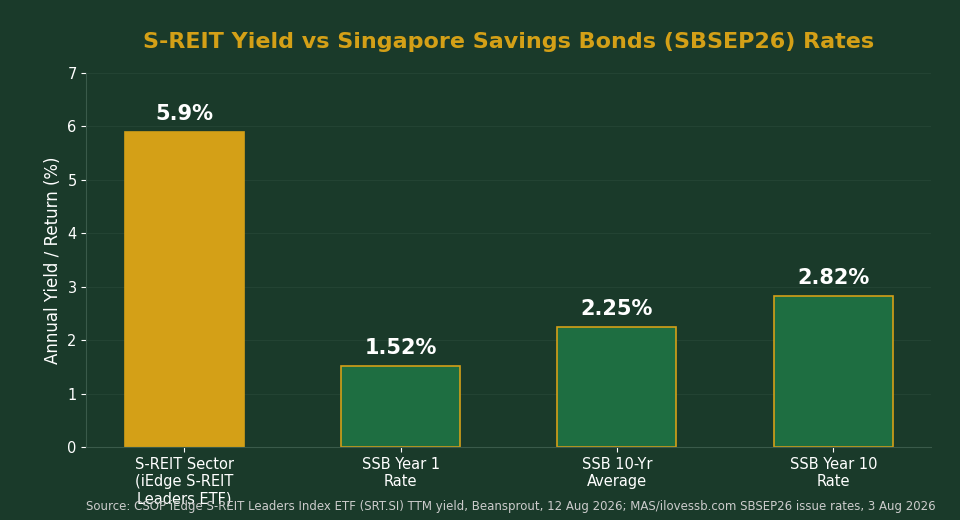
Here’s the headline number: S-REITs currently pay roughly 2.6x more income than the latest Singapore Savings Bond tranche. The CSOP iEdge S-REIT Leaders Index ETF (SGX: SRT) — a reasonable proxy for the broad S-REIT sector — has a trailing twelve-month dividend yield of 5.9% as at 12 August 2026. Compare that to SBSEP26’s 10-year average return of 2.25% p.a.
| Metric | S-REITs (Sector Avg) | SSB (SBSEP26) |
|---|---|---|
| Current annual return | ~5.9% (TTM yield) | 2.25% (10-yr average) |
| First-year return | Variable, market-driven | 1.52% (fixed, known upfront) |
| Return if held 10 years | Not guaranteed, depends on DPU trend | 2.82% in year 10 (fixed) |
| Payment frequency | Quarterly or semi-annually (varies by REIT) | Every 6 months (1 Mar & 1 Sep) |
Source: CSOP iEdge S-REIT Leaders Index ETF (SRT.SI) TTM yield, Beansprout, 12 Aug 2026; MAS/ilovessb.com SBSEP26 issue rates, 3 Aug 2026.
Risk Comparison
Higher income always comes with a trade-off. Here’s what you’re actually risking with each option.
| Risk Factor | S-REITs | SSB |
|---|---|---|
| Capital guarantee | None — unit price moves with the market | 100% principal guaranteed by the SG Government |
| Income stability | DPU can be cut if occupancy or rents fall | Fixed step-up schedule, known from day one |
| Interest rate sensitivity | High — REIT prices often fall when rates rise (higher gearing cost, competing yields) | None once bought — your rate schedule is locked in |
| Liquidity | Very high — trade anytime the market is open | Redeemable any month, no penalty, but takes about a month to process |
| Credit / default risk | REIT-specific — depends on gearing, tenant mix, refinancing risk | None — sovereign-backed, AAA-rated |
| Capital growth potential | Yes — unit price can rise with asset value or acquisitions | No — you get back exactly what you put in |
Source: MAS Singapore Savings Bonds programme details; general S-REIT structural characteristics.
In practice, this means SSBs behave like a savings account with a better rate — your capital is never at risk. S-REITs behave more like dividend stocks: the income is real, but so is the chance your capital is worth less than you paid, especially in a rising-rate environment.
Tax Treatment
Good news on both sides: neither income stream adds to your tax bill if you’re an individual investor.
SSB interest is fully tax-exempt for individuals. According to the Monetary Authority of Singapore (MAS), “the interest which you earn from the purchase of Savings Bonds is tax-exempted and does not have to be included in the chargeable income for your tax return.”
S-REIT distributions are also tax-exempt for individuals in almost all cases. Per the IRAS e-Tax Guide on Income Tax Treatment of REITs, distributions to individuals — whether local or foreign — are tax-exempt, except where you hold your units through a partnership or as part of a trade or business.
So for most retail investors, this comparison really is apples-to-apples on tax: what you see on the yield chart above is what actually lands in your bank account.
Worked Example: S$50,000 Over 10 Years
Say you have S$50,000 to put to work for the next 10 years. Here’s how the two options stack up, using today’s rates held constant (this is a simplification — real S-REIT yields move around, real SSB rates are fixed by tranche).
If you put S$50,000 into S-REITs at a constant 5.9% yield with no reinvestment of distributions, you’d collect roughly S$2,950 a year, or S$29,500 in total cash distributions over 10 years. Your S$50,000 principal would still be invested and could be worth more or less than S$50,000 depending on how unit prices move.
If you put S$50,000 into SBSEP26, you’d earn the guaranteed step-up schedule — 1.52% in year one, rising to 2.82% by year ten — for a total of S$11,355 in interest over 10 years. Your full S$50,000 principal is returned to you at maturity, guaranteed.
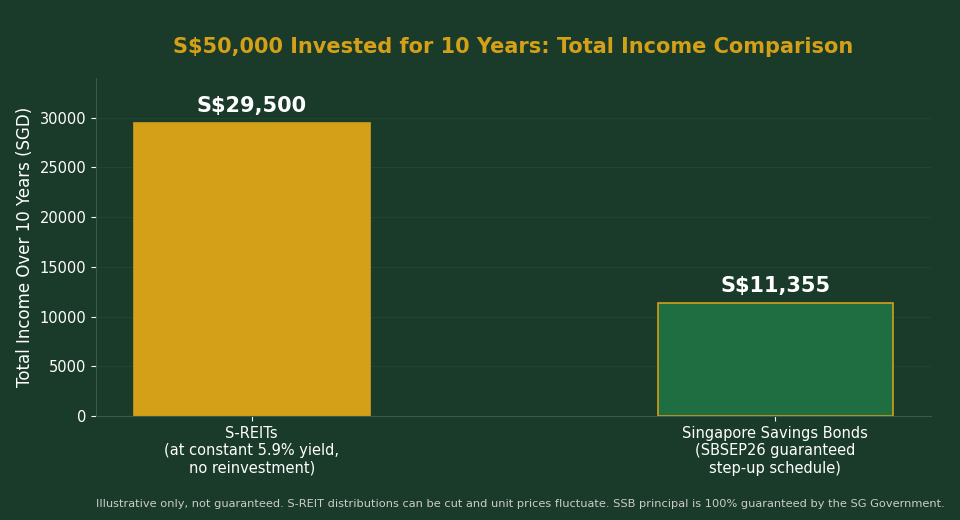
That’s an S$18,145 income gap in favour of S-REITs. But here’s the catch: that gap only holds if the S-REIT sector’s average yield stays near 5.9% and DPUs don’t get cut. If unit prices fall 10% over the decade, you’d give back roughly S$5,000 of that income advantage in paper losses — and unlike the SSB, there’s no guarantee you get your S$50,000 back in full.
This is the real trade-off: SSBs give you a known, guaranteed floor. S-REITs give you a much higher expected return, with real variance around that number.
Which Should You Choose?
Here’s the honest answer: most Singapore investors shouldn’t pick one exclusively. Instead, think of it as a barbell.
Use SSBs for money you can’t afford to lose. Your emergency fund, a house down payment you’ll need in 2-3 years, or the “safe” portion of your retirement savings all belong in SSBs (or similar guaranteed instruments). You’re not trying to grow this money — you’re protecting it while still earning more than a savings account.
Use S-REITs for money you can leave invested for 7-10+ years. If you don’t need the capital back on a specific date, and you can stomach unit prices moving 20-30% in either direction along the way, S-REITs give you a much stronger shot at building meaningful passive income. Our passive income Singapore guide walks through how S-REIT income fits into a broader income strategy.
A simple starting split for many investors: keep 1-2 years of expenses in SSBs or similar guaranteed instruments, and put long-term capital toward income-generating assets like S-REITs. Adjust based on your own risk tolerance and timeline — there’s no universally “correct” ratio.
How to Buy Each
Buying S-REITs: You can buy individual S-REITs directly through any SGX brokerage, or get instant diversification through a REIT ETF like the Lion-Phillip S-REIT ETF (SGX: CLR) — see our Lion-Phillip S-REIT ETF (CLR) guide for how it works. Robo-advisors like Syfe also offer curated REIT portfolios with automatic dividend reinvestment. You can pay with cash, SRS funds, and — for a shortlist of CPFIS-included REITs — CPF Ordinary Account funds.
Buying SSBs: Apply through DBS/POSB, OCBC, or UOB internet banking, mobile banking apps, or ATMs, using your cash or SRS account. Applications for the current tranche must be submitted before the closing date (26 August 2026 for SBSEP26); allotment is announced the next business day. Minimum investment is S$500, in multiples of S$500, up to the S$200,000 individual cap.
If you’re setting up a broader income and retirement plan, our Singapore retirement calculator can help you work out how much of each you’ll realistically need.
Want a Diversified Way Into S-REITs?
Syfe’s REIT+ portfolio gives you exposure to a curated basket of S-REITs with automatic dividend reinvestment — no need to pick individual names.
Frequently Asked Questions
Are S-REITs safer than Singapore Savings Bonds?
Can I lose money investing in S-REITs?
Is SSB interest or S-REIT distribution income taxable in Singapore?
What is the current Singapore Savings Bond interest rate?
What is the average S-REIT dividend yield right now?
Can I use CPF to buy Singapore Savings Bonds?
Should I put all my money in S-REITs for the higher yield?
This article was researched with the help of AI. While we strive to keep all information accurate and up to date, there may be errors. If you notice any discrepancies, please contact us.