MRTA vs Term Life Insurance for Your Singapore Home Loan (2026)
HPS, MRTA and level term life insurance all protect your mortgage — but they work very differently. Here’s how to pick the right one.
MRTA (Mortgage Reducing Term Assurance) pays off your home loan and shrinks as your loan balance falls. Term life insurance stays fixed and pays your nominated beneficiaries, not the bank directly. If you have an HDB loan paid with CPF, the Home Protection Scheme (HPS) already covers you.
Not financial advice. All figures are for educational reference only. Data verified as at 12 August 2026 against cpf.gov.sg and industry sources.
- HDB flat + CPF-funded loan: you’re already covered by HPS. No need to buy MRTA or term life just for this.
- HDB flat + bank loan, or private property: HPS isn’t compulsory (or doesn’t apply). You need MRTA or term life to protect your family from inheriting the loan.
- MRTA is usually cheaper upfront but shrinks with your loan and isn’t portable. Term life costs more but stays fixed and follows you if you refinance or move.
Table of Contents
Contents — Click to expand
Quick Answer: MRTA vs Term Life for Your Mortgage
If you own an HDB flat and pay your loan with CPF savings, you’re almost certainly already covered by the Home Protection Scheme (HPS). You don’t need to buy anything extra just for this.
But if you took a bank loan, or you own a private property, HPS either doesn’t apply or isn’t automatic. That’s where MRTA and term life insurance come in. Both can pay off your outstanding mortgage if something happens to you. The difference is how the cover behaves and who the payout goes to.
What HPS Actually Covers (And Its Limits)
The Home Protection Scheme (HPS) is CPF Board’s mortgage-reducing insurance for HDB flat owners. If you’re using CPF Ordinary Account (OA) savings to pay your HDB loan instalments, HPS cover is required. If you’re paying in cash, you’re strongly encouraged to apply, though it isn’t compulsory.
Here’s the part many homeowners miss: HPS only covers HDB flats. It does not cover executive condominiums (ECs), privatised HUDC flats, or any private property. If your outstanding loan needs protecting on one of these, HPS simply isn’t an option — you’re on your own to arrange MRTA or term life insurance.
HPS pays your outstanding HDB loan directly to HDB or your mortgagee if you pass away, are diagnosed with a terminal illness, or become totally and permanently disabled. Cover runs until age 65 or until the loan is paid off, whichever comes first. Premiums are deducted automatically from your CPF OA each year.
You can also apply for an HPS exemption if you already hold a Whole Life, Term Life, Endowment, Life Rider, or MRTA/Decreasing Term Rider policy that covers your outstanding loan for its full term, or until you turn 65. This is exactly why the MRTA-vs-term-life decision still matters, even for HDB owners.
What Is MRTA?
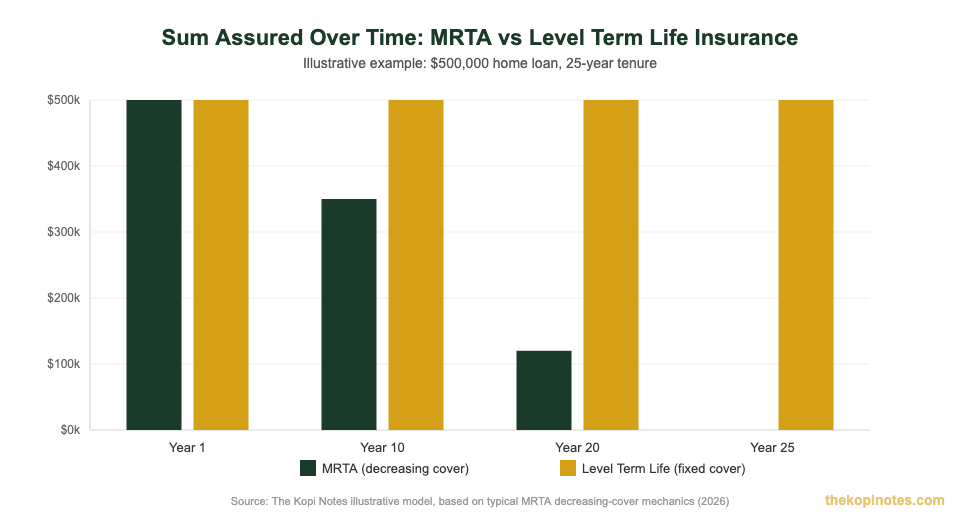
Mortgage Reducing Term Assurance (MRTA), also called mortgage-reducing insurance or a decreasing term rider, is a life insurance policy built specifically to match your home loan. The sum assured falls over time, roughly tracking your outstanding loan balance, while your premium usually stays level or is paid as a single upfront sum.
Banks and insurers commonly bundle MRTA with a bank home loan, whether it’s for an HDB flat or private property. If you pass away, are diagnosed with a terminal illness, or become totally and permanently disabled, MRTA pays out — typically straight to the bank — to clear the remaining loan.
Because the payout goes to the bank rather than your family, and the cover shrinks each year, MRTA is a narrow tool. It does exactly one job: making sure the roof over your family’s head is paid for. It doesn’t leave anything extra for daily expenses, your children’s school fees, or your spouse’s income replacement.
What Is Level Term Life Insurance?
Level term life insurance is a standard term policy with a fixed sum assured for a set period, say 20 or 30 years. Unlike MRTA, the coverage amount doesn’t shrink as your loan balance falls. Your premium is usually level too, so what you pay in year one is what you pay in year 20.
You can size a level term policy to cover your full outstanding mortgage, exactly like MRTA does, but the payout goes to your nominated beneficiaries, not automatically to the bank. That gives your family flexibility. They can use the payout to clear the mortgage, or split it between the loan and other needs, such as living expenses or your children’s education.
Because the sum assured never falls, a level term policy sized to your loan amount is technically over-insuring you in the later years, when your outstanding loan is smaller than your original coverage. This is part of why it typically costs more than MRTA for the same starting sum assured.
MRTA vs Term Life: Key Differences
The table below lays out the structural differences. These apply whether your loan is for an HDB flat or private property.
| Feature | MRTA | Level Term Life Insurance |
|---|---|---|
| Sum assured | Decreases with your loan balance | Fixed for the whole policy term |
| Premium | Level, or single lump sum | Level throughout the term |
| Payout goes to | Usually the bank directly | Your nominated beneficiaries |
| Use of payout | Restricted to clearing the loan | Flexible — loan, income replacement, education |
| Portability | Usually tied to the specific loan | Stays with you if you refinance or sell |
| Typical cost vs same starting sum assured | Generally lower | Generally higher |
Source: CPF Board (cpf.gov.sg) and general industry product structures, 2026.
Do You Even Need MRTA or Term Life?
This is the question most homeowners skip. Before comparing MRTA and term life, work out whether you already have mortgage protection through HPS.
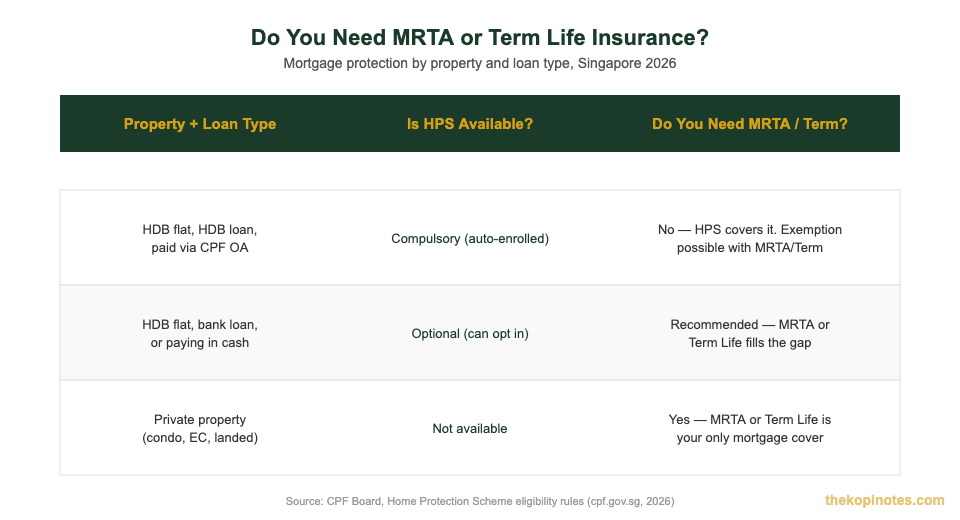
HDB flat, HDB loan, paying with CPF OA: You’re automatically enrolled in HPS. This is compulsory, and it already covers your outstanding loan on death, terminal illness, or total permanent disability. You don’t need to separately buy MRTA or term life just for the mortgage — though you may still want term life for broader family protection beyond the flat. See Is DPS Enough Life Insurance? for a similar gap that catches CPF members off guard.
HDB flat, bank loan, or paying in cash: HPS is optional here, not automatic. If you skip it and don’t have another policy, your family would need to service or clear the loan themselves if something happened to you. This is exactly the gap MRTA or term life insurance is meant to fill.
Private property — condo, EC, or landed: HPS isn’t available at all, regardless of how you fund your instalments. Whether you use MRTA, term life, or something else is entirely your call. Nobody is going to auto-enrol you, which is precisely why so many private property buyers end up under-protected.
What You’ll Actually Pay
HPS premiums are genuinely low. As an illustrative example based on CPF’s HPS Premium Calculator, a healthy 30-year-old covering 100% of a $500,000 HDB loan over 25 years pays around $350 a year, deducted straight from CPF OA. Your own premium depends on your age, gender, loan amount, and remaining tenure — use the official HPS Premium Calculator for your exact number.
For MRTA and term life, exact premiums vary by insurer, age, health, sum assured, and loan tenure, so there’s no single number that applies to everyone. What’s consistent across insurers is the general cost pattern: because MRTA’s cover shrinks each year while term life’s stays flat, an MRTA policy sized to the same starting sum assured is usually the cheaper of the two upfront. Term life costs more precisely because it keeps paying out the full amount even in year 20, when your actual loan balance is much smaller.
That said, term life bought young and healthy can work out better value over a longer horizon for some buyers, since the premium is locked in and the policy can be reused as broader protection even after the mortgage is paid off — something a loan-specific MRTA typically can’t do. If you’re unsure how much cover you actually need beyond the mortgage, work that out before comparing quotes.
Which Should You Choose?
MRTA fits you if: your only goal is making sure the mortgage gets cleared, you want the lowest upfront premium, and you’re comfortable with the payout going straight to the bank rather than your family.
Term life insurance fits you if: you want your family to have flexibility with the payout, you’re likely to refinance or upgrade your property later, or you want life cover that outlives the mortgage and protects income, not just the roof. Compare this against a term vs whole life insurance policy if you’re also weighing permanent cover.
Many Singapore homeowners end up doing a hybrid: rely on HPS or MRTA for the bare minimum mortgage protection, then layer a separate TPD insurance or term life policy on top for income replacement and family expenses. There’s no single right answer — it depends on how much of your family’s total financial picture the mortgage represents.
Frequently Asked Questions
Is MRTA compulsory for my HDB loan in Singapore?
No. If you took an HDB loan and pay it with CPF savings, you’re covered by the Home Protection Scheme (HPS) instead, which is compulsory. MRTA becomes relevant if you took a bank loan, pay in cash, or own private property, where HPS doesn’t apply or isn’t automatic.
What is the difference between HPS and MRTA?
HPS is a government scheme run by CPF Board, available only for HDB flats, with premiums paid from your CPF OA. MRTA is a private insurance product sold by insurers, available for both HDB and private property bank loans, with premiums usually paid in cash. Both work similarly: decreasing cover that pays off your outstanding loan.
Can I use a term life insurance policy instead of buying MRTA?
Yes. As long as the term life policy covers your outstanding loan for its full remaining term, or until age 65, you can use it to apply for an HPS exemption, or simply rely on it as your standalone mortgage protection for a bank loan or private property.
Is MRTA or term life insurance cheaper for my Singapore home loan?
For the same starting sum assured, MRTA is generally cheaper because its coverage shrinks in line with your loan balance. Term life insurance costs more because it keeps the full sum assured fixed throughout the policy, even in later years when your outstanding loan is much smaller.
What happens to my MRTA or term life policy if I sell my flat or refinance?
MRTA is usually tied to the specific loan it was bought for, so selling your flat or fully refinancing typically ends that cover, and you may need a new policy for your next loan. A standalone term life policy is not tied to any loan, so it stays in force regardless of what happens to your property or mortgage.
Do I need mortgage insurance for a private property in Singapore?
HPS is not available for private property, including condos, executive condominiums, and landed homes, no matter how you fund your instalments. Mortgage insurance for private property is entirely voluntary, but banks and financial advisers generally recommend MRTA or term life insurance so your family isn’t left servicing the loan alone.
Protect Your Home the Right Way
Work out how much cover you actually need before comparing MRTA and term life quotes.
Get Free Insurance Advice
Speak with a licensed insurance advisor. No obligation, no cost.
By submitting this form, you agree to our Privacy Policy.
This article was researched with the help of AI. While we strive to keep all information accurate and up to date, there may be errors. If you notice any discrepancies, please contact us.