Can MediSave Pay a Family Member’s Integrated Shield Plan Premium?
Spouse, parents, children, grandparents and siblings — how the 2026 Additional Withdrawal Limit actually works.
Yes. Your MediSave can pay Integrated Shield Plan (IP) premiums for your spouse, parents, children, grandparents or siblings, not just your own. The catch: the Additional Withdrawal Limit (AWL) that caps how much MediSave can cover is set by the insured family member’s age, not the age of whoever is paying. Anything above that limit still needs cash.
Not financial advice. All figures are for educational reference only. Data verified as at 11 August 2026 against Ministry of Health (MOH) and CPF Board sources unless otherwise stated.
- You can use your own MediSave for a spouse, parent, child, grandparent or sibling’s IP premium — and they can do the same for you.
- The Additional Withdrawal Limit ($300 to $900 a year) follows the insured person’s age, not the payer’s. Paying for an elderly parent unlocks a higher limit than paying for a child.
- Rider premiums are always cash-only, even when you’re paying on a family member’s behalf. MediSave can never touch that portion.
Table of Contents
Contents — Click to expand
Which Family Members Qualify?
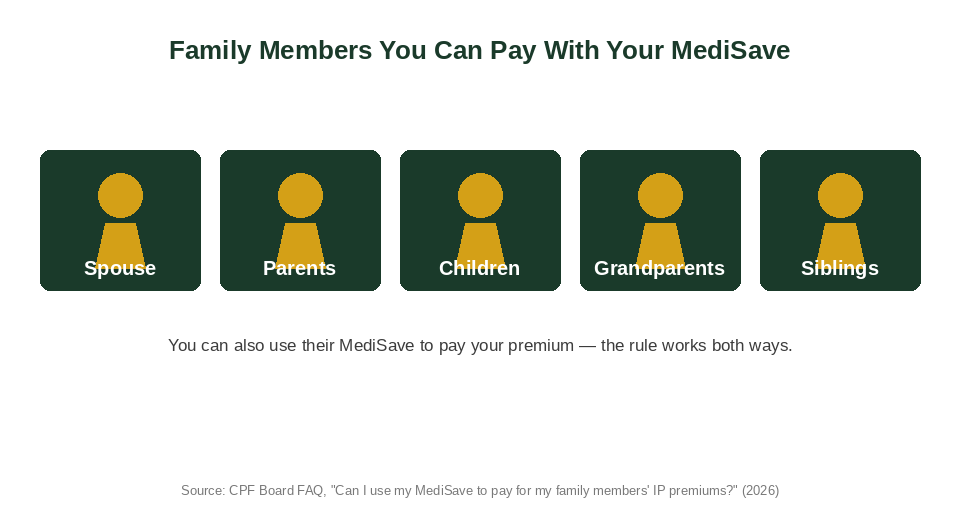
The CPF Board allows you to use your own MediSave to pay Integrated Shield Plan premiums for a defined circle of family: your spouse, parents, children, grandparents and siblings. This is confirmed directly by CPF Board’s own FAQ on the topic.
The rule works both ways. You can pay for their premium, and they can pay for yours. A retired mother with limited cash flow can have her working son cover her IP premium from his MediSave. A young couple can split premiums between two MediSave accounts instead of relying on one.
This matters more in 2026 than it used to. Since 1 April 2026, riders cover less and premiums for the base plan keep climbing with medical inflation. Spreading the MediSave load across a family’s combined accounts is one of the few ways to reduce the cash bite without dropping coverage.
How MediSave Payment for a Family Member Works
An Integrated Shield Plan premium isn’t one single number. It’s actually two components bundled into one bill, and MediSave treats each differently — whether you’re paying for yourself or a family member.
- MediShield Life component: fully payable by MediSave, no withdrawal limit. This applies whether the policy is yours or a family member’s.
- Additional private insurance component: this is the part sold by the private insurer on top of MediShield Life. It’s payable by MediSave, but only up to the Additional Withdrawal Limit (AWL). Anything above the AWL must be paid in cash.
According to CPF Board’s Integrated Shield Plan info page, this two-part structure is identical no matter whose MediSave account is footing the bill. The only thing that changes when a family member pays is whose age determines the AWL — which we’ll cover next.
For a full breakdown of how the AWL applies to your own premium specifically, see our guide on using MediSave to pay your own Integrated Shield Plan premium.
Whose Age Sets the Withdrawal Limit?
Here’s the detail most people miss: the Additional Withdrawal Limit is based on the insured person’s age next birthday, not the age of the family member whose MediSave account is paying the bill.
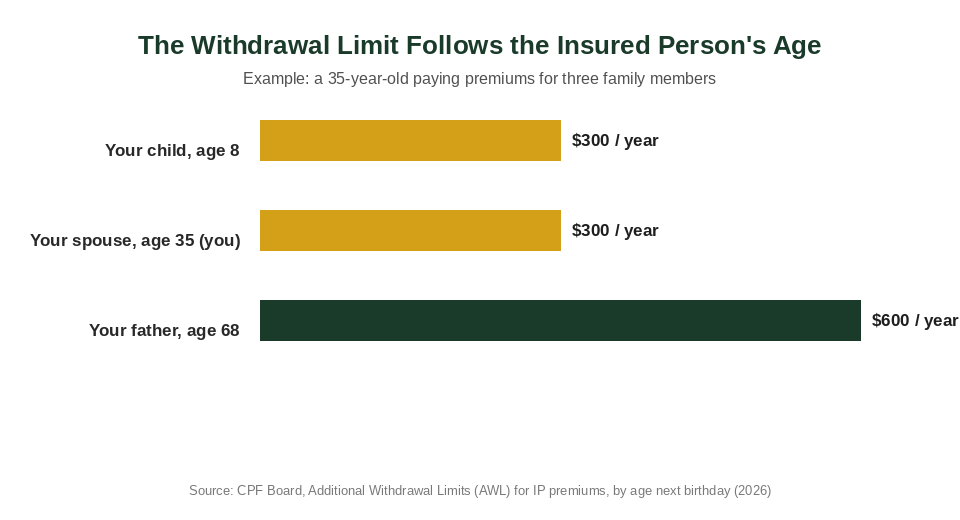
That means if a 35-year-old uses their own MediSave to pay their 68-year-old father’s IP premium, the applicable AWL is the one for a 68-year-old, not a 35-year-old. This is a meaningfully higher limit, since AWLs rise with age.
| Insured Person’s Age Next Birthday | Additional Withdrawal Limit |
|---|---|
| 1 – 40 | $300 / year |
| 41 – 70 | $600 / year |
| 71 and above | $900 / year |
Source: CPF Board, “What are Additional Withdrawal Limits (AWLs) for IP premiums?” (2026).
This limit applies to the private insurance component of that one policy, no matter how many people are contributing to it. If both you and a sibling each put money from your MediSave accounts toward a parent’s premium, the combined MediSave amount used still can’t exceed the AWL tied to your parent’s age band. Above that, the balance has to come from someone’s cash.
Worked Examples: Parents, Spouse and Kids
The numbers below use illustrative premium amounts to show how the mechanics play out. Your actual private insurance component will depend on your family member’s insurer, plan tier and ward class.
Example 1: Paying for your father, age 68. Say his IP’s private insurance component costs $1,050 a year. Because he’s in the 41-70 age band, the AWL is $600. You can draw $600 from your own MediSave toward that premium; the remaining $450 needs to be paid in cash, either by you or him.
Example 2: Paying for your child, age 8. Children fall in the 1-40 age band, so the AWL is only $300 — regardless of how much MediSave you personally have. If your child’s private insurance component costs $400 a year, $300 comes from MediSave and $100 is cash.
Example 3: Spouses splitting one policy. If you and your spouse are both on the same insurer but hold separate IP policies, each policy has its own AWL based on each of your ages. You could use your MediSave to help pay your spouse’s premium, and they could use theirs for yours — but the two limits don’t combine into a bigger pool for either single policy.
These examples show why it’s worth checking your family member’s age band before assuming your MediSave will cover most of the bill. For someone in their 70s, this is where how MediSave rules for Integrated Shield Plans change after you retire becomes especially relevant, since premiums and AWLs both shift with age.
Can MediSave Pay a Family Member’s Rider?
No. Rider premiums are always cash-only, whether you’re paying for yourself or a family member. MOH confirms this directly: “Rider premiums are only payable in cash as they are not part of IPs or MediShield Life.”
This is by design. Riders exist to reduce co-payment on hospital bills, and MOH deliberately keeps a real cash cost attached to them so policyholders don’t over-consume healthcare simply because claiming feels “free”. That logic doesn’t change based on who’s paying.
So if you’re helping a parent or sibling afford both an IP and a rider, plan for two separate cash flows: MediSave (yours or theirs, up to the AWL) for the base IP’s private component, and cash only for the rider. Our guide on choosing the right rider after MOH’s 2026 reform breaks down how much that cash commitment typically looks like.
How to Set It Up With Your Insurer
There’s no separate CPF application for this. In practice, you arrange it directly with the IP insurer when the policy is taken up or renewed:
- Nominate the paying MediSave account. Your insurer’s application or renewal form will ask which MediSave account should be deducted for the private insurance component. You’ll typically need the payer’s NRIC and proof of the family relationship.
- Confirm the AWL band with your insurer. Ask them to confirm which age band applies (based on the insured person, not the payer) so you know how much will come from MediSave versus cash.
- Set up the cash portion separately. Anything above the AWL, plus the full rider premium, is usually collected via GIRO or card from whoever is designated to pay in cash — this doesn’t have to be the same person as the MediSave payer.
If you’re not sure whether your current policy already draws from your own MediSave or a family member’s, check your CPF healthcare dashboard, which shows your active IP coverage, or contact your insurer directly.
Things to Watch Out For
Before you commit your own MediSave to a family member’s premium, keep these in mind:
It draws down your own MediSave, not a separate pool. Money used for a parent’s or sibling’s IP premium comes out of your account exactly like any other approved MediSave use. It’s still your savings, set aside for your own future healthcare and retirement needs.
The AWL resets annually, not per bill. It’s a yearly cap on the private insurance premium component, so plan the family’s contributions at the start of each policy year rather than assuming unlimited coverage.
Your own Basic Healthcare Sum still caps how much MediSave you can hold. Using MediSave for a family member’s premium doesn’t change your BHS, but it’s worth checking your balance before committing to cover someone else’s premium every year.
Check if your family member’s rider is due to change. If they bought an old-style rider before 27 November 2025, they may be affected by the Integrated Shield Plan rider switch deadline, which shifts their cash needs over the next two years.
Compare insurers before assuming the premium is fixed. Since April 2026, all insurers’ riders and base premiums have shifted. Our comparison of how all 7 insurers’ new riders stack up is a useful starting point if a family member is shopping around.
Frequently Asked Questions
Can I use my own MediSave to pay for my parents' Integrated Shield Plan premium?
Yes. CPF Board allows you to use your MediSave to pay Integrated Shield Plan premiums for your spouse, parents, children, grandparents and siblings. The MediShield Life portion is fully payable, and the private insurance portion is payable up to the Additional Withdrawal Limit based on your parent’s age.
Whose age determines the Additional Withdrawal Limit when I pay for a family member?
The insured family member’s age next birthday, not the age of whoever is paying. A 35-year-old paying for a 68-year-old parent uses the $600/year limit that applies to the parent’s age band, not the $300/year limit for their own age band.
Can I use MediSave to pay for a family member's Integrated Shield Plan rider?
No. Rider premiums are always cash-only, regardless of who is insured or who is paying. MOH confirms MediSave cannot be used for rider premiums under any circumstances, since riders sit outside both MediShield Life and the base Integrated Shield Plan.
Which family members can I use my MediSave for?
Your spouse, parents, children, grandparents and siblings. This is the same list CPF Board uses for its own MediSave-for-family-members FAQ, and it applies both ways — they can use their MediSave for your premium too.
Does paying a family member's premium reduce my own MediSave balance?
Yes. The funds come out of your own MediSave account exactly as they would for your own premium. It doesn’t create a separate pool, so it’s worth checking your balance and Basic Healthcare Sum before committing to pay for someone else’s IP premium every year.
Can two family members split one person's premium using both their MediSave accounts?
Yes, in principle — for example, you and a sibling could each contribute toward a parent’s premium from your own MediSave accounts. However, the combined MediSave amount used still can’t exceed the single Additional Withdrawal Limit tied to your parent’s age band; any excess must be paid in cash.
Planning MediSave Across Your Family?
Check how much MediSave can cover for your own premium, your rider options, and what changes at retirement.
Get Free Insurance Advice
Speak with a licensed insurance advisor. No obligation, no cost.
By submitting this form, you agree to our Privacy Policy.
This article was researched with the help of AI. While we strive to keep all information accurate and up to date, there may be errors. If you notice any discrepancies, please contact us.