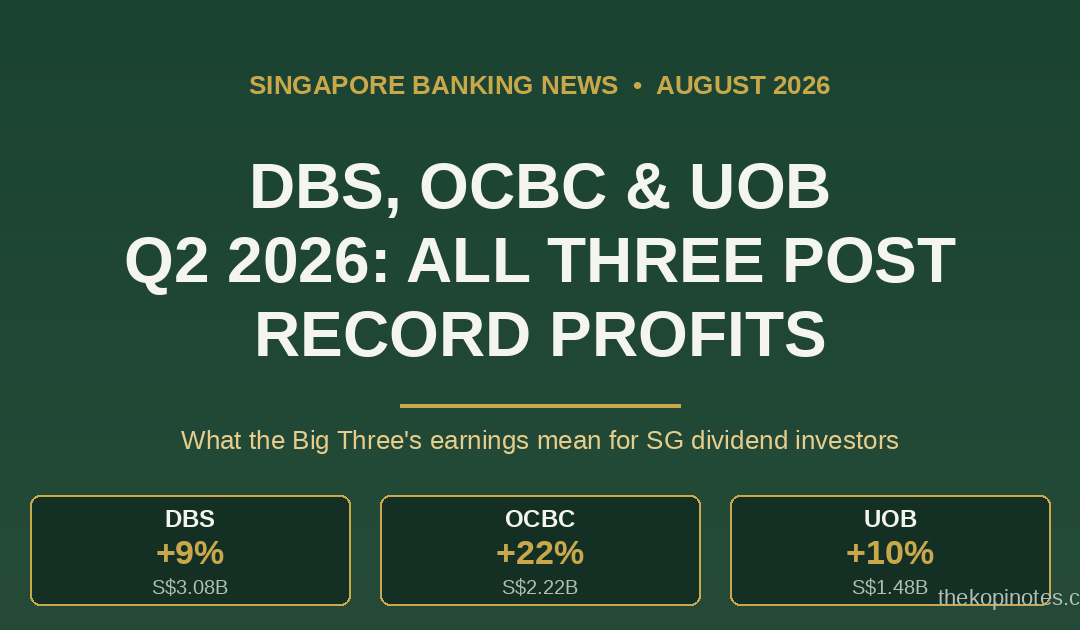
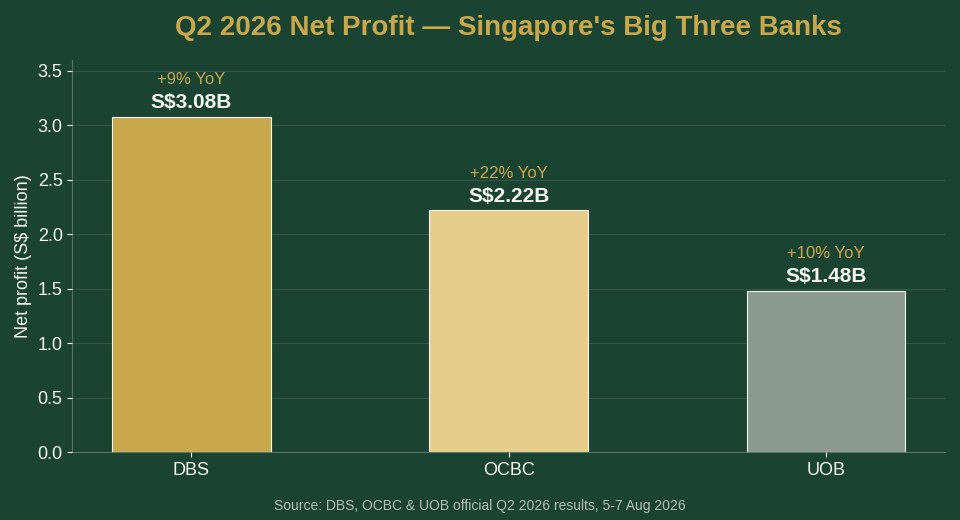
DBS, OCBC and UOB have all reported Q2 2026 results, and every one of them posted a record or near-record profit. DBS hit S$3.08 billion (+9%), OCBC surged 22% to a record S$2.22 billion, and UOB grew 10% to S$1.48 billion. Here’s what the trio’s results mean for Singapore’s bank shareholders and dividend investors.
This is an editorial analysis. Not financial advice. Data verified as at 11 August 2026 against DBS, OCBC and UOB’s official Q2 2026 results announcements and investor presentations (all released 5–7 August 2026).
What Happened: Singapore’s Big Three Banks All Beat Records in Q2 2026
Between 5 and 7 August 2026, DBS, OCBC and UOB each reported second-quarter and first-half 2026 results, and the pattern across all three was strikingly similar: record or near-record profit, driven overwhelmingly by fee and wealth management income rather than traditional lending margins. DBS kicked things off on 5 August with a record S$3.08 billion Q2 net profit, up 9% year-on-year, as total income crossed S$6 billion in a single quarter for the first time. OCBC followed on 6 August with the standout number of the season — a 22% jump in net profit to a record S$2.22 billion, the first time any of the three banks has crossed S$2 billion in quarterly profit outside of DBS. UOB rounded out the trio on 7 August with a steadier 10% rise to S$1.48 billion, alongside a notable strategic move: selling its asset management arm to Allianz Global Investors.
What this means for SG retail investors: the local banking sector just delivered its strongest earnings season in years, at a time when interest rates are falling — which is normally bad news for bank margins. If you already hold DBS shares or track its results, our deep dive on DBS’s Q2 2026 results covers that release in full detail; this article focuses on how OCBC and UOB compare and what the full picture means for your portfolio.

OCBC’s Wealth Engine Delivers the Sector’s Biggest Surprise
OCBC’s results were the most dramatic of the three. Second-quarter net profit jumped 22% year-on-year to a record S$2.22 billion — up 12% from the previous quarter and the first time OCBC has crossed S$2 billion in quarterly earnings. First-half net profit rose 13% to a record S$4.19 billion. The engine behind this wasn’t lending; non-interest income surged 51% year-on-year to a record S$1.91 billion, making up close to 46% of total income, up from 36% a year earlier.
Within that, net fee income grew 28% to S$739 million, powered by record wealth management fees of S$470 million (+45%). Net trading and investment income jumped 85% to a record S$695 million, helped by a rebound in Great Eastern Holdings-linked investment income, and insurance income rose 68% to S$382 million. Group wealth management income for the half reached a record S$3.29 billion, now 41% of total group income, with banking wealth AUM up 13% to a new high of S$350 billion. Loans grew 11% year-on-year to S$364 billion. On the other side of the ledger, net interest margin fell 22 basis points year-on-year to 1.70%, and new non-performing assets emerged from two Greater China corporate real estate accounts — worth watching, though overall asset quality stayed sound with the NPL ratio steady at 0.9%.
What this means for SG retail investors: OCBC’s profit mix has shifted further toward wealth management and insurance (via its Great Eastern stake) than either of the other two banks, which makes its earnings more sensitive to how actively affluent clients are investing and trading — a useful data point if you’re deciding how much of your dividend portfolio to concentrate in bank stocks versus S-REITs. Our top dividend stocks in Singapore guide compares banks, REITs and dividend ETFs side by side.
UOB’s Steadier Quarter — Plus a S$555 Million Asset Sale
UOB’s Q2 2026 net profit rose 10% year-on-year to S$1.48 billion, ahead of the S$1.40 billion analysts had expected, though first-half net profit growth was a more modest 3% to S$2.92 billion. Unlike DBS and OCBC, part of UOB’s quarter was boosted by non-recurring gains from asset divestments that lifted other non-interest income 37% quarter-on-quarter to S$632 million; underlying operating trends were softer, with net interest margin narrowing 8 basis points to 1.74% and full-year fee income guidance cut from high-single-digit to low-single-digit growth.
The bigger strategic news came separately: on 5 August, UOB announced it would sell UOB Asset Management to Allianz Global Investors for S$555 million, a deal expected to complete in 2027 and generate a pre-tax gain of roughly S$330 million while lifting UOB’s CET1 capital ratio by about 14 basis points. Wealth management was UOB’s other bright spot, with record wealth fees in the quarter and ASEAN-4 (Malaysia, Indonesia, Thailand, Vietnam) wealth income up 30% for the half. On asset quality, the Greater China NPL ratio rose to 4.8% from 3.5% in a single quarter, tied to one closely monitored real estate account — a trend echoing OCBC’s own Greater China flag and worth tracking across both banks.
What this means for SG retail investors: UOB’s headline growth looks the steadiest of the three on paper, but strip out the one-off divestment gain and the underlying quarter was softer, with fee guidance cut for the year. The UOBAM sale to Allianz also signals UOB is choosing to distribute third-party funds rather than manage them in-house going forward — worth knowing if you hold any UOB-branded unit trusts. If you’re weighing bank stocks against the broader index, our STI ETF guide explains how much of the STI’s record run has been carried by these three banks.
Comparing the Big Three: Q2 2026 By the Numbers
| Metric | DBS | OCBC | UOB |
|---|---|---|---|
| Q2 2026 net profit | S$3.08 billion | S$2.22 billion | S$1.48 billion |
| YoY profit growth | +9% (record) | +22% (record) | +10% |
| H1 2026 net profit | S$6.01 billion | S$4.19 billion | S$2.92 billion |
| Net interest margin | 1.87% (-18 bps) | 1.70% (-22 bps) | 1.74% (-8 bps) |
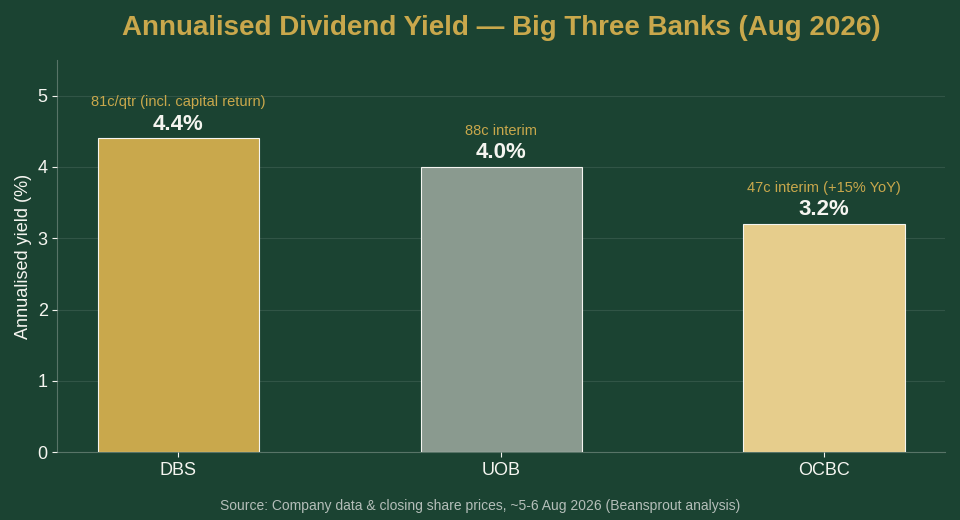
| Interim/Q2 dividend per share | 81 cents (incl. capital return) | 47 cents | 88 cents |
| Dividend change YoY | Flat vs prior quarter | +15% (from 41 cents) | +3.5% (from 85 cents) |
| Annualised dividend yield* | ~4.4% | ~3.2% | ~4.0% |
| Price-to-book valuation* | ~3.0x | ~2.19x | ~1.48x |
| NPL ratio | 1.0% | 0.9% | 1.6% |
*Based on closing share prices around 5–6 August 2026, per company results presentations and Beansprout analysis. Source: DBS, OCBC and UOB official Q2 2026 results announcements, 5–7 August 2026.
What This Means for Different Types of SG Investors
If you’re a dividend/income investor: UOB’s ~4.0% and DBS’s ~4.4% annualised yields currently look more attractive than OCBC’s ~3.2%, but OCBC’s 15% dividend increase and 50% payout policy suggest the fastest dividend growth trajectory of the three if its earnings momentum holds. None of these yields are guaranteed — payout ratios and capital return programmes can change. Our dividend investing in Singapore guide walks through how to size a bank-stock allocation within a broader income portfolio, and our dividend payout calendar tracks exactly when each bank pays out.
If you’re an ETF/index investor: DBS, OCBC and UOB together make up a large share of the Straits Times Index, so three record-ish quarters in a row is a meaningful tailwind for anyone holding an STI ETF like ES3 or G3B. That concentration cuts both ways, though — a shared risk like the Greater China real estate exposure flagged by both OCBC and UOB this quarter would move the index more than it would move a globally diversified fund.
If you’re a CPF-first saver: CPF Board has kept its interest rates unchanged for the third quarter of 2026 — the Ordinary Account (OA) rate stays at its floor of 2.5% per annum, and the combined Special, MediSave and Retirement Account (SMRA) rate stays at its floor of 4% per annum, both for 1 July to 30 September 2026. Bank stocks like DBS, OCBC and UOB are eligible under the CPF Investment Scheme for OA savings above the first S$20,000, if you’re comfortable trading the CPF floor rate for market risk in pursuit of a higher return.
Bottom Line for SG Investors
All three of Singapore’s local banks proved this quarter that record profit and falling interest rates aren’t mutually exclusive — as long as wealth management, fees and trading income keep growing fast enough to offset shrinking net interest margins. OCBC’s 22% profit jump was the standout, DBS’s S$6 billion income quarter was the biggest in absolute terms, and UOB’s steadier headline number masked a softer underlying quarter plus a meaningful strategic pivot in selling its asset management business. For shareholders, the practical takeaway is the same across all three: check whether the wealth-management engine driving these results is still intact each quarter, watch the Greater China asset-quality flags both OCBC and UOB raised, and don’t assume today’s dividend yield is fixed — it moves with both the payout and the share price.
Frequently Asked Questions
Which Singapore bank had the highest profit growth in Q2 2026?
OCBC had the highest year-on-year profit growth among the three local banks in Q2 2026, with net profit up 22% to a record S$2.22 billion. DBS grew 9% to S$3.08 billion and UOB grew 10% to S$1.48 billion.
What dividends did DBS, OCBC and UOB declare for Q2 2026?
DBS declared a combined 81 cents per share for Q2 2026 (66 cents ordinary dividend plus 15 cents Capital Return dividend). OCBC declared an interim dividend of 47 cents per share, up 15% from 41 cents a year earlier. UOB declared an interim dividend of 88 cents per share, up from 85 cents a year earlier.
Why are Singapore bank profits rising even as interest rates fall?
All three banks offset falling net interest margins with strong growth in fee income, wealth management, trading and (for OCBC) insurance income. Non-interest income grew 51% year-on-year at OCBC and 25% at DBS in Q2 2026, more than compensating for lower net interest income.
What did UOB announce about its asset management business?
On 5 August 2026, UOB announced a strategic partnership under which Allianz Global Investors will acquire UOB Asset Management for S$555 million across eight Asian markets. The deal is expected to complete in 2027, generate a pre-tax gain of about S$330 million, and lift UOB’s CET1 capital ratio by roughly 14 basis points.
Which Singapore bank has the highest dividend yield right now?
Based on annualised Q2 2026 dividend declarations against early-August 2026 share prices, DBS’s yield was approximately 4.4%, UOB’s approximately 4.0%, and OCBC’s approximately 3.2%. Yields move with share prices and are not guaranteed to hold at these levels.
Are DBS, OCBC and UOB’s results a sign of a shared risk in the sector?
Both OCBC and UOB flagged rising non-performing assets tied to Greater China corporate real estate accounts in Q2 2026, which is worth monitoring as a shared sector risk, even though both banks reported overall asset quality as sound. DBS’s non-performing loan ratio held stable at 1.0% with no similar flag raised in its release.
Should I buy Singapore bank shares after these Q2 2026 results?
This is an editorial analysis, not financial advice. Record profits don’t automatically mean a stock is attractively valued — all three banks are trading above their historical average price-to-book ratios. Your time horizon, existing portfolio concentration in Singapore financials, and risk tolerance are all relevant, and readers should consider speaking with a licensed financial adviser for personalised guidance.
Sources
- DBS Group: Second-quarter net profit up 9% to record SGD 3.08 billion (5 August 2026)
- OCBC Group: Newsroom and media releases (6 August 2026 results)
- Beansprout: OCBC reports 22% rise in net profit and higher interim dividend (6 August 2026)
- Beansprout: UOB reports 10% increase in 2Q26 profit and higher interim dividend (7 August 2026)
- Beansprout: DBS profit rises 9% and declares S$0.81 in total dividends in 2Q26 (5 August 2026)
- CPF Board: CPF interest rates from 1 July to 30 September 2026
This article was researched with the help of AI. While we strive to keep all information accurate and up to date, there may be errors. If you notice any discrepancies, please contact us.