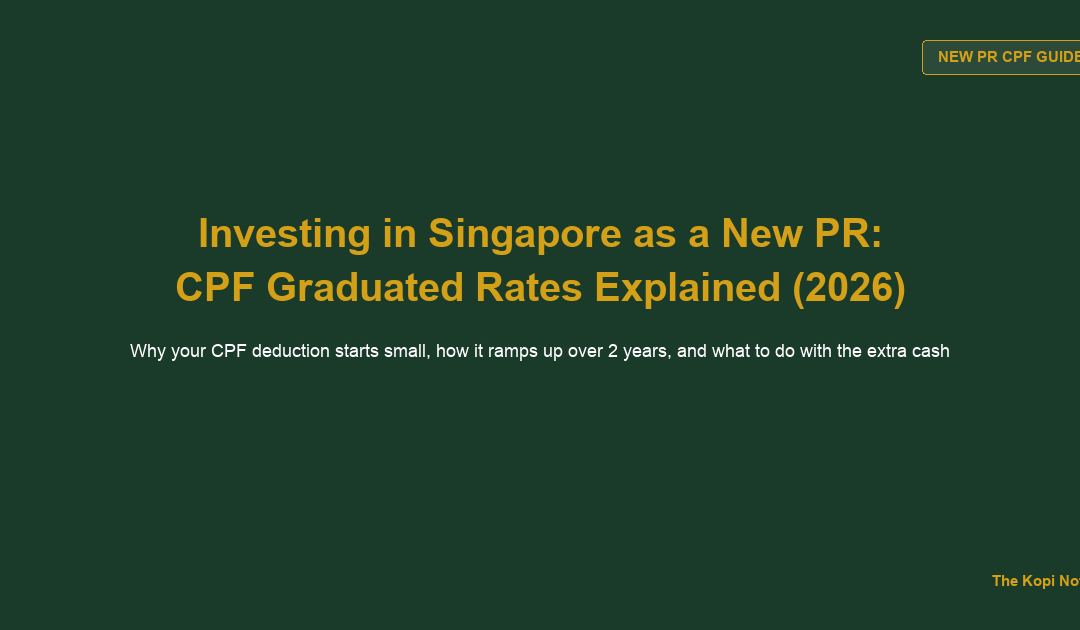
How to Invest in Singapore as a New Permanent Resident: CPF Graduated Rates and What Changes (2026)
Your CPF deduction starts small and grows over two years — here’s how to use the extra cash wisely while it lasts.
New Singapore Permanent Residents don’t pay CPF at citizen rates immediately. Contribution rates start low in Year 1 (9% of wages combined) and step up in Year 2 (24%) before matching citizens in Year 3 (37%). That means lower CPF savings early on, but more cash in hand each month — money you can put into SRS, ETFs, or T-bills while your CPF account catches up.
Not financial advice. All figures are for educational reference only. Data verified as at 9 August 2026.
- Total CPF contribution for new PRs rises from 9% of wages (Year 1) to 24% (Year 2) to 37% (Year 3 onward), for those aged 55 and below.
- You and your employer can jointly opt into full CPF rates earlier if you’d rather grow CPF faster than keep the extra take-home pay.
- The extra cash in Year 1 and 2 is a chance to build SRS and brokerage investments while CPF catches up — don’t just let it get absorbed into spending.
Table of Contents
Contents — Click to expand
- Why New PRs Face a Different CPF Starting Point
- CPF Graduated Contribution Rates for New PRs (2026)
- Should You Opt Into Full CPF Rates Early?
- What This Means for Your Take-Home Pay and Investable Cash
- CPFIS-OA/SA and SRS: What’s Still Open to You as a New PR
- A Worked Example: Year 1 vs Year 2 vs Year 3 CPF and Take-Home Pay
- What New PRs Should Do in Year 1 and Year 2
- Frequently Asked Questions
Why New PRs Face a Different CPF Starting Point
If you just became a Singapore Permanent Resident (SPR), your first payslip probably surprised you. Your CPF deduction is smaller than a colleague who’s been a citizen for years — and that’s by design, not a mistake.
Singapore Citizens and SPRs from their third year onward contribute CPF at the same “full” rate. But brand-new SPRs go through two years of graduated rates first. The government built this ramp-up so new PRs and their employers aren’t hit with the full CPF bill the moment their status changes, when the adjustment to take-home pay can otherwise be jarring for both sides.
For you as a new PR, this has a real investing consequence. Your CPF Ordinary Account and Special Account grow more slowly in Years 1 and 2 than they will from Year 3 onward. At the same time, your take-home pay is higher than it will eventually be, because less of your salary goes into CPF each month.
Here’s why that matters: the moves that make sense in Year 1 are not the moves that make sense once you hit Year 3. This guide walks through what changes, when, and what to do with the extra cash while you have it.
CPF Graduated Contribution Rates for New PRs (2026)
CPF Board publishes three separate contribution rate tables depending on citizenship and PR history: Table 1 for citizens and SPRs from their third year onward, Table 2 for SPRs in their first year, and Table 3 for SPRs in their second year.
Your “SPR year” doesn’t reset on the calendar year — it’s tied to your own conversion date. Year 1 starts the day you become a PR. Year 2 starts on the first day of the month after your first PR anniversary. Year 3 starts on the first day of the month after your second anniversary, and that’s when you move onto the full-rate table for good.
For an employee aged 55 and below, earning above $750 a month, here’s how the total CPF contribution (employer’s share plus your share) changes across the three years, using the rates that took effect on 1 January 2026:
| SPR Year | Employer’s Share | Your Share | Total CPF Contribution |
|---|---|---|---|
| Year 1 | 4% | 5% | 9% |
| Year 2 | 9% | 15% | 24% |
| Year 3 onward | 17% | 20% | 37% |
Source: CPF Board, CPF Contribution Rate Table from 1 January 2026 (employee aged 55 and below, monthly wages above $750)
Notice that in Year 1, your own CPF deduction is only 5% of wages — a quarter of what it will eventually be. Your employer’s contribution is capped too, at 4%. Combined, that’s just 9% of wages going into CPF in Year 1, compared with 37% from Year 3 onward.
These rates apply up to the CPF Ordinary Wage ceiling, which rose to $8,000 a month from 1 January 2026, up from $7,400 previously. Wages above that ceiling don’t attract CPF contributions regardless of your PR year, though a separate Additional Wage ceiling applies to bonuses.
Should You Opt Into Full CPF Rates Early?
You’re not locked into the graduated rates. CPF Board allows you and your employer to jointly apply for higher contributions during your first two years as a PR, in one of two ways: both of you contribute at the full Table 1 rate, or your employer pays the full rate while you continue on the graduated rate.
Why would you want this? A faster-growing CPF balance compounds for longer before retirement, and CPF’s Ordinary Account and Special Account interest rates — 2.5% and 4% per annum respectively as at Q3 2026, guaranteed and risk-free — are hard to beat on a like-for-like risk basis. If you’re planning to stay in Singapore long-term and want to use CPF toward a home purchase, or you simply want to lock in retirement savings early, opting up can make sense.
The trade-off is immediate cash flow. Opting into full rates during Year 1 and 2 means a bigger CPF deduction from every payslip today, in exchange for a bigger CPF balance later. If you’re still building your emergency fund, adjusting to Singapore’s cost of living, or paying off relocation costs, the extra take-home pay under graduated rates may matter more right now.
There’s no single right answer — it depends on how settled you feel in Singapore and how much of a cash buffer you already have outside CPF. Both you and your employer need to agree and apply for the higher rate together; you can’t opt in unilaterally.
What This Means for Your Take-Home Pay and Investable Cash
Here’s the part most new PRs don’t immediately think through: because your own CPF deduction is smaller in Year 1 and 2, your take-home pay is actually higher than it will be once you hit Year 3 — even if your gross salary doesn’t change at all.
For a $6,000 monthly salary, your own CPF deduction goes from $300 a month in Year 1, to $900 a month in Year 2, to $1,200 a month in Year 3. That’s roughly $900 a month of extra take-home cash in Year 1 compared with what you’ll keep once you’re on full rates — cash that isn’t going into a CPF account you can’t touch until retirement age.
That extra cash is easy to let disappear into everyday spending. A more deliberate approach is to treat it the way you’d treat a temporary bonus: route it into investments outside CPF while it’s available, so you’re not starting from zero once your CPF deduction rises and your take-home pay tightens in Year 2 and Year 3.
Practical options include topping up a Supplementary Retirement Scheme (SRS) account, which is open to PRs on the same annual cap as citizens, or building a simple ETF or unit trust portfolio through a broker. Because your CPF Ordinary Account balance will still be small in Year 1, most of your invested savings early on will sit outside CPF by default — which isn’t necessarily a bad thing, since it gives you more flexibility than money locked inside CPF until retirement age.
CPFIS-OA/SA and SRS: What’s Still Open to You as a New PR
Your PR status determines whether CPF investment schemes are open to you at all — but your CPF balance is what actually limits you in practice during Year 1 and 2.
The CPF Investment Scheme (CPFIS) lets you invest CPF Ordinary Account savings above $20,000, and Special Account savings above $40,000, in approved unit trusts, ETFs, and selected stocks. As a new PR in Year 1 or Year 2, your OA and SA balances may simply not have reached those set-aside thresholds yet, especially if your starting balance was zero when you converted to PR. That’s not a rule specific to PRs — citizens face the same thresholds — but it does mean CPFIS is usually a Year 3-onward tool for new PRs rather than something you can use on day one.
The Supplementary Retirement Scheme (SRS) works differently and is available to you from day one as a PR, with no set-aside threshold to clear. You can open an SRS account with a participating bank — DBS, OCBC, or UOB — and contribute up to $15,300 a year, the same cap that applies to citizens. Only non-PR foreigners get the higher $35,700 annual cap. SRS contributions reduce your taxable income for the year, and the cash you put in can then be invested, rather than sitting idle earning close to nothing.
For most new PRs in Year 1 and Year 2, SRS is the more immediately useful account: no threshold to clear, a clear tax deduction, and full control over what you invest the funds in.
A Worked Example: Year 1 vs Year 2 vs Year 3 CPF and Take-Home Pay
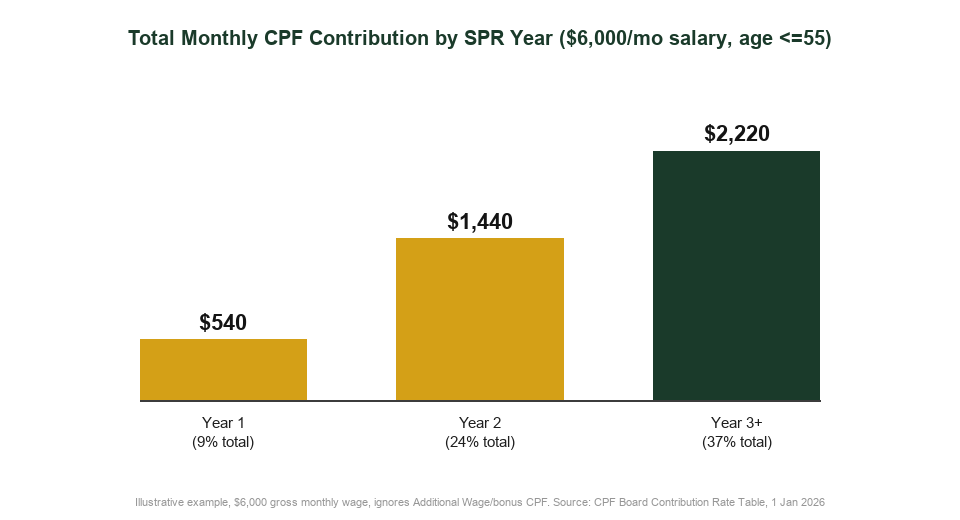
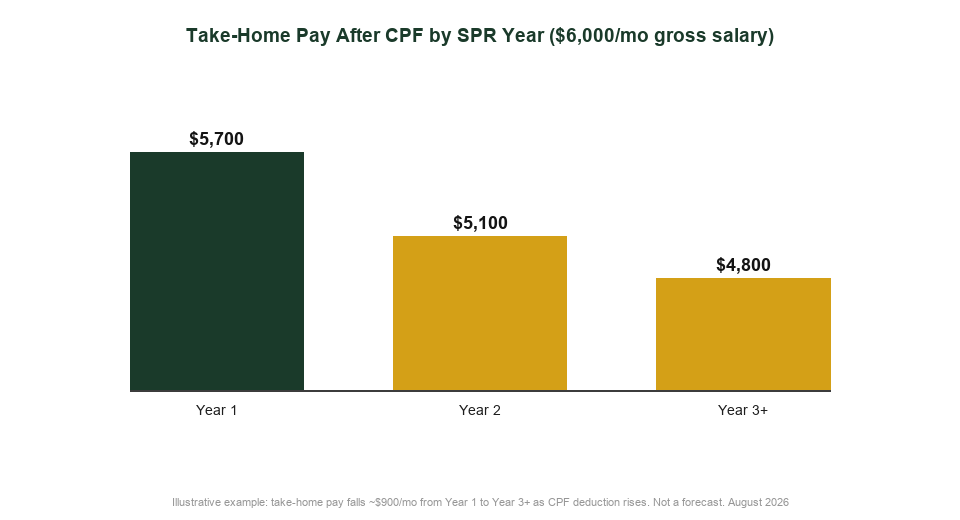
Take a new PR earning a gross monthly salary of $6,000, aged under 55. Here’s how their CPF contributions and take-home pay compare across the three SPR years, using the 2026 contribution rates:
| SPR Year | Employer’s CPF | Your CPF (deducted from pay) | Total Into CPF | Take-Home Pay |
|---|---|---|---|---|
| Year 1 | $240 | $300 | $540 | $5,700 |
| Year 2 | $540 | $900 | $1,440 | $5,100 |
| Year 3+ | $1,020 | $1,200 | $2,220 | $4,800 |
Source: Author’s calculation applying the CPF Board Contribution Rate Table effective 1 January 2026 to a $6,000 monthly wage. Illustrative only; ignores Additional Wage/bonus CPF and assumes no opt-up to full rates.
Two things stand out. First, the total going into this person’s CPF accounts more than quadruples from Year 1 to Year 3 — from $540 a month to $2,220 a month — a meaningful boost to long-term retirement and housing savings once it kicks in. Second, take-home pay drops by $900 a month between Year 1 and Year 3, purely because of the CPF rate change, with no change in gross salary at all.
If this new PR invests that $900-a-month gap into an SRS account or a simple ETF portfolio during Year 1 and Year 2, they’ll have built a meaningful pool of non-CPF savings by the time their take-home pay tightens in Year 3 — rather than feeling the full pay cut all at once with nothing built up from the two years before it.
What New PRs Should Do in Year 1 and Year 2
A few practical moves make the graduated-rate period work in your favour rather than catching you off guard.
Track your own SPR year, not just the calendar year. Your Year 2 and Year 3 dates are tied to your conversion anniversary, so mark them so you know exactly when your take-home pay and CPF deductions will change.
Treat the extra take-home pay as investable, not spendable. If you know your take-home pay will drop by several hundred dollars once you hit full rates, build the habit of investing or saving that gap now, rather than adjusting your lifestyle to the temporarily higher number.
Open an SRS account early if you plan to invest anyway. There’s no set-aside threshold, contributions are tax-deductible, and you can start with a small monthly amount. You can read more in our SRS account Singapore guide.
Decide deliberately on opting into full CPF rates, rather than defaulting into it or avoiding it by inertia. If you’re planning to stay in Singapore long-term, especially if you want to use CPF toward a home purchase, opting up early can be worth the smaller take-home pay — see our CPF investment strategy guide for how to think about CPF vs cash allocation.
Revisit your budget when Year 2 and Year 3 begin. Because the CPF rate jumps are scheduled and predictable, they shouldn’t be a surprise — build them into your financial plan the same way you’d plan for a scheduled pay cut. If you’re still working out the basics of where to start, our how to invest in Singapore guide and CPF, SRS or cash first guide cover the broader sequencing question.
Frequently Asked Questions
How long do CPF graduated contribution rates apply to new Singapore PRs?
Graduated rates apply for your first two years as a PR. Year 1 starts the day you convert to PR status, and full CPF rates matching citizens begin from the first day of the month after your second PR anniversary.
Can I choose to pay full CPF rates from Year 1 as a new PR?
Yes, but only jointly with your employer. You can apply together to contribute at the full Table 1 rate from the start, or have your employer pay full rates while you stay on the graduated rate. You cannot opt in unilaterally.
Does my SRS contribution cap change because I'm a Permanent Resident?
No. Permanent Residents use the same SRS annual cap as Singapore Citizens — $15,300 a year in 2026. Only non-PR foreigners get the higher $35,700 annual cap.
Can I invest my CPF savings through CPFIS as a new PR?
Yes, the scheme itself isn’t restricted by PR status, but you need at least $20,000 in your Ordinary Account or $40,000 in your Special Account before you can invest the excess. New PRs in Year 1 or 2 often haven’t built up enough CPF balance yet to use CPFIS.
What CPF interest rate will I earn during my graduated-rate years?
The same rates as everyone else. As at Q3 2026 (1 July to 30 September), the Ordinary Account floor rate is 2.5% per annum, and Special, MediSave and Retirement Account savings earn a floor rate of 4% per annum.
Does the CPF Ordinary Wage ceiling apply differently to PRs?
No. The $8,000 Ordinary Wage ceiling that took effect on 1 January 2026 applies equally to citizens and PRs at every SPR year. It caps how much of your monthly wage attracts CPF contributions, regardless of your contribution rate.
Put Your Extra Take-Home Pay to Work
While your CPF deduction is still low, use the gap to start an SRS account or a simple investment portfolio.
Not financial advice. All figures are for educational reference only and were verified against official CPF Board and IRAS sources as at 9 August 2026. The Kopi Notes may earn a referral fee if you sign up through the links below.
This article was researched with the help of AI. While we strive to keep all information accurate and up to date, there may be errors. If you notice any discrepancies, please contact us.