Endowment Plan vs Investment-Linked Policy (ILP) Singapore 2026: Guaranteed Savings vs Market-Linked Growth
Both come wrapped in an insurance policy. Only one of them guarantees you anything.
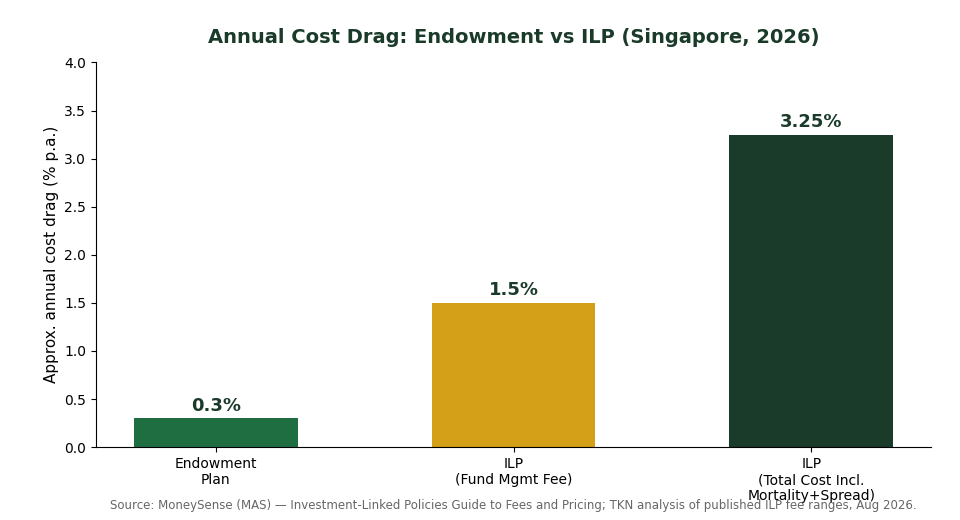
An endowment plan gives you a guaranteed maturity value locked in from day one, illustrated up to LIA’s 3.00-4.25% p.a. cap. An investment-linked policy (ILP) has no guaranteed cash value at all — your money buys sub-fund units, illustrated at 4% and 8% p.a. gross, but eaten into by fund management fees, mortality charges, and bid-offer spreads that can total 2.5-4.0% p.a.
Not financial advice. All figures are for educational reference only. Data verified as at August 2026 unless noted.
- Endowments guarantee a fixed payout upfront. ILPs guarantee nothing — your returns depend entirely on how your chosen sub-funds perform
- ILPs carry real costs most buyers never see clearly: fund management fees (1-2% p.a.), rising mortality charges, and a 3-5% bid-offer spread on every premium
- If you want certainty for a dated goal, use an endowment. If you want market exposure with life cover bundled in, know you’re paying for both — and often paying more than buying them separately
What Is an Endowment Plan?
An endowment plan is an insurance-wrapped savings product. You pay premiums — a single lump sum or regular instalments — for a fixed term, and the insurer pays out a guaranteed maturity value at the end.
Most Singapore endowment plans run 2 to 25 years. The endowment plan Singapore guide covers the full mechanics if this is new to you. Life protection is minimal, usually just 101-105% of premiums paid.
The insurer takes on the investment risk. You just wait for a number that was fixed when you signed the contract.
What Is an Investment-Linked Policy?
An investment-linked policy, or ILP, bundles life insurance with unit-linked investing. Your premium buys units in sub-funds you choose — equity, bonds, balanced, or specialist themes. Some of that premium also pays for insurance coverage.
There’s no par fund and no guaranteed cash value component here. Every dollar of your policy value moves with the sub-funds you picked. If the funds fall, so does your policy value — sometimes below zero relative to what you’ve paid in.
As at 2026, the standard illustration for ILPs uses two rates set under Life Insurance Association guidelines: 4% p.a. (Lower) and 8% p.a. (Upper), both gross figures before charges. MAS also now classifies regular premium ILPs as complex investment products, requiring insurers to issue a Product Summary and a Key Information Document (KID) that discloses total cost using the Reduction in Yield (RIY) metric — a direct response to years of buyers not realising how much of their return charges were quietly eating.
You can compare specific plans in TKN’s Best ILP in Singapore 2026 roundup, or read the full ILP guide for how sub-fund switching and top-ups work.
Key Differences at a Glance
| Feature | Endowment Plan | Investment-Linked Policy (ILP) |
|---|---|---|
| Primary purpose | Savings toward a fixed goal | Market-linked investing + insurance bundled together |
| Guaranteed cash value | Full maturity value guaranteed | None — fully market-linked |
| Underlying assets | Insurer’s participating (par) fund | Sub-funds you choose (equity, bond, balanced, thematic) |
| Illustration rates (2026) | 3.00% (Lower) / 4.25% (Upper) p.a. | 4% (Lower) / 8% (Upper) p.a., gross of charges |
| Typical annual cost | Embedded in insurer’s pricing, not itemised | 2.5-4.0% p.a. total (fund fee + mortality charge + spread + admin) |
| Can lose money | No — guaranteed portion is fixed | Yes — policy value can fall below premiums paid |
| Best used for | A specific, dated savings goal | Investors who want market upside and are comfortable paying for bundled insurance |
Source: TKN analysis of published Singapore endowment and ILP product structures; LIA illustration rate guidelines, August 2026.
The Cost Drag: Why ILPs Rarely Match Their Illustrated Returns
The 4% and 8% illustration rates for ILPs are gross figures. They don’t include what the policy actually charges you. That gap matters more than most buyers realise.
According to MoneySense, Singapore’s national financial education programme run by MAS, a typical ILP carries several layers of cost stacked on top of each other:
- Fund management fee — 1.0% to 2.0% p.a., charged by the sub-fund manager on your invested balance
- Mortality or insurance charge — deducted monthly to pay for your life cover, and it rises as you age. A 30-year-old might pay S$20-40 a month early on; by your late 50s that can climb past S$100-200 a month for the same sum assured
- Bid-offer spread — a 3-5% haircut applied when your premium buys units, meaning only S$95-97 of every S$100 actually gets invested at fair value
- Policy administration fee — typically S$5-10 a month, regardless of how your funds perform
Compare that to a low-cost index ETF like VWRA or CSPX, which charges 0.03-0.22% p.a. in total expense ratio. The gap between an ILP’s illustrated 8% and its actual net-of-cost return can easily run 2.5-4 percentage points a year. Over 20 years, that compounds into a very different ending balance — even before a single market downturn.
MAS moved to address this directly. As at 2026, insurers must issue a Key Information Document (KID) using the Reduction in Yield (RIY) metric for regular premium ILPs, so buyers can see the true cost drag in one number instead of piecing it together from separate fee tables.
The Numbers: S$500/Month for 20 Years
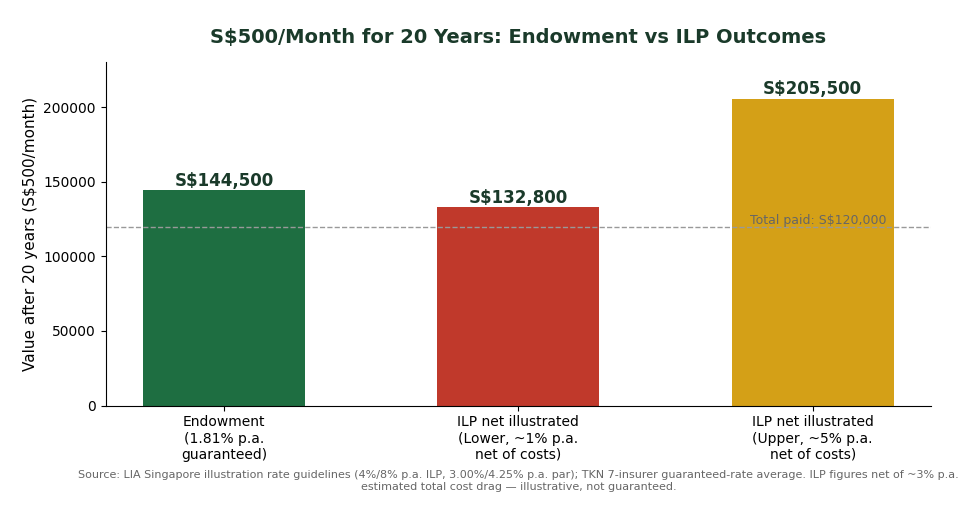
Say you put S$500 a month into each product for 20 years. Total premiums paid: S$120,000. Here’s how the guaranteed and illustrated outcomes stack up once ILP charges are netted out.
| Scenario | 20-Year Value | Guaranteed? |
|---|---|---|
| Endowment (1.81% p.a.) | ~S$144,500 | Fully guaranteed |
| ILP, net illustrated (Lower 4% gross, ~1% net of costs) | ~S$132,800 | Not guaranteed |
| ILP, net illustrated (Upper 8% gross, ~5% net of costs) | ~S$205,500 | Not guaranteed |
Source: LIA Singapore illustration rate guidelines (endowment par cap 3.00-4.25% p.a.; ILP 4%/8% p.a. gross); TKN 7-insurer guaranteed-rate average for endowments; ILP figures assume ~3% p.a. average total cost drag applied to gross illustration rates — illustrative only, actual charges vary by insurer, sub-fund, and age at entry.
Notice what’s actually being compared. The endowment’s S$144,500 is locked in — it doesn’t move regardless of markets. The ILP’s Lower scenario, after realistic costs, can land below the endowment and even below what you paid in during a weak market stretch. Only the Upper scenario, which assumes 8% gross market growth every year for two decades, pulls ahead — and that’s not a promise, it’s an illustration ceiling.
Who Should Buy Which
Buy an endowment plan if you have a specific, dated goal — a house down payment, a child’s education fund, a wedding — and you want a fixed number you can plan around without worrying about markets.
An ILP makes more sense if you specifically want life insurance and market-linked investing bundled into one policy, and you’ve compared the total cost against buying term insurance plus a separate investment portfolio. For most Singaporeans chasing pure growth, that separated approach — a low-cost ETF portfolio via FSMOne or a robo-advisor like Syfe or Endowus — usually beats an ILP’s net-of-cost return, since you’re not paying insurance charges layered on top of fund fees.
Run your own numbers before committing to either product with TKN’s retirement planning calculator.
Frequently Asked Questions
Is an ILP better than an endowment plan?
Can an ILP lose money?
What is the LIA illustration rate for ILPs?
How much does an ILP actually cost each year?
What is the Key Information Document (KID) for ILPs?
Should I buy an ILP for investment growth alone?
Can I hold both an endowment plan and an ILP?
Get Free Insurance Advice
Speak with a licensed insurance advisor. No obligation, no cost.
By submitting this form, you agree to our Privacy Policy.
This article was researched with the help of AI. While we strive to keep all information accurate and up to date, there may be errors. If you notice any discrepancies, please contact us.