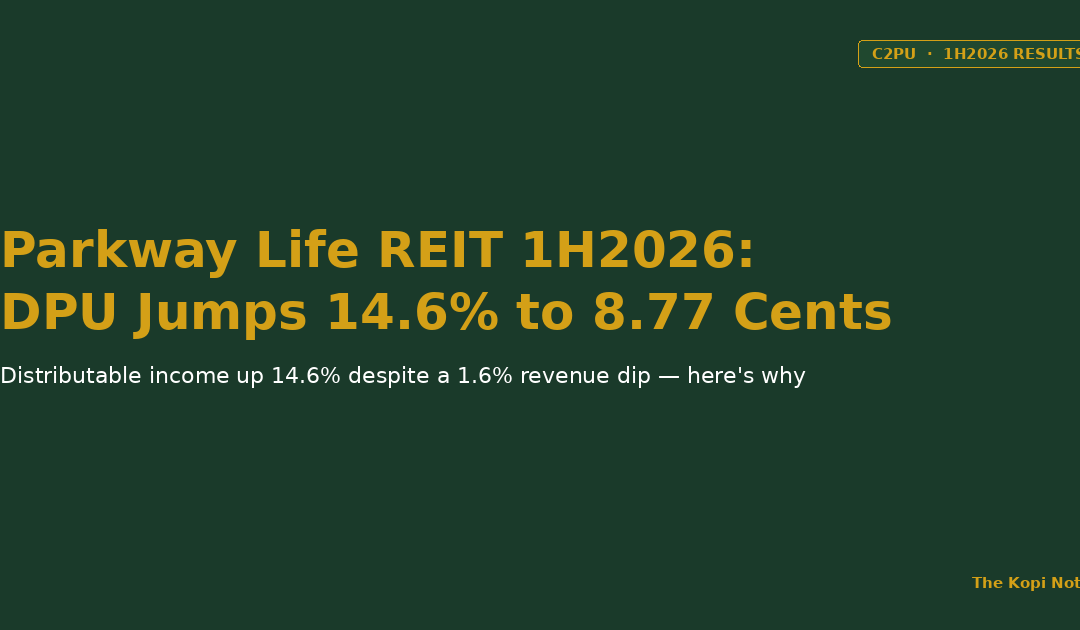
Parkway Life REIT 1H2026 Results: DPU Jumps 14.6% to 8.77 Cents Despite Revenue Dip (SGX: C2PU)
Distributable income rose to S$57.2 million as Singapore hospital rent escalations offset yen weakness in Japan.
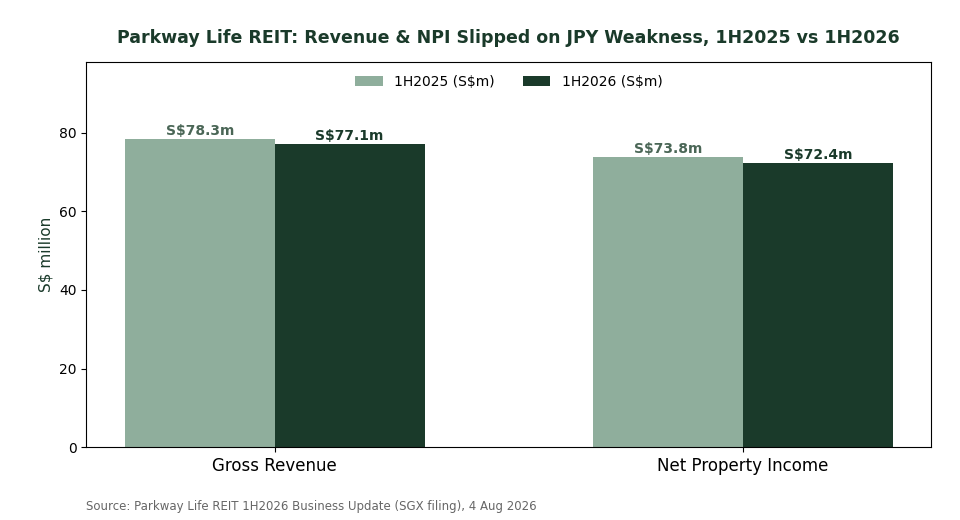
Parkway Life REIT (SGX: C2PU) reported 1H2026 distributable income of S$57.2 million, up 14.6% year-on-year, lifting DPU to 8.77 cents from 7.65 cents. Gross revenue slipped 1.6% to S$77.1 million on yen weakness and Japan tenant exits, but a 24.3% CPI-linked step-up in Singapore hospital rent more than offset the drag.
Not financial advice. All figures are sourced from Parkway Life REIT’s official 1H2026 Business Update (SGX filing, 4 August 2026) unless otherwise noted.
- DPU rose 14.6% to 8.77 cents even though revenue and net property income (NPI) both fell slightly — the gap is fully explained by a Singapore rent reset, not one-off gains.
- Gearing stayed low at 33.8%, with S$542.5 million of headroom before hitting the regulatory 45% cap, and no refinancing is due until March 2027.
- Japan remains the soft spot: yen depreciation and five nursing-home tenant exits dragged revenue, though PLife REIT has hedged around 96% of its interest rate exposure and part of its Japan income.
Parkway Life REIT 1H2026 Results at a Glance
Parkway Life REIT is one of Asia’s largest listed healthcare REITs, with 73 properties across Singapore, Japan, and France valued at S$2.56 billion as at 30 June 2026. You may know it as the REIT that has never cut its distribution since its 2007 IPO — a streak that continued in 1H2026.
Here’s the headline number: distributable income jumped 14.6% year-on-year to S$57.24 million, even though gross revenue actually fell. That’s an unusual combination, and it’s worth understanding why before you read the rest of this article.
| Metric | 1H2025 | 1H2026 | YoY Change |
|---|---|---|---|
| Gross Revenue | S$78.31m | S$77.08m | -1.6% |
| Net Property Income | S$73.84m | S$72.36m | -2.0% |
| Distributable Income | S$49.92m | S$57.24m | +14.6% |
| DPU | 7.65¢ | 8.77¢ | +14.6% |
| Gearing | — | 33.8% | — |
Source: Parkway Life REIT 1H2026 Business Update (SGX filing), 4 August 2026.
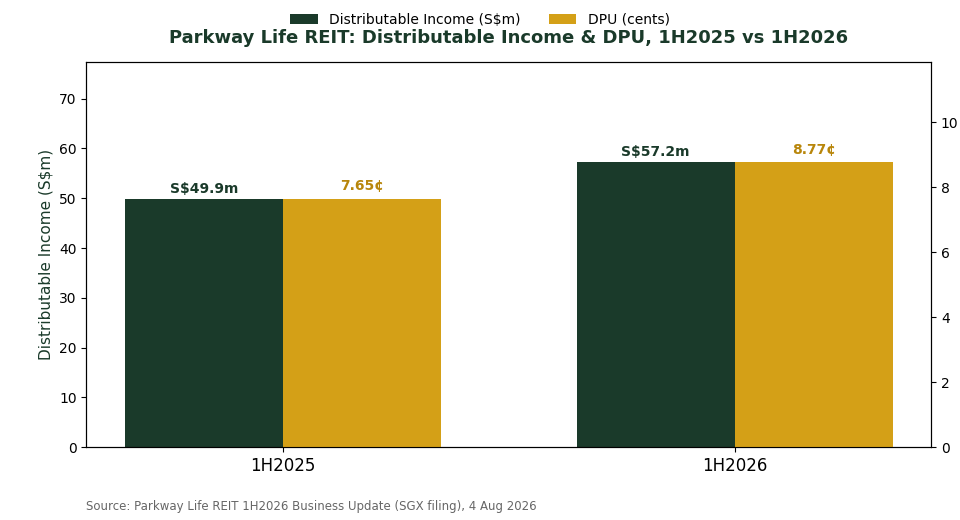
Why DPU Jumped 14.6% While Revenue Fell
This is the part that trips people up. Revenue fell 1.6%. NPI fell 2.0%. Yet DPU rose 14.6%. How?
The short answer: a scheduled rent reset in Singapore, not a one-off gain. Under Parkway Life REIT’s master lease structure, the minimum rent for its Singapore hospitals is set to increase by 24.3% in FY2026, tied to a CPI-linked escalation clause built into the leases years ago. That single mechanic drove most of the distributable income growth.
A second, smaller contributor: the divestment of a Japan nursing home for JPY1,165.5 million (about S$9.4 million) — a 38% premium to its original acquisition cost and a 5% premium over its latest valuation. That single sale added a S$0.6 million gain on disposal.
You also need to know that PLife REIT secured a tax exemption on foreign-sourced dividend and interest income from its France portfolio during the period. That’s a quieter change, but it directly boosts what actually reaches unitholders, on top of the headline NPI figures.
Put together: rent escalation + one property sale + a tax exemption fully offset the JPY-driven revenue softness and then some — which is how distributable income can rise 14.6% in a half where top-line revenue actually shrank.
Singapore, Japan & France: Portfolio Performance by Region
Parkway Life REIT’s 73 properties span three markets, and each played a different role in 1H2026.
Singapore — the core engine
Singapore remains the REIT’s largest and most defensive income source. Its hospital leases are long-term, downside-protected, and carry the built-in CPI-linked rent escalations that drove this period’s DPU growth. As long as this mechanism keeps working, Singapore acts as the reliable base of PLife REIT’s income.
Japan — the drag, but a managed one
Japan is where the headline softness came from. Yen depreciation against the Singapore dollar directly reduces the SGD value of Japan rental income when converted back. On top of that, five Japan nursing home properties saw tenant exits during the period, which further dented revenue from that market.
That said, PLife REIT isn’t sitting still on Japan. It divested one nursing home at a premium to both cost and valuation, and it says net income from Japan is hedged — meaning currency swings are only partially felt at the distributable-income level, even when they show up fully in headline revenue.
France — the newest diversification leg
The France portfolio, acquired in December 2024, is still the smallest of the three but adds geographic diversification and indexed lease income outside the Singapore-Japan axis. The tax exemption secured this period on France’s foreign-sourced income is a direct, quantifiable benefit of that expansion.
Balance Sheet & Capital Management
For a REIT, the balance sheet often matters as much as the income statement — it tells you how much room the manager has to keep growing distributions without taking on excessive risk. Parkway Life REIT’s numbers here are conservative by S-REIT standards.
| Capital & Risk Metric | Value (as at 30 June 2026) |
|---|---|
| Gearing ratio | 33.8% |
| Debt headroom to 45% gearing cap | S$542.5 million |
| Interest rate exposure hedged | ~96% |
| Next long-term debt refinancing due | March 2027 |
| Total portfolio value | S$2.56 billion (73 properties) |
Source: Parkway Life REIT 1H2026 Business Update (SGX filing), 4 August 2026.
A gearing ratio of 33.8% sits well under the Monetary Authority of Singapore’s (MAS) 50% aggregate leverage cap for S-REITs, and even further under the 45% level PLife REIT itself uses as an internal reference point. With ~96% of interest rate exposure hedged and no refinancing due until March 2027, the REIT has limited near-term exposure to rate volatility — a meaningfully different risk profile from more leveraged S-REITs still working through 2026 refinancing.
What This Means for Singapore Investors
If you’re holding Parkway Life REIT, this result reinforces the core reason people buy it: an uninterrupted distribution growth record since IPO, now extended to 1H2026, on the back of contractual rent mechanics rather than market luck. DPU has grown 141.9% since IPO, and total return over that period stands at 395% — figures that reflect a genuinely defensive healthcare-property income stream, not a REIT chasing yield through leverage.
If you’re considering an entry, the trade-off to understand is currency and tenant concentration risk in Japan. That market is a real drag right now, even if it’s a managed one. The Singapore rent escalation mechanism won’t repeat at 24.3% every year — it’s a step-up tied to specific lease terms, not a recurring growth rate you should extrapolate forward.
For income-focused Singapore investors building a diversified passive income portfolio, healthcare REITs like PLife REIT sit at the more defensive end of the S-REIT spectrum, alongside data centre and industrial REITs at the growth end. If you’re weighing how a REIT like this fits into a broader retirement income plan, our Singapore retirement calculator can help you model how REIT distributions stack up against your target retirement income.
You can also read our full ParkwayLife REIT share price and dividend yield review for a broader valuation view, or see how this half compares with the 1Q2026 results that first signalled this year’s DPU growth trend.
If you’re building a broader S-REIT income portfolio around names like Parkway Life REIT, our best S-REITs in Singapore 2026 guide and passive income Singapore guide are good next reads. Investors wanting broad, low-cost exposure instead of single-REIT picking may also want our Singapore REIT ETF guide.
To fund new REIT or ETF positions, brokers like Syfe (referral code and sign-up bonus) and FSMOne (referral code) both support CPF-OA and cash investing into SGX-listed REITs.
Frequently Asked Questions
What was Parkway Life REIT's DPU for 1H2026?
Why did DPU rise when revenue and NPI both fell?
What is Parkway Life REIT's gearing ratio?
How exposed is Parkway Life REIT to interest rate risk?
Why did Japan drag on Parkway Life REIT's 1H2026 revenue?
How many properties does Parkway Life REIT own?
Has Parkway Life REIT ever cut its distribution since IPO?
This article was researched with the help of AI. While we strive to keep all information accurate and up to date, there may be errors. If you notice any discrepancies, please contact us.