Far East Hospitality Trust 1H2026 Results: Core DPS Up 7.9% as Japan Cushions Softer Singapore Hotels (SGX: Q5T)
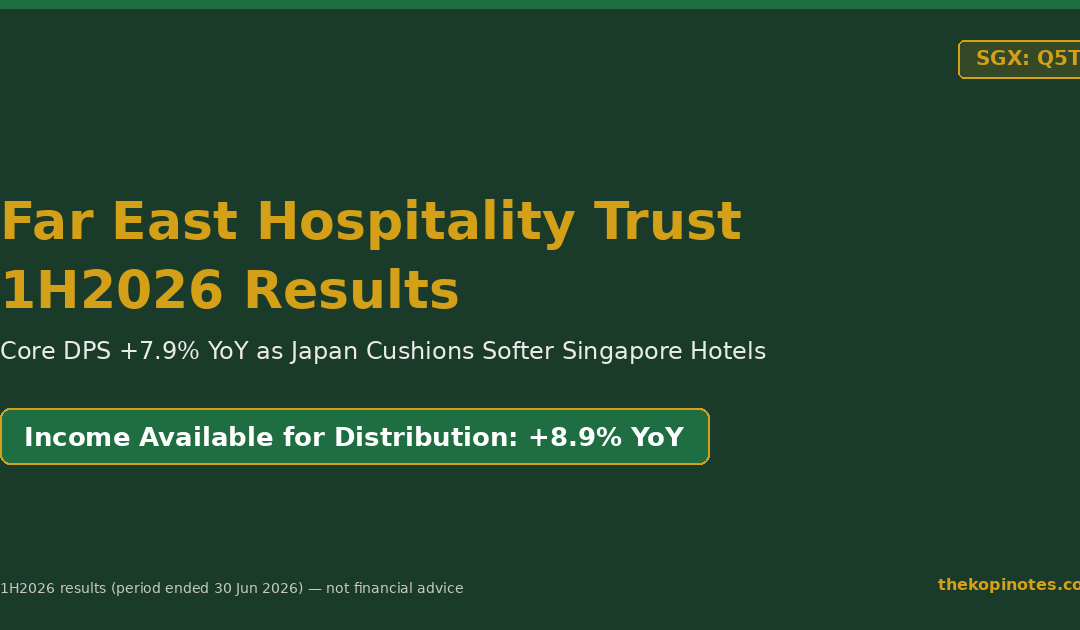
Income available for distribution rose 8.9% year-on-year to S$33.68 million, even as Singapore hotel room rates softened.
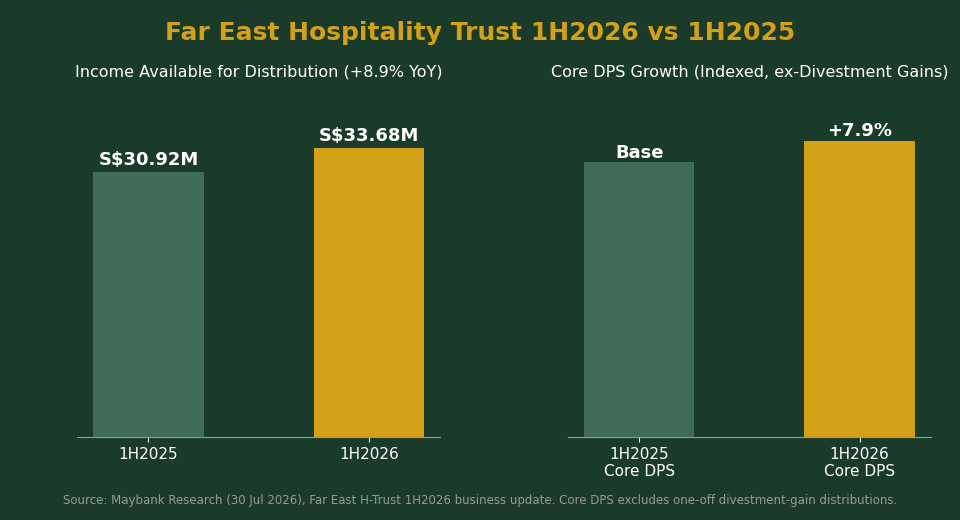
Far East Hospitality Trust (SGX: Q5T) reported 1H2026 results on 30 July 2026: income available for distribution rose 8.9% year-on-year to S$33.68 million, and core DPS (excluding one-off divestment gains) grew 7.9%. Lower financing costs and resilient Japan operations offset a 1.6% dip in Singapore hotel RevPAR.
Not financial advice. All figures are for educational reference only. Data as at August 2026 unless noted.
- Distributable income grew 8.9% YoY even though Singapore hotel room rates softened — mostly thanks to lower financing costs and a resilient Japan hotel.
- Gearing sits at a healthy 32.8% and the average cost of debt fell to 2.3%, giving FEHT room to keep refinancing cheaply.
- Maybank Research kept its BUY call with a S$0.65 target (14% upside from S$0.575), but trimmed FY26-27E DPU forecasts 2-6% on a softer travel-demand outlook.
Table of Contents
Contents — Click to expand
- FEHT 1H2026 Results at a Glance
- Why Distributable Income Rose Even as Hotels Softened
- Singapore Hotels vs Serviced Residences vs Japan
- Balance Sheet: Gearing and Cost of Debt
- What Analysts Are Saying
- The Distribution: Ex-Date and What You’ll Receive
- How FEHT Compares to Other Singapore Hospitality REITs
- Risks to Watch
- Should You Buy FEHT for Passive Income?
- FAQ
FEHT 1H2026 Results at a Glance
Far East Hospitality Trust — the stapled trust that owns Oasia, Rendezvous, Quincy and Village hotels around Singapore, plus one hotel in Japan — released its 1H2026 business update on 30 July 2026, covering the six months to 30 June 2026. Here’s the headline table.
| Metric | 1H2026 | YoY Change |
|---|---|---|
| Income available for distribution | S$33.68 million | +8.9% |
| Core DPS (ex-divestment gains) | — | +7.9% |
| Singapore hotel RevPAR | — | -1.6% |
| Serviced residence RevPAU | — | +5.7% |
| Gearing ratio | 32.8% | Healthy, well under MAS’s 50% aggregate leverage limit for S-REITs |
| Cost of debt | 2.3% | Down from a higher base in 2025 |
Source: Maybank Research (30 July 2026), citing Far East Hospitality Trust’s 1H2026 business update.
Why Distributable Income Rose Even as Hotels Softened
Here’s the part that surprises most readers: FEHT’s Singapore hotels had a slightly weaker half. RevPAR (revenue per available room) — basically how much income each hotel room generates on average, whether it’s occupied or not — fell 1.6%. Occupancy actually improved, but average daily rates came down, so the net effect on RevPAR was negative.
Despite that, income available for distribution still grew 8.9%. Two things did the heavy lifting.
First, lower financing costs. FEHT’s average cost of debt fell to 2.3% in 1H2026. That’s a meaningful drop, and on a REIT with hundreds of millions in borrowings, even a small rate reduction frees up real cash for unitholders. Refinancing at lower rates matters more for FEHT than for many other S-REITs, because hospitality trusts tend to run tighter distributable-income margins than, say, industrial or retail REITs.
Second, resilient Japan operations. FEHT’s freehold 319-room hotel near Chubu Centrair International Airport in Nagoya — its first overseas acquisition — kept performing steadily through the half, cushioning the softer Singapore numbers. That’s the benefit of geographic diversification: when one market has a soft patch, another can pick up the slack.
Singapore Hotels vs Serviced Residences vs Japan — Segment Breakdown
FEHT doesn’t run a single homogenous portfolio — it’s split across three distinct demand pools, and 1H2026 showed just how differently they can behave in the same six months.
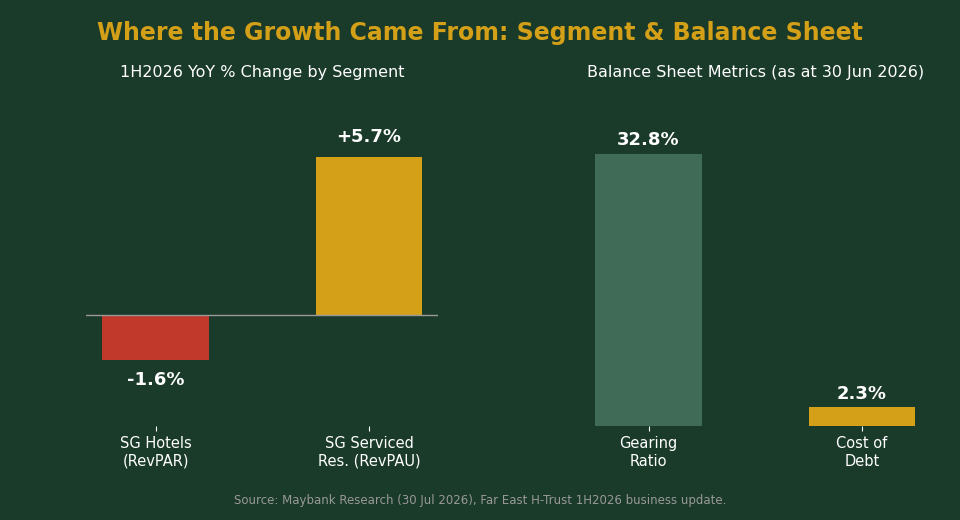
Singapore hotels (RevPAR -1.6%) serve mostly leisure and corporate travellers booking short stays. That segment is the most exposed to swings in average daily rates, which is exactly what dragged on 1H2026. Serviced residences, on the other hand, cater to longer-stay guests — relocating executives, project teams, families between homes — and that segment’s RevPAU (revenue per available unit) actually rose 5.7% year-on-year, a sign that longer-stay demand held up better than short-stay leisure demand this half.
Then there’s Japan. The Nagoya hotel isn’t large relative to FEHT’s ~3,334-room Singapore-heavy portfolio, but it’s doing what a diversification play is supposed to do: holding steady while a bigger chunk of the portfolio has a softer stretch.
Balance Sheet: Gearing and Lower Cost of Debt
Gearing (how much of FEHT’s total assets are funded by debt rather than unitholders’ equity) sits at 32.8% — comfortably under the Monetary Authority of Singapore’s 50% aggregate leverage limit for S-REITs, and lower than many of its industrial and retail peers. That gives FEHT headroom to take on more debt for acquisitions without breaching the regulatory ceiling, or to simply run a more conservative balance sheet through an uncertain travel-demand environment.
The average cost of debt falling to 2.3% is arguably the single biggest driver of this half’s distributable-income growth. If FEHT can keep refinancing maturing debt at similarly low rates — and 32.8% gearing gives it room to do so without stress — that’s a recurring tailwind, not a one-off.
Maybank Research also flagged potential asset monetisation as a further lever: FEHT could divest non-core assets like Village Hotel Robertson Quay or Village Hotel Albert Court, using the proceeds to pay down debt or fund higher-yielding acquisitions. Nothing has been announced yet — this is analyst speculation, not company guidance — but it’s worth watching.
What Analysts Are Saying
Maybank Research maintained its BUY call on FEHT after the 1H2026 results, setting a target price of S$0.65 — about 14% above the S$0.575 closing price on 30 July 2026. Their DDM-based (dividend discount model) valuation leans on the same story we’ve covered above: cost discipline, lower financing costs, and potential upside from asset recycling.
That said, Maybank also trimmed its FY26-27E DPU forecasts by 2-6%, citing a lower RevPAR assumption — largely because of Middle East tensions weighing on international travel demand into 2027. It’s a reminder that even a “BUY” call comes with a lowered forward estimate, not just an upgrade.
Beyond Maybank, the broader analyst consensus (5 analysts covering the stock) leans Buy, with an average 12-month target of S$0.71 — a wider range than any single house’s number, which is normal for a small-cap S-REIT with thin coverage.
| Metric | Figure |
|---|---|
| Unit price (30 Jul 2026 close) | S$0.575 |
| Maybank target price | S$0.65 (BUY) |
| Analyst consensus target (5 analysts) | S$0.71 (Buy) |
| Total portfolio | 13 properties, 3,334 rooms/units (12 Singapore, 1 Japan) |
| Sponsor | Far East Organization |
Source: Maybank Research (30 July 2026); FEHT portfolio data from fehtrust.com, as at latest disclosed figures.
The Distribution: Ex-Date and What You’ll Receive
If you already hold FEHT units, here’s the practical bit. The trust’s latest cash distribution has an ex-date of 6 August 2026. That means you need to hold your units before that date to qualify — buying on or after the ex-date won’t entitle you to this particular payout.
For context on FEHT’s income track record: FY2025’s total distribution per stapled security came in at 3.70 cents (down 8.4% from FY2024, mostly because FY2024 included a one-off divestment-gain distribution from the sale of Central Square that didn’t repeat). Against the current S$0.575 unit price, that works out to a trailing yield of roughly 6.4% — though remember, trailing yield looks backward, and 1H2026’s core DPS growth of 7.9% is the more forward-looking signal.
How FEHT Compares to Other Singapore Hospitality REITs
FEHT is one of a small handful of pure-play or near-pure-play hospitality trusts on SGX. CDL Hospitality Trusts is the largest, with roughly S$3.5 billion in AUM and a yield closer to 6.2%. CapitaLand Ascott Trust runs a similarly diversified serviced-residence-heavy model, yielding around 6.8-6.9%. FEHT itself, at around S$1.16 billion market cap, sits at the smaller end of the group.
There’s also a new entrant to watch: DoubleDragon’s proposed Hotel101 REIT, a roughly S$300 million hospitality trust planned for an SGX listing. We covered the mechanics and comparison in our Hotel101 REIT SGX listing guide — worth a read if you’re comparing FEHT against the next wave of hospitality REITs likely to list in Singapore.
If you’re building out a broader income portfolio and want to see how FEHT stacks up against non-hospitality S-REITs, our top 10 high-yield S-REITs roundup and our best S-REITs in Singapore 2026 comparison table are both good starting points.
Risks to Watch
No REIT result is risk-free, and FEHT’s 1H2026 print comes with a few honest caveats.
Softening Singapore RevPAR. The -1.6% RevPAR print isn’t catastrophic, but it’s a real trend, not noise. If average daily rates keep softening while occupancy plateaus, the core Singapore hotel segment could become a drag rather than a contributor.
Trimmed forward estimates. Maybank’s 2-6% cut to FY26-27E DPU forecasts, driven by Middle East tensions affecting international travel, is a reminder that geopolitical events well outside Singapore can still move a Singapore-listed hospitality REIT’s numbers.
Unconfirmed asset sales. The potential Village Hotel Robertson Quay and Village Hotel Albert Court monetisation is analyst speculation, not a company announcement. Don’t price it in as a certainty.
Small-cap liquidity. At roughly S$1.16 billion market cap and thin analyst coverage (5 analysts), FEHT’s unit price can be more volatile on lower trading volumes than a mega-cap REIT like CICT or Mapletree Pan Asia Commercial Trust.
Should You Buy FEHT for Passive Income?
FEHT’s 1H2026 results tell a “quality over headline” story. The eye-catching number — RevPAR down 1.6% — sounds like a problem. But look one layer deeper: distributable income still grew 8.9%, gearing is conservative at 32.8%, and the cost of debt is falling. That’s a REIT managing its balance sheet well through a soft patch in one segment, not a REIT in trouble.
Whether it fits your portfolio depends on what you’re optimising for. If you want the highest possible headline yield today, larger diversified S-REITs may offer more. If you want a smaller-cap hospitality play with a conservative balance sheet, falling financing costs, and geographic diversification into Japan, FEHT’s 1H2026 print is a reasonable data point in its favour — with the caveat that Maybank itself just trimmed forward estimates on softer travel demand.
As always, position size matters more than any single REIT pick. A retirement calculator can help you see how a REIT like FEHT fits into your broader income plan — try our Singapore retirement planning calculator to model it out.
Building a Broader S-REIT Income Portfolio?
Track your S-REIT gearing exposure across your whole portfolio with our free S-REIT Gearing Ratio Calculator, or start investing through a low-cost platform like Syfe.
Frequently Asked Questions
What is Far East Hospitality Trust?
What were FEHT's 1H2026 results?
Why did FEHT's distributable income rise while RevPAR fell?
When is FEHT's next distribution paid?
What is FEHT's dividend yield in 2026?
What is FEHT's target price according to analysts?
What are the main risks for FEHT investors?
This article was researched with the help of AI. While we strive to keep all information accurate and up to date, there may be errors. If you notice any discrepancies, please contact us.