T-Bill June 2026 Results: What the Latest Auction Means for Singapore Investors
Updated June 2026 | By The Kopi Notes
The June 2026 Singapore T-bill auction (BS26111H) closed with a cut-off yield of 1.44% per annum — the lowest since 2021. Applications totalled S$12.7 billion against S$6.5 billion on offer, with a bid-to-cover ratio of 1.96. For the first time since 2022, the CPF Ordinary Account rate of 2.5% now beats the 6-month T-bill yield by over 100 basis points. Here is what the June 2026 T-bill results mean for your cash and how to position your portfolio.
Not financial advice. All figures are for educational reference only. Data as at June 2026 unless noted.
- June 2026 T-bill cut-off yield: 1.44% p.a. — down from 3.74% at peak in 2023
- CPF OA (2.5%) now beats T-bills by 106 basis points — a significant reversal
- If you have idle cash, SSBs, CPF top-ups, and S-REIT ETFs now offer better risk-adjusted returns
June 2026 T-Bill Auction Results
The latest 6-month T-bill auction (BS26111H) closed on 5 June 2026. Here are the key numbers from MAS:
| Metric | June 2026 Result |
|---|---|
| Issuance Code | BS26111H |
| Cut-Off Yield | 1.44% p.a. |
| Amount on Offer | S$6.5 billion |
| Total Applications | S$12.7 billion |
| Bid-to-Cover Ratio | 1.96× |
| Maturity Date | 4 December 2026 |
| Non-Competitive Allotment | 100% |
Source: Monetary Authority of Singapore (MAS), June 2026
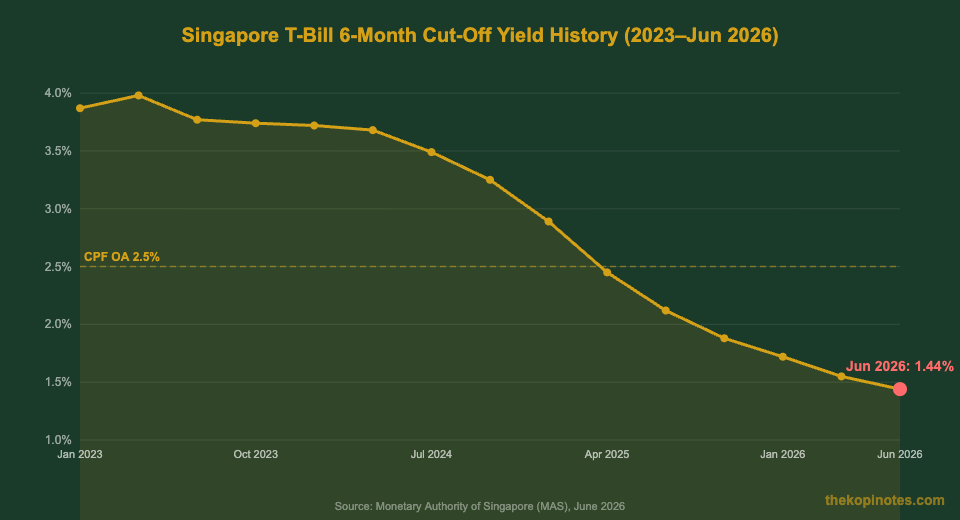
The yield of 1.44% is a sharp drop from the 3.74% peak seen in late 2023. Non-competitive applicants — most retail investors — received full allotment, meaning everyone who applied through their bank or CPF got their full amount.
Why Singapore T-Bill Yields Have Fallen So Far
The drop from 3.74% to 1.44% in under three years is significant. Three forces drove this decline:
1. US Federal Reserve rate cuts. The Fed cut rates aggressively through 2024 and 2025 as US inflation cooled. Singapore’s SORA and MAS bill yields track global short-term rates closely. As the Fed funds rate came down, Singapore’s short-term yields followed.
2. Strong safe-haven demand. Global uncertainty — from trade tensions to geopolitical risks — pushed investors into high-quality government bonds worldwide. More demand for T-bills = lower yields for issuers.
3. Singapore’s strong fiscal position. MAS has been running a tighter exchange rate policy to combat inflation. A strong SGD attracts foreign capital into SGS bonds and T-bills, further suppressing yields.
The result: Singapore T-bills now yield less than CPF OA for the first time since 2022. This changes the calculus for many Singapore investors who had been parking cash in T-bills as a CPF alternative.
CPF OA vs T-Bill in June 2026: The Big Reversal
For most of 2022 and 2023, T-bills were an attractive place to park cash that would otherwise sit in your CPF Ordinary Account. The math was simple: T-bills at 3.7% beat CPF OA at 2.5%.
That equation has now flipped completely.
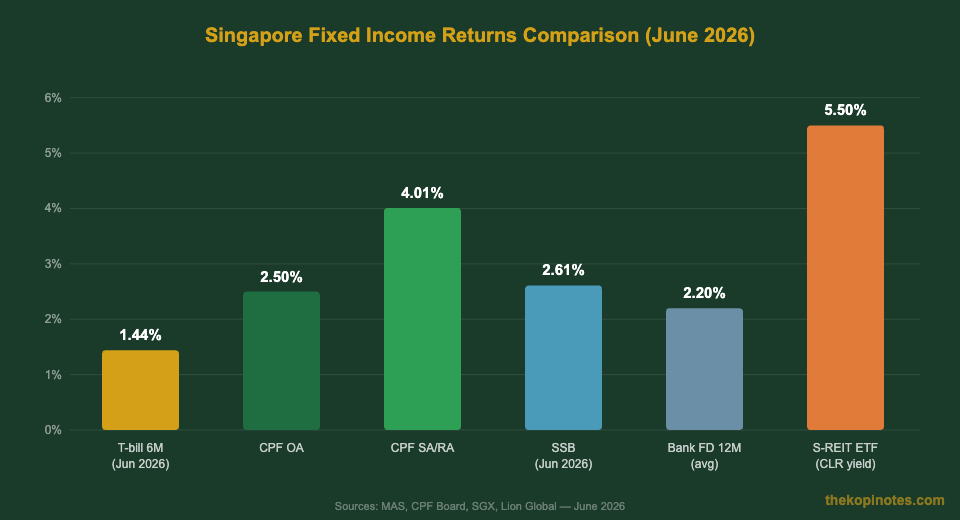
| Product | Rate (June 2026) | Liquidity | Risk |
|---|---|---|---|
| T-Bill 6M (BS26111H) | 1.44% | 6 months lock-in | Zero (govt-guaranteed) |
| CPF OA | 2.50% | CPF rules apply | Zero |
| CPF SA/RA | 4.01% | Restricted (retirement) | Zero |
| SSB (Jun 2026 issue) | 2.61% (avg 10Y) | Redeem anytime | Zero |
| Bank FD 12M (avg) | ~2.20% | 12 months lock-in | Low (SDIC S$100k) |
| CLR (S-REIT ETF) yield | ~5.5% | Exchange-tradeable | Market risk applies |
Source: MAS, CPF Board, MAS SSB, Lion Global, June 2026
The bottom line: if you have cash sitting in a bank account or were thinking of rolling T-bills, you now have better risk-free options available.
T-Bill Yield History 2023–2026: How Far Yields Have Fallen
To understand the June 2026 result in context, here is the full cut-off yield history for the 6-month Singapore T-bill over the past three years:
| Auction Date | Cut-Off Yield | vs CPF OA 2.5% |
|---|---|---|
| Jan 2023 | 3.87% | +1.37% |
| Apr 2023 | 3.98% | +1.48% |
| Oct 2023 (peak) | 3.74% | +1.24% |
| Jan 2024 | 3.72% | +1.22% |
| Jul 2024 | 3.49% | +0.99% |
| Jan 2025 | 2.89% | +0.39% |
| Apr 2025 | 2.45% | -0.05% |
| Oct 2025 | 1.88% | -0.62% |
| Jan 2026 | 1.72% | -0.78% |
| Apr 2026 | 1.55% | -0.95% |
| Jun 2026 (latest) | 1.44% | -1.06% |
Source: Monetary Authority of Singapore (MAS), June 2026
The trend is clear: yields have been falling consistently since mid-2023. The April 2025 auction was the first time T-bill yields dipped below CPF OA. By June 2026, you are giving up 1.06 percentage points by choosing T-bills over CPF OA.
Better Alternatives to T-Bills in June 2026
If you have been rolling T-bills or considering applying for the next auction, here are five alternatives worth considering instead:
1. Singapore Savings Bonds (SSB). The June 2026 SSB issue offers an average yield of 2.61% over 10 years, with full flexibility to redeem in any month. There is no lock-in — unlike T-bills, you can get your money back without penalty. For idle cash you might need in 1–3 years, SSBs are a strong alternative. Applications open through your bank or CPF OA. Learn more in our Singapore T-bills 2026 guide which compares both instruments in detail.
2. CPF Voluntary Cash Top-Up (VCTO). If you have not yet hit the Full Retirement Sum in your CPF SA or RA, a voluntary cash top-up earns you 4.01% guaranteed — tax-free. That beats T-bills by 2.57 percentage points. The trade-off is that CPF funds are restricted for retirement use. But if you were already planning to save for retirement anyway, this is one of the most powerful moves available. Check how much you can top up using our CPF RA top-up calculator.
3. S-REIT ETFs for income. If you want yield significantly above T-bills and are comfortable with market risk, S-REIT ETFs like the Lion-Phillip S-REIT ETF (CLR) currently yield around 5.5% — over three times the T-bill rate. CLR is CPFIS-OA eligible, meaning you can invest CPF OA funds directly. For a full breakdown, see the Singapore REIT ETF guide.
4. Robo-Advisors (Endowus / Syfe). Platforms like Endowus and Syfe now offer income portfolios and fixed income funds that have historically returned 3–5% annually with diversification. You can access them with CPF OA, SRS, or cash. If you are new to either platform, use our referral links for a fee waiver: Endowus referral code 2V343 or Syfe referral code SRPRFFFCD.
5. FSMOne Regular Savings Plan. For longer-term capital deployment into SGX-listed stocks and ETFs, FSMOne’s RSP lets you invest from S$50/month with 0.08% commission. Use our FSMOne referral code P0544985 to get started.
What Should You Do With Your Cash Now?
Your action depends on your financial situation. Here is a simple framework:
| Your Situation | Recommended Action |
|---|---|
| Cash needed within 6 months | High-yield savings (MariBank 2.7%, GXS) or SSB |
| Cash available for 1–3 years | SSB (2.61%, fully flexible) or FD (2.2%) |
| Retirement savings (CPF eligible) | CPF SA/RA top-up (4.01%) — highest guaranteed yield |
| Income investor, 5+ year horizon | S-REIT ETFs (CLR ~5.5%) or best S-REITs in Singapore 2026 |
| Tax on income, SRS investor | Top up SRS, invest via Endowus or Syfe for tax relief |
| Want T-bill simplicity | Still valid — but accept you are giving up ~1% vs alternatives |
For general guidance only. Consult a licensed financial adviser for personalised advice.
For most retail investors, stopping T-bill applications and redirecting cash to SSBs or CPF top-ups is the highest-value move in June 2026. You get better yields with equal or more safety.
If you have a longer horizon and want real passive income growth, the retirement planning calculator can show you exactly how much your current savings rate grows over time — and what yield you need to hit your retirement number.
Frequently Asked Questions
What was the T-bill cut-off yield for June 2026?
Should I still apply for T-bills in Singapore in 2026?
Is CPF OA now better than T-bills?
What is the next Singapore T-bill auction after June 2026?
How do I apply for Singapore T-bills?
Are Singapore T-bills taxable?
What is a Singapore Savings Bond and how does it compare to T-bills?
Can I use CPF OA to buy Singapore T-bills?
Will T-bill yields recover in Singapore?
Where can I calculate how much passive income I need for retirement?
Start Earning More on Your Cash in 2026
With T-bill yields at 1.44%, it pays to explore smarter alternatives. Open an Endowus or Syfe account today to access income portfolios, S-REIT ETFs, and CPF/SRS investing — all in one place.
This article was researched with the help of AI. While we strive to keep all information accurate and up to date, there may be errors. If you notice any discrepancies, please contact us.