Return of Premium Term Life Insurance Singapore 2026: Do You Get Your Money Back, or the Sum Assured?
Two Singapore insurers let you get something back if you outlive your term policy — but they don’t pay back the same thing. Here’s the difference, with real product terms.
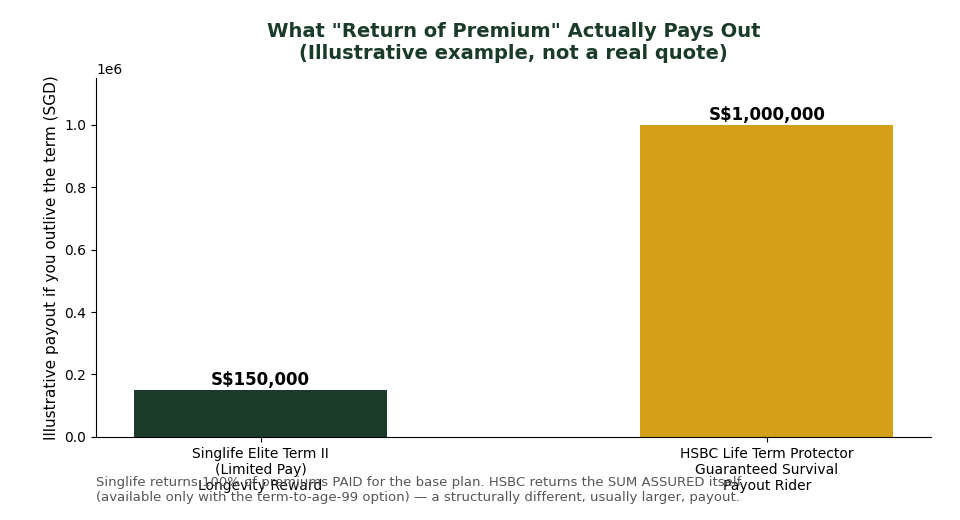
“Return of premium” term life insurance in Singapore isn’t one standard feature — it’s two different mechanics wearing the same marketing label. Singlife Elite Term II (Limited Pay) pays back 100% of the premiums you paid for the base plan if you outlive your policy. HSBC Life Term Protector’s Guaranteed Survival Payout rider instead pays out the full sum assured — a structurally different, usually much larger, number.
Not financial advice. All figures are for educational reference only. Product terms verified directly against Singlife’s and HSBC Life’s official pages, data as at April/February 2026 respectively unless noted.
- Singlife’s “Longevity Reward” refunds your premiums paid — you get back exactly what you put in, no more.
- HSBC’s “Guaranteed Survival Payout” refunds the sum assured — potentially many times more than your premiums, but only if you pick the term-to-age-99 option.
- Both cost more per month than a plain term plan with no cash-back feature — the “free” refund is really a forced savings component built into your premium.
Table of Contents
Contents — Click to expand
- What “Return of Premium” Actually Means
- Singlife Elite Term II: The Longevity Reward Explained
- HSBC Life Term Protector: The Guaranteed Survival Payout Rider
- The Real Difference: Premiums Back vs Sum Assured Back
- What Happens If You Surrender Early
- Is Return of Premium Term Life Insurance Worth the Extra Cost?
- Who Should Actually Consider This
- Frequently Asked Questions
What “Return of Premium” Actually Means
A normal term life insurance policy is “use it or lose it.” You pay premiums for protection. If you never claim, your insurer keeps every dollar you paid — that’s how term stays cheap.
Return of premium (ROP) term plans flip part of that equation. If you outlive the policy term without making a claim, you get some or all of your money back. It sounds like a free upgrade. It isn’t. You’re paying a meaningfully higher premium every month to fund that eventual payout — the insurer is essentially forcing you to save alongside your protection.
Here’s the part that trips people up: in the Singapore market, “return of premium” doesn’t mean the same thing at every insurer. We looked at the two clearest examples currently sold here — Singlife Elite Term II and HSBC Life Term Protector — and found they refund two completely different amounts.
Singlife Elite Term II: The Longevity Reward Explained
Singlife Elite Term II comes in two structures: Regular Pay (standard term, no cash-back, you pay premiums for as long as you’re covered) and Limited Pay. Only Limited Pay has the return-of-premium feature, called the Longevity Reward.
Here’s how you, as a policyholder, would experience it. You choose a premium term — 5 years, 10 years, up to age 65, or up to age 75 — and pay premiums only during that window. Your protection, however, continues all the way to age 99. If you hold the policy to the end of the coverage term at age 99, Singlife pays you 100% of the total premiums you paid for the base plan.
Two details matter here. First, “base plan” excludes rider premiums — if you added Critical Illness or TPD riders, those premiums are never refunded, only the core life protection premium is. Second, you have to survive to age 99 to get the full Longevity Reward. Die earlier and your beneficiaries get the death benefit instead (as with any term plan); surrender earlier and you get a smaller Surrender Benefit, not the full refund.
Singlife Elite Term II (Limited Pay) also lets you convert to a whole life or endowment plan without further medical underwriting, and increase your coverage at key life events (marriage, new child, buying a home) without a new health check.
HSBC Life Term Protector: The Guaranteed Survival Payout Rider
HSBC Life Term Protector works differently. It’s a standard term plan (Regular Pay only, no Limited Pay option) that you can extend to age 99. Attach the Guaranteed Survival Payout rider, and here’s the key fact: if you outlive the policy term, HSBC reimburses you with the prevailing sum assured — not your premiums paid.
That’s a completely different number. Take HSBC’s own worked example: a 30-year-old non-smoker buys Term Protector to age 99 with a S$1,000,000 basic sum assured, paying roughly S$651.37 a month. If he lives to 99 with the Guaranteed Survival Payout rider attached, he gets back S$1,000,000 — the full sum assured, which is almost certainly far more than his cumulative premiums over that time.
Three conditions gate this rider. It’s only available if you choose the term-to-age-99 option (you can’t attach it to a shorter 10- or 20-year term). There’s no medical underwriting needed to attach it. And the minimum sum assured for the base HSBC Life Term Protector plan is S$100,000 (S$2,000,000 for the higher-tier Term Protector Prime variant).
You should read that worked example carefully — a S$1,000,000 payout for outliving a policy sounds almost too generous. That’s precisely why the premium for a Term Protector policy with this rider runs meaningfully higher than one without it: you’re effectively pre-paying, over decades, for a guaranteed lump sum at age 99.
The Real Difference: Premiums Back vs Sum Assured Back
Side by side, the mechanics look like this:
| Feature | Singlife Elite Term II (Limited Pay) | HSBC Life Term Protector |
|---|---|---|
| What you get back | 100% of total base-plan premiums paid | The prevailing sum assured |
| Feature name | Longevity Reward | Guaranteed Survival Payout rider |
| Premium structure required | Limited Pay only (5yr, 10yr, to 65, or to 75) | Regular Pay, term-to-age-99 only |
| Coverage age at payout | Age 99 | Age 99 |
| Rider premiums included in refund? | No — base plan only | N/A — payout is sum assured, not premium-based |
| Early exit before age 99 | Surrender Benefit (30% or 80% of base premiums, see below) | No refund unless policy runs to full term |
Source: Singlife Elite Term II product page (accurate as at 22 April 2026); HSBC Life Term Protector product page (accurate as at 1 February 2026).
The practical takeaway: don’t assume “return of premium” means the same payout size across insurers. Ask your adviser (or read the product summary) exactly one question — “Am I getting my premiums back, or the sum assured back?” — before comparing the extra cost against the benefit.
What Happens If You Surrender Early
Most people don’t hold a policy for 40-50 years without touching it. Life changes. You might downsize your coverage, switch insurers, or simply stop needing the plan. Here’s where Singlife’s Limited Pay structure gives you a meaningful middle ground that a pure “all or nothing” ROP plan wouldn’t.
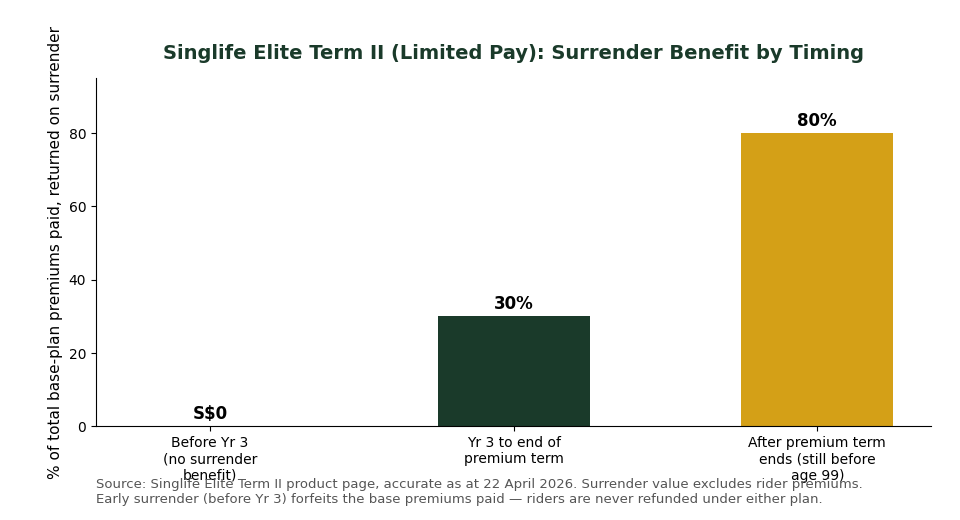
If you surrender your Singlife Elite Term II (Limited Pay) policy from the start of the 3rd policy year through to the end of your premium term, you get back 30% of total base-plan premiums paid as a Surrender Benefit. Surrender after your premium term has ended (you’ve stopped paying, but haven’t yet reached age 99), and that jumps to 80%. Surrender in the first two policy years, and you get nothing — the base premiums paid are forfeited entirely.
HSBC Life Term Protector’s Guaranteed Survival Payout doesn’t have an equivalent tiered exit ramp in what HSBC publishes — the rider is built around a single condition (surviving the full term-to-age-99), not a graduated surrender schedule. If you’re the type of buyer who might realistically exit early, that structural difference matters as much as the headline payout amount.
Is Return of Premium Term Life Insurance Worth the Extra Cost?
Here’s the honest trade-off. A plain term plan with no cash-back feature is the cheapest way to buy a large death benefit. Every dollar of premium goes toward mortality risk pricing — nothing is set aside for you. Add a return-of-premium feature (whether Singlife’s or HSBC’s version), and part of your premium becomes a forced savings pot instead.
That forced savings pot doesn’t earn you investment returns the way a robo-advisor or endowment plan might — it’s guaranteed, but it’s also opportunity cost. If you’d have actually invested the premium difference between a plain term plan and an ROP plan, and stuck with it for decades, you’d likely come out ahead of a 0%-real-return premium refund. The value of ROP is behavioural, not financial: for someone who wouldn’t reliably invest the difference on their own, “guaranteed money back” removes the temptation to spend it elsewhere.
Run the numbers before you decide. Compare (1) a plain term plan’s premium, (2) the ROP plan’s premium, and (3) what you’d end up with if you invested the monthly difference between the two at a conservative long-run return. Our Insurance Gap Calculator can help you size the coverage amount first, so you’re not overpaying for a bigger-than-needed sum assured just to get a bigger refund later.
Who Should Actually Consider This
Return of premium term life insurance tends to suit a narrower buyer profile than standard term. You’re a reasonable fit if you have a stable, high enough income to comfortably absorb the higher premium without straining your emergency fund; you’re disciplined about protection but not about DIY investing (so a forced-savings structure genuinely helps you); and you’re planning multi-decade financial commitments — a legacy for your children, or a source of guaranteed liquidity in old age — where a known payout at age 99 has real appeal.
You’re probably a poor fit if you’re early in your career and every dollar of premium competes directly with debt paydown or your first investments; you already have disciplined investing habits and would rather keep protection and wealth-building completely separate (many experienced Singapore investors deliberately buy cheap term and invest the rest, following our term vs whole life insurance logic); or your main concern is simply making sure your coverage amount is adequate in the first place — in which case, start with our guide to how much term life insurance you need before shopping for premium-refund features.
It’s also worth checking what riders you’re already carrying. If your policy has a Waiver of Premium rider or a TPD rider, remember that under Singlife’s structure, rider premiums are never included in the Longevity Reward refund — only the base plan is. That can meaningfully shrink your expected refund if riders make up a large share of your total premium.
Frequently Asked Questions
Does return of premium term insurance exist in Singapore?
Is return of premium term insurance the same as whole life insurance?
Do I get back my rider premiums too?
What happens if I die before the policy term ends?
Can I surrender a return of premium policy early and get money back?
Why is return of premium term insurance more expensive than regular term insurance?
Is the Guaranteed Survival Payout only available with HSBC Life Term Protector?
Should I buy return of premium insurance instead of investing the difference myself?
Size Your Coverage Before You Shop for Refund Features
Use our free calculator to work out how much term life insurance you actually need — then decide if a premium-refund feature is worth the extra cost on top.
Get Free Insurance Advice
Speak with a licensed insurance advisor. No obligation, no cost.
By submitting this form, you agree to our Privacy Policy.
This article was researched with the help of AI. While we strive to keep all information accurate and up to date, there may be errors. If you notice any discrepancies, please contact us.