Total & Permanent Disability (TPD) Insurance Singapore 2026: Why Your Payout May Not Be “Extra” Money
A plain-English guide to how TPD riders really work — the age-based definitions, the accelerated payout structure, and what it costs in 2026.
Total and Permanent Disability (TPD) insurance pays a lump sum if you can never work again due to injury or illness. In Singapore, most TPD riders are “accelerated” — meaning the payout comes out of your death benefit, not on top of it. Coverage definitions also change at age 65. Here’s exactly how TPD works in 2026.
Not financial advice. All figures are for educational reference only, sourced from insurer product summaries and policy contracts. Data verified as at 5 August 2026.
- Most TPD riders “accelerate” your death benefit — a claim reduces (often to zero) what your family gets later. It doesn’t add to it.
- The definition of “disabled” changes at age 65. Before 65 it’s usually “can’t do any job.” From 65, it shifts to needing help with basic daily tasks.
- TPD cover isn’t always automatic. Some term plans bundle it in. Others sell it as an optional add-on you must actively choose.
Table of Contents
Contents — Click to expand
- What Is TPD Insurance, Exactly?
- The Age-Based Definition Nobody Explains Clearly
- Accelerated vs Additional TPD: The Difference That Actually Matters
- Is TPD Automatically Included in Your Term Life Policy?
- What TPD Insurance Does NOT Cover
- How Much Does TPD Coverage Cost in 2026?
- TPD vs Critical Illness vs Disability Income Insurance
- Singapore’s Protection Gap: Why This Matters
- How Much TPD Coverage Do You Need?
- Frequently Asked Questions
What Is TPD Insurance, Exactly?
Total and Permanent Disability (TPD) insurance pays out a lump sum if you become permanently unable to work due to injury or illness. It’s almost always sold as a rider attached to a term or whole life policy in Singapore — not as a standalone plan, unlike Critical Illness (CI) cover.
To qualify, your disability generally has to last continuously for at least 180 days (about six months). A doctor must also consider it permanent, with “no possibility of improvement in the foreseeable future,” according to Etiqa’s Accelerated Death and TPD Rider policy provisions — wording that’s standard across most Singapore insurers.
This is a high bar. You’re not just unable to do your current job — you have to be unable to do almost any job, or meet a specific medical threshold explained below.
The Age-Based Definition Nobody Explains Clearly
Here’s something most people never read until they try to claim: the definition of “totally and permanently disabled” changes as you age. It’s not one fixed test.
Before age 65 (some riders use 66), the standard is an “any occupation” test. You must be permanently unable to perform any work you’re reasonably suited for by education, training or experience — not just your current job.
From age 65 (or 66) to around 70–86, depending on the rider, the test shifts to Activities of Daily Living (ADLs). You typically need help with at least 3 of these 6 tasks: washing, dressing, feeding, toileting, mobility (moving between rooms) and transferring (bed to chair). This makes sense — most people that age have already stopped working, so an “occupation” test no longer applies.
Regardless of age, some conditions automatically qualify: total and irrecoverable blindness in both eyes, loss of two or more limbs above the wrist or ankle, or loss of sight in one eye plus one limb.
For example, Etiqa sells two versions: its standard Accelerated Death and TPD rider ends at 65, while its Extra Disability Care rider extends TPD protection to age 86 — but at a different cost structure. Always check your own rider’s expiry age; it’s easy to assume cover runs for the full term of your policy when it doesn’t.
Accelerated vs Additional TPD: The Difference That Actually Matters
Here’s the part that surprises most policyholders. Almost every retail TPD rider sold in Singapore is “accelerated,” not additional.
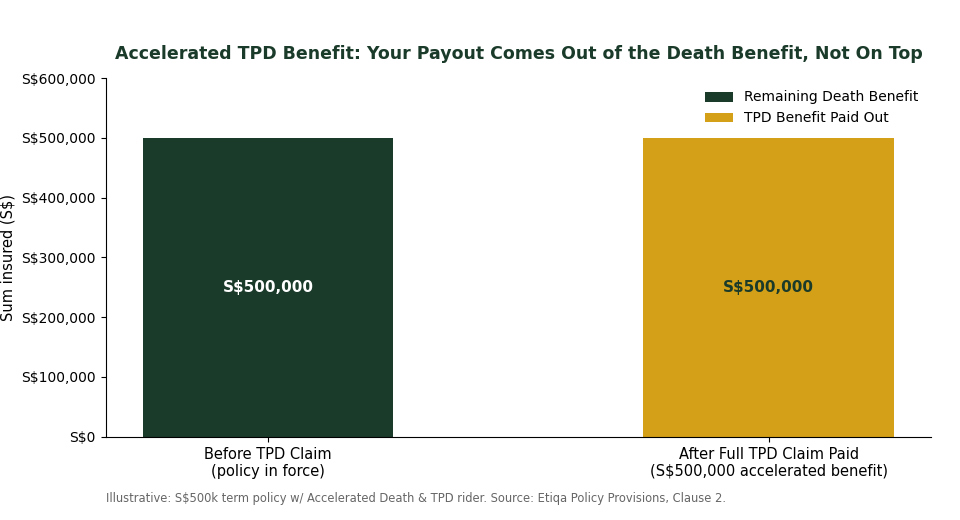
An accelerated TPD benefit pays your TPD claim out of your policy’s death benefit. If you have a S$500,000 term policy and successfully claim the full S$500,000 TPD benefit, your remaining death benefit drops to S$0. Your family would receive nothing more if you later passed away from the same or an unrelated cause — the chart above shows exactly this.
This is confirmed directly in Etiqa’s policy wording: “This TPD Benefit shall accelerate the death Benefit payment.” It’s standard industry language, not a one-off clause.
It gets more layered still. Under Etiqa’s Extra Disability Care rider, if you’d already received a payout from a separate Critical Illness rider, your TPD benefit is reduced proportionally — so a prior CI claim can shrink what you can later claim under TPD too.
An “additional” TPD benefit — one that pays out on top of, rather than instead of, your death benefit — does exist in principle, but it’s rare in Singapore’s mass-market term life space. If you want cover structured this way, you’ll need to ask your adviser directly and check the policy contract’s exact wording before signing.
Is TPD Automatically Included in Your Term Life Policy?
Not always — and this catches people out. Great Eastern’s GREAT Term 2, for instance, makes the TPD Benefit Rider compulsory when you buy it directly online, but optional when you buy it through a financial representative.
This pattern shows up elsewhere too. Many Direct Purchase Insurance (DPI) plans bundle TPD into the base death benefit by design, since DPI is meant to be simple, no-frills cover you buy without an adviser. Adviser-distributed term plans, on the other hand, often present TPD as a separate rider with its own premium — something you could accidentally leave unticked.
The only way to know for sure is to check your policy schedule or benefit illustration. Look for a specific line item for “Total and Permanent Disability Benefit” and its sum insured — if it’s not listed separately, ask your insurer whether it’s built into the base death benefit or not covered at all.
What TPD Insurance Does NOT Cover
Like most protection products, TPD riders carry standard exclusions. Based on Etiqa’s published rider provisions — broadly representative of the market — a TPD claim typically won’t pay out if the disability results from:
- Intentional acts, including self-inflicted injury, suicide or attempted suicide
- Pre-existing conditions within the first 12 months of the rider (or its latest reinstatement)
- Criminal acts, declared or undeclared war, terrorism, or chemical warfare
- Hazardous hobbies or sports — think scuba diving, motor racing, mountaineering, or aerial sports like skydiving and bungee jumping
- Aviation, except as a fare-paying passenger or crew member of a commercial airline
- The effects of drug or alcohol addiction
- HIV/AIDS, except where transmitted via blood transfusion or occupational exposure
Exact wording differs by insurer, so always read your own policy contract rather than assume this list applies word-for-word to your plan.
How Much Does TPD Coverage Cost in 2026?
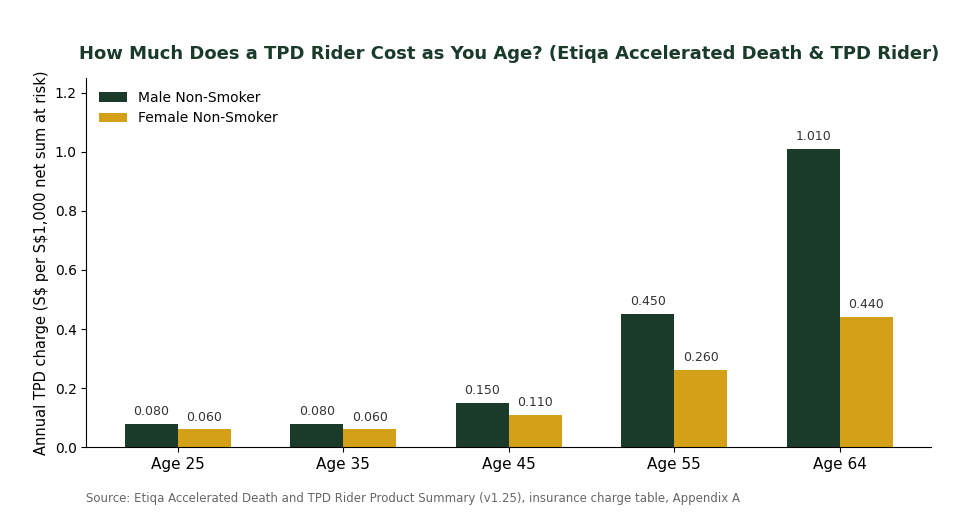
TPD riders are surprisingly affordable, especially while you’re young. The chart above uses Etiqa’s published Accelerated Death and TPD rider rates — the annual charge per S$1,000 of net sum at risk. At age 25, a male non-smoker pays just S$0.08 a year per S$1,000 of cover. That climbs to roughly S$1.01 by age 64, as the underwriting risk of a permanent disability rises with age.
Smoking status also moves the needle, sometimes significantly. Here’s the breakdown at age 45:
| Profile (Age 45) | Annual TPD Charge (per S$1,000 net sum at risk) |
|---|---|
| Male, Non-Smoker | S$0.150 |
| Male, Smoker | S$0.280 |
| Female, Non-Smoker | S$0.110 |
| Female, Smoker | S$0.210 |
Source: Etiqa Accelerated Death and TPD Rider Product Summary (v1.25), Appendix A insurance charge table, August 2026.
On a S$500,000 sum assured at age 45, that works out to roughly S$75 a year for a male non-smoker, rising to S$140 a year if he smokes — a small add-on relative to your base term life premium, given the size of the protection gap it closes.
Cutoff ages and structures also vary meaningfully by rider. Here’s how three real Singapore products compare:
| Rider | TPD Cutoff Age | Structure |
|---|---|---|
| Etiqa Accelerated Death & TPD Rider | Before age 65 | Accelerated (reduces death benefit); max S$4,000,000 aggregate |
| Etiqa Extra Disability Care Rider | Before age 86 | Accelerated; reduced proportionally if a CI benefit was already paid |
| Great Eastern GREAT Term 2 TPD Benefit | Before age 65 next birthday | Compulsory if bought DIRECT online; optional via an adviser |
Source: Etiqa rider product summaries & policy provisions; Great Eastern GREAT Term 2 product page, August 2026.
TPD vs Critical Illness vs Disability Income Insurance
These three products get confused constantly, but they trigger very differently:
TPD pays a one-time lump sum, but only once you’re permanently unable to work at all (or meet the ADL/specific-loss test above). It’s the highest bar of the three — but the payout is usually already built into your term life sum assured, so it can be very affordable to add, as shown above.
Critical Illness (CI) pays out — often in stages, if you have a multi-pay plan — when you’re diagnosed with a specific listed condition, such as cancer, a heart attack or a stroke. You don’t need to be unable to work at all; a diagnosis alone can trigger the claim. We cover this in detail in our guide to how Singapore’s CI rider rules changed in 2026.
Disability Income (DI) insurance is different again — it replaces your income with a recurring monthly payout if you can’t work in your own occupation, typically for a defined period rather than a one-off sum. It has a lower bar to claim than TPD (own occupation, not any occupation), but pays less per claim overall. Our Disability Income Insurance guide breaks down the costs and top plans.
In practice, most Singaporeans layer all three: term life with a TPD rider as the foundation, CI for early-stage illness protection, and DI if their job doesn’t already provide sick-pay or income continuance benefits.
Singapore’s Protection Gap: Why This Matters
The Life Insurance Association (LIA) Singapore’s most recent Protection Gap Study, covering 2022 data and published in 2023, found economically active Singaporeans and Permanent Residents carried a S$373 billion mortality protection gap — a 21% shortfall against what households would actually need if a breadwinner died or became totally and permanently disabled.
LIA’s mortality protection figure explicitly includes death, Total Permanent Disability and terminal illness — TPD isn’t a footnote here, it’s baked into the headline number. The same study found an even larger 74% gap for Critical Illness cover (S$579 billion), which is worth keeping in mind if you’re prioritising which rider to add first on a limited budget.
How Much TPD Coverage Do You Need?
Because TPD is usually accelerated against your term life death benefit, your term life sum assured effectively is your TPD coverage amount, up to whatever cap your specific rider allows.
A sensible starting point most advisers use: 10–15 times your annual income, plus your outstanding mortgage and other debts, minus any existing coverage and liquid savings. But every household is different — dependants, CPF balances, and existing MediShield/Integrated Shield Plan cover all shift the right number.
Rather than guess, run your numbers through our Insurance Gap Calculator or our dedicated Life Insurance Needs Calculator to see exactly where you stand before your next policy review.
Frequently Asked Questions
Does every term life policy in Singapore include TPD cover?
What's the difference between TPD before 65 and after 65?
If I claim TPD, do I still get a payout when I die?
Can I get TPD cover that pays out on top of my death benefit?
Does TPD cover cost a lot on top of term life?
What isn't covered under TPD insurance?
Is TPD the same as Critical Illness (CI) insurance?
How much TPD coverage should I have?
Get Free Insurance Advice
Speak with a licensed insurance advisor. No obligation, no cost.
By submitting this form, you agree to our Privacy Policy.
This article was researched with the help of AI. While we strive to keep all information accurate and up to date, there may be errors. If you notice any discrepancies, please contact us.