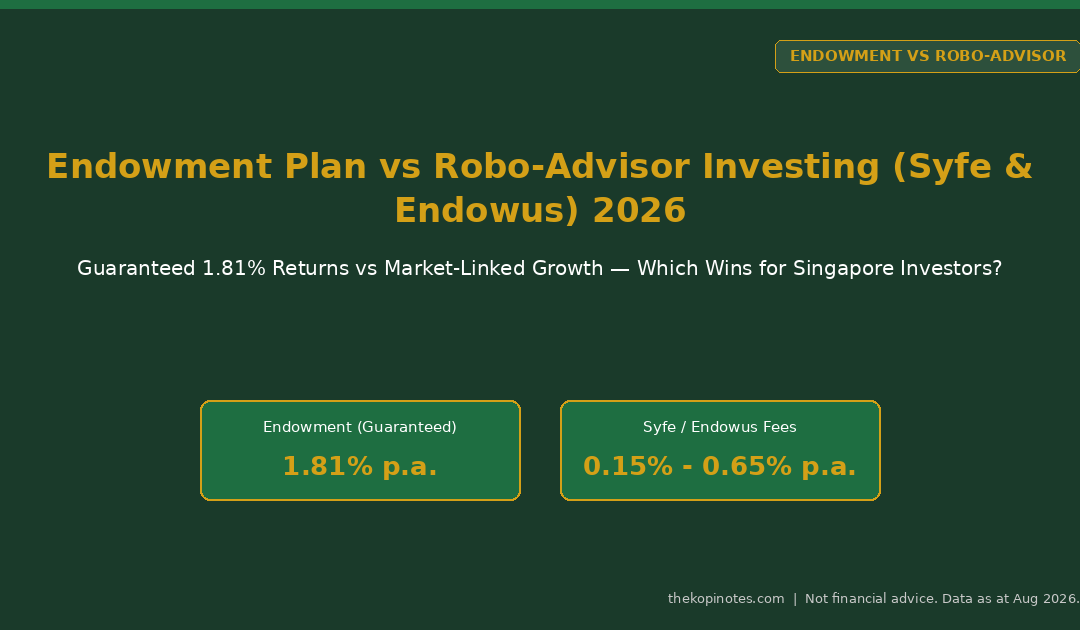
Endowment Plan vs Robo-Advisor Investing (Syfe & Endowus) 2026: Guaranteed Returns vs Market Growth
Comparing a guaranteed 1.81% p.a. endowment plan against Syfe and Endowus robo-advisor portfolios — fees, projected growth, and which fits your risk profile in 2026.
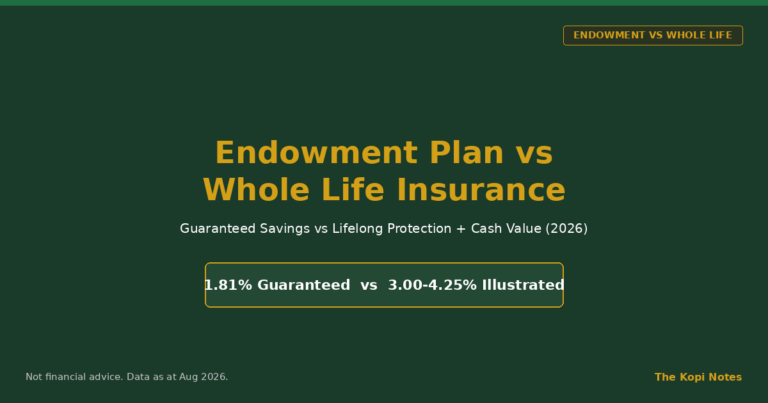
An endowment plan guarantees around 1.81% p.a. (average across 13 Singapore insurers) with your capital protected at maturity, while robo-advisors like Syfe and Endowus invest in market-linked portfolios that have historically returned more but carry real downside risk. On S$20,000 over 10 years, an endowment guarantees roughly S$23,930, while a robo-advisor portfolio could grow to around S$37,000 — if markets cooperate.
Not financial advice. All figures are for educational reference only. Data verified as at August 2026 unless noted.
- Endowment plans guarantee your return (avg 1.81% p.a.) and your capital at maturity — but you lock in a fixed rate for years, sometimes decades.
- Syfe (0.25%-0.65% p.a.) and Endowus (0.15%-0.60% p.a.) charge low, transparent fees and invest in globally diversified portfolios that can grow faster — but your capital is not guaranteed and can fall in value.
- Most Singaporeans should use both: an endowment (or similar) for money you truly cannot afford to lose, and a robo-advisor for long-term wealth building you can leave invested through market cycles.
What Is an Endowment Plan?
An endowment plan is a life insurance policy that combines protection with a savings component. You pay premiums — either as a single lump sum or over a fixed number of years — and the insurer guarantees you a specific payout at maturity, plus a smaller life insurance coverage along the way.
The guaranteed portion is the headline feature. Across the 13 major Singapore insurers TKN has reviewed (AIA, Prudential, Great Eastern, NTUC Income, Manulife, OCBC, Aviva, Singlife, HSBC Life, Etiqa, China Life, FWD, and Tokio Marine), the average guaranteed return on currently available plans works out to 1.81% p.a., with individual plans ranging from around 0.70% to 2.80% p.a. depending on the insurer and policy term. Some plans also pay a non-guaranteed bonus on top, but that portion depends on the insurer’s investment performance and is never promised.
You can read our fact-checked breakdown of guaranteed rates in endowment plan vs CPF returns and endowment plan vs T-Bills, which use the same 1.81% average figure.
What Is Robo-Advisor Investing (Syfe & Endowus)?
Syfe and Endowus are Singapore’s two largest digital wealth platforms, sometimes called “robo-advisors.” Instead of a single insurer promising a fixed rate, you invest in a diversified portfolio of ETFs or unit trusts — typically a mix of global equities and bonds — that the platform automatically manages and rebalances for you.
Syfe offers Managed Portfolios like Core Equity100 (100% equities), Core Growth, Core Balanced, and Core Defensive, plus thematic and income-focused options. You choose your risk level, and Syfe handles the rest.
Endowus takes a slightly different approach: it gives you access to institutional share classes of well-known funds (Dimensional, PIMCO, and others) at lower cost than retail investors normally get, with 100% cashback on any trailer fees the fund manager pays. Its Flagship portfolios cover cash, CPF, and SRS money.
Neither platform guarantees a return. Your capital moves up and down with the market, and in a bad year you could see your S$20,000 shrink before it grows again. That trade-off — more growth potential, less certainty — is the core of this comparison.
Both platforms are regulated by the Monetary Authority of Singapore (MAS): Syfe holds a Capital Markets Services Licence, and Endowus is licensed and regulated as a fund management company. This isn’t unlicensed crypto-style investing — it’s the same regulatory oversight that applies to traditional financial advisers, just delivered through an app instead of a face-to-face meeting.
Key Differences at a Glance
| Feature | Endowment Plan | Syfe / Endowus |
|---|---|---|
| Return type | Guaranteed + non-guaranteed bonus | Market-linked, not guaranteed |
| Typical return | 1.81% p.a. average guaranteed | Long-run equities have historically returned more, but with no guarantee and years of loss possible |
| Capital guarantee | Yes, at maturity (subject to insurer solvency) | No — value fluctuates daily |
| Annual fee | No visible fee; commission bundled into premium | Syfe 0.25%-0.65% p.a.; Endowus 0.15%-0.60% p.a. |
| Liquidity | Locked in; early surrender usually means a loss (see our insurance surrender value guide) | Sell and withdraw anytime, usually within a few business days |
| CPF / SRS eligible | Some plans, via CPFIS or SRS single-premium products | Yes, both platforms offer dedicated CPF-OA and SRS portfolios |
| Best for | Money you cannot afford to lose, with a fixed goal date | Long-term wealth building you can leave invested through ups and downs |
Fee Comparison
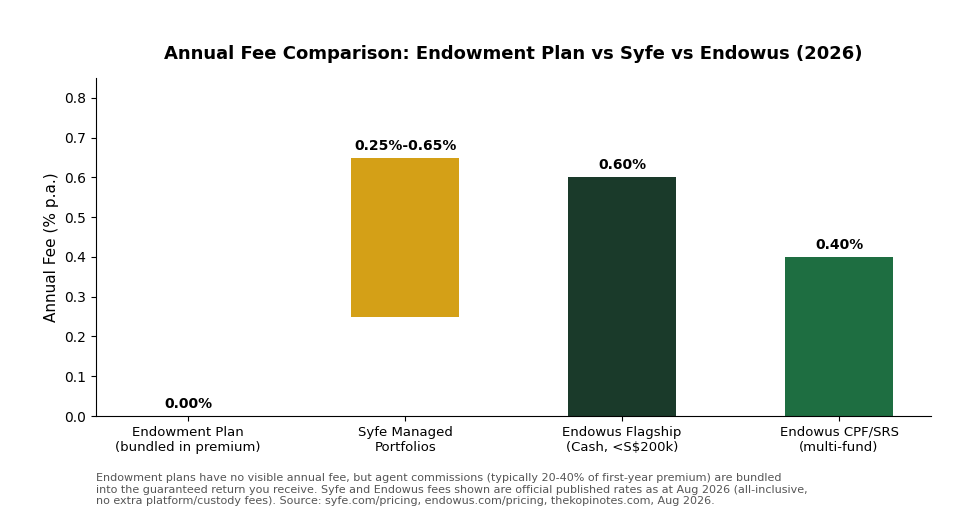
Endowment plans do not show you an annual percentage fee. Instead, the insurer and the advisor who sold you the plan take their cut upfront — typically 20%-40% of your first-year premium as commission — which is one reason surrendering early gives you back so little (more on that below). The 1.81% guaranteed rate you’re quoted is already net of these costs.
Robo-advisors are the opposite: fully transparent, published percentage fees, charged annually on your invested balance.
Syfe charges between 0.25% and 0.65% p.a. across its Managed Portfolios, all-inclusive of portfolio monitoring, automatic rebalancing, and ongoing optimisation, per its official fee schedule. Its all-equity Core Equity100 portfolio sits at the top of that range, 0.65% p.a. — on S$20,000, that’s S$130 a year, or about S$10.83 a month. There are no separate custody, platform, or inactivity fees, and opening an account costs nothing.
Endowus charges an “Access Fee” of 0.15% to 0.60% p.a. for cash investments, tiered by how much you have invested — below S$200,000 you pay 0.60%, and the rate falls as your balance grows, per its official pricing page. On S$20,000, that’s S$120 a year. CPF and SRS portfolios are charged a flat 0.40% p.a. (multi-fund advised portfolios) or 0.30% p.a. (single-fund). Endowus also rebates 100% of any trailer fees it receives from fund managers back to you — a distinctive feature most competitors don’t offer.
Both platforms’ fees are meaningfully lower than the ~1.5%-2% p.a. a traditional commission-based financial adviser might cost, and both cover advice, rebalancing, and platform access in one number — no hidden extras. On top of the platform fee, you’ll also indirectly pay the underlying fund-level fee (Total Expense Ratio) embedded in each ETF or unit trust — typically 0.05%-0.25% p.a. for Syfe’s underlying ETFs, and 0.05%-1% p.a. for Endowus’s fund universe, though these are already reflected in the fund’s daily price, not billed separately.
S$20,000 Growth Comparison Over 10 Years
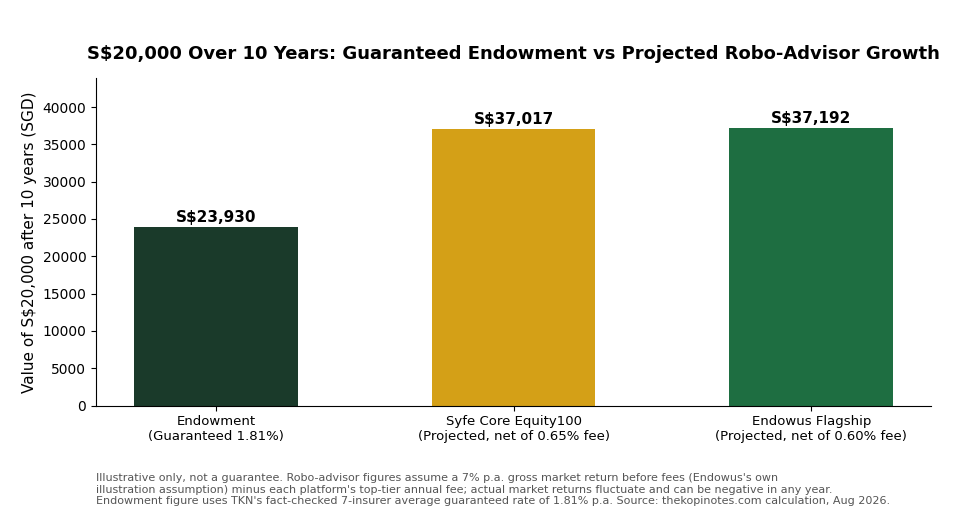
Here’s the original calculation behind the chart above. We put S$20,000 into each option and let it compound annually for 10 years, with no further top-ups.
For the endowment plan, we used the fact-checked 1.81% p.a. average guaranteed rate. For Syfe and Endowus, we used a 7% p.a. gross market return assumption before fees — this is the same illustration assumption Endowus itself publishes on its own pricing page — and then subtracted each platform’s top-tier annual fee (0.65% for Syfe Core Equity100, 0.60% for Endowus Flagship below S$200,000).
| Option | Assumed Net Return | S$20,000 After 10 Years |
|---|---|---|
| Endowment Plan (guaranteed) | 1.81% p.a. | S$23,929.54 |
| Syfe Core Equity100 (projected) | 6.35% p.a. (7% gross — 0.65% fee) | S$37,017.32 |
| Endowus Flagship (projected) | 6.40% p.a. (7% gross — 0.60% fee) | S$37,191.72 |
Source: thekopinotes.com calculation, verified via independent Python compounding check, August 2026. Robo-advisor figures are illustrative projections only, not guarantees or forecasts.
On paper, that’s roughly a S$13,000 gap in favour of the robo-advisor route over 10 years. But this comparison only tells half the story: the 7% figure is an assumption, not a promise. In any given year, a Syfe or Endowus equity portfolio can fall 10%, 20%, or more — the endowment plan cannot. If you needed your money back in a downturn year, the endowment’s guaranteed S$23,930 would still be there; the robo-advisor portfolio might be worth less than your original S$20,000.
Risk, Volatility and CPF/SRS Eligibility
The single biggest difference between these two options isn’t the return — it’s what happens when markets fall. An endowment plan’s guaranteed component cannot go down once the policy is issued, regardless of what happens to interest rates or stock markets (though this guarantee still depends on the insurer’s own solvency). A Syfe or Endowus portfolio, by contrast, moves with the market every single day.
This matters most for near-term goals. If you need the money in 2-3 years for a wedding, home downpayment, or your child’s school fees, a market downturn right before you need to withdraw could force you to sell at a loss. Endowment plans exist precisely to remove that risk for money with a fixed deadline.
Both Syfe and Endowus let you invest CPF Ordinary Account and SRS funds, not just cash — a genuine advantage over most endowment plans, which are usually cash or single-premium SRS products only. If you’re weighing up how to deploy idle CPF-OA money specifically, our CPF investment strategy guide covers this in more depth.
Who Should Pick Which?
An endowment plan makes sense if: you have a fixed goal with a known date (like a child turning 18 or a specific retirement year), you cannot tolerate any chance of losing capital, and you’re comfortable locking money away for the full policy term. It also works as a forced-savings discipline tool if you know you’d otherwise dip into the money.
Syfe or Endowus make more sense if: your time horizon is long (7+ years), you can stomach short-term ups and downs without panic-selling, and you want the flexibility to withdraw without a surrender penalty. They’re also the better fit for CPF-OA or SRS money you won’t need for a long time.
Between Syfe and Endowus specifically, the choice often comes down to style. Syfe leans towards ready-made, algorithm-driven portfolios that are quick to set up and easy to understand at a glance. Endowus leans towards a more “expert-advised” feel — you’re accessing the same institutional-class funds used by pension funds and endowments, with a human-reviewed investment philosophy behind the portfolio construction. Both are solid, MAS-regulated choices; neither is clearly “better” across the board.
In practice, most Singaporeans don’t need to pick just one. A common approach: use an endowment (or a similarly guaranteed instrument) for money tied to a fixed near-term goal, and a robo-advisor for long-term wealth you can leave invested through multiple market cycles. You can start either with a modest amount — see our best endowment plans in Singapore roundup if you’re leaning guaranteed, or open a Syfe or Endowus account below if you’d rather start building a market-linked portfolio.
Frequently Asked Questions
Is an endowment plan better than investing with Syfe or Endowus?
Neither is universally “better” — they solve different problems. An endowment plan guarantees your return and capital, making it suited to money you cannot afford to lose. Syfe and Endowus offer no guarantee but have historically higher growth potential over long horizons, making them better suited to long-term wealth building where you can ride out short-term drops.
What is the average guaranteed return on a Singapore endowment plan in 2026?
Based on TKN’s fact-checked review of 13 major Singapore insurers, the average guaranteed return on currently available endowment plans is approximately 1.81% p.a., with individual plans ranging from around 0.70% to 2.80% p.a. depending on the insurer and policy term.
How much does Syfe charge in fees?
Syfe’s Managed Portfolios charge an all-inclusive fee of 0.25% to 0.65% p.a., depending on the portfolio and your account tier. Its all-equity Core Equity100 portfolio sits at the top of that range at 0.65% p.a. There are no separate platform, custody, or inactivity fees.
How much does Endowus charge in fees?
Endowus charges an Access Fee of 0.15% to 0.60% p.a. for cash investments, tiered by your invested amount (below S$200,000 pays the top 0.60% rate). CPF and SRS advised portfolios are charged a flat 0.40% p.a. (multi-fund) or 0.30% p.a. (single-fund). Endowus also returns 100% of any trailer fees to you as cashback.
Can I invest my CPF or SRS with a robo-advisor instead of an endowment plan?
Yes. Both Syfe and Endowus offer dedicated CPF Ordinary Account and SRS portfolios. This gives them an edge over most endowment plans, which are typically only available as cash or single-premium SRS products, not CPF-OA products.
What happens if I need to withdraw money early from each option?
Surrendering an endowment plan early usually means receiving back significantly less than what you’ve paid in, especially in the first few years, since upfront commissions have already been deducted — see our insurance surrender value guide for the full mechanics. Syfe and Endowus, by contrast, let you sell your holdings and withdraw at any time, with proceeds typically reaching your bank account within a few business days and no surrender penalty, though you may sell at a loss if markets are down.
Which is safer for a risk-averse investor — endowment or robo-advisor?
An endowment plan is the safer choice for a risk-averse investor in the sense that your guaranteed capital and return cannot fall, subject to the insurer’s solvency. A robo-advisor portfolio can lose value in the short term, though a more conservative option like Syfe Core Defensive or an Endowus lower-equity portfolio reduces (but does not eliminate) that volatility.
Ready to Start Growing Your Money?
Whether you want guaranteed peace of mind or long-term market growth, start with the right platform for your goal.
Get Free Insurance Advice
Speak with a licensed insurance advisor. No obligation, no cost.
By submitting this form, you agree to our Privacy Policy.
This article was researched with the help of AI. While we strive to keep all information accurate and up to date, there may be errors. If you notice any discrepancies, please contact us.