Healthcare ETF Singapore: Best Global Health & Biotech Funds for 2026 (IUHC vs HEAL)
A Singapore investor’s guide to LSE-listed healthcare ETFs — TER, holdings, and how the 2026 AI drug discovery rally is reshaping returns.
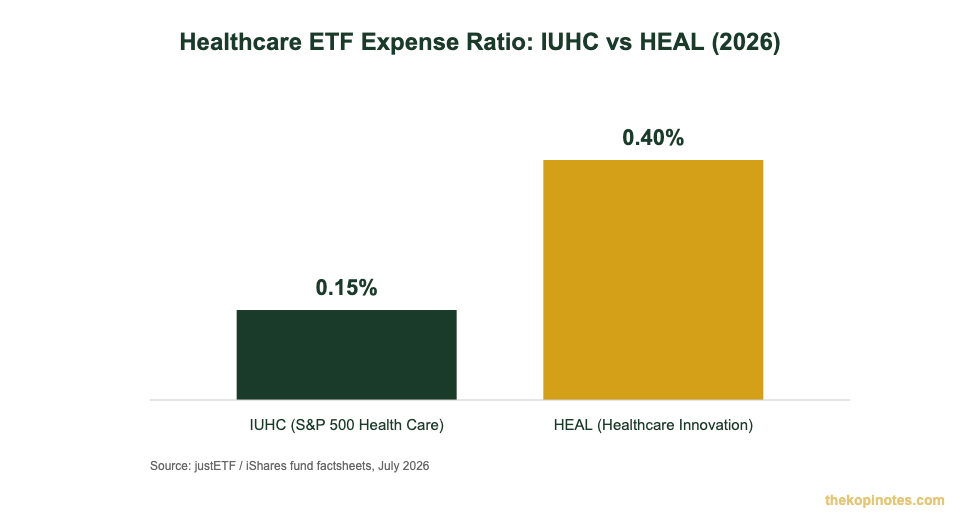
Healthcare ETFs give Singapore investors low-cost exposure to global pharmaceutical, biotech, and medical-device companies without picking single stocks. Two LSE-listed UCITS options stand out: iShares S&P 500 Health Care Sector ETF (IUHC), tracking large US health names at a 0.15% TER, and iShares Healthcare Innovation ETF (HEAL), a broader innovation-focused fund at 0.40% TER. Both are bought through brokers like Interactive Brokers or Syfe.
Not financial advice. All figures are for educational reference only. Data verified as at 31 July 2026 unless otherwise noted.
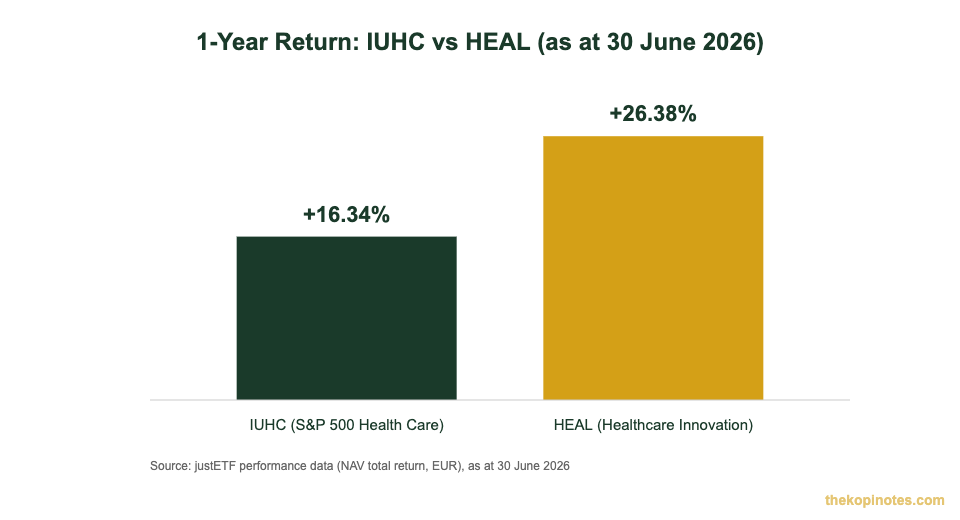
- IUHC (0.15% TER) gives pure-play, low-cost US healthcare exposure. HEAL (0.40% TER) is more diversified and innovation-focused, and has outperformed over the past year (+26.38% vs +16.34%) on AI drug discovery and GLP-1 demand.
- Both are Ireland-domiciled UCITS ETFs — 15% US dividend withholding tax and no US estate tax exposure, unlike US-listed healthcare ETFs such as XLV or IBB.
- Buy either through IBKR, Saxo, or Syfe. Neither is CPF-OA eligible, but both can be bought with SRS funds through supporting brokers.
Table of Contents
What Is a Healthcare ETF?
A healthcare ETF is a fund that buys a basket of pharmaceutical, biotech, medical-device, and healthcare-provider stocks in one trade. Instead of picking between Eli Lilly, Johnson & Johnson, or a small biotech name, you own dozens (or hundreds) of them through a single UCITS-compliant fund listed on the London Stock Exchange (LSE).
There are two broad flavours. A sector ETF like IUHC tracks the healthcare slice of the S&P 500 — large, established US drugmakers and insurers. A thematic or innovation ETF like HEAL casts a wider net, holding smaller and mid-cap companies worldwide that are pushing new treatments, diagnostics, and gene-editing technology to market. Both are Ireland-domiciled, accumulating (dividends are reinvested automatically), and traded in USD on the LSE — the same UCITS structure used by CSPX and VWRA.
For Singapore investors, the appeal is straightforward: healthcare is a defensive sector that also carries real growth exposure through drug innovation, and a UCITS wrapper means you avoid the tax drag that comes with buying US-listed healthcare ETFs like XLV or IBB directly.
Why Healthcare ETFs Are Trending in 2026
Healthcare has had a strong 2026, and it’s not just defensive rotation. Two forces are driving it: AI-powered drug discovery and GLP-1 weight-loss drugs.
In March 2026, Eli Lilly signed a $2.75 billion deal with Insilico Medicine, granting global rights to develop drugs discovered using Insilico’s generative AI platform. That’s one of the largest AI-pharma tie-ups to date, and it’s not an isolated bet — the global AI drug discovery market is projected to reach USD 10.3 billion by 2031, according to industry estimates. AI is being used to compress the drug discovery timeline from years to months, cutting costs and raising the odds a molecule actually clears clinical trials.
At the same time, GLP-1 weight-loss drugs remain a huge earnings driver. Eli Lilly’s newer drug retatrutide has kept demand elevated, and the knock-on effect ripples through manufacturers, supply chain companies, and diagnostics firms that HEAL holds. Biotech specifically has caught fire — the SPDR S&P Biotech ETF (XBI), a US-listed proxy for the sector, gained 17.9% in the first half of 2026 on a wave of small-cap consolidation and M&A.
Here’s why this matters even if you’re not a biotech trader: healthcare is one of the few sectors where an aging population, in Singapore and globally, provides a structural demand floor. That’s a different kind of “trending” from, say, an AI chip rally — it’s a multi-year theme layered on top of a near-term catalyst.
Best Healthcare ETFs for Singapore Investors
Two LSE-listed UCITS ETFs cover most of what a Singapore investor needs: IUHC for pure, low-cost US healthcare exposure, and HEAL for a more diversified, innovation-tilted portfolio. Here’s how they stack up.
| Metric | IUHC (S&P 500 Health Care) | HEAL (Healthcare Innovation) |
|---|---|---|
| Full Name | iShares S&P 500 Health Care Sector UCITS ETF (Acc) | iShares Healthcare Innovation UCITS ETF |
| Ticker (LSE, USD) | IUHC | HEAL |
| ISIN | IE00B43HR379 | IE00BYZK4776 |
| Index Tracked | S&P 500 Capped 35/20 Health Care | iSTOXX FactSet Breakthrough Healthcare |
| Domicile | Ireland | Ireland |
| Structure | Accumulating, physical (full replication) | Accumulating, physical (sampling) |
| TER (Expense Ratio) | 0.15% p.a. | 0.40% p.a. |
| AUM | ~EUR 2.16bn (~USD 2.49bn) | ~EUR 1.00bn (~USD 1.16bn) |
| Number of Holdings | 59 | 168 |
| Launch Date | 20 November 2015 | 8 September 2016 |
| 1-Year Return (to 30 Jun 2026) | +16.34% | +26.38% |
Source: justETF / iShares fund data, as at July 2026 (performance data to 30 June 2026, NAV total return in EUR)
IUHC’s top five holdings — Eli Lilly (13.75%), Johnson & Johnson (11.11%), AbbVie (7.25%), Merck & Co (5.63%), and UnitedHealth Group (4.62%) — read like a who’s-who of US pharma, as at 31 March 2026. HEAL spreads its bets much thinner: its top five are Illumina (2.83%), UCB SA (2.38%), Moderna (2.26%), Merck & Co (2.23%), and Biogen (2.21%), as at 29 May 2026, with meaningful weight in Switzerland, South Korea, and Japan alongside the US.
Here’s a worked example. Say you put SGD 20,000 into IUHC. At a 0.15% TER, you’d pay roughly SGD 30 a year in fund fees. Put the same SGD 20,000 into HEAL at 0.40% TER, and you’d pay about SGD 80 a year — SGD 50 more. That fee gap looks small next to the return gap: HEAL returned +26.38% over the past year to IUHC’s +16.34%, a difference of over 10 percentage points. That said, past performance doesn’t guarantee future returns, and IUHC’s lower cost, larger AUM, and blue-chip concentration may suit more conservative investors who don’t want HEAL’s higher exposure to smaller, more volatile innovation names.
Like CSPX and other LSE-listed UCITS ETFs, both IUHC and HEAL benefit from Ireland’s tax treaty with the US. That means a 15% withholding tax on US dividends instead of 30%, and no US estate tax exposure — a real risk for Singapore investors holding US-listed ETFs like XLV or IBB directly above the USD 60,000 threshold.
| ETF Type | Domicile | US Dividend WHT | US Estate Tax Risk |
|---|---|---|---|
| IUHC / HEAL (LSE) | Ireland | 15% | None |
| XLV / IBB (US-listed) | USA | 30% | Yes (above USD 60k) |
Source: IRS estate tax rules for non-residents, accessed July 2026
How to Buy Healthcare ETFs in Singapore
Buying IUHC or HEAL works the same way as buying any other LSE-listed UCITS ETF. You’ll need a brokerage account that gives you access to the London Stock Exchange.
Interactive Brokers (IBKR) has the widest access and the lowest FX spread, which matters more as your portfolio grows. Fund your account, search “IUHC” or “HEAL” in the order entry screen, select the London Stock Exchange as the exchange, and place a limit order in USD. IBKR charges a small per-trade commission plus a tiny exchange fee, but for portfolios above roughly SGD 10,000, it’s usually the cheapest option over time.
Saxo Markets offers a similarly wide range of LSE tickers with a more beginner-friendly interface, though its FX spread and custody fees tend to run higher than IBKR’s for larger balances.
MooMoo Singapore has been expanding its UCITS ETF coverage and is worth checking directly for IUHC/HEAL availability before you commit capital, since sector and thematic tickers aren’t always onboarded as quickly as the big index funds.
Syfe Brokerage is the simplest option if you want a mobile-first experience and are comfortable with a slightly smaller ticker universe. Opening an account through the Syfe referral code and sign-up bonus page gets you a welcome bonus on top of the platform’s usual zero-commission US and UK stock trades.
One important caveat: neither IUHC nor HEAL is CPF-OA investable, since CPF Investment Scheme approval is limited to a specific list of SGX-listed and unit trust products. Both are, however, buyable with SRS funds through brokers that support SRS-linked trading — worth checking if you’re building out your CPF investment strategy or want a tax-deferred wrapper for a satellite healthcare position. If you’re newer to LSE ETFs generally, the Semiconductor ETF Singapore guide and AI-powered ETF guide walk through the same broker mechanics for other trending sector plays.
Risks to Consider
Healthcare ETFs aren’t a one-way bet, even with two strong catalysts behind them right now.
Concentration risk. IUHC is over 95% US-listed companies. If US drug pricing policy shifts unfavourably — a recurring political risk in US healthcare — the whole fund feels it at once, since there’s no geographic diversification to cushion the blow.
Company-specific risk inside a “diversified” wrapper. Eli Lilly alone makes up nearly 14% of IUHC. A single disappointing trial readout or regulatory setback at one company can meaningfully drag down fund performance.
Higher volatility in HEAL. Smaller-cap innovation and biotech names are far more binary than large pharma — a failed Phase 3 trial can halve a stock overnight. HEAL’s 5-year return actually shows a -4.93% loss despite its strong recent 12 months, a reminder that innovation-focused healthcare investing has been a bumpy ride historically.
Valuation risk after the 2026 rally. Both funds have re-rated sharply this year. Buying after a run-up in AI drug discovery optimism means some of that story may already be priced in.
Currency risk. Both ETFs are USD-denominated. A stronger SGD against the USD reduces your returns in Singapore dollar terms, independent of how the underlying stocks perform.
None of this means avoid the sector — it means size the position appropriately and treat healthcare as one satellite holding within a broader portfolio like a plan built around your retirement calculator numbers, not a core holding on its own.
Frequently Asked Questions
What is the best healthcare ETF for Singapore investors in 2026?
It depends on your goal. IUHC (0.15% TER) suits investors who want low-cost, blue-chip exposure to established US pharma and insurance names. HEAL (0.40% TER) suits investors who want broader, more diversified exposure to global healthcare innovation, including smaller biotech and diagnostics companies, and are comfortable with more volatility in exchange for higher recent returns.
Is HEAL the same as IUHC?
No. Both are iShares UCITS ETFs domiciled in Ireland and listed on the LSE, but they track different indexes. IUHC tracks the S&P 500 Capped 35/20 Health Care index — 59 large US healthcare companies. HEAL tracks the iSTOXX FactSet Breakthrough Healthcare index — 168 global companies, developed and emerging markets, focused on healthcare innovation.
Can I buy healthcare ETFs using my CPF or SRS funds?
Neither IUHC nor HEAL is approved under the CPF Investment Scheme, so you cannot use CPF Ordinary Account funds to buy them. Both can be bought using SRS funds if your brokerage supports SRS-linked trading — check with your broker before assuming SRS compatibility.
Which broker is best for buying IUHC or HEAL in Singapore?
Interactive Brokers (IBKR) generally offers the lowest total cost for larger portfolios thanks to tight FX spreads. Saxo Markets is a solid alternative with a friendlier interface. Syfe Brokerage is simplest for beginners and offers referral sign-up bonuses. Always confirm the specific ticker is available on your broker’s LSE ticker list before funding your account.
Are healthcare ETFs risky given the 2026 AI drug discovery rally?
They carry real risk. Both funds have re-rated sharply in 2026 on AI drug discovery and GLP-1 optimism, which means some of that good news may already be priced in. HEAL in particular holds smaller, more binary biotech names that can move sharply on a single clinical trial result. Neither fund should be a core retirement holding on its own — treat healthcare as a satellite position sized to your risk tolerance.
What is the minimum investment for IUHC or HEAL?
There’s no fund-level minimum — you can buy a single share if your broker allows fractional or low-minimum orders. In practice, most Singapore investors start with a few hundred to a few thousand SGD per position, factoring in brokerage minimum commissions and FX conversion costs, which matter more on smaller trade sizes.
Ready to Start Investing in Healthcare ETFs?
Open a brokerage account and buy IUHC or HEAL today. Use our referral links for exclusive sign-up bonuses.
This article was researched with the help of AI. While we strive to keep all information accurate and up to date, there may be errors. If you notice any discrepancies, please contact us.